Upgrade & Secure Your Future with DevOps, SRE, DevSecOps, MLOps!
We spend hours scrolling social media and waste money on things we forget, but won’t spend 30 minutes a day earning certifications that can change our lives.
Master in DevOps, SRE, DevSecOps & MLOps by DevOps School!
Learn from Guru Rajesh Kumar and double your salary in just one year.
Introduction
AI Safety & Evaluation Tools are specialized software platforms designed to help organizations assess, measure, monitor, and ensure that artificial intelligence models behave as intended. In plain language, these tools help check whether an AI system is accurate, fair, robust, unbiased, and safe before and after deployment. They provide insights into model performance, detect unwanted behavior such as bias or toxicity, and help teams certify that AI outputs meet organizational, ethical, and regulatory expectations.
In and beyond, the rapid adoption of AI across high‑stakes applications—such as hiring systems, healthcare diagnostics, customer decision systems, and automated operations—has made safety and evaluation indispensable. Businesses deploying AI at scale need dedicated visibility into how models behave, how performance drifts over time, and how to mitigate unintended negative outcomes. As regulations evolve worldwide and public scrutiny of AI grows, these tools serve both risk management and trust assurances.
Real‑world use cases include:
- Monitoring and alerting for model drift and performance degradation in production.
- Detecting and reporting bias or fairness issues in training or inference.
- Evaluating generative AI outputs for toxicity, misinformation, or harmful content.
- Providing governance reports to legal, compliance, and executive teams.
- Stress testing AI for edge cases, adversarial examples, and silent failures.
What buyers should evaluate:
- Scope of safety checks (bias, fairness, toxicity detection).
- Support for different AI models and modalities (text, image, audio).
- Integration with development and deployment pipelines.
- Visibility into drift, performance decay, and root cause analysis.
- Collaboration, governance, and role‑based access controls.
- Reporting and audit features for regulatory compliance.
- Explainability and interpretability tools.
- Scalability and real‑time monitoring.
- API accessibility and extensibility.
- Cost structures and enterprise support.
Best for: enterprises, regulated industries (finance, healthcare, government), AI/ML teams, data science teams, risk&S compliance teams, and responsible AI practitioners.
Not ideal for: hobby projects, simple one‑off experiments, or teams deploying AI for prototyping without production plans.
Key Trends in AI Safety & Evaluation Tools
- Shift toward real‑time monitoring: AI safety tools are extending beyond static evaluation to real‑time observability as models are deployed in production systems.
- Unified multimodal evaluation: Growing support for evaluating text, image, audio, and video models through a single framework.
- Automated alerts & guardrails: Tools increasingly offer automated thresholds, anomaly detection, and safety incident alerts ahead of human review.
- Governance & compliance reporting: Built‑in compliance dashboards and audit logs help enterprises satisfy external regulation requirements.
- Explainability integration: Tools provide explainability artifacts (e.g., feature importance, counterfactuals) for interpreting model decisions.
- Anchored to MLOps workflows: Safety evaluation is becoming an integral part of the MLOps lifecycle, from testing to deployment and monitoring.
- Synthetic and adversarial testing: More tools offer synthetic data generation and adversarial testing to uncover edge case vulnerabilities.
- Collaborative risk scoring: Shared dashboards and risk scoring systems help cross‑functional teams prioritize mitigation.
- AI certification and trust standards: Emergence of internal “AI certification” workflows to standardize safe deployments.
- Elastic pricing models: Usage‑based, credit‑based, and enterprise seat pricing options expand access across organization sizes.
How We Selected These Tools (Methodology)
We applied the following criteria to choose the “Top 10” tools:
- Market Adoption & Mindshare: Evaluated community recognition, enterprise footprints, and signal from practitioners.
- Feature Completeness: Assessed breadth of safety checks, monitoring, reporting, and governance capabilities.
- Reliability & Performance Signals: Considered uptime, robustness, precision of evaluation metrics, and drift detection capabilities.
- Security Posture: Looked for tools with strong access controls, encryption, audit logs, and organizational security features.
- Integrations & Ecosystem: Measured support for common AI frameworks, MLops pipelines, cloud providers, and APIs.
- Cross‑Segment Fit: Included tools relevant for SMBs, mid‑market, and enterprises, with flexibility for technical and non‑technical users.
- Observability & Feedback: Preferred platforms providing rich dashboards, alerting, and feedback loops.
- Scalability & Flexibility: Scored products that support growing demands and complex workflows.
- Support & Documentation: Tools with comprehensive documentation and professional support get higher consideration.
- Value & Future‑readiness: Considered viability of long‑term use, roadmap ambition, and adaptability to emerging safety needs.
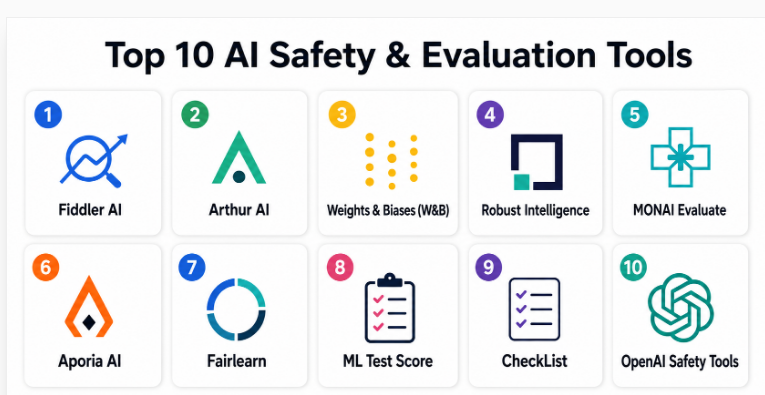
Top 10 AI Safety & Evaluation Tools
#1 — Fiddler AI
Short description:
Fiddler AI is an enterprise‑grade AI observability and evaluation platform that enables teams to monitor model performance, detect bias, and ensure compliance across AI deployments. It is suitable for data science, risk, and compliance teams in regulated industries. The platform provides dashboards for model drift, fairness metrics, and explainability. Fiddler AI supports multi‑model monitoring and integrates into machine learning pipelines to ensure continuous evaluation after deployment. It helps organizations identify risky behavior, validate model decisions, and maintain transparency with stakeholders. Fiddler AI is often used in finance, healthcare, and enterprise environments where safety and compliance are top priorities.
Key Features
- Real‑time model performance monitoring
- Bias and fairness evaluation
- Explainable AI metrics and dashboards
- Drift detection and alerting
- Model lineage and audit logs
- Multi‑model support
- Collaboration and reporting features
Pros
- Comprehensive observability for enterprise models
- Strong bias and fairness assessments
- Explainability features help interpret decisions
Cons
- Premium pricing for full enterprise bundles
- Technical setup may require engineering resources
- Some features may be complex for smaller teams
Platforms / Deployment
Web / Cloud
Security & Compliance
- SSO/SAML, MFA, RBAC
- Encryption at rest and in transit
- SOC 2, GDPR support
Integrations & Ecosystem
Fiddler AI integrates with common AI/ML frameworks and data platforms:
- Python ML pipelines
- Spark and distributed compute
- TensorFlow & PyTorch
- MLflow and other metadata tools
- Data warehouses
- Alerting and workflow tools
Support & Community
Robust documentation and enterprise onboarding support. Active user community and case study resources.
#2 — Arthur AI
Short description:
Arthur AI provides end‑to‑end machine learning monitoring and evaluation capabilities, offering real‑time insights into model performance, bias, and stability. It is ideal for ML engineers, data scientists, and risk teams. Arthur AI continuously monitors deployed models, notifies stakeholders about drift or anomalies, and helps interpret model behavior. Built with enterprise needs in mind, the platform offers governance features, explainability tools, and customizable alerts. Arthur AI supports structured, unstructured, and multimodal models, enabling organizations to standardize safety practices across their AI footprint.
Key Features
- Continuous model monitoring
- Drift and anomaly detection
- Fairness and bias evaluation
- Explainable AI visualizations
- Customizable alerting
- Multi‑cloud and multi‑model support
- Collaboration dashboards
Pros
- Designed for production safety and monitoring
- Actionable alerts and reporting
- Scales across AI application types
Cons
- Requires integration expertise
- Usage cost may scale with volume
- Learning curve for new users
Platforms / Deployment
Web / Cloud
Security & Compliance
- Encryption and RBAC
- GDPR, SOC 2 compliance
Integrations & Ecosystem
- ML frameworks and training tools
- CI/CD pipelines
- Data lakes and observability stacks
- BI tools for dashboards
- Alerting channels
Support & Community
Enterprise support tiers, detailed docs, onboarding assistance, and professional services.
#3 — Weights & Biases (W&B)
Short description:
Weights & Biases is a popular ML lifecycle platform that offers experiment tracking, dataset versioning, and model evaluation features. It helps teams compare model runs, analyze training behavior, and track safety metrics over time. While traditionally known for experiment tracking, W&B also provides evaluation tools that support drift detection, bias tracking, performance visualization, and collaboration. It is widely adopted by data science and Ml engineering teams to ensure reproducibility, model insight sharing, and robust development workflows. W&B provides a unified workspace for teams working on both research and production AI systems.
Key Features
- Experiment tracking and logging
- Model evaluation dashboards
- Performance and drift metrics
- Dataset versioning and comparisons
- Collaboration tools and comments
- Integration with major ML frameworks
Pros
- Strong integration with research and production workflows
- Deep performance insights and reproducibility
- Collaborative workspace for teams
Cons
- Bias analysis is less comprehensive than purpose‑built safety tools
- Some advanced evaluation features require paid tiers
- Visualization overload for beginners
Platforms / Deployment
Web / Cloud
Security & Compliance
- RBAC and encryption
- SOC 2 and GDPR support
Integrations & Ecosystem
- TensorFlow, PyTorch, Keras
- Jupyter notebooks and training pipelines
- Cloud AI workflows
- MLflow integration
Support & Community
Large developer community, rich documentation, and learning resources.
#4 — Robust Intelligence
Short description:
Robust Intelligence is focused on ensuring AI systems are robust, fair, and safe against edge cases and adversarial behavior. The platform is designed for enterprise risk management, compliance, and safety operations. It continuously tests models against worst‑case scenarios, identifies safety vulnerabilities, and provides governance dashboards. Robust Intelligence supports automated policies that can block unsafe outputs before they reach users. The tool is suitable for environments where trust and resiliency are top priorities, such as finance and regulated industries.
Key Features
- Safety and robustness testing
- Adversarial scenario evaluation
- Bias and fairness metrics
- Governance dashboards
- Policy enforcement and alerts
- Multi‑model evaluation
- Automated compliance checks
Pros
- Strong safety and adversarial testing capabilities
- Enterprise governance focus
- Supports automated policy enforcement
Cons
- Requires technical familiarity
- Premium pricing for full enterprise features
- Setup can be complex for smaller teams
Platforms / Deployment
Web / Cloud
Security & Compliance
- SOC 2, ISO 27001, GDPR support
- Encryption and RBAC
Integrations & Ecosystem
- ML model frameworks
- Training and deployment pipelines
- CI/CD systems
- Data observability tools
Support & Community
Documentation and enterprise support. User base focused on robust AI deployments.
#5 — MONAI Evaluate
Short description:
MONAI Evaluate is a healthcare‑oriented evaluation platform designed for AI models in medical imaging and clinical workflows. It provides rigorous performance and safety evaluation metrics tailored for healthcare needs. Clinical teams, radiologists, and AI developers use MONAI Evaluate to measure bias, reliability, and model safety across real patient data and edge cases. The tool emphasizes compliance and adheres to healthcare data protections. It supports explainability, error analysis, and performance benchmarking in medical contexts. MONAI Evaluate is essential for teams building AI that directly impacts diagnosis and patient outcomes.
Key Features
- Clinical performance evaluation
- Bias detection in medical models
- Multi‑modal data support
- Compliance reporting (HIPAA adherence)
- Explainability for clinical decisions
- Assessment dashboards
- Collaboration for clinical AI teams
Pros
- Tailored for medical and clinical AI usage
- Prioritizes safety and compliance
- Supports complex data modalities
Cons
- Limited relevance outside healthcare
- Domain expertise required
Platforms / Deployment
Web / Cloud
Security & Compliance
- HIPAA, GDPR compliance
- RBAC and encryption
Integrations & Ecosystem
- PACS imaging systems
- Clinical data repositories
- ML training workflows
- Research collaboration systems
Support & Community
Healthcare‑focused documentation and support. Strong community in clinical AI research.
#6 — Aporia AI
Short description:
Aporia AI provides comprehensive ML monitoring, including performance, drift detection, bias metrics, and data quality checks. It helps teams ensure reliability and safety once models are deployed in production. The platform monitors model inputs, predictions, and outputs for anomalies, integrating with MLops workflows. Aporia AI’s dashboards and alerting systems notify teams about unsafe behaviors or unexpected patterns, enabling rapid mitigation. It is suitable for enterprises that need real‑time observability and safety evaluation across complex models and data pipelines.
Key Features
- Real‑time drift and anomaly detection
- Performance tracking
- Bias and fairness metrics
- Data quality monitoring
- Custom alerts
- Integration with MLops pipelines
- Reproducibility tracking
Pros
- Strong real‑time monitoring
- Useful for performance and safety observability
- Alerts help operational teams act quickly
Cons
- Enterprise focus may be overkill for small teams
- Some advanced workflows require setup
Platforms / Deployment
Web / Cloud
Security & Compliance
- Encryption and RBAC
- SOC 2, GDPR compliance features
Integrations & Ecosystem
- Cloud compute services
- ML training systems
- Workflow orchestration tools
- Logging and observability pipelines
Support & Community
Documentation and enterprise support available.
#7 — Fairlearn
Short description:
Fairlearn is an open‑source tool that helps assess and improve fairness of machine learning models. It is suitable for data scientists, researchers, and teams prioritizing equity and fairness. The toolkit provides metrics and visualization tools to measure disparate impact and fairness gaps. Fairlearn allows iterative testing and mitigation strategies to improve fairness outcomes. It integrates well with Python‑based ML workflows and is widely used in experimentation and data exploration phases. Fairlearn excels for teams seeking to embed fairness checks early in model development.
Key Features
- Fairness metrics and visualizations
- Mitigation strategy support
- Integration with Python ML workflows
- Disparate impact assessment
- Metrics dashboards
- Support for multiple fairness definitions
Pros
- Open‑source and accessible
- Strong fairness evaluation tools
- Good for research and experimentation
Cons
- Not comprehensive for full safety evaluation
- Lacks enterprise governance features
Platforms / Deployment
Python / Self‑hosted
Security & Compliance
Varies / N/A – depends on deployment
Integrations & Ecosystem
- Python ML frameworks
- Sci‑kit learn and data pipelines
- Jupyter workflows
Support & Community
Open‑source community with frequent contributions and discussion forums.
#8 — ML Test Score
Short description:
ML Test Score is a framework for evaluating model quality across accuracy, robustness, fairness, and other key dimensions. It helps teams generate standardized evaluation reports. AI developers, researchers, and quality assurance teams use ML Test Score to quantify how well models meet safety and performance criteria. The tool is valuable for model benchmarking and comparison across multiple releases.
Key Features
- Model evaluation benchmarks
- Fairness and robustness tests
- Standardized scoring metrics
- Visual reporting tools
- Integration hooks for pipelines
Pros
- Provides benchmarking scorecards
- Useful for comparison and reporting
- Simple evaluation framework
Cons
- Not full production monitoring
- Limited real‑time features
Platforms / Deployment
Web / Cloud / Self‑hosted
Security & Compliance
Varies / N/A
Integrations & Ecosystem
- ML pipelines
- CI/CD integrations
- Data validation tools
Support & Community
Documentation available; broader adoption varies.
#9 — CheckList
Short description:
CheckList is an open‑source evaluation framework developed to apply behavioral testing to AI models. It allows data scientists to define test cases and systematically evaluate model behavior under different scenarios. It is useful for model validation, structured testing, and ensuring safety criteria are met across edge cases. CheckList emphasizes specifying tests for linguistic, boundary, and logical behavior, making it valuable for responsible AI development.
Key Features
- Behavioral test design
- Edge case testing
- Model validation scenarios
- Test suite organization
- Output evaluation and logging
Pros
- Flexible for diverse test scenarios
- Useful in development phase
- Encourages systematic evaluation
Cons
- Not a full enterprise platform
- Lacks dashboards and monitoring
Platforms / Deployment
Python / Self‑hosted
Security & Compliance
Varies / N/A
Integrations & Ecosystem
- Python‑based workflows
- Model testing pipelines
Support & Community
Open‑source community driven.
#10 — OpenAI Safety Tools
Short description:
OpenAI Safety Tools provide built‑in safety evaluations and content filters for models deployed on the OpenAI platform. These tools help teams identify toxic, hateful, or unsafe outputs before they reach end users. They are suitable for developers integrating OpenAI models into products, enabling safety checks and moderation.
Key Features
- Content safety filtering
- Toxicity and harmful content detection
- Moderation APIs
- Integrated with model inference
- Customizable thresholds
Pros
- Native to the OpenAI model ecosystem
- Useful for real‑time content safety
- Easy to integrate for products using OpenAI models
Cons
- Limited beyond safety flags
- Not a full evaluation suite
- Depends on OpenAI usage
Platforms / Deployment
Web / Cloud
Security & Compliance
Not publicly stated
Integrations & Ecosystem
- Integrated with AI inference
- Works with prompt systems and moderation
- API hooks for safer deployments
Support & Community
Documentation and developer resources available.
Comparison Table (Top 10)
| Tool Name | Best For | Platform(s) Supported | Deployment | Standout Feature | Public Rating |
|---|---|---|---|---|---|
| Fiddler AI | Enterprise safety and observability | Web | Cloud | Bias & drift dashboards | N/A |
| Arthur AI | Continuous monitoring & fairness | Web | Cloud | Real‑time performance alerts | N/A |
| Weights & Biases | Model tracking & evaluation | Web | Cloud | Experiment monitoring | N/A |
| Robust Intelligence | Safety & adversarial testing | Web | Cloud | Policy enforcement | N/A |
| MONAI Evaluate | Healthcare model safety | Web | Cloud | Clinical evaluation | N/A |
| Aporia AI | Real‑time production monitoring | Web | Cloud | Data quality checks | N/A |
| Fairlearn | Fairness analysis and mitigation | Python | Self‑hosted | Open‑source fairness tools | N/A |
| ML Test Score | Standardized scoring metrics | Web / Self‑hosted | Cloud/Self‑hosted | Benchmark scoring | N/A |
| CheckList | Behavioral edge case testing | Python | Self‑hosted | Systematic test design | N/A |
| OpenAI Safety Tools | Built‑in content safety nets | Web | Cloud | Integrated safety filters | N/A |
Evaluation & Scoring of AI Safety & Evaluation Tools
| Tool Name | Core (25%) | Ease (15%) | Integrations (15%) | Security (10%) | Performance (10%) | Support (10%) | Value (15%) | Weighted Total (0–10) |
|---|---|---|---|---|---|---|---|---|
| Fiddler AI | 9 | 8 | 8 | 9 | 8 | 8 | 7 | 8.35 |
| Arthur AI | 9 | 8 | 8 | 8 | 8 | 8 | 7 | 8.20 |
| Weights & Biases | 8 | 8 | 9 | 8 | 9 | 9 | 7 | 8.25 |
| Robust Intelligence | 8 | 7 | 8 | 8 | 8 | 8 | 7 | 8.00 |
| MONAI Evaluate | 7 | 7 | 7 | 9 | 8 | 7 | 7 | 7.75 |
| Aporia AI | 8 | 7 | 8 | 8 | 8 | 7 | 7 | 8.00 |
| Fairlearn | 7 | 7 | 7 | 7 | 7 | 7 | 8 | 7.40 |
| ML Test Score | 7 | 8 | 7 | 7 | 7 | 7 | 7 | 7.40 |
| CheckList | 7 | 7 | 7 | 7 | 6 | 6 | 7 | 7.05 |
| OpenAI Safety Tools | 6 | 9 | 6 | 6 | 6 | 7 | 8 | 7.10 |
These scores are comparative, not absolute. Higher totals suggest stronger overall capability across our weighted criteria. Scores help teams prioritize tools based on organizational priorities such as compliance, ease of use, or performance monitoring.
Which AI Safety & Evaluation Tool Is Right for You?
Solo / Freelancer
Solo practitioners and small data science teams benefit from tools that are easy to start with and require minimal infrastructure. Weights & Biases, Fairlearn, and CheckList offer accessible workflows and open‑source options. OpenAI Safety Tools help with built‑in filtering if using OpenAI models.
SMB
Small and medium businesses should choose tools that balance safety insights and usability. Fiddler AI, Aporia AI, and Arthur AI provide enterprise‑grade monitoring with streamlined dashboards suitable for smaller teams. These tools help extend safety without complex setup.
Mid‑Market
Mid‑market teams often need multi‑model support and continuous monitoring. Arthur AI, Weights & Biases, and Robust Intelligence fit well by providing monitoring, alerts, and governance dashboards. Integration with existing MLops tools is key at this scale.
Enterprise
Enterprises often demand deep safety assessments, governance reporting, compliance dashboards, and robust observability. Fiddler AI, Robust Intelligence, and MONAI Evaluate (for regulated domains like healthcare) shine here. High scalability and security controls are prioritized.
Budget vs Premium
Open‑source options like Fairlearn and CheckList lower barrier to entry for teams iterating on safety practices. Premium enterprise platforms like Fiddler AI and Arthur AI provide deeper governance, analytics, and managed support for mission‑critical AI.
Feature Depth vs Ease of Use
For deep analytics and governance: Fiddler AI, Arthur AI, and Robust Intelligence are strong. For ease of onboarding and team collaboration: Weights & Biases, Aporia AI, and OpenAI Safety Tools are practical.
Integrations & Scalability
Prioritize tools that integrate with your existing MLops and data pipelines. Tools like Weights & Biases, Fiddler AI, and Arthur AI offer flexible SDKs and APIs that fit into cloud workflows and CI/CD systems.
Security & Compliance Needs
Healthcare, finance, and enterprise AI teams need strong audit logs, SSO, RBAC, encryption, and compliance alignments (SOC 2, GDPR, HIPAA). MONAI Evaluate and Fiddler AI provide deeper compliance hooks, while others offer high‑level controls.
Frequently Asked Questions (FAQs)
1. What exactly are AI Safety & Evaluation Tools?
AI Safety & Evaluation Tools help teams test, monitor, and validate AI models to ensure they produce accurate, fair, unbiased, and safe outputs. They support risk mitigation and governance.
2. Why is AI safety important in 2026?
As AI powers more business decisions, errors, bias, or unsafe behaviors can cause reputational harm, legal exposure, and financial loss. Regulations and ethical expectations demand robust evaluations.
3. What pricing models do safety tools use?
Pricing can be subscription‑based, usage‑based, or enterprise bundles with tiered features. Some open‑source tools are free, with cost associated with hosting and maintenance.
4. How long does implementation take?
Basic monitoring can be set up within days. Full enterprise deployments with governance workflows, integrations, and custom policies may take weeks.
5. Are these tools secure?
Enterprise offerings typically include encryption, role‑based access, SSO, and compliance certifications. Open‑source tools require internal governance integration.
6. Do these tools replace manual testing?
They augment and automate safety checks but human review and domain expertise remain essential for nuanced decisions.
7. Which tools are best for regulated industries?
Fiddler AI, MONAI Evaluate (healthcare), and Arthur AI provide deeper compliance hooks and governance metrics suited for regulated environments.
8. Can safety tools evaluate multimodal models?
Yes. Many modern tools support text, images, audio, and combined model evaluation for drift, bias, and unsafe outputs.
9. Are open‑source options viable for enterprises?
Open‑source tools like Fairlearn and CheckList are valuable for experimentation and fairness checks, though enterprises often layer them with governance platforms.
10. How do I measure bias in AI?
Bias tools provide statistical metrics across demographic groups, fairness dashboards, and mitigation strategies to evaluate disparate outcomes.
Conclusion
Ensuring AI is safe, fair, robust, and compliant is no longer optional—it is essential. As organizations integrate AI into critical workflows, choosing the right safety and evaluation tools protects both users and businesses. Tools like Fiddler AI and Arthur AI provide enterprise‑grade observability and governance. Weights & Biases is strong in model tracking and reproducibility. Open‑source options like Fairlearn and CheckList excel in early‑stage fairness and behavioral testing.
