Upgrade & Secure Your Future with DevOps, SRE, DevSecOps, MLOps!
We spend hours scrolling social media and waste money on things we forget, but won’t spend 30 minutes a day earning certifications that can change our lives.
Master in DevOps, SRE, DevSecOps & MLOps by DevOps School!
Learn from Guru Rajesh Kumar and double your salary in just one year.
Introduction
AI governance and policy tools are platforms designed to ensure that artificial intelligence systems are used responsibly, ethically, and in compliance with organizational and regulatory standards. These tools help organizations define AI usage policies, monitor AI outputs, enforce governance controls, and mitigate risks associated with biased, unsafe, or non-compliant AI behavior. In and beyond, as AI adoption accelerates across industries, governance and policy frameworks are critical to manage ethical risks, regulatory compliance, and operational accountability.
Real-world use cases include:
- Monitoring AI systems for bias, fairness, and ethical compliance
- Enforcing regulatory policies in finance, healthcare, or government applications
- Automating audit trails and reporting for AI decisions
- Managing access and role-based permissions for AI models
- Establishing governance frameworks across multiple AI models or teams
Buyers should evaluate:
- Policy enforcement and monitoring capabilities
- Regulatory compliance support (GDPR, HIPAA, SOC 2)
- Integration with existing AI models and pipelines
- Workflow automation and audit logging
- Risk scoring and bias detection
- User access control and RBAC
- Scalability and cloud/on-premise deployment flexibility
- Ease of use and learning curve
- Customization and extensibility
- Community support and documentation quality
Best for: AI governance officers, compliance teams, data scientists, ML engineers, enterprises adopting multiple AI systems, regulated industries such as finance, healthcare, and government.
Not ideal for: Small teams or projects with minimal AI use, non-regulated environments, or organizations relying solely on third-party AI with built-in compliance.
Key Trends in AI Governance & Policy Tools
- Automated policy enforcement across multiple AI models and pipelines
- Real-time bias and fairness detection integrated into workflows
- End-to-end audit logging and reporting for regulatory compliance
- Role-based access control (RBAC) and identity management
- Cloud-native, hybrid, and on-premise deployment flexibility
- Integration with AI observability platforms and ML monitoring tools
- Model and data lineage tracking for transparency and accountability
- Risk scoring and automated alerts for non-compliant or unsafe outputs
- Standardization of AI governance frameworks across teams
- Open-source and commercial ecosystems providing prebuilt policies and templates
How We Selected These Tools
- Adoption by enterprises and regulated industries
- Feature completeness: governance, compliance, monitoring, and risk assessment
- Reliability and performance signals under multi-model orchestration
- Security posture and privacy controls
- Integration with ML/AI pipelines, model monitoring, and workflow tools
- Support for role-based access, audit logging, and reporting
- Flexibility for small teams and large enterprises
- Documentation, community support, and learning resources
- Extensibility and customization options
- Real-world applicability and proven impact on governance and compliance
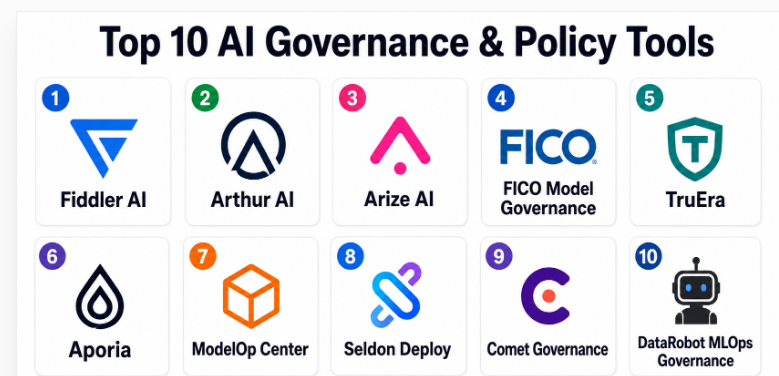
Top 10 AI Governance & Policy Tools
#1 — Fiddler AI
Short description: Fiddler AI is a platform for monitoring, explaining, and governing AI models. It provides tools to detect bias, assess fairness, and ensure regulatory compliance. Fiddler is used by enterprises to maintain transparency, build trust in AI outputs, and meet compliance requirements. Teams can integrate Fiddler into existing ML pipelines for continuous monitoring and reporting. It supports multi-cloud deployments and offers dashboards for interpretability and accountability.
Key Features
- Bias detection and fairness analysis
- Model performance monitoring
- Explainable AI dashboards
- Regulatory compliance tracking
- Multi-cloud support
- Integration with ML pipelines
- Alerting and risk scoring
Pros
- Comprehensive AI governance features
- Strong transparency and explainability
- Enterprise-ready monitoring dashboards
Cons
- Technical expertise required for setup
- May require customization for specific compliance needs
- Cost can be high for smaller teams
Platforms / Deployment
Windows / macOS / Linux / Cloud / Hybrid
Security & Compliance
- SOC 2, GDPR, ISO 27001
- RBAC and encryption
- Audit logging supported
Integrations & Ecosystem
- ML frameworks: TensorFlow, PyTorch
- Data sources and pipelines
- Cloud services integration
- API access for custom workflows
Support & Community
Enterprise support, documentation, and active customer community.
#2 — Arthur AI
Short description: Arthur AI is an AI observability platform that provides governance, monitoring, and policy enforcement. It is designed for enterprises needing to ensure fairness, accountability, and compliance in AI models. Arthur AI offers automated alerting for model drift, bias detection, and regulatory policy violations. It integrates into existing ML pipelines and helps teams enforce governance across models at scale.
Key Features
- Bias and fairness monitoring
- Model drift detection
- Automated alerts and risk scoring
- Compliance dashboards
- Multi-ML framework support
- Integration with data pipelines
- Reporting and audit trails
Pros
- Real-time governance and monitoring
- Supports multiple ML frameworks
- Enterprise-ready dashboards
Cons
- Setup can be complex
- Customization for unique policies may be required
- Subscription cost for enterprise features
Platforms / Deployment
Windows / macOS / Linux / Cloud / Hybrid
Security & Compliance
- SOC 2, GDPR
- Encryption and RBAC
- Audit logging
Integrations & Ecosystem
- TensorFlow, PyTorch, Scikit-learn
- Data connectors and APIs
- Workflow automation tools
Support & Community
Documentation, enterprise support, customer success resources.
#3 — Arize AI
Short description: Arize AI provides monitoring, observability, and governance for production AI systems. It focuses on model performance, bias detection, and operational accountability. Enterprises use Arize AI to ensure ML models adhere to internal policies and regulatory requirements. It supports multi-model monitoring, real-time alerts, and detailed audit trails for compliance and governance teams.
Key Features
- Model performance and drift monitoring
- Bias and fairness analysis
- Real-time alerting
- Audit logs and compliance reporting
- Multi-model support
- Integration with ML pipelines
- Observability dashboards
Pros
- Strong for enterprise-scale AI governance
- Multi-model orchestration
- Real-time monitoring
Cons
- Technical expertise required
- May require integration effort with legacy systems
- Cost-intensive for smaller deployments
Platforms / Deployment
Windows / macOS / Linux / Cloud / Hybrid
Security & Compliance
- SOC 2, GDPR, HIPAA (where applicable)
- RBAC and encryption
- Logging and audit capabilities
Integrations & Ecosystem
- ML frameworks: TensorFlow, PyTorch
- Cloud and on-prem pipelines
- API and workflow integration
Support & Community
Enterprise support, onboarding resources, knowledge base.
#4 — FICO Model Governance
Short description: FICO Model Governance provides compliance, monitoring, and risk management for AI and ML models. It is widely used in financial services to ensure adherence to regulatory requirements, audit readiness, and risk mitigation. The platform supports end-to-end monitoring of AI models, automated reporting, and workflow integration.
Key Features
- Model risk management
- Compliance and regulatory reporting
- Automated monitoring
- Integration with enterprise workflows
- Audit-ready dashboards
- Role-based access control
- Reporting and alerting
Pros
- Strong regulatory focus
- Enterprise-ready features
- Automated monitoring and reporting
Cons
- Primarily targeted for financial services
- Implementation complexity
- Higher cost for smaller teams
Platforms / Deployment
Windows / macOS / Linux / Cloud / Hybrid
Security & Compliance
- SOC 2, ISO 27001
- RBAC, encryption
- Audit logging
Integrations & Ecosystem
- Enterprise ML pipelines
- Data connectors and APIs
- Workflow integration
Support & Community
Enterprise support, consulting services, training materials.
#5 — TruEra
Short description: TruEra offers AI model quality, governance, and policy enforcement. It emphasizes explainability, fairness, and monitoring across production ML models. Organizations use TruEra to detect model bias, drift, and compliance violations while integrating with pipelines and cloud platforms. It supports multi-model orchestration and provides dashboards for governance teams.
Key Features
- Bias and fairness detection
- Model performance monitoring
- Explainable AI metrics
- Compliance dashboards
- Integration with ML pipelines
- Alerting for policy violations
- Multi-model support
Pros
- Comprehensive governance and monitoring
- User-friendly dashboards
- Enterprise-scale support
Cons
- Setup requires technical expertise
- Premium features may be expensive
- Focused on enterprise use cases
Platforms / Deployment
Windows / macOS / Linux / Cloud / Hybrid
Security & Compliance
- SOC 2, GDPR, ISO 27001
- RBAC and encryption
- Audit logs
Integrations & Ecosystem
- TensorFlow, PyTorch
- Data pipelines and vector stores
- API integrations
Support & Community
Documentation, enterprise support, forums.
#6 — Aporia
Short description: Aporia specializes in model monitoring and governance with a focus on compliance, fairness, and risk detection. It helps enterprises observe AI models in production, detect anomalies, and enforce policy rules. The platform integrates into ML pipelines and provides dashboards and alerts for governance teams.
Key Features
- Bias and fairness monitoring
- Model drift detection
- Policy enforcement
- Observability dashboards
- Multi-model support
- Integration with cloud and data pipelines
- Audit logging
Pros
- Real-time monitoring and alerting
- Supports enterprise governance
- Flexible integration
Cons
- Requires technical setup
- Enterprise plan may be costly
- Limited GUI for non-technical users
Platforms / Deployment
Windows / macOS / Linux / Cloud / Hybrid
Security & Compliance
- SOC 2, ISO 27001
- RBAC and encryption
- Audit logging
Integrations & Ecosystem
- ML frameworks
- Cloud storage and APIs
- Workflow connectors
Support & Community
Enterprise support, documentation, community forums.
#7 — ModelOp Center
Short description: ModelOp Center is an AI governance and policy platform for enterprise ML operations. It focuses on model lifecycle management, monitoring, and compliance. Teams use it to enforce governance policies, track risk, and ensure regulatory compliance across deployed models.
Key Features
- Model lifecycle management
- Governance and policy enforcement
- Compliance reporting
- Risk scoring
- Multi-model monitoring
- Audit logs
- Integration with ML pipelines
Pros
- Enterprise-ready features
- Comprehensive governance tools
- Supports multiple ML workflows
Cons
- Complex implementation
- Primarily for large organizations
- Premium pricing
Platforms / Deployment
Windows / macOS / Linux / Cloud / Hybrid
Security & Compliance
- SOC 2, ISO 27001
- RBAC, encryption
- Audit logging
Integrations & Ecosystem
- ML frameworks
- Data sources and APIs
- Workflow integration
Support & Community
Enterprise support, professional services, documentation.
#8 — Seldon Deploy
Short description: Seldon Deploy is a model deployment and governance platform with policy enforcement and monitoring capabilities. It is used to manage ML models, enforce compliance rules, and ensure ethical AI operations. It integrates with multiple cloud environments and supports observability.
Key Features
- Model deployment management
- Policy enforcement
- Monitoring and logging
- Compliance dashboards
- Multi-model orchestration
- Cloud and hybrid deployment support
- Alerting and risk detection
Pros
- Strong for production ML governance
- Cloud-native and hybrid options
- Integration with ML pipelines
Cons
- Enterprise-focused
- Technical setup required
- Premium features for advanced governance
Platforms / Deployment
Windows / macOS / Linux / Cloud / Hybrid
Security & Compliance
- SOC 2, ISO 27001
- Encryption, RBAC
- Audit logs
Integrations & Ecosystem
- ML frameworks: TensorFlow, PyTorch
- Cloud storage and APIs
- Workflow automation
Support & Community
Documentation, enterprise support, community forums.
#9 — Comet Governance
Short description: Comet Governance provides monitoring, reporting, and policy enforcement for ML models. It helps organizations manage risk, ensure compliance, and maintain transparency across AI workflows. Teams leverage it for bias detection, auditing, and policy enforcement.
Key Features
- Model monitoring
- Bias and fairness assessment
- Policy enforcement
- Audit logging
- Multi-model support
- Integration with ML pipelines
- Reporting dashboards
Pros
- Strong observability and governance
- Supports enterprise compliance needs
- Flexible integration
Cons
- Setup complexity
- Best suited for technical teams
- Some features may require premium plans
Platforms / Deployment
Windows / macOS / Linux / Cloud / Hybrid
Security & Compliance
- SOC 2, ISO 27001
- RBAC and encryption
- Audit logging
Integrations & Ecosystem
- ML frameworks
- API and SaaS integration
- Workflow pipelines
Support & Community
Enterprise support, documentation, and forums.
#10 — DataRobot MLOps Governance
Short description: DataRobot provides MLOps governance tools with a focus on compliance, risk, and policy enforcement. It enables enterprises to manage models throughout their lifecycle, track performance, and ensure adherence to internal policies and regulatory requirements.
Key Features
- Model lifecycle management
- Governance and policy enforcement
- Compliance dashboards
- Risk scoring
- Monitoring and logging
- Multi-model orchestration
- Integration with enterprise pipelines
Pros
- Comprehensive governance capabilities
- Enterprise-grade compliance
- Multi-model support
Cons
- Enterprise-focused, high cost
- Requires technical setup
- Learning curve for complex workflows
Platforms / Deployment
Windows / macOS / Linux / Cloud / Hybrid
Security & Compliance
- SOC 2, ISO 27001, HIPAA
- RBAC and encryption
- Audit logging
Integrations & Ecosystem
- ML frameworks
- Data pipelines
- SaaS and API connectors
Support & Community
Enterprise support, professional services, knowledge base.
Comparison Table
| Tool Name | Best For | Platform(s) Supported | Deployment | Standout Feature | Public Rating |
|---|---|---|---|---|---|
| Fiddler AI | Bias, fairness & compliance | Windows / macOS / Linux | Cloud / Hybrid | Explainable AI dashboards | N/A |
| Arthur AI | Model monitoring & governance | Windows / macOS / Linux | Cloud / Hybrid | Real-time alerting & risk scoring | N/A |
| Arize AI | Production AI observability | Windows / macOS / Linux | Cloud / Hybrid | Multi-model monitoring | N/A |
| FICO Model Governance | Regulatory compliance | Windows / macOS / Linux | Cloud / Hybrid | Audit-ready dashboards | N/A |
| TruEra | Model quality & governance | Windows / macOS / Linux | Cloud / Hybrid | Bias & fairness monitoring | N/A |
| Aporia | Model monitoring & policy | Windows / macOS / Linux | Cloud / Hybrid | Real-time alerts | N/A |
| ModelOp Center | Enterprise MLOps governance | Windows / macOS / Linux | Cloud / Hybrid | Lifecycle management | N/A |
| Seldon Deploy | Model deployment & governance | Windows / macOS / Linux | Cloud / Hybrid | Policy enforcement & monitoring | N/A |
| Comet Governance | Bias & compliance tracking | Windows / macOS / Linux | Cloud / Hybrid | Observability dashboards | N/A |
| DataRobot MLOps Governance | Enterprise model compliance | Windows / macOS / Linux | Cloud / Hybrid | Policy enforcement & risk scoring | N/A |
Evaluation & Scoring of AI Governance & Policy Tools
| Tool Name | Core (25%) | Ease (15%) | Integrations (15%) | Security (10%) | Performance (10%) | Support (10%) | Value (15%) | Weighted Total (0–10) |
|---|---|---|---|---|---|---|---|---|
| Fiddler AI | 9 | 8 | 8 | 8 | 8 | 8 | 8 | 8.25 |
| Arthur AI | 8 | 7 | 8 | 8 | 8 | 7 | 8 | 7.85 |
| Arize AI | 8 | 7 | 7 | 8 | 8 | 7 | 8 | 7.80 |
| FICO Model Governance | 9 | 6 | 7 | 9 | 8 | 7 | 8 | 8.05 |
| TruEra | 8 | 7 | 7 | 8 | 8 | 7 | 8 | 7.80 |
| Aporia | 7 | 7 | 7 | 8 | 7 | 7 | 8 | 7.50 |
| ModelOp Center | 8 | 6 | 7 | 9 | 8 | 7 | 8 | 7.95 |
| Seldon Deploy | 8 | 7 | 7 | 8 | 8 | 7 | 8 | 7.85 |
| Comet Governance | 7 | 7 | 7 | 8 | 7 | 7 | 8 | 7.45 |
| DataRobot MLOps Governance | 9 | 6 | 7 | 9 | 8 | 7 | 8 | 8.05 |
Interpretation: Scores indicate relative strength across governance, compliance, integration, and usability. Higher scores suggest mature, enterprise-ready tools with comprehensive AI governance capabilities. Selection depends on organizational scale, regulatory requirements, and technical expertise.
Which AI Governance & Policy Tool Is Right for You?
Solo / Freelancer
Fiddler AI, TruEra, and Aporia are suitable for small teams experimenting with AI governance or monitoring individual models.
SMB
Arthur AI, Arize AI, and Seldon Deploy provide scalable policy enforcement, integration with pipelines, and dashboards for small teams.
Mid-Market
FICO Model Governance, TruEra, and ModelOp Center deliver enterprise features, risk scoring, and regulatory compliance suitable for growing AI operations.
Enterprise
Vertex-scale enterprises benefit from DataRobot MLOps Governance, FICO Model Governance, and Seldon Deploy for comprehensive monitoring, auditing, and compliance.
Budget vs Premium
Open-source or mid-tier solutions (Aporia, TruEra) are cost-effective. Premium platforms provide richer compliance, monitoring, and governance features.
Feature Depth vs Ease of Use
Enterprise-focused tools (FICO, DataRobot) offer deep governance capabilities but require expertise. Tools like TruEra or Aporia are easier to adopt for smaller teams.
Integrations & Scalability
Evaluate API integrations, pipeline connectivity, multi-model orchestration, and cloud/hybrid deployment options.
Security & Compliance Needs
Ensure SOC 2, ISO 27001, GDPR, HIPAA, RBAC, audit logging, and encryption are supported.
Frequently Asked Questions
1. What is an AI governance tool?
A platform to monitor, enforce, and manage AI policies, compliance, fairness, and risk.
2. Do these tools prevent AI bias?
Yes, tools provide bias detection, fairness analysis, and monitoring to reduce unintended outcomes.
3. Are they enterprise-ready?
Most tools, like FICO, Arize AI, and DataRobot, support enterprise deployment, auditing, and reporting.
4. Can these integrate with existing ML pipelines?
Yes, integrations with ML frameworks, cloud services, APIs, and workflows are standard.
5. How do I monitor compliance?
Dashboards, logging, and automated alerts allow continuous compliance monitoring and auditing.
6. Are these tools expensive?
Pricing varies from mid-tier subscriptions to enterprise plans. Open-source options may reduce costs.
7. Do they support multi-cloud environments?
Yes, tools like Fiddler AI, Seldon Deploy, and Arize AI support cloud and hybrid deployments.
8. Are open-source frameworks production-ready?
Yes, but enterprise support and compliance features may require additional configuration.
9. How do they help with regulatory audits?
Automated reporting, logging, and policy enforcement streamline audit readiness.
10. Can small teams use these tools?
Yes, but lighter tools like Aporia or TruEra may be better suited for smaller deployments.
Conclusion
AI governance and policy tools are essential for managing compliance, mitigating risk, and ensuring ethical AI adoption. Platforms like Fiddler AI, Arthur AI, and Arize AI provide monitoring, bias detection, and policy enforcement, while enterprise-focused tools such as FICO Model Governance and DataRobot MLOps Governance offer advanced compliance and lifecycle management. Selection depends on organizational scale, regulatory needs, workflow complexity, and budget.
