Upgrade & Secure Your Future with DevOps, SRE, DevSecOps, MLOps!
We spend hours scrolling social media and waste money on things we forget, but won’t spend 30 minutes a day earning certifications that can change our lives.
Master in DevOps, SRE, DevSecOps & MLOps by DevOps School!
Learn from Guru Rajesh Kumar and double your salary in just one year.
Introduction
Austria is one of the most stable, prosperous, and culturally rich countries in the European Union. For skilled professionals, international students, and ambitious immigration aspirants, the Austrian job market offers incredible career growth, high salaries, and unmatched social benefits. However, relocating to a new country can feel like solving a complex puzzle. Navigating immigration policies, understanding visa pathways, and figuring out paperwork can quickly become overwhelming for first-timers. This is where Austria’s structured immigration framework comes into play to simplify your journey. To attract global talent, the Austrian government utilizes a streamlined, points-based immigration system known as the Red-White-Red (RWR) Card. This framework ensures a fair, transparent, and highly structured pathway for qualified third-country nationals to settle and work legally in Austria. To determine whether you qualify for this life-changing opportunity, you must first assess your profile using an objective evaluation system. You can evaluate your baseline scores and track your specific pathway using the online platform at Austria Red-White-Red Card Points Calculator
before initiating your official application.
What Is Austria PR Points Calculator?
The Austria PR Points Calculator is an objective, criteria-based evaluation tool used to determine your initial eligibility for the Red-White-Red Card. Instead of relying on arbitrary selection or strict lottery quotas, Austria evaluates applicants on tangible human capital factors. This means your education, work background, age, and language proficiency directly impact your immigration success. The primary purpose of this points system is to bridge the acute labor shortages facing Austrian businesses. By assigning numerical values to specific professional achievements, the Austrian government can efficiently identify talent that will seamlessly integrate into the local economy. The calculator mirrors the official assessment metrics used by Austrian immigration authorities. When you use the points calculator, you input personal details regarding your academic degrees, past employment history, age brackets, and certified language skills. The system then aggregates these inputs to generate a comprehensive score. This scoring mechanism provides immediate clarity on whether you meet the legal thresholds required to apply for residency.
For example, a software engineer might score 70 points on an online calculator based on their qualifications. If they cannot provide certified university degrees or valid employment letters during the official verification stage, their application will be rejected. The calculator is your essential first step, but meticulous documentation is what seals your success.
Austria PR Points System Explained
The Austrian Red-White-Red Card system breaks down your immigration score into highly specific, verifiable human capital categories. To build a highly competitive profile, you need to understand exactly how points are distributed across these individual areas. Let us take an in-depth look at the core scoring pillars that form the foundation of the points framework.
Education Points
Your academic qualifications form the cornerstone of your points calculation. Higher levels of education yield significantly higher scores, reflecting Austria’s deep appreciation for specialized skills. For instance, completing a recognized university degree or an advanced vocational training program acts as a major boost for your profile.
If a candidate holds a Master’s degree or a PhD in a MINT field (Mathematics, Informatics, Natural Sciences, or Technology), they receive the highest point allocation. Vocational training completed specifically in an occupation experiencing an active shortage also grants a strong baseline score. The goal is to prove that your educational background has directly prepared you for high-value economic contributions.
Work Experience Points
Your professional history is evaluated based on its relevance, duration, and the location where it was acquired. Continuous employment in your designated field shows stability and advanced expertise. Points are typically calculated either per year or per half-year of documented, verifiable work experience.
Furthermore, Austria offers significant bonus points if you have prior work experience acquired directly within Austria. This is because regional experience demonstrates that you are already familiar with the local working culture and business practices. All past work experience must be backed by official reference letters, detailed job descriptions, and tax records.
Age Factor
The age component of the points system is designed to balance Austria’s domestic demographic shifts by attracting young, active professionals. Maximum points are awarded to younger applicants who fall into the prime working age brackets, typically under 30 or 35 years old.
As an applicant moves into higher age brackets, the point allocation gradually decreases. For example, individuals between 40 and 50 years old receive fewer points than their younger counterparts. However, older professionals can easily offset this decrease by leveraging their extensive senior management experience or advanced language competencies.
Language Skills (German/English)
Language proficiency is a vital pillar for both economic productivity and successful social integration in Austria. The points system rewards certified skills in both German (the national language) and English (the global business language). You must provide official test scores from recognized institutions to claim these points.
For German skills, points scale upwards from basic levels like A1 and A2 to intermediate levels like B1 and B2. English language skills are similarly tier-rated using standardized exams such as the IELTS or TOEFL. Interestingly, some visa tracks allow you to accumulate combined points for knowing both languages, or offer special bonuses for corporate English fluency.
Bonus Points
To address hyper-specific economic needs, Austria integrates unique bonus point opportunities into its calculator. These include special considerations for individuals who have received recognized international awards or hold registered patents.
Additionally, if your prospective employer requires a specific corporate language or if you are applying under an urgent regional shortage list, you can unlock extra points. These bonus points often make a life-changing difference for applicants who find themselves sitting just a few points shy of the mandatory passing threshold.
Red-White-Red Card System
The Red-White-Red (RWR) Card is a combination of a residence permit and a work permit, granting you the legal right to live and work in Austria. It is issued for a specific duration, usually two years, and binds you to a specific employer. This system ensures that your entry into the country directly correlates with a genuine vacancy in the local labor market.
The RWR Card is divided into distinct categories, each designed to cater to a unique segment of global talent. Understanding which specific track aligns with your profile is the most important strategic choice you will make. Let us examine the four primary categories that applicants use to migrate to Austria:
- Very Highly Qualified Workers: This premium track is tailored for senior executives, researchers, scientists, and high-level innovators. Uniquely, this category does not strictly require a pre-existing job offer to begin the journey. If you score high enough, you can obtain a 6-month Job Seeker Visa to find employment directly on the ground in Austria.
- Skilled Workers in Shortage Occupations: This pathway targets professionals training in fields where Austrian employers face severe local labor deficits. Examples include mechanical engineers, nurses, data analysts, and various certified technical trades. To qualify, you must possess a valid job offer that pays the legally mandated minimum wage.
- Other Key Workers: If your specific profession does not appear on the official annual shortage occupation list, you can still apply through this track. It is designed for essential professionals who bring unique skills to an Austrian business. This pathway relies heavily on strict minimum salary thresholds determined by your age group.
- Startup Founders: Austria actively welcomes foreign entrepreneurs who want to establish innovative, scalable businesses within its borders. To qualify under this entrepreneurial track, you must present a comprehensive business plan, secure significant capital investment, and prove that your startup will create jobs.
To give you a clear, bird’s-eye view of how these distinct pathways compare against one another, review the comprehensive structural table below:
| Visa Category | Minimum Points Required | Pre-Existing Job Offer Required? | Primary Focus & Target Group |
| Very Highly Qualified Workers | 70 out of 100 points | No (Can use Job Seeker Visa) | Researchers, scientists, senior executives, high-level tech specialists. |
| Skilled Workers in Shortage Occupations | 55 out of 90 points | Yes (Must match shortage list) | Engineers, health workers, IT professionals, certified tradespeople. |
| Other Key Workers | 55 out of 90 points | Yes (Must meet salary floor) | Managers, specialists, and essential staff not on the shortage list. |
| Startup Founders | Evaluated on Business Plan | No (Requires capital & plan) | Entrepreneurs launching innovative, job-creating companies. |
How Austria PR Points Are Calculated
Calculating your official Austria immigration score requires matching your personal milestones against the precise legal criteria established by the government. The points calculation process is strict, transparent, and completely mathematical. Let us break down the exact scoring metrics across the three main professional visa pathways.
Detailed Scoring Breakdown Tables
1. Very Highly Qualified Workers (Maximum: 100 Points | Passing Score: 70)
This category places an immense emphasis on advanced degrees, research credentials, high historical salaries, and proven leadership positions.
- Highest Qualification (Max 40 Points):
- University graduation (minimum 4-year program): 20 points
- Degree in a MINT subject (Math, IT, Natural Sciences, Tech): 30 points
- PhD or Post-doctoral qualification (Habilitation): 40 points
- Previous Gross Salary (Max 30 Points):
- Annual senior management salary between €50,000 and €60,000: 20 points
- Annual senior management salary between €60,000 and €70,000: 25 points
- Annual senior management salary exceeding €70,000: 30 points
- Research & Innovation (Max 20 Points):
- Documented patent applications or scientific publications: 20 points
- Work Experience (Max 20 Points):
- General professional experience matching qualification: 2 points per year
- Prior six months of continuous work experience within Austria: 10 points
- Language Skills (Max 10 Points):
- German language certificate (A1 Level): 5 points
- German language certificate (A2 Level): 10 points
- English language certificate (A2 Level): 5 points
- English language certificate (B1 Level): 10 points
- Age Factor (Max 20 Points):
- Up to 35 years of age: 20 points
- 35 to 40 years of age: 15 points
- 40 to 45 years of age: 10 points
2. Skilled Workers in Shortage Occupations (Maximum: 90 Points | Passing Score: 55)
This scoring matrix prioritizes functional vocational training, youthful age brackets, and flexible language competencies to address immediate domestic trade deficits.
- Qualifications (Max 30 Points):
- Completed vocational training/apprenticeship in a listed shortage occupation: 30 points
- General eligibility for Austrian university admission: 25 points
- Completion of a 3-year minimum higher education institution degree: 30 points
- Work Experience (Max 20 Points):
- General work experience matching qualification: 1 point per half-year (2 points per year)
- Experience acquired directly inside Austria: 2 points per half-year (4 points per year)
- Language Skills (Max 25 Points):
- German certificate (A1): 5 points | (A2): 10 points | (B1): 15 points
- English certificate (A2): 5 points | (B1): 10 points
- Bonus for additional languages (e.g., French, Spanish at B1): 5 points
- Age Factor (Max 15 Points):
- Up to 30 years of age: 15 points
- Up to 40 years of age: 10 points
- Up to 50 years of age: 5 points
- Additional Bonus Points:
- Workplace corporate language is explicitly English: 5 points
3. Other Key Workers (Maximum: 90 Points | Passing Score: 55)
This track features a points breakdown identical to the shortage occupations matrix, but carries a mandatory minimum monthly salary requirement that must be met to validate the application.
- Qualifications: Up to 30 points (Vocational = 20, University Entry = 25, Tertiary Degree = 30)
- Work Experience: Up to 20 points (2 points per year general, 4 points per year in Austria)
- Language Skills: Up to 25 points (German up to 15 points, English up to 10 points)
- Age Factor: Up to 15 points (Under 30 = 15 points, Under 40 = 10 points, Under 50 = 5 points)
Real-Life Sample Profile Calculation
To see how these abstract points come together in the real world, let us calculate the score for a hypothetical applicant named Sarah. Sarah is a 29-year-old software developer from South Africa applying under the “Skilled Workers in Shortage Occupations” category.
- Sarah’s Profile Metrics:
- Education: Completed a 3-year Bachelor’s Degree in Computer Science (30 points)
- Experience: 4 years of continuous software development experience outside Austria (8 points)
- Age: 29 years old, falling safely into the maximum youth bracket (15 points)
- Languages: Native English speaker with a certified B1 level equivalent (10 points); no German skills yet (0 points)
- Sarah’s Final Points Tally:$$\text{Education (30)} + \text{Experience (8)} + \text{Age (15)} + \text{Languages (10)} = \mathbf{63\text{ Points}}$$
Because the passing threshold for the Shortage Occupations track is 55 points, Sarah’s total score of 63 points makes her fully eligible to apply for the Red-White-Red Card. Once she secures a valid employment contract from an Austrian tech firm that meets the standard local wage criteria, she can confidently launch her application.
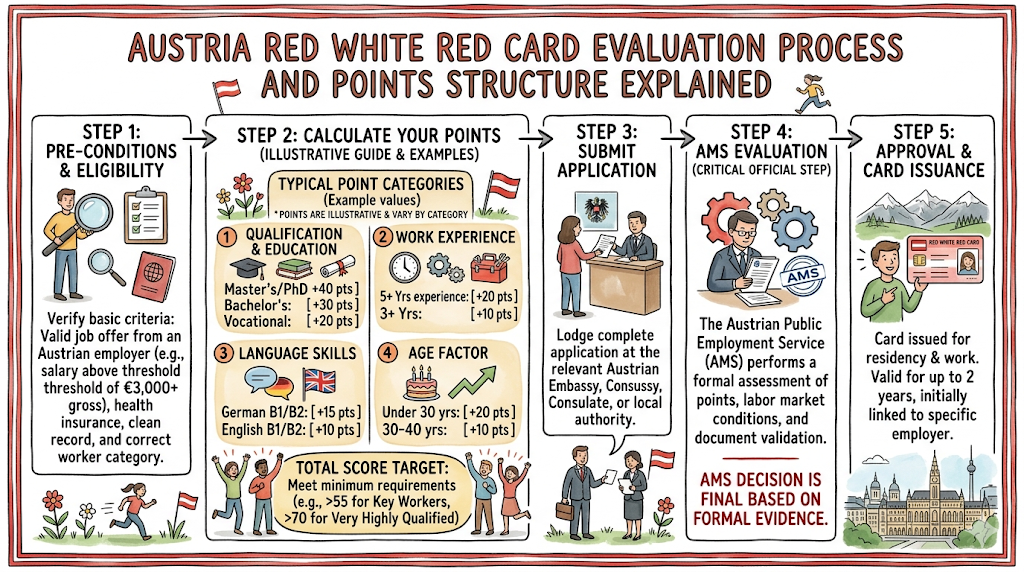
Step-by-Step Application Process
Moving to Austria requires a methodical execution of administrative steps. Missing a single stage or submitting documents out of sequence can result in processing delays or immediate visa denials. Let us walk through the exact six-step sequence required to turn your points calculator score into a physical residency permit.
Step 1 – Check Your Points Eligibility
Before spending money on visa fees or document translations, utilize the online points calculator to evaluate your profile. Ensure that you possess verifiable proof for every point you claim. If your score sits safely above the required passing threshold (55 or 70 points depending on your category), you can proceed to the next stage.
Step 2 – Collect and Legalize Documents
Gather all necessary academic degrees, detailed employment reference letters, language scorecards, and identity certificates. Depending on your home country, these documents must undergo strict legalization. This involves obtaining official apostilles or diplomatic authentication to ensure they are legally recognized by the Austrian government.
Step 3 – Secure a Valid Job Offer
Except for the elite Very Highly Qualified track, you must secure a binding job offer from an employer registered in Austria. The job offer must be accompanied by a formal Employer’s Declaration (Arbeitgebererklärung). This document outlines your specific tasks, corporate working hours, and confirms that the company will pay you the statutory minimum salary.
Step 4 – Submit Your Official Application
If you require a Job Seeker Visa, you will submit your application at the local Austrian Embassy or Consulate in your home country. If you already hold a valid job offer and a complete employer declaration, you can file the Red-White-Red Card application directly. Alternatively, your prospective employer can submit the paperwork on your behalf to the local residence authority inside Austria.
Step 5 – The AMS Labor Market Evaluation
Once submitted, the immigration authority forwards your complete file to the Arbeitsmarktservice (AMS), which is the Austrian Public Employment Service. The AMS acts as the primary gatekeeper of the process. They verify your points, review your certificates, and confirm that your salary matches local collective bargaining agreements.
Step 6 – Final Approval and Visa Issuance
Upon a positive evaluation by the AMS, the local residence authority (Aufenthaltsbehörde) issues the final approval notice. The embassy will grant you a specialized entry visa if you are outside Austria. Once you arrive on Austrian soil, you will visit the local immigration office to pick up your physical, biometric Red-White-Red Card.
Documents Required
The document compilation stage is often the most time-consuming part of the entire immigration process. Your documents must be perfectly organized, completely accurate, and flawlessly translated. Any discrepancy between what you claimed on the points calculator and what you show in your paperwork will cause an immediate rejection.
Make sure you compile the following core documents before initiating your submission:
- Valid Passport: Must be undamaged, have at least two blank pages, and remain valid for the entire initial duration of your intended stay.
- Birth Certificate: A certified copy of your full birth certificate, including parents’ names, fully translated into German.
- Biometric Passport Photographs: Recent color photographs taken within the last six months matching strict European Schengen visa specifications.
- Academic Degrees & Transcripts: Official diplomas, graduation certificates, and course transcripts verifying your years of tertiary study or completed vocational training.
- Detailed Work Experience Letters: Formal letters from past employers printed on company letterhead. They must clearly state your exact job title, start and end dates, precise daily duties, and be signed by management.
- Certified Language Certificates: Official test result sheets from internationally recognized testing bodies (such as ÖSD, Goethe-Institut, TELC for German, or IELTS/TOEFL for English) issued within the last two years.
- Binding Job Contract & Employer Declaration: A signed copy of your future Austrian employment contract alongside the completed Arbeitgebererklärung form from your sponsor.
- Proof of Clean Criminal Record: An official police clearance certificate obtained from your home country, as well as any country where you have resided for more than six months over the past five years.
- Proof of Covered Accommodation: A signed rental agreement (Mietvertrag) or accommodation contract proving you have a valid place to live upon arrival in Austria.
- Comprehensive Travel Health Insurance: A valid insurance policy providing full medical coverage within the Schengen zone until you are fully registered under the Austrian public healthcare system.
Processing Time & Validity
Expected Processing Timeline
Once your complete application packet is formally lodged with the Austrian authorities, the official review timeline begins. On average, the standard processing time for a Red-White-Red Card ranges between 6 to 8 weeks.
This processing speed is highly efficient compared to many other global immigration systems. However, the timeline can easily extend if the AMS requires additional documentation, or if your home country’s documents require complex background verification.
Initial Card Validity
When your first Red-White-Red Card is approved, it is typically issued with a fixed validity period of 24 months (2 years). During these initial two years, your residence permit is legally tied to the specific employer who sponsored your application. If you wish to change jobs during this initial window, you must file a formal application to modify your visa parameters through the AMS.
The Path to Permanent Residency: Transitioning to the RWR Card Plus
As you approach the end of your initial 24-month visa term, you unlock the pathway to full permanent residency. If you have been legally employed for at least 21 months out of the preceding 24 months in accordance with your visa terms, you can apply for the Red-White-Red Card Plus.
The RWR Card Plus is a major milestone because it decouples your residency from a single employer. It grants you completely unrestricted access to the entire Austrian labor market, allowing you to switch companies or start a business freely. After 5 years of continuous, legal residence on the RWR Card frameworks, you become eligible to apply for long-term EU permanent residency (Daueraufenthalt EU).
How to Increase Your Austria PR Points
If you run your initial profile through the Austria PR Points Calculator and discover that your score falls just below the passing mark, there is no need to panic. The points system is dynamic, meaning you can take proactive, strategic steps to upgrade your human capital value. Let us examine the most effective expert strategies to boost your overall score.
- Proactively Learn the German Language: This is the fastest, most controllable way to supercharge your points total. Moving from zero knowledge to a certified A2 or B1 level can instantly inject an extra 10 to 15 points into your profile, while making you far more attractive to local employers.
- Accumulate Additional Years of Experience: If your qualification points are fixed, dedicating another year or two to your current profession outside Austria will steadily increase your work experience points. Ensure that every month of work is documented with flawless reference letters.
- Pursue Advanced Academic Qualifications: Upgrading an educational profile can close a major points gap. For example, transitioning from a basic diploma to a full Bachelor’s degree, or completing a targeted Master’s program in a MINT field, adds significant points to your application.
- Target a Specific Shortage Occupation: Review Austria’s official annual shortage occupation list carefully. If your skills sit adjacent to a listed shortage field, tailoring your job search to focus heavily on that specific niche lowers your required passing score from 70 points to 55 points.
- Secure an English-Speaking Corporate Job Offer: Some specific tracks offer an automatic 5-point bonus if the prospective company explicitly documents that their primary operational workplace language is English. This completely eliminates immediate pressure to speak fluent German.
Common Mistakes Applicants Make
Even highly qualified applicants frequently face visa rejections simply due to easily avoidable administrative errors. Understanding where past applicants have failed allows you to safeguard your own application journey. Let us look at the most common pitfalls you must avoid when navigating the Austrian immigration system.
- Selecting the Wrong Immigration Category: Many applicants mistakenly evaluate themselves under the “Very Highly Qualified” track because they hold an advanced degree, without realizing they lack the unique research or senior executive points to hit the 70-point mark. Always select the specific track that matches your actual day-to-day employment contract.
- Submitting Non-Certified Language Certificates: Austria will completely reject language points if your test results come from an unaccredited local school. Your language certificates must come exclusively from authorized, internationally recognized testing systems like the Goethe-Institut, ÖSD, or IELTS.
- Failing to Properly Legalize Essential Documents: Submitting official university degrees or police clearances without the mandatory apostille or consular authentication stamps is a primary cause of immediate processing rejections. Authorities will treat un-legalized foreign documents as completely invalid.
- Miscalculating General Work Experience Points: Applicants often assume that any job they have held counts toward their score. In reality, the AMS will only award points for past work experience that directly and clearly matches the specific professional qualification and job description you are applying for.
- Applying Without a Legally Valid Job Offer: For the Shortage Occupations and Key Worker categories, submitting an application based on a casual verbal agreement or a basic interview invitation is completely impossible. You must hold a physical, signed contract alongside a fully completed Employer’s Declaration form.
Real-Life Examples
To understand how the points framework operates across different backgrounds, let us analyze three distinct real-world candidate profiles, their point distributions, and their ultimate immigration outcomes.
Example 1: The Specialized IT Professional (Shortage Occupation)
- Profile: Alexei is a 32-year-old Senior DevOps Engineer from Ukraine. He holds a 4-year Bachelor’s Degree in Software Engineering and has 6 years of international work experience. He has secured a job offer in Vienna with an annual gross salary of €65,000. He speaks fluent English (B1 certified) but knows no German.
- Points Estimation:
- Education: 30 points (Recognized university degree)
- Experience: 12 points (6 years of matching experience = 12 points)
- Age: 10 points (32 years old falls into the under-40 bracket)
- Language: 10 points (Certified English B1)
- Total Score: 62 Points
- Immigration Outcome: Approved. Because software engineering is prominently featured on Austria’s nationwide shortage occupation list, Alexei only needed 55 points. Since his score is 62, his application is successfully validated by the AMS.
Example 2: The Experienced Trade Professional (Moderate Experience)
- Profile: Carlos is a 28-year-old certified industrial electrician from Mexico. He completed a formal 2-year vocational training program in his home country and has 3 years of documented work experience. He has an active job offer from an engineering firm in Graz. Carlos has proactively studied German and holds an official A2 German certificate.
- Points Estimation:
- Education: 30 points (Completed vocational training in a shortage trade)
- Experience: 6 points (3 years of matching experience)
- Age: 15 points (28 years old falls into the maximum youth bracket)
- Language: 10 points (Certified German A2 level)
- Total Score: 61 Points
- Immigration Outcome: Approved. Industrial electricity is a high-demand shortage occupation in Austria. Carlos comfortably clears the 55-point threshold, largely driven by his young age and his proactive effort to secure an official A2 German certificate.
Example 3: The International Student Transitioning to Work
- Profile: Ananya is a 25-year-old student from India who just completed her Master’s Degree in Data Science at a university in Vienna. She has received a full-time junior data analyst job offer from an Austrian financial institution paying a gross monthly salary of €3,400.
- Points Estimation & Special Rule: International graduates of Austrian tertiary institutions are exempt from the standard points-based scoring matrix. Instead, they can transition directly to a Red-White-Red Card if they secure a local job offer within 12 months of graduation that matches their degree level and meets the basic monthly salary criteria.
- Immigration Outcome: Approved. Because Ananya holds an Austrian university degree and her job offer satisfies the localized salary floor for graduates, the AMS approves her RWR card automatically without requiring a traditional points tally.
FAQs (Frequently Asked Questions)
1. What is the Austria PR Points Calculator?
The Austria PR Points Calculator is an online pre-screening evaluation tool that mirrors the official point system utilized by the Austrian government. It allows prospective migrants to input their personal metrics—such as education, work experience, age, and language skills—to see if they meet the minimum legal point thresholds required to qualify for a Red-White-Red Card.
2. Is knowledge of the German language mandatory to get an Austria work visa?
No, German is not universally mandatory for all applicants. If you are highly skilled and possess a certified B1 or higher level of English proficiency, you can easily accumulate enough points to qualify, especially in tech and engineering fields. However, learning basic German (A1 or A2) adds substantial points to your profile and is highly beneficial for daily integration.
3. Exactly how many points are needed to qualify for the Red-White-Red Card?
The passing score depends on the specific visa track you apply under. If you apply as a Very Highly Qualified Worker, you must score a minimum of 70 out of 100 points. If you apply as a Skilled Worker in a Shortage Occupation or as an Other Key Worker, the minimum passing requirement is 55 out of 90 points.
4. Can I apply for the Austria Red-White-Red Card without a job offer?
You can only apply without a job offer if you qualify under the elite “Very Highly Qualified Workers” category. If you score 70+ points on this specific track, you can apply for a 6-month Job Seeker Visa to look for work on the ground. All other tracks—including Shortage Occupations and Key Workers—strictly require a binding job contract to apply.
5. How long does it take for the authorities to process the RWR Card?
Once your complete application packet is successfully submitted to the Austrian authorities, the standard processing timeline typically takes between 6 to 8 weeks. This timeline relies heavily on the efficiency of the local AMS office reviewing your file and the completeness of your documentation.
6. Can I convert a standard Red-White-Red Card into full Permanent Residency (PR)?
Yes. The Red-White-Red Card provides a direct, legally structured pathway to permanent residency. After holding the initial RWR card for 2 years and working for at least 21 months, you can upgrade to a Red-White-Red Card Plus. After a total of 5 years of continuous legal residence, you can apply for permanent residency (Daueraufenthalt EU).
7. What institutions are recognized for proving English language skills?
To claim language points for English, you must submit a valid, official test scorecard from an internationally accredited testing framework. The most widely accepted options are the IELTS (International English Language Testing System) and the TOEFL (Test of English as a Foreign Language). The test must have been taken within the last two years.
8. What happens if I want to change my employer while holding an initial RWR Card?
Because your initial Red-White-Red Card is legally tied to a specific employer for the first 24 months, you cannot simply switch jobs without notifying the government. If you receive a new job offer, you must file a formal application for a modification of your residence permit with the local immigration authority and wait for a fresh AMS evaluation before starting work at the new company.
9. Are there specific salary thresholds for the “Other Key Workers” category?
Yes. The Other Key Workers track relies heavily on strict gross monthly salary minimums that change slightly each year. The required salary is indexed based on your age. If you are under 30 years old, your prospective job must pay a lower designated monthly floor, whereas applicants over 30 years old must meet a higher mandatory gross monthly salary threshold to pass.
10. Does an annual list of shortage occupations exist, and where can I find it?
Yes, the Austrian Federal Ministry for Labour and Economy publishes an updated, official list of nationwide and regional shortage occupations (Mangelberufe) towards the end of every year. This list reflects the changing real-time structural deficits of the Austrian labor market and determines which professionals qualify for the lower 55-point threshold.
11. Can my family members migrate to Austria with me under my RWR Card?
Yes, your immediate family members—including your spouse and dependent minor children—can migrate to Austria with you under the family reunification framework. They can apply for a “Red-White-Red Card Plus” simultaneously with your application. This grant provides your spouse with immediate, completely unrestricted access to work anywhere in the Austrian labor market from day one.
12. What is the fee associated with applying for an Austrian Red-White-Red Card?
The total government application and processing fees for a Red-White-Red Card sum up to approximately €218 per applicant. This fee is paid in structured increments: a portion is paid during your initial application submission, another portion is settled upon final approval, and a small nominal fee is collected for the physical production of your biometric card. This does not include separate costs for document translation, notarization, or embassy administrative surcharges.
Conclusion
Navigating a move to Europe does not have to be an overwhelming process. The Austrian Red-White-Red Card system is designed to provide global professionals with an objective, predictable, and transparent pathway to relocation. By eliminating guesswork and replacing it with a clear, mathematical points-based evaluation, Austria allows you to take complete control of your immigration destiny. Mapping your personal milestones against the official education, experience, age, and language criteria is the ultimate foundation of a successful application. Taking the time to calculate your score early allows you to pinpoint your strong suits, identify profile gaps, and build a highly competitive application packet. Whether you clear the thresholds easily or discover you need to study German to boost your score, the points framework gives you a definitive roadmap.
