Upgrade & Secure Your Future with DevOps, SRE, DevSecOps, MLOps!
We spend hours scrolling social media and waste money on things we forget, but won’t spend 30 minutes a day earning certifications that can change our lives.
Master in DevOps, SRE, DevSecOps & MLOps by DevOps School!
Learn from Guru Rajesh Kumar and double your salary in just one year.
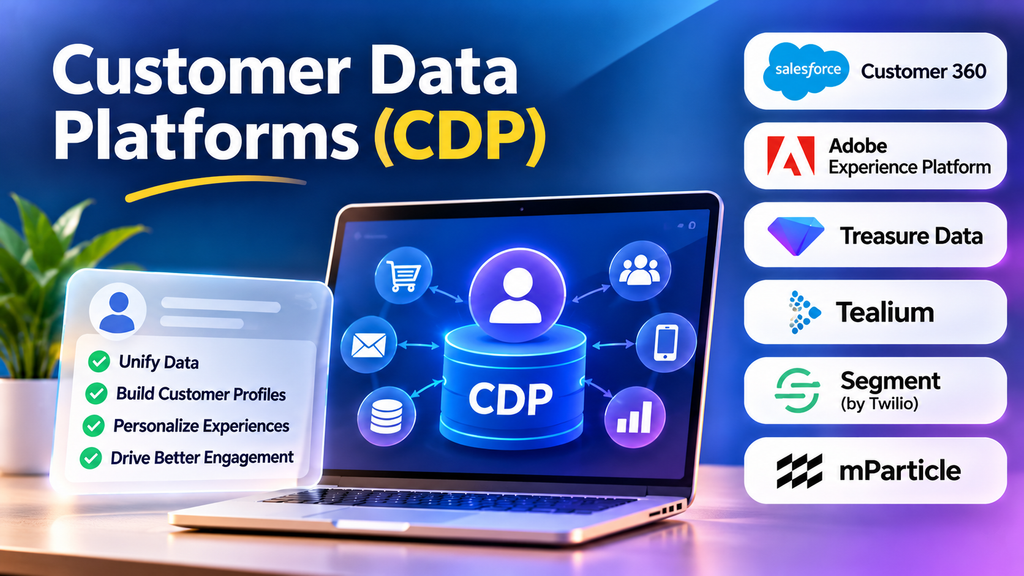
Customer information is often scattered across website analytics, CRM systems, email platforms, e-commerce stores, and customer support applications. When these systems operate independently, marketing teams struggle to understand the complete customer journey. A Customer Data Platform (CDP) addresses this problem by bringing customer data together and making it available for more consistent analysis and personalization.
A CDP can help organizations understand how customers discover products, interact with campaigns, make purchases, and engage with a brand over time. However, its value depends on more than collecting data in one place. Identity resolution, data quality, consent management, integration capabilities, and activation workflows all influence whether a CDP becomes a useful part of the marketing technology stack.
What Is a Customer Data Platform?
A Customer Data Platform is software designed to collect customer data from multiple sources, organize it into unified customer profiles, and make that information available to other business systems.
Depending on the platform, the data may include website activity, mobile app events, purchase history, email engagement, customer attributes, and records from other connected systems.
A CDP is not necessarily a replacement for a CRM, data warehouse, or marketing automation platform. These technologies serve different purposes. A CRM typically supports relationship management and sales workflows, a data warehouse supports analytical workloads, and marketing automation software executes campaigns. A CDP focuses on making customer data usable across these activities.
How a CDP Turns Fragmented Data Into Customer Profiles
The process generally involves several connected stages.
Data Collection
The platform receives data through website tags, software development kits, APIs, file imports, database connections, and supported integrations. The available collection methods depend on the product and the organization’s architecture.
For example, an online retailer might collect product views from its website, purchases from its commerce system, and email engagement from its campaign platform.
Identity Resolution
The CDP attempts to determine which records belong to the same customer. It may use identifiers such as authenticated account IDs, email addresses, or other permitted identifiers.
Identity resolution can be deterministic, based on known matching identifiers, or probabilistic, based on estimated relationships between records. Probabilistic matching introduces uncertainty and requires careful governance. Anonymous visitors may also remain separate from known profiles until an appropriate link can be established.
Profile Unification and Data Quality
Once records are matched, the platform organizes relevant attributes and interactions into a more coherent profile. Data validation, deduplication, timestamp handling, and source-of-truth rules help prevent conflicting information from undermining that profile.
A unified profile should not be mistaken for a perfectly complete record. Some information will remain unavailable, outdated, inconsistent, or inappropriate to combine.
Audience Segmentation and Activation
Teams can build audiences using attributes and behavior, such as customers who viewed a product without purchasing or existing customers who have not engaged with recent campaigns.
Depending on the platform’s capabilities, these audiences and associated data can be sent to advertising systems, email tools, customer engagement platforms, analytics environments, or other destinations.
Customer Data Platforms Worth Evaluating
Different CDPs emphasize different architectural approaches. Some focus on event collection and warehouse integration, while others provide broader customer profile management and campaign activation capabilities.
Twilio Segment
Segment provides customer data infrastructure for collecting, standardizing, and routing event data to connected destinations. Its tracking and integration model can help product and marketing teams coordinate customer data across multiple tools.
It is worth considering when an organization needs a structured way to collect customer events and distribute them throughout its technology stack. Buyers should evaluate destination support, event volume, data governance requirements, identity resolution needs, and the cost of maintaining a large integration footprint.
mParticle
mParticle focuses on customer data infrastructure, including the collection and management of customer event data for downstream activation. It can be relevant to organizations coordinating data across digital products and customer engagement systems.
Its suitability depends on the organization’s event architecture, supported integrations, identity requirements, and operational needs. Teams should verify the exact capabilities available in the proposed configuration rather than assuming every feature is included in every plan.
Salesforce Data Cloud
Salesforce Data Cloud brings customer data capabilities into the Salesforce ecosystem, supporting profile unification and data activation across connected business applications.
Organizations already using Salesforce may value the relationship between customer data and their existing sales, service, and marketing workflows. The important evaluation questions include integration requirements, data model alignment, consumption-based costs, implementation complexity, and how the platform fits with existing analytics infrastructure.
Adobe Real-Time CDP
Adobe Real-Time CDP is designed to support audience management and customer data activation within Adobe’s experience and marketing ecosystem.
It may suit organizations with sophisticated cross-channel marketing requirements and established Adobe integrations. Buyers should assess identity stitching, audience governance, destination support, implementation resources, and the total cost of operating the wider Adobe environment.
Tealium Customer Data Hub
Tealium provides customer data solutions centered on collecting, managing, and activating customer information across connected systems. Its capabilities can be relevant to organizations that need to coordinate customer data and control how it flows to downstream destinations.
Evaluation should focus on data collection architecture, consent and governance workflows, supported integrations, identity management, and the amount of technical configuration required.
Treasure Data
Treasure Data offers enterprise customer data platform capabilities for unifying customer information and supporting audience segmentation and activation. It can be relevant where organizations need to coordinate data from numerous systems and manage complex customer data workflows.
Before choosing it, assess integration complexity, data processing requirements, activation destinations, governance controls, and the resources needed to maintain the implementation.
These products overlap, but they are not identical. The strongest choice is the platform that fits the organization’s data architecture and activation requirements, rather than the one with the longest feature list.
Comparing CDP Approaches
| Platform | Architectural emphasis | Important consideration |
|---|---|---|
| Twilio Segment | Event collection and data routing | Event volume, destinations, and governance |
| mParticle | Customer data infrastructure and activation | Identity requirements and integration fit |
| Salesforce Data Cloud | Customer data within the Salesforce ecosystem | Existing Salesforce architecture and consumption costs |
| Adobe Real-Time CDP | Audience management and experience activation | Adobe ecosystem dependencies and implementation scope |
| Tealium | Customer data collection, management, and activation | Data governance and integration configuration |
| Treasure Data | Enterprise customer data unification and activation | Operational complexity and enterprise requirements |
Product packaging, supported integrations, and commercial terms can change. Confirm the capabilities, contractual limits, and costs of the specific offering being evaluated.
CDP vs. CRM vs. Data Warehouse
These systems may exchange information, but their responsibilities differ.
A CDP focuses on unifying customer data and making it available for segmentation and activation.
A CRM focuses on managing customer relationships, including sales activities, service interactions, accounts, and opportunities.
A data warehouse consolidates data for reporting, analytics, and other analytical workloads. It may also support customer profile modeling and audience creation through additional tools.
Some organizations can build CDP-like workflows using a warehouse, transformation tools, identity logic, and activation connectors. This approach offers flexibility and control, but it also transfers responsibility for data modeling, identity resolution, orchestration, monitoring, and maintenance to the organization.
A dedicated CDP may reduce the need to assemble these capabilities independently, although it does not eliminate the need for sound data architecture.
How to Evaluate a CDP Before Buying
Start With Specific Business Outcomes
Define what the organization needs to improve. Examples include reducing duplicate customer records, building more reliable audiences, coordinating marketing consent, or making customer events available to several engagement tools.
A vague objective such as creating a single customer view is insufficient without identifying which teams will use the data and what decisions it should support.
Map the Existing Data Architecture
Document the sources of customer information, important identifiers, existing integrations, and destinations that need the data. Identify which systems own important attributes and how conflicts should be resolved.
This exercise often reveals that the biggest challenge is not selecting a platform but resolving inconsistent definitions and unreliable data collection.
Examine Identity Resolution Carefully
Ask how the platform handles anonymous visitors, authenticated users, duplicate records, shared devices, identifier changes, and conflicting source data. Confirm whether matching behavior is configurable and how uncertain matches are handled.
Identity errors can combine unrelated customer records or split one person across several profiles, affecting personalization and reporting.
Verify Activation Requirements
A CDP is useful only when its data reaches the systems that need it. Confirm that the platform supports the required destinations, update frequency, audience rules, error handling, and monitoring.
If an integration requires custom development, include the engineering and maintenance costs in the evaluation.
Understand Total Cost of Ownership
Subscription fees are only one part of the expense. Depending on the architecture, costs may also include event volume, data processing, profile counts, activation usage, cloud infrastructure, implementation partners, and ongoing engineering work.
Request a cost estimate based on realistic data volumes and expected growth. Ask what happens when usage exceeds contracted limits.
Privacy, Consent, and Governance
A unified customer profile can improve marketing coordination, but it can also concentrate sensitive or identifying information.
Organizations should establish clear rules for data collection, access, retention, deletion, and activation. Consent and preference signals must be handled consistently across relevant systems, and downstream destinations should receive appropriate restrictions where required.
Teams should also assess role-based access, audit capabilities, data residency requirements, and contractual responsibilities. A CDP’s available privacy features do not automatically make an organization’s data practices compliant with applicable laws.
Before implementation, involve the teams responsible for privacy, security, legal review, marketing operations, and data engineering.
Common CDP Implementation Mistakes
Collecting everything without a purpose: More data does not automatically produce better decisions. Begin with defined use cases and collect only the information needed to support them.
Ignoring data ownership: If different systems disagree about customer status, purchase history, or consent, the CDP needs explicit rules for resolving those conflicts.
Treating every profile as accurate: Unified records can still contain stale or incorrectly matched information. Establish monitoring and correction processes.
Underestimating integration work: Source systems may use inconsistent schemas, identifiers, and event definitions. Budget for implementation and maintenance, not just the initial connection.
Measuring success by profile count: The number of unified profiles is an operational metric, not proof of business value. Track improvements in data reliability, audience usability, campaign execution, and relevant customer outcomes.
A Sensible Rollout Plan
A focused pilot helps establish whether a CDP solves a real problem before the organization commits to a larger deployment.
- Choose one measurable use case, such as creating a reliable audience of repeat customers.
- Select a small number of important data sources and destinations.
- Document customer identifiers, profile rules, and consent requirements.
- Validate event quality and profile matching with representative records.
- Test audience activation, monitoring, and error recovery.
- Measure the operational and business results against the existing process.
- Expand gradually when the data quality and implementation effort justify it.
The pilot should test the entire workflow, not merely whether records can be imported into the platform.
A Customer Data Platform is most valuable when it connects reliable customer information to decisions and experiences that matter. Organizations with complex data environments may benefit from a dedicated CDP, while others may achieve their goals through their existing warehouse, CRM, and activation tools. Start with a clear business requirement, verify identity and governance capabilities, and compare the full operating cost before committing to a platform.
