Upgrade & Secure Your Future with DevOps, SRE, DevSecOps, MLOps!
We spend hours scrolling social media and waste money on things we forget, but won’t spend 30 minutes a day earning certifications that can change our lives.
Master in DevOps, SRE, DevSecOps & MLOps by DevOps School!
Learn from Guru Rajesh Kumar and double your salary in just one year.
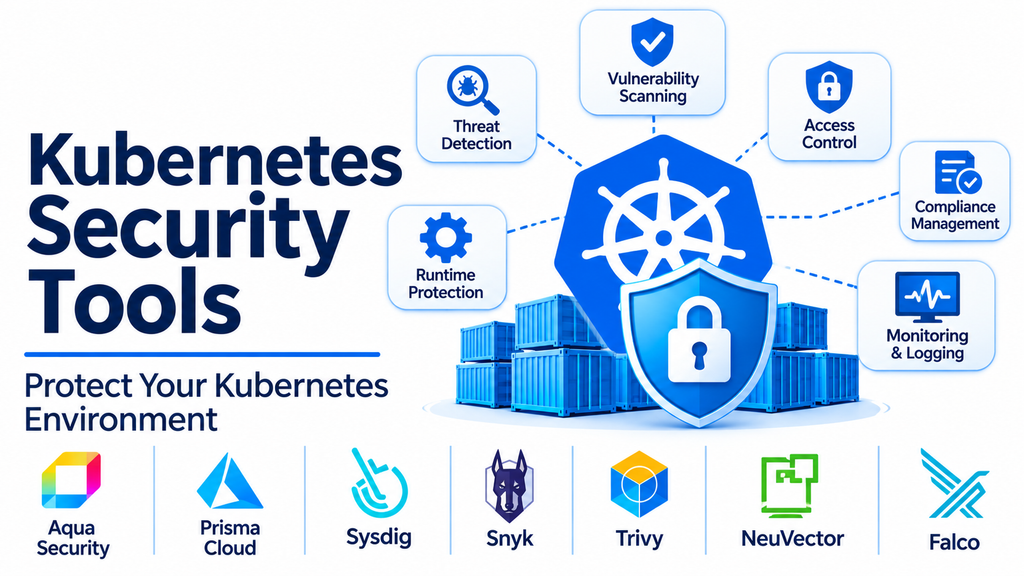
Kubernetes has become a widely adopted platform for deploying and managing containerized applications. It provides powerful capabilities for application orchestration, scaling, and infrastructure automation. However, Kubernetes environments can also introduce security risks when clusters, workloads, network configurations, and access permissions are not properly protected.
Kubernetes security tools help organizations identify vulnerabilities, detect suspicious activities, enforce security policies, and protect applications throughout their lifecycle. They provide visibility into cluster configurations, container images, runtime behavior, and user permissions.
As organizations increasingly rely on cloud-native infrastructure, implementing effective Kubernetes security practices is essential for protecting sensitive information and maintaining reliable application environments.
What Are Kubernetes Security Tools?
Kubernetes security tools are software solutions designed to identify, prevent, and manage security risks in Kubernetes clusters and containerized applications.
They help security teams and administrators protect different layers of the Kubernetes environment, including the control plane, worker nodes, container images, workloads, network connections, and application configurations.
Common capabilities include:
- Vulnerability scanning: Identify security weaknesses in container images and software dependencies.
- Configuration assessment: Detect insecure Kubernetes settings and misconfigurations.
- Runtime protection: Monitor running workloads for suspicious activities.
- Access control: Manage user permissions and enforce least-privilege policies.
- Network security: Control communication between workloads and services.
- Compliance management: Evaluate configurations against security standards and organizational policies.
- Threat detection: Identify unusual behavior and potential attacks.
- Policy enforcement: Apply consistent security rules across clusters and workloads.
Popular Kubernetes Security Tools
1. Aqua Security
Aqua Security provides cloud-native application protection capabilities for containers, Kubernetes environments, and cloud infrastructure. It helps organizations secure applications from development through production.
Key capabilities:
- Kubernetes configuration assessment.
- Container image vulnerability scanning.
- Runtime threat detection.
- Software supply chain security.
- Security policy enforcement.
- Compliance monitoring.
Best suited for: Enterprises that need security coverage across container development, deployment, and runtime environments.
2. Prisma Cloud
Prisma Cloud by Palo Alto Networks is a cloud-native security platform that provides capabilities for protecting cloud infrastructure, applications, containers, and Kubernetes environments.
It helps security teams identify risks and monitor workloads across distributed cloud environments.
Key capabilities:
- Kubernetes security posture management.
- Container image scanning.
- Cloud workload protection.
- Configuration and compliance assessments.
- Runtime threat detection.
- Cloud infrastructure security monitoring.
Best suited for: Organizations that need integrated security across cloud infrastructure and Kubernetes workloads.
3. Sysdig Secure
Sysdig Secure is a cloud-native security platform focused on container, Kubernetes, and cloud workload protection. It provides tools for identifying vulnerabilities, monitoring runtime behavior, and detecting suspicious activities.
Key capabilities:
- Kubernetes threat detection.
- Container vulnerability scanning.
- Runtime activity monitoring.
- Security investigations.
- Compliance reporting.
- Risk prioritization.
Best suited for: DevSecOps and security teams that need visibility into Kubernetes workloads and runtime threats.
4. Snyk
Snyk provides developer-focused security tools that help identify vulnerabilities in application code, open-source dependencies, container images, and infrastructure configurations.
Its Kubernetes-related security capabilities support teams that want to identify risks before applications reach production.
Key capabilities:
- Container image vulnerability scanning.
- Infrastructure-as-code security testing.
- Dependency vulnerability detection.
- Kubernetes configuration analysis.
- Developer workflow integrations.
- Remediation recommendations.
Best suited for: Development teams integrating security testing into software development and deployment pipelines.
5. Trivy
Trivy is an open-source security scanner maintained by Aqua Security. It can scan container images, file systems, repositories, and infrastructure configuration files for vulnerabilities and misconfigurations.
Key capabilities:
- Container image vulnerability scanning.
- Kubernetes configuration scanning.
- Infrastructure-as-code analysis.
- Secret detection.
- Software bill of materials generation.
- CI/CD pipeline integration.
Best suited for: Developers and DevSecOps teams looking for a flexible security scanner for cloud-native environments.
6. NeuVector
NeuVector, part of SUSE, provides security capabilities for containers and Kubernetes environments. It focuses on vulnerability management, network security, and runtime protection.
Key capabilities:
- Container and Kubernetes vulnerability scanning.
- Network traffic monitoring.
- Runtime threat detection.
- Security policy enforcement.
- Container workload protection.
- Compliance support.
Best suited for: Organizations that require integrated network and runtime security for Kubernetes infrastructure.
7. Falco
Falco is an open-source cloud-native runtime security tool designed to detect suspicious behavior in containers, Kubernetes environments, and Linux systems.
It monitors system activity and evaluates events against security rules to identify potentially harmful actions.
Key capabilities:
- Runtime threat detection.
- System call monitoring.
- Rule-based security alerts.
- Suspicious process detection.
- Container and Kubernetes activity monitoring.
- Integration with alerting and security workflows.
Best suited for: Security and platform teams that need open-source runtime threat detection.
8. Kubescape
Kubescape is an open-source Kubernetes security platform that helps organizations assess cluster configurations, identify vulnerabilities, and evaluate security posture.
It supports Kubernetes security assessments and can be integrated into development and deployment workflows.
Key capabilities:
- Kubernetes configuration scanning.
- Security posture assessment.
- Vulnerability identification.
- Compliance framework assessments.
- Risk prioritization.
- CI/CD integration.
Best suited for: Organizations looking for Kubernetes-focused security assessments and configuration analysis.
Kubernetes Security Tools Comparison
| Tool | Main strength | Best suited for |
|---|---|---|
| Aqua Security | Full-lifecycle cloud-native security | Enterprise environments |
| Prisma Cloud | Integrated cloud and Kubernetes protection | Large cloud-based organizations |
| Sysdig Secure | Runtime security and threat detection | DevSecOps teams |
| Snyk | Developer-focused security testing | Software development teams |
| Trivy | Open-source vulnerability and configuration scanning | Developers and security teams |
| NeuVector | Container network and runtime protection | Kubernetes environments |
| Falco | Runtime threat detection | Security operations teams |
| Kubescape | Kubernetes security posture assessment | Kubernetes administrators |
These platforms offer different security capabilities. Some focus on scanning and configuration assessment, while others specialize in runtime protection, network security, or broader cloud-native security management.
Important Features to Look For
Selecting a Kubernetes security tool requires evaluating how effectively it protects clusters and workloads.
1. Vulnerability Scanning
The tool should identify known vulnerabilities in container images, operating system packages, and application dependencies. Prioritization and remediation guidance can help teams address important risks.
2. Kubernetes Configuration Assessment
Security tools should identify insecure settings involving permissions, workloads, networking, API access, and cluster configurations.
3. Runtime Threat Detection
Monitoring running workloads helps identify suspicious processes, unexpected system activity, unauthorized access, and potentially harmful behavior.
4. Role-Based Access Control
Access management features help administrators assign permissions according to user responsibilities and enforce least-privilege principles.
5. Network Security
Network policies and traffic monitoring help control communication between Pods, services, and external systems.
6. Compliance Monitoring
Organizations may need to evaluate Kubernetes environments against internal security policies and recognized frameworks. Automated assessments can simplify this process.
7. CI/CD Integration
Security checks integrated into development pipelines help detect vulnerabilities and configuration problems before applications are deployed.
8. Centralized Visibility
A unified security dashboard can help teams understand risks across clusters, workloads, and infrastructure environments.
Business Applications of Kubernetes Security Tools
Kubernetes security tools support organizations across different industries and technology operations.
- Financial services: Help protect containerized applications that process financial information.
- Healthcare technology: Support security controls for applications handling confidential information.
- E-commerce: Help protect online services, customer-facing applications, and payment infrastructure.
- SaaS platforms: Improve visibility and security across cloud-native application environments.
- Enterprise IT: Enforce consistent security policies across Kubernetes clusters.
- DevSecOps: Integrate automated security testing into software delivery processes.
- Cloud infrastructure: Detect risks and protect workloads distributed across cloud environments.
Kubernetes Security vs. Container Security
Kubernetes security and container security are closely connected, but they address different parts of the technology environment.
Container security focuses on protecting container images, dependencies, runtime processes, and container configurations.
Kubernetes security extends protection to the orchestration platform itself. It includes cluster access, API server security, role-based permissions, network policies, workload configurations, and control plane protection.
For example, a container image may be free from known vulnerabilities but still be deployed with excessive privileges inside a Kubernetes cluster. Kubernetes security controls help identify and reduce this type of risk.
A comprehensive security strategy should address both container and Kubernetes security.
Common Kubernetes Security Challenges
Organizations managing Kubernetes environments may encounter several security challenges.
- Misconfigured permissions: Excessive privileges can allow unauthorized users or workloads to access sensitive resources.
- Vulnerable container images: Outdated software packages can expose applications to known vulnerabilities.
- Exposed secrets: Credentials and API keys may be accidentally included in configuration files or container images.
- Insecure network policies: Unrestricted communication between workloads can increase the attack surface.
- Runtime threats: Malicious processes and unexpected activities may occur after deployment.
- Supply chain risks: Untrusted images and compromised dependencies can introduce security problems.
- Compliance complexity: Maintaining consistent security configurations across multiple clusters can be difficult.
Organizations can reduce these risks through regular security assessments, automated scanning, strong access controls, trusted image sources, and continuous runtime monitoring.
How to Choose the Right Kubernetes Security Tool
Before selecting a security platform, evaluate the organization’s infrastructure and protection requirements.
- Assess your Kubernetes environment: Identify the number of clusters, deployment platforms, and container technologies in use.
- Identify security priorities: Decide whether vulnerability scanning, runtime protection, configuration assessment, or compliance is most important.
- Review integration options: Check compatibility with CI/CD pipelines, container registries, cloud platforms, and monitoring systems.
- Evaluate access controls: Ensure the tool supports suitable identity management and permission policies.
- Check runtime capabilities: Determine whether it can detect suspicious activities in running workloads.
- Consider scalability: Choose a solution that can support growing clusters and distributed infrastructure.
- Compare costs: Review licensing, deployment, support, and ongoing maintenance expenses.
- Run a practical evaluation: Test shortlisted tools with real Kubernetes configurations and workloads before adopting them organization-wide.
Conclusion
Kubernetes security tools play an important role in protecting modern cloud-native infrastructure. They help organizations identify vulnerabilities, secure configurations, monitor runtime activity, manage permissions, and enforce security policies.
Aqua Security, Prisma Cloud, and Sysdig Secure offer broad cloud-native protection capabilities, while Snyk and Trivy support vulnerability identification and developer security workflows. NeuVector focuses on container network and runtime protection, Falco provides runtime threat detection, and Kubescape supports Kubernetes security posture assessment.
The right solution depends on infrastructure complexity, security requirements, development workflows, and budget. By combining automated scanning, strong access controls, runtime monitoring, and consistent security policies, organizations can build safer and more resilient Kubernetes environments.
