Upgrade & Secure Your Future with DevOps, SRE, DevSecOps, MLOps!
We spend hours scrolling social media and waste money on things we forget, but won’t spend 30 minutes a day earning certifications that can change our lives.
Master in DevOps, SRE, DevSecOps & MLOps by DevOps School!
Learn from Guru Rajesh Kumar and double your salary in just one year.
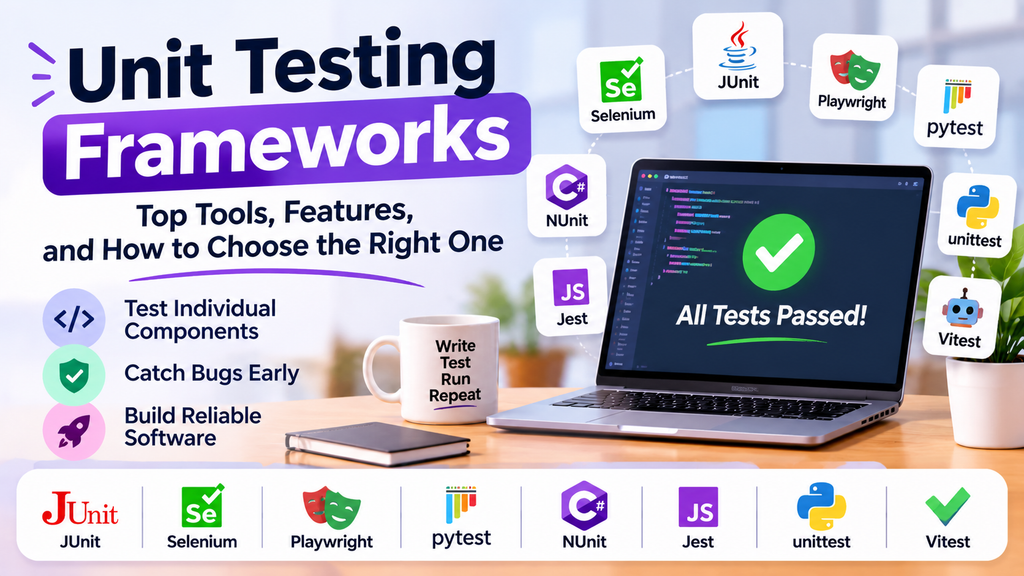
Unit testing frameworks are essential tools in modern software development. They help developers test small, isolated parts of an application and verify that each component behaves as expected. By detecting issues early, unit tests reduce debugging effort and make code changes safer.
What Are Unit Testing Frameworks?
A unit testing framework provides the structure and utilities needed to write, execute, organize, and report unit tests. Developers use assertions to compare actual results with expected outcomes and identify failures when code does not behave correctly.
Common framework features include test discovery, setup and teardown routines, assertions, test grouping, reporting, mocking support, and integration with build pipelines.
Popular Unit Testing Frameworks
1. JUnit
JUnit is a widely used testing framework for Java. It supports annotations, assertions, test lifecycle methods, and integration with Java development tools.
Best for: Java applications and JVM-based development.
2. TestNG
TestNG is a Java testing framework that supports flexible test configuration, grouping, dependencies, and parallel execution.
Best for: Java teams that need configurable test suites and execution strategies.
3. NUnit
NUnit is a unit testing framework for .NET applications. It provides attributes, assertions, parameterized tests, and integration with common .NET development workflows.
Best for: C# and .NET projects.
4. xUnit.net
xUnit.net is a testing framework for .NET that supports extensible test patterns and modern testing practices.
Best for: .NET teams that prefer a flexible, community-driven testing framework.
5. pytest
pytest is a popular Python testing framework known for concise test syntax, fixtures, parameterization, and a rich plugin ecosystem.
Best for: Python projects ranging from small libraries to larger applications.
6. unittest
unittest is included in Python’s standard library. It provides test cases, assertions, setup and teardown methods, and test discovery.
Best for: Python teams that want a built-in testing option without an additional framework dependency.
7. Jest
Jest is a JavaScript testing framework commonly used for JavaScript and front-end projects. It provides assertions, mocking features, and test reporting.
Best for: JavaScript applications and supported front-end workflows.
8. Vitest
Vitest is a modern testing framework designed to work well with Vite-based development environments. It supports fast execution, mocking, and familiar testing APIs.
Best for: Modern JavaScript and TypeScript projects using Vite.
9. Go testing package
Go includes a built-in testing package that supports test functions, benchmarks, and examples.
Best for: Go applications that benefit from native testing tools.
Unit Testing Frameworks Comparison
| Framework | Language or ecosystem | Key strength |
|---|---|---|
| JUnit | Java | Established Java testing ecosystem |
| TestNG | Java | Flexible test configuration |
| NUnit | .NET | Rich assertions and parameterized tests |
| xUnit.net | .NET | Extensible testing patterns |
| pytest | Python | Fixtures and concise syntax |
| unittest | Python | Built into the standard library |
| Jest | JavaScript | Integrated testing and mocking features |
| Vitest | JavaScript / TypeScript | Modern Vite integration |
| Go testing | Go | Native testing and benchmarking |
Key Features to Consider
When choosing a unit testing framework, evaluate the following:
- Language compatibility: Ensure it supports the programming language and runtime used by your project.
- Assertions: Check whether it provides clear ways to validate expected results.
- Fixtures and lifecycle hooks: Look for support for preparing and cleaning up test conditions.
- Mocking and isolation: Determine how dependencies can be replaced or controlled during tests.
- Parameterized tests: Consider whether the same test can run with multiple inputs.
- Reporting: Look for readable failure messages and support for machine-readable reports.
- CI/CD integration: Confirm that tests can run automatically in your build pipeline.
- Community and maintenance: Consider documentation, plugin support, and project activity.
How to Choose the Right Framework
Start with your programming language and existing development stack. Many languages already have a well-established testing option, so adopting a framework that fits your ecosystem can reduce setup and maintenance effort.
Next, consider your project’s complexity, team familiarity, reporting needs, and integration requirements. For example, pytest may suit Python teams, JUnit is a common choice for Java, and NUnit or xUnit.net may fit .NET projects.
Create a small proof of concept before standardizing on a framework. Test how easily the team can write test cases, isolate dependencies, diagnose failures, and run tests in automation pipelines.
Best Practices for Unit Testing
- Test one focused behavior at a time.
- Use clear and descriptive test names.
- Keep tests independent and repeatable.
- Cover normal inputs, edge cases, and expected error conditions.
- Use mocks or stubs when necessary to isolate external dependencies.
- Avoid tests that depend on execution order or unrelated system state.
- Run unit tests regularly during development and in CI/CD pipelines.
- Refactor test code when it becomes difficult to understand or maintain.
- Treat code coverage as a useful signal, not proof that every behavior is correct.
Common Challenges
Unit tests can become brittle when they depend heavily on implementation details, shared state, external services, or unstable test data. Poorly isolated tests may also fail for reasons unrelated to the code being tested.
Teams can address these issues by testing observable behavior, keeping tests independent, controlling dependencies, and maintaining clear test data. Regularly reviewing slow or flaky tests helps preserve confidence in the test suite.
Conclusion
Unit testing frameworks help developers validate individual software components, catch defects early, and support safer code changes. JUnit, TestNG, NUnit, xUnit.net, pytest, unittest, Jest, Vitest, and Go’s testing package offer options for different programming ecosystems.
The best framework is one that fits your language, team skills, project needs, and delivery pipeline. Combined with focused tests and consistent practices, it can become a valuable foundation for software quality.
