Upgrade & Secure Your Future with DevOps, SRE, DevSecOps, MLOps!
We spend hours scrolling social media and waste money on things we forget, but won’t spend 30 minutes a day earning certifications that can change our lives.
Master in DevOps, SRE, DevSecOps & MLOps by DevOps School!
Learn from Guru Rajesh Kumar and double your salary in just one year.
Data Security Posture Management: Finding Sensitive Data Is Only the First Step
Sensitive information rarely stays in one place. Customer records may sit in cloud object storage, employee files in collaboration platforms, application secrets in development environments, and regulated data in databases that have accumulated years of permissions and copies. Security teams can protect the infrastructure hosting these systems and still have little clarity about what sensitive data exists, who can reach it, or whether it is exposed.
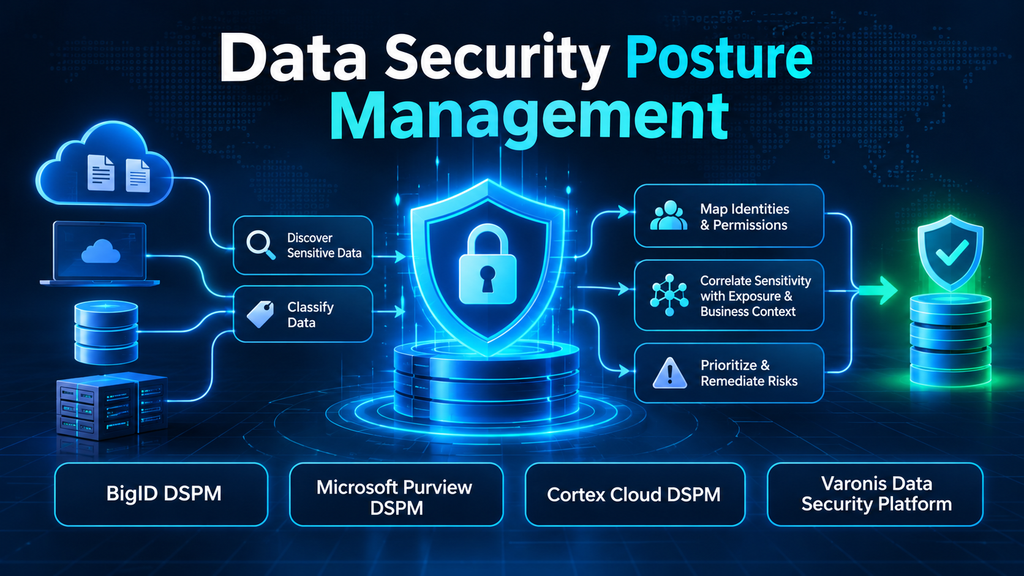
Data Security Posture Management (DSPM) addresses that gap. It gives security teams a data-centric view of risk by discovering sensitive information, classifying it, examining access and exposure, and helping organizations prioritize corrective action.
The important distinction is that discovery alone does not make data safer. A useful DSPM program must connect the data it finds to identities, permissions, business context, and remediation workflows. Otherwise, it can produce another large inventory of findings without helping teams reduce risk.
What DSPM actually does
DSPM is a security discipline and a product category focused on understanding the security posture of an organization’s data. It helps answer four practical questions:
- Where is sensitive data? Identify data across cloud storage, databases, file repositories, SaaS applications, and other connected environments.
- What kind of data is it? Classify information such as personal data, financial records, intellectual property, credentials, and regulated information.
- Who or what can access it? Connect data stores and individual records to users, groups, service accounts, applications, and permissions.
- What should be fixed first? Prioritize exposures based on sensitivity, accessibility, business importance, and the likelihood or impact of misuse.
A DSPM platform may also support policy enforcement, data access governance, activity monitoring, compliance reporting, and remediation. The exact capabilities vary considerably by vendor.
This makes DSPM different from tools that focus primarily on infrastructure configuration or network activity. A cloud security platform may identify a publicly accessible storage resource. DSPM adds the data context: whether that resource contains sensitive customer records, how much information is exposed, and which identities can access it.
Why data discovery must be connected to access and exposure
An inventory of sensitive information is useful, but it is not a complete risk assessment.
Consider a cloud storage repository containing employee identity documents. The repository may be encrypted and hosted in a correctly configured cloud account. Yet a broad internal group might still have access, an old application identity might retain permissions, or a sharing link might expose files beyond the intended audience.
A meaningful assessment needs to correlate several signals:
- Sensitivity: What information does the repository contain?
- Location: Is the data in cloud storage, a database, a SaaS application, or an on-premises system?
- Access: Which human and machine identities can read, modify, share, or export it?
- Exposure: Is the data publicly reachable, broadly shared, or accessible through unnecessary permissions?
- Activity: Is the information being accessed in expected ways?
- Business context: Does the data support a critical process, belong to a particular owner, or fall under a retention requirement?
This context helps distinguish a large but low-impact finding from a smaller exposure involving highly sensitive information.
It also explains why organizations should be cautious about treating a DSPM dashboard’s finding count as a measure of security. A platform that discovers more data may initially report more issues than a narrower scanner. The useful measure is whether the organization can identify meaningful risks, assign ownership, and reduce exposure without disrupting legitimate work.
Four DSPM platforms worth evaluating
DSPM products differ in the environments they cover, the depth of their classification, how they model access, and how closely they connect discovery to remediation. The following platforms illustrate distinct approaches. Their descriptions reflect published product capabilities, not independent performance testing.
BigID DSPM: Broad data discovery and classification
BigID DSPM focuses on discovering and classifying sensitive information across structured, unstructured, semi-structured, cloud, SaaS, hybrid, and AI-connected data environments.
Its approach is relevant to organizations that need to understand data spread across many repositories rather than concentrate on a single cloud provider. BigID describes capabilities for identifying sensitive and regulated data, connecting findings to access and business context, prioritizing risk, and supporting remediation workflows.
The platform’s wider data-security portfolio also includes capabilities related to access governance, data lifecycle management, data loss prevention, and AI security. This can be useful when a DSPM deployment is part of a broader effort to govern how sensitive information is stored, used, retained, and shared.
Where it may fit: Enterprises with diverse data estates, complex classification requirements, and a need to connect discovery with governance and remediation.
What to validate: Confirm that the specific repositories, data formats, and cloud or SaaS services in scope are supported at the required depth. Test classification accuracy against representative organizational data, including unusual internal formats and business-specific terminology. Broad discovery coverage does not automatically guarantee equally deep analysis in every source.
Microsoft Purview DSPM: Data security insights within the Microsoft ecosystem
Microsoft Purview Data Security Posture Management brings together insights from Microsoft Purview capabilities to provide a centralized view of data security posture. Microsoft’s documentation describes analytics, trends, recommendations, and connections to controls such as Data Loss Prevention and Insider Risk Management.
This approach is particularly relevant to organizations already using Microsoft 365 and the broader Microsoft security and compliance ecosystem. Security teams can use Purview’s data-related signals alongside existing governance and protection workflows rather than treating DSPM as an entirely separate operational environment.
Microsoft also describes the use of Security Copilot-based investigation experiences within its DSPM deployment guidance. The precise features available should be checked against the organization’s licensing, configuration, and deployment requirements.
Where it may fit: Organizations with substantial Microsoft 365 and Microsoft Purview adoption that want data security insights connected to existing compliance, DLP, and insider-risk processes.
What to validate: Map the actual data estate before assuming that Microsoft-centric visibility covers every repository. Confirm licensing, supported workloads, required configuration, and the extent to which non-Microsoft cloud and SaaS data sources can be assessed.
Cortex Cloud DSPM: Data risk in cloud and AI environments
Palo Alto Networks Cortex Cloud DSPM emphasizes data discovery, classification, exposure analysis, and risk prioritization across cloud and AI environments.
Palo Alto Networks describes capabilities for identifying sensitive information, analyzing data access patterns and cross-account permissions, and connecting data risks with compliance and threat detection. Its published material also discusses visibility across cloud, SaaS, on-premises, and AI deployments.
This makes the product relevant to teams that want to evaluate data exposure as part of a wider cloud security and security operations program. The relationship between data posture, cloud identity permissions, and detection can be important when investigating whether a sensitive data store is merely misconfigured or is also being accessed in suspicious ways.
Where it may fit: Organizations already investing in Palo Alto Networks cloud security and security operations technologies, particularly those seeking to connect cloud data exposure with broader risk and threat workflows.
What to validate: Examine the supported data sources and the depth of coverage for each environment. Determine how findings are correlated with identity permissions, how remediation is carried out, and which capabilities depend on other Cortex Cloud components or subscriptions.
Varonis Data Security Platform: Access intelligence and data activity
Varonis DSPM combines data discovery and classification with access intelligence, activity monitoring, and data risk remediation.
A central part of its approach is understanding who can access sensitive information and how that access is granted. Varonis describes analysis of permissions, group memberships, sharing links, and other access paths, along with monitoring of data activity and detection of unusual behavior.
This is important in environments where excessive access is a major concern. A repository may not be publicly exposed, yet still be accessible to far more employees, groups, or service identities than its business purpose requires. Access intelligence can help security teams identify these conditions and assess whether permissions should be reduced.
Varonis also describes integration with Microsoft Purview for applying labels and enforcing DLP policies. Organizations should confirm the exact integration scope and licensing for their intended deployment.
Where it may fit: Organizations that need detailed visibility into data access, excessive permissions, data activity, and remediation across supported cloud and on-premises environments.
What to validate: Check the exact repositories and platforms covered, the level of access detail available for each source, and how remediation is controlled. Automated permission changes should be tested carefully to avoid interrupting business processes.
Comparing the platforms by operational focus
| Platform | Main emphasis | Potentially suitable environment | Important evaluation point |
|---|---|---|---|
| BigID DSPM | Broad discovery, classification, governance, and remediation | Diverse enterprise data estates | Validate source coverage and classification quality |
| Microsoft Purview DSPM | Centralized data security insights and Microsoft security workflows | Microsoft-heavy organizations | Confirm licensing and non-Microsoft coverage |
| Cortex Cloud DSPM | Cloud and AI data risk, access analysis, and threat context | Cloud-focused security operations | Validate integrations and component dependencies |
| Varonis Data Security Platform | Data access intelligence, activity monitoring, and remediation | Environments with complex permissions and file access | Test access visibility and remediation safety |
This comparison is intended to identify evaluation priorities, not declare a universal winner. Product capabilities, packaging, and supported integrations can change. Buyers should verify current documentation and test the features included in the proposed subscription.
How DSPM fits alongside CSPM, DLP, and data governance
DSPM is often discussed alongside other security disciplines. They overlap, but they do not solve exactly the same problem.
DSPM and CSPM
Cloud Security Posture Management (CSPM) focuses on cloud infrastructure configuration and posture. It identifies conditions such as insecure storage settings, exposed services, and configuration weaknesses.
DSPM focuses on the data within those environments: what is sensitive, where it resides, who can access it, and how it is exposed.
The two disciplines complement each other. CSPM may identify a storage configuration problem; DSPM can help establish whether the affected resource contains sensitive information and how serious the exposure is.
DSPM and Data Loss Prevention
Data Loss Prevention (DLP) focuses on detecting and controlling sensitive data movement or use. Depending on the product and deployment, it can inspect activity across endpoints, email, web traffic, cloud applications, and other channels.
DSPM supplies context that can make protection more precise. Knowing where sensitive data lives and how it is classified can help organizations design more relevant DLP policies. DLP, in turn, can enforce controls at points where data is shared, uploaded, copied, or transmitted.
DSPM and data governance
Data governance addresses ownership, quality, access responsibilities, retention, lifecycle, and appropriate use of information. DSPM is more directly concerned with security posture and exposure, although modern platforms may include governance-related capabilities.
The distinction matters operationally. A security team can identify an overexposed repository, but resolving the issue may require a data owner to determine which users genuinely need access and whether the information should still be retained.
A successful DSPM program therefore needs cooperation between security, IT, data governance, privacy, compliance, and business teams.
What to examine during a DSPM proof of concept
A proof of concept should test whether a product can reduce real data risk in the organization’s environment. A polished dashboard or a large discovery count is not enough.
1. Test discovery against known data
Select representative repositories containing different types of information: structured databases, file shares, cloud object storage, collaboration platforms, and development environments.
Include known sensitive records and examples that are difficult to classify. Compare the platform’s findings with an independently prepared sample inventory.
Measure both missed detections and false positives. A tool that flags large volumes of ordinary business content as sensitive can create unnecessary investigation work.
2. Examine permissions, not just storage locations
Ask the vendor to demonstrate how the platform identifies access through:
- Direct user permissions
- Group membership
- Inherited permissions
- Public or external sharing links
- Service accounts and application identities
- Cross-account or cross-project access paths
A simple list of users attached to a storage resource may not reveal the effective access path. The platform should make it possible to understand how a particular identity can reach sensitive data.
3. Evaluate risk prioritization
Create test cases with different combinations of sensitivity, access, exposure, and business importance.
For example, compare a highly sensitive file accessible to a small approved team with a moderately sensitive dataset available to a broad group. Ask the platform to explain why one finding should receive more attention.
Risk scores should be understandable. Teams need to know which signals contribute to a finding and what evidence supports the suggested priority.
4. Test remediation safely
Discovery and recommendations are only part of the process. Determine whether the product can support actions such as:
- Removing unnecessary access
- Restricting external sharing
- Correcting risky configurations
- Applying or recommending data labels
- Escalating findings to data owners
- Triggering workflows in existing security tools
Start with a controlled repository and a reversible change. Confirm approval requirements, audit logging, rollback options, and the ability to exclude legitimate business access.
5. Measure operational effort
A DSPM platform can introduce substantial work if it generates findings that require manual investigation. Track how long it takes to validate a finding, identify its owner, understand the access path, approve a change, and confirm remediation.
Also evaluate connector maintenance, scan scheduling, API limits, deployment permissions, and the effect of scanning on source systems.
The best technical fit is not necessarily the platform with the largest feature list. It is the one that can deliver reliable insight and manageable remediation within the organization’s operating model.
Common mistakes that weaken DSPM programs
Treating discovery as the end goal. An inventory of sensitive data is a starting point. Without access analysis, ownership, prioritization, and remediation, exposure can remain unchanged.
Assuming every connector provides equal visibility. A product may support a source without exposing every permission type, activity event, or data format. Confirm the depth of integration, not just the presence of a connector.
Automating permission changes too early. Removing access can disrupt applications, reporting, and business workflows. Begin with observation and approval-based remediation before expanding automation.
Ignoring data ownership. Security teams may identify an issue but lack the business context to determine which access is necessary. Assign accountable data owners and define an escalation process.
Using scan coverage as the only success metric. The number of repositories scanned does not show whether risk has fallen. Track exposure reduction, remediation time, excessive permissions removed, and recurring findings.
Overlooking data lifecycle. Old copies, abandoned test datasets, and unnecessary retained information can increase risk. DSPM findings should connect to retention and deletion processes where appropriate.
Questions to ask before selecting a DSPM platform
Before committing to a product, ask vendors to demonstrate the following using representative data and access patterns:
- Which cloud, SaaS, database, file-storage, and on-premises sources are supported?
- Does discovery inspect data content, metadata, or both?
- How are sensitive data types classified, and can classification rules be tuned?
- How does the platform calculate effective access across groups, inherited permissions, and sharing links?
- Can it identify machine identities and application access, not just human users?
- How are findings prioritized, and can analysts inspect the evidence behind each score?
- Which remediation actions are native, and which require integrations or separate products?
- What permissions does the connector need, and how are credentials protected?
- How are scan frequency, API limits, data residency, and platform costs handled?
- Can findings be assigned to data owners and tracked through closure?
- What audit records are retained when permissions or policies are changed?
Request a demonstration of a complete workflow: discover a sensitive dataset, identify its effective access, explain why it is risky, assign the issue, remediate it, and verify that the exposure has been reduced.
Making DSPM useful beyond the security dashboard
DSPM is most valuable when it becomes part of an ongoing data-risk process rather than a periodic scanning exercise.
Start with a clearly defined scope: important repositories, high-value data, and the teams responsible for them. Establish a baseline of sensitive-data exposure and excessive access. Agree on how findings are prioritized and who can approve changes. Then expand coverage as the organization develops confidence in the discovery and remediation process.
The right platform depends on the shape of the data estate. BigID may warrant evaluation where broad discovery and classification are central. Microsoft Purview DSPM is a natural candidate for Microsoft-oriented environments. Cortex Cloud DSPM is relevant when cloud data risk needs to connect with wider cloud security operations. Varonis deserves consideration where access intelligence and data activity are major priorities.
The decision should ultimately rest on a practical test: can the platform show what sensitive information is exposed, explain why the exposure matters, identify who can fix it, and help verify that the fix worked? If it can do that across the organization’s real data sources without creating an unmanageable operational burden, it is doing the work DSPM is meant to accomplish.
