Upgrade & Secure Your Future with DevOps, SRE, DevSecOps, MLOps!
We spend hours scrolling social media and waste money on things we forget, but won’t spend 30 minutes a day earning certifications that can change our lives.
Master in DevOps, SRE, DevSecOps & MLOps by DevOps School!
Learn from Guru Rajesh Kumar and double your salary in just one year.
Introduction
Employees are often the first people to encounter a cyberattack—and sometimes the last opportunity an organization has to prevent it from becoming an incident. A convincing phishing email, fraudulent payment request, malicious attachment, or impersonation call can bypass technical defenses by exploiting trust, urgency, and routine business behavior.
Security awareness training platforms help organizations address this human dimension of cybersecurity. They provide structured education, simulated attacks, targeted reinforcement, and reporting capabilities that help employees recognize threats and respond appropriately.
However, effective security awareness is not achieved by assigning an annual course and measuring completion. Modern programs need to adapt to changing attack techniques, employee roles, organizational risk, and real-world behavior.
The objective is to build a workforce that can recognize suspicious activity, make safer decisions, and report potential threats quickly.
What Are Security Awareness Training Platforms?
Security awareness training platforms are software solutions designed to educate employees about cybersecurity risks and improve their ability to respond to threats.
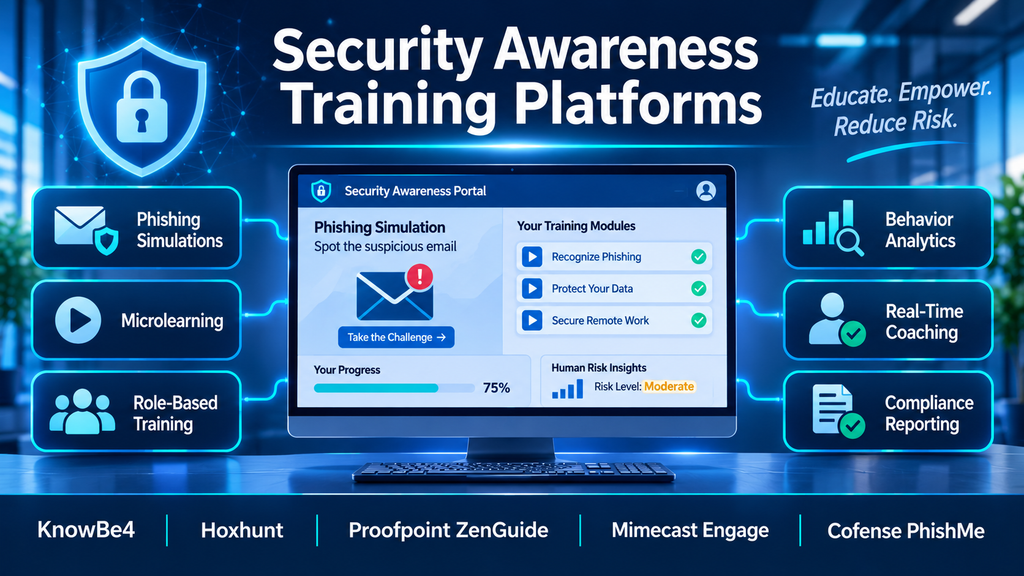
They provide a centralized environment for creating, assigning, delivering, and measuring security education. Many platforms also include phishing simulations, automated campaigns, behavioral analytics, and employee reporting mechanisms.
Common capabilities include:
- Training libraries containing videos, courses, quizzes, and interactive lessons.
- Simulated phishing campaigns and other social engineering exercises.
- Role-based learning paths.
- Automated training assignments and reminders.
- Employee reporting tools for suspicious messages.
- Risk scoring and behavioral analytics.
- Compliance-oriented completion records and reports.
- Integration with email, identity, HR, and security systems.
The most useful platforms connect learning with observable behavior rather than treating training as a standalone administrative exercise.
Why Organizations Need Security Awareness Training
Cybersecurity incidents frequently involve human interaction, whether through stolen credentials, fraudulent requests, unsafe file handling, or manipulation of employees.
Security awareness programs help address several recurring challenges.
1. Phishing and social engineering
Attackers use deceptive emails, messages, websites, QR codes, and phone calls to persuade employees to reveal information or perform unsafe actions.
Training helps employees identify suspicious senders, unexpected requests, unusual links, and attempts to create urgency.
2. Business email compromise
Business email compromise can involve impersonating executives, suppliers, customers, or finance personnel.
Employees need clear procedures for verifying payment changes, sensitive requests, and unusual instructions through trusted communication channels.
3. Credential theft
Fake login pages and credential-harvesting campaigns attempt to capture passwords, authentication codes, or session information.
Training should explain how to verify authentication prompts, recognize suspicious login pages, and report unexpected MFA requests.
4. Data protection
Employees routinely handle confidential information, customer records, intellectual property, and business documents.
Awareness programs reinforce appropriate data classification, sharing, storage, and disposal practices.
5. Remote and hybrid work
Distributed workforces face risks involving personal devices, unsecured networks, collaboration applications, and cloud-based file sharing.
Training should address the specific tools and working practices employees use.
Core Features of Security Awareness Training Platforms
Training content libraries
A content library provides reusable educational material covering common cybersecurity topics.
Useful subjects include:
- Phishing and email security.
- Password and authentication security.
- Business email compromise.
- Ransomware awareness.
- Data privacy and protection.
- Safe internet browsing.
- Remote-work security.
- Social engineering.
- Physical security.
- Generative AI and deepfake awareness.
Content should be concise, current, accessible, and relevant to the workforce.
Phishing simulation
Phishing simulations send controlled test messages to employees to evaluate how they respond to realistic scenarios.
Depending on the platform, simulations can include malicious-looking links, attachments, QR codes, SMS messages, or voice-based scenarios.
A useful simulation program measures more than clicks. It should also recognize employees who report suspicious messages and identify recurring training needs.
Role-based learning
Different employees face different threats.
Finance teams may need training on payment fraud and supplier impersonation. Developers may need secure coding and secret-handling education. Executives may face targeted impersonation attempts, while IT administrators require additional guidance on privileged access.
Role-based learning makes training more relevant and helps prioritize higher-risk activities.
Automated training campaigns
Automation helps administrators assign courses, schedule simulations, send reminders, and initiate follow-up training.
For example, an employee who repeatedly interacts with simulated phishing messages might receive a targeted learning module rather than another generic course.
Employee reporting tools
Employees should have a simple way to report suspicious emails and other potential threats.
Reporting buttons and connected workflows can help security teams collect suspicious messages, investigate them, and identify campaigns affecting multiple users.
Behavioral analytics and risk reporting
Analytics help administrators evaluate program performance over time.
Useful measurements include training completion, phishing reporting behavior, repeat simulation outcomes, time to report, and changes across departments.
Risk scores can provide an additional view, but organizations should understand how each vendor calculates them before relying on the results.
Compliance reporting
Organizations may need to demonstrate that employees received required training and completed relevant assessments.
Platforms should preserve assignment records, completion evidence, campaign history, and exportable reports.
Leading Security Awareness Training Platforms
1. KnowBe4 Security Awareness Training
KnowBe4 provides a broad security awareness platform combining training content, simulated phishing, automated learning, and reporting.
Its capabilities include a large training library, phishing and vishing simulations, personalized training, and risk-oriented analytics. Its AI-native approach adds automated program management and contextual coaching capabilities.
Organizations can use the platform to create recurring awareness campaigns and identify groups that need additional reinforcement.
Best suited for: Organizations seeking a broad training library, phishing simulation capabilities, and configurable awareness programs.
2. Hoxhunt
Hoxhunt focuses on adaptive, personalized security awareness training and behavior change.
Its platform combines phishing simulations, gamified learning, role-based training, and behavioral insights. Hoxhunt also provides tools for generating and customizing training content using organizational policies and existing materials.
Its approach is designed to make learning more relevant to individual employees rather than relying exclusively on fixed training schedules.
Best suited for: Organizations prioritizing employee engagement, adaptive learning, and personalized training experiences.
3. Proofpoint ZenGuide
Proofpoint ZenGuide combines security education with human-risk insights and adaptive learning.
The platform supports personalized learning paths, phishing simulations, assessments, and targeted interventions. Its relationship with Proofpoint’s broader threat and people-risk capabilities can help organizations connect employee education with observed exposure.
For organizations already using Proofpoint security products, the integration may help align awareness activities with wider security operations.
Best suited for: Organizations seeking risk-informed training and alignment with the Proofpoint security ecosystem.
4. Mimecast Engage
Mimecast Engage is a security behavior management solution that combines training, phishing simulations, and human-risk visibility.
Its Human Risk Command Center helps organizations bring together behavior-related signals and identify areas requiring intervention. Engage Core and Engage Pro offer different levels of training and adaptive behavior-management capabilities.
The platform also supports targeted learning and behavioral nudges through supported communication channels.
Best suited for: Organizations seeking security awareness and behavior management connected to a broader security ecosystem.
5. Cofense PhishMe
Cofense PhishMe focuses on phishing readiness, employee reporting, and threat-informed awareness training.
Its approach uses realistic phishing simulations and educational content to help employees recognize and report suspicious messages. Cofense also connects awareness activities with its broader phishing detection and response capabilities.
This can be particularly relevant for organizations that want to improve the quality and speed of employee threat reporting.
Best suited for: Organizations emphasizing phishing simulations, employee reporting, and phishing response workflows.
Security Awareness Training Platform Comparison
| Platform | Key strengths | Potential fit |
|---|---|---|
| KnowBe4 | Broad content library, simulations, automation, risk reporting | Broad enterprise and midmarket programs |
| Hoxhunt | Adaptive learning, gamification, personalized training | Engagement-focused programs |
| Proofpoint ZenGuide | Human-risk insights, adaptive pathways, targeted interventions | Proofpoint-oriented environments |
| Mimecast Engage | Training, phishing simulations, risk visibility, behavioral nudges | Mimecast-oriented environments |
| Cofense PhishMe | Phishing simulations, employee reporting, threat-informed education | Phishing readiness and response |
This comparison highlights general product positioning rather than a universal ranking. Feature availability, licensing, integrations, and packaging should be validated with vendors.
How to Measure Security Awareness Effectiveness
Training completion is useful for tracking administration, but it does not prove that employees can recognize or respond to real threats.
Organizations should evaluate a combination of learning and behavioral indicators.
Phishing reporting rate
Measure how frequently employees report simulated and genuine suspicious messages.
A rising reporting rate can indicate improved awareness, although the quality of reports and the volume of campaigns also matter.
Simulation outcomes
Track interactions with simulated messages, including clicks, attachment openings, credential-submission attempts, and reporting actions.
Interpret these results in context. Simulation difficulty and campaign design can materially affect outcomes.
Time to report
Measure how quickly employees report suspicious messages after receiving them.
Faster reporting can give security teams more time to investigate and contain a campaign.
Repeat behavior
Evaluate whether employees repeat the same risky action after receiving feedback or targeted training.
This can help identify where existing education is not sufficiently effective.
Training completion and assessment results
Track course completion, quiz performance, and knowledge retention.
Assessments should test practical understanding rather than simply reward memorization.
Department-level trends
Compare outcomes across roles, departments, locations, and business units to identify where additional support may be needed.
Avoid using a single employee score as a complete measure of security competence.
Common Implementation Challenges
Treating training as an annual event
An annual course may satisfy a minimum requirement, but it rarely provides enough reinforcement for a changing threat landscape.
A continuous program should combine short lessons, realistic simulations, and timely feedback.
Using generic content for every employee
A finance employee, software developer, and executive do not face identical threats.
Training should reflect relevant responsibilities and access privileges.
Creating unrealistic phishing simulations
Simulations that are obviously fake provide little insight. Conversely, overly aggressive exercises can damage employee trust.
Use realistic but controlled scenarios, communicate program objectives, and provide constructive feedback.
Measuring clicks instead of positive behavior
Employees who report suspicious messages contribute directly to the organization’s defensive capability.
Reporting behavior should be recognized and measured alongside simulation susceptibility.
Ignoring accessibility and localization
Employees should be able to understand training in the languages and formats they use most effectively.
Test mobile usability, captions, screen-reader compatibility, and language support.
Overlooking employee privacy
Behavioral analytics can involve individual-level information.
Organizations should explain what is collected, how it is used, who can access it, and how long it is retained. Training programs should improve security rather than create an unnecessarily punitive monitoring culture.
How to Select the Right Security Awareness Training Platform
1. Define program objectives
Identify the threats and behaviors the organization wants to address. Objectives may include improving phishing reporting, reducing unsafe credential handling, or strengthening data protection practices.
2. Evaluate training content
Review the quality, relevance, frequency of updates, accessibility, and localization of available courses.
Ask whether administrators can create content based on internal policies and procedures.
3. Test simulation capabilities
Evaluate support for email, SMS, voice, QR codes, and other relevant attack channels.
Confirm that simulations are safe, configurable, and suitable for the organization’s workforce.
4. Review personalization and automation
Determine whether learning paths can be tailored to employee roles, behavior, and risk profiles.
Check whether campaigns, reminders, and follow-up assignments can be automated.
5. Validate reporting and analytics
Ask vendors to demonstrate how they measure training outcomes, reporting behavior, repeat susceptibility, and program trends.
Understand the methodology behind any composite risk score.
6. Assess integration requirements
Evaluate integration with:
- Microsoft 365 and Google Workspace.
- Identity providers and single sign-on.
- Human resources information systems.
- Learning management systems.
- Security information and event management platforms.
- Security orchestration and response tools.
- Email security and phishing response workflows.
7. Examine privacy and security controls
Review role-based access, data retention, encryption, audit logging, regional hosting options, and employee privacy controls.
8. Conduct a pilot
Run a controlled pilot with representative departments. Evaluate user experience, administrator workload, reporting quality, and the relevance of training content before committing to a broader rollout.
A Practical Implementation Roadmap
Phase 1: Establish a baseline
Review existing training, incident trends, phishing reporting, and workforce requirements. Define measurable program objectives.
Phase 2: Segment the workforce
Identify roles, departments, locations, and user groups that require different training approaches.
Phase 3: Configure the platform
Set up identity integration, training assignments, simulation policies, reporting workflows, and privacy controls.
Phase 4: Run a pilot
Test a limited set of campaigns and training modules. Validate employee experience, simulation quality, and reporting workflows.
Phase 5: Launch continuous learning
Introduce recurring microlearning, realistic simulations, targeted reinforcement, and accessible reporting mechanisms.
Phase 6: Measure and improve
Review trends, gather employee feedback, and adjust content and campaigns as threats and business processes evolve.
The Role of AI in Security Awareness Training
AI is changing both the threats employees face and the way organizations deliver cybersecurity education.
Attackers can use generative AI to create convincing messages, imitate writing styles, and support impersonation attempts. Voice cloning and synthetic media also make it increasingly important to verify unusual requests through trusted channels.
Training platforms can use AI to:
- Generate and customize learning content.
- Personalize training assignments.
- Create phishing simulation scenarios.
- Summarize behavioral trends.
- Provide contextual coaching.
- Help administrators identify knowledge gaps.
These capabilities require oversight. AI-generated training should be reviewed for accuracy, relevance, accessibility, and alignment with organizational policies.
Simulation controls should also prevent the collection of real employee credentials or unnecessary sensitive information.
AI should make awareness programs more responsive, not replace security professionals or organizational governance.
Conclusion
Security awareness training platforms help organizations turn cybersecurity education into an ongoing operational capability. By combining relevant learning, realistic simulations, accessible reporting, and meaningful measurement, they can strengthen employee readiness against phishing, social engineering, and other human-targeted threats.
KnowBe4, Hoxhunt, Proofpoint ZenGuide, Mimecast Engage, and Cofense PhishMe demonstrate different approaches to workforce education and human-risk reduction. The right platform depends on the organization’s threat profile, existing security stack, workforce needs, and ability to operate a continuous program.
The objective is not simply to make employees complete courses. It is to help them make safer decisions, recognize suspicious activity, and become an effective part of the organization’s defense.
