Upgrade & Secure Your Future with DevOps, SRE, DevSecOps, MLOps!
We spend hours scrolling social media and waste money on things we forget, but won’t spend 30 minutes a day earning certifications that can change our lives.
Master in DevOps, SRE, DevSecOps & MLOps by DevOps School!
Learn from Guru Rajesh Kumar and double your salary in just one year.
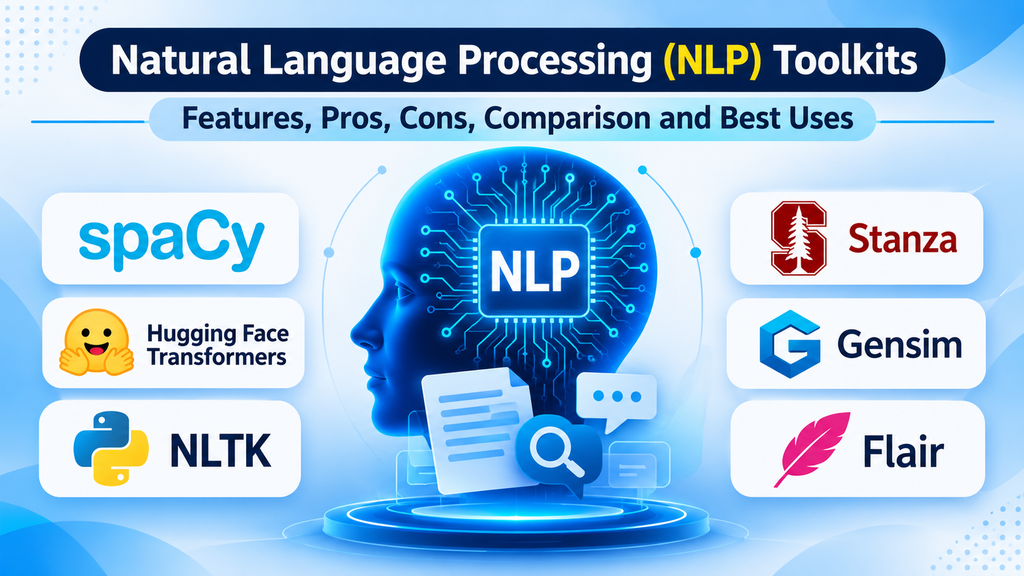
Natural Language Processing (NLP) Toolkits: Features, Pros, Cons, Comparison and Best Uses
Natural language processing (NLP) is used in applications that classify customer messages, extract information from documents, analyze feedback, power search systems, and interpret human language. Choosing the right toolkit determines how text is prepared, processed, and integrated into applications.
An NLP toolkit provides reusable components for tokenization, part-of-speech tagging, named entity recognition, sentiment analysis, text classification, dependency parsing, lemmatization, topic modeling, and text embeddings.
1. spaCy
spaCy is an open-source Python library designed for practical NLP applications. It provides structured pipelines for tokenization, grammatical tagging, dependency parsing, entity recognition, and text classification.
Key Features: Tokenization, sentence segmentation, named entity recognition, dependency parsing, lemmatization, text classification, pretrained language pipelines, and custom components.
Pros: Organized pipelines, useful for production applications, customizable, pretrained models, and strong documentation.
Cons: Models require separate installation, quality depends on the selected pipeline, and advanced customization requires technical knowledge.
Common Applications: Document processing, information extraction, customer-message classification, and text analytics.
Best For: Python developers and teams building structured NLP applications.
2. Hugging Face Transformers
Hugging Face Transformers provides access to pretrained transformer models for sentiment analysis, text classification, named entity recognition, question answering, and feature extraction.
Key Features: Pretrained models, task-specific pipelines, inference, fine-tuning, tokenizers, and integration with machine-learning frameworks.
Pros: Broad model ecosystem, modern neural NLP capabilities, fine-tuning support, and convenient inference interfaces.
Cons: Large models require substantial resources, model selection can be complex, and licensing varies between models.
Common Applications: Sentiment analysis, semantic search, question answering, document classification, and information extraction.
Best For: AI engineers and developers working with pretrained neural models.
3. Natural Language Toolkit (NLTK)
NLTK is an established Python platform for computational linguistics, education, research, and traditional NLP experimentation.
Key Features: Tokenization, stemming, tagging, parsing, classification, corpora, lexical resources, and linguistic evaluation utilities.
Pros: Excellent learning resources, traditional NLP components, access to corpora, and useful research tools.
Cons: Some workflows require manual configuration, separate resources, and additional optimization for production use.
Common Applications: Linguistic research, corpus analysis, classroom projects, and text classification experiments.
Best For: Students, educators, researchers, and developers learning traditional NLP.
4. Stanza
Stanza is a Python NLP package from the Stanford NLP Group, focused on neural linguistic analysis across many human languages.
Key Features: Tokenization, sentence segmentation, lemmatization, morphological analysis, part-of-speech tagging, dependency parsing, and named entity recognition.
Pros: Multilingual focus, neural processing pipelines, detailed linguistic annotations, and Python interface.
Cons: Language models require downloads, neural processing uses computing resources, and model availability differs across languages.
Common Applications: Multilingual document analysis, linguistic research, and grammatical annotation.
Best For: Researchers and developers working with multilingual text.
5. Stanford CoreNLP
Stanford CoreNLP is an integrated language-analysis suite providing tokenization, part-of-speech tagging, entity recognition, syntactic parsing, sentiment analysis, and coreference resolution.
Key Features: Tokenization, NER, constituency and dependency parsing, coreference resolution, sentiment analysis, and configurable annotation pipelines.
Pros: Integrated linguistic operations, configurable components, and useful sentence analysis.
Cons: Java deployment may not suit Python-first teams, configuration can be complex, and components may have specific model requirements.
Common Applications: Document analysis, linguistic research, entity extraction, and coreference resolution.
Best For: Java developers and research teams requiring integrated linguistic processing.
6. Gensim
Gensim focuses on topic modeling, document similarity, and semantic representations of text. It includes methods such as Latent Dirichlet Allocation, Latent Semantic Analysis, and word2vec.
Key Features: Topic modeling, semantic analysis, word embeddings, document similarity, streamed corpus processing, and vector-space utilities.
Pros: Specialized topic modeling, useful for large document collections, and efficient corpus workflows.
Cons: Not a complete NLP pipeline, requires preprocessing, and topic results need human interpretation.
Common Applications: Document clustering, topic discovery, research analysis, and content organization.
Best For: Researchers and analysts exploring large text collections.
7. Flair
Flair is an open-source NLP framework focused on sequence labeling and contextual text representations.
Key Features: Contextual embeddings, named entity recognition, sequence labeling, word representations, and model training support.
Pros: Contextual word representations, useful entity recognition, and support for different embedding approaches.
Cons: Specialized scope, model compatibility considerations, and a need for machine-learning expertise in some workflows.
Common Applications: Named entity recognition, sequence labeling, and information extraction.
Best For: NLP researchers and machine-learning developers working on token-level tasks.
8. TextBlob
TextBlob provides a simplified Python interface for common NLP operations, including part-of-speech tagging, noun phrase extraction, sentiment analysis, tokenization, and classification.
Key Features: Tokenization, sentiment analysis, noun phrase extraction, classification, word frequencies, lemmatization, and lexical utilities.
Pros: Simple interface, beginner-friendly, and useful for prototypes.
Cons: Limited suitability for complex production requirements, basic sentiment analysis can miss context, and specialized multilingual needs may require other models.
Common Applications: Basic sentiment analysis, educational projects, and small text-processing applications.
Best For: Beginners and developers building simple NLP prototypes.
Comparison of the NLP Toolkits
| Software | Main Specialization | Main Strength | Important Limitation |
|---|---|---|---|
| spaCy | Structured NLP pipelines | Application-oriented processing | Requires language models |
| Hugging Face Transformers | Pretrained neural models | Broad model ecosystem | Model and infrastructure complexity |
| NLTK | Traditional NLP | Linguistic learning and research | More manual production work |
| Stanza | Multilingual neural annotation | Detailed language analysis | Model and compute requirements |
| Stanford CoreNLP | Integrated linguistic processing | Configurable annotation pipeline | Java deployment complexity |
| Gensim | Topic modeling | Document-level semantic analysis | Not a general NLP pipeline |
| Flair | Contextual embeddings | Sequence labeling | Specialized scope |
| TextBlob | Simplified text analysis | Ease of use | Limited advanced capabilities |
Which NLP Toolkit Is Right for You?
For beginners and students, NLTK and TextBlob are useful starting points. For Python application developers, spaCy is a strong candidate. For pretrained neural models, consider Hugging Face Transformers. For multilingual linguistic processing, evaluate Stanza. For research and document analysis, consider NLTK, Gensim, Stanza, or Stanford CoreNLP depending on the task. For specialized sequence labeling, evaluate Flair.
Important Factors Before Choosing
Evaluate language support, accuracy, hardware requirements, integration compatibility, licensing, data privacy, maintenance, and long-term support. Test candidate tools on representative documents rather than relying on demonstrations alone.
Frequently Asked Questions
What is the most commonly used NLP toolkit? There is no universal best toolkit. spaCy, NLTK, and Transformers serve different needs.
Which is easiest to learn? TextBlob offers a simple interface, while NLTK is useful for learning traditional NLP.
Are NLP toolkits free? Many are open source, but individual models, datasets, and services may have separate licensing conditions.
Which toolkit supports multiple languages? Stanza, spaCy, and suitable Hugging Face models offer multilingual options. Verify the exact language and task.
Do NLP toolkits require a GPU? Not always. Traditional NLP can often run on CPUs, while larger neural models may benefit from GPU acceleration.
Can multiple toolkits work together? Yes. For example, spaCy can extract entities, Transformers can classify documents, and Gensim can identify topics.
Final Thoughts
spaCy is a practical choice for structured NLP pipelines, Hugging Face Transformers provides pretrained neural models, and NLTK remains useful for traditional language processing and education. Stanza supports multilingual linguistic analysis, Stanford CoreNLP offers integrated annotations, Gensim specializes in topic modeling, Flair focuses on contextual representations, and TextBlob simplifies basic text analysis.
Choose based on the task, representative test results, language coverage, licensing, infrastructure, privacy, and maintenance requirements. The strongest solution is the one that delivers dependable results without unnecessary operational complexity.
