Upgrade & Secure Your Future with DevOps, SRE, DevSecOps, MLOps!
We spend hours scrolling social media and waste money on things we forget, but won’t spend 30 minutes a day earning certifications that can change our lives.
Master in DevOps, SRE, DevSecOps & MLOps by DevOps School!
Learn from Guru Rajesh Kumar and double your salary in just one year.
Introduction
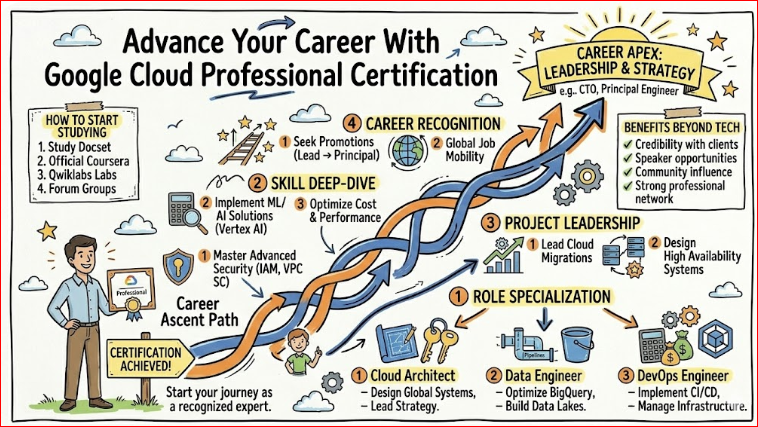
Navigating the transition from traditional infrastructure to a cloud-native ecosystem requires more than just learning new tools; it requires a fundamental shift in how we approach reliability, automation, and scale. With over two decades of experience watching the industry evolve from physical data centers to global cloud platforms, I have seen firsthand how mastering the Google Cloud ecosystem can redefine an engineer’s career trajectory. This guide is designed to provide software engineers, DevOps practitioners, and engineering managers with a clear, expert-level roadmap for the Google Cloud Professional Engineer certifications, with a deep dive into the high-demand Professional Cloud DevOps Engineer track. Whether you are aiming to implement Google’s legendary Site Reliability Engineering (SRE) principles or looking to lead large-scale digital transformations, understanding these certification paths is your first step toward building resilient, future-proof systems.
Who should take it
This path is perfect for engineers who are tired of just fixing bugs and want to start building the systems that host those applications. It is also very useful for technical managers who need to lead teams through a cloud migration and want to speak the same language as their developers. If you want to move into a leadership role or a high-level technical position, this is the right choice for you. It serves as a bridge for those moving from traditional IT roles into the modern cloud-native world.
Skills you’ll gain
- Mastering Site Reliability Engineering (SRE): You will develop a deep understanding of Google’s SRE philosophy, learning how to balance the velocity of new feature releases with the critical need for system stability using Service Level Indicators (SLIs) and Service Level Objectives (SLOs).
- Advanced CI/CD Automation: You’ll gain the expertise to build, deploy, and manage fully automated continuous integration and delivery pipelines using Cloud Build, Artifact Registry, and Cloud Deploy, ensuring that your code moves from development to production with minimal manual intervention.
- Container Orchestration with GKE: You will become proficient in managing Google Kubernetes Engine (GKE) at scale, including cluster configuration, multi-cluster deployments, and implementing advanced traffic-splitting strategies like Canary and Blue/Green rollouts.
- Infrastructure as Code (IaC): You’ll master the ability to provision and manage cloud resources programmatically using tools like Terraform and Google Cloud Deployment Manager, allowing you to create consistent, repeatable environments across development, staging, and production.
- Proactive Monitoring and Observability: You will learn to implement comprehensive monitoring, logging, and tracing using the Google Cloud Operations Suite (formerly Stackdriver), enabling you to diagnose performance bottlenecks and resolve incidents before they impact your end-users.
- Cloud Security and Compliance: You will gain the skills to implement the Principle of Least Privilege using Identity and Access Management (IAM), ensuring that your automated pipelines and cloud resources are secure, audited, and compliant with industry standards.
Real-world projects you should be able to do
- Automated Multi-Stage CI/CD Pipelines: You will be able to design and implement sophisticated pipelines using Cloud Build and Artifact Registry that automate the journey from a code commit to a production-ready container image, including automated testing and security scanning.
- Advanced Deployment Strategies: You can confidently execute high-availability deployment patterns such as Canary and Blue/Green on Google Kubernetes Engine (GKE), allowing for zero-downtime updates and the ability to instantly roll back if a new release shows issues.
- Self-Healing Infrastructure: By integrating Cloud Monitoring with Cloud Functions, you can build systems that automatically detect common production failures—like a memory leak or a full disk—and trigger automated scripts to remediate the problem without manual human intervention.
- Infrastructure as Code (IaC) at Scale: You will have the skills to manage complex, multi-environment cloud resources using Terraform or Config Connector, ensuring that your development, staging, and production environments remain perfectly synchronized and easily reproducible.
- Comprehensive SRE Dashboards: You can create advanced monitoring dashboards that track Service Level Indicators (SLIs) and Service Level Objectives (SLOs), providing the business with a clear view of the “Error Budget” and helping teams make data-driven decisions about when to slow down for stability.
Preparation Plan
- 7–14 Days (The Fast Track): If you use Google Cloud every day at work, you can probably get ready in about two weeks by focusing on the specific way Google asks questions. You should spend this time taking practice tests to get used to the format and reviewing the official documentation for any tools you don’t use daily. It is mostly about fine-tuning your existing knowledge and filling in any small gaps you might have overlooked in your daily routine.
- 30 Days (The Standard Path): For most working professionals, a one-month plan is the best way to balance your job and your studies without getting burned out. You should aim for an hour of focused study each evening, moving between watching training videos and actually doing labs in the Google console. This builds a strong foundation that helps you remember the material long after the exam is over and gives you time to digest complex topics.
- 60 Days (The Deep Dive): If you are new to the cloud or switching from a different platform, taking two months will give you the breathing room you need to truly learn. You should start by building small projects on your own to see how things like networking and storage work together in the real world. This slow and steady approach ensures you don’t just pass the test but actually become an expert who can handle real-world challenges.
Common Mistakes
Ignoring the Google SRE Books: Many candidates focus only on the technical tools like Cloud Build or GKE. However, a large portion of the exam is based on the cultural philosophy of Site Reliability Engineering (SRE), including SLIs, SLOs, and error budgets.
Over-focusing on Coding: This is an operations-heavy certification. While being able to read Python or Go is helpful, the exam tests your knowledge of deployment strategies, monitoring, and infrastructure-as-code rather than your ability to write complex application logic.
Not Practicing Identity and Access Management (IAM): Security is integrated into almost every scenario-based question. If you don’t understand how service accounts and permissions work within a pipeline, you will likely choose the wrong architecture.
Skipping Hands-on Labs: Reading the documentation provides the theory, but without spending time in the Google Cloud console, you won’t understand how services actually interact. Real-world experience with Qwiklabs or your own sandbox is essential for answering scenario-based questions.
Misunderstanding the Shared Responsibility Model: Many engineers assume Google handles everything. In reality, you are responsible for how you configure your clusters, secure your data, and manage your own deployment risks.
Best next certification after this
Same Track (Deep Technical Specialization): Professional Cloud Network Engineer This is the ideal next move if you want to master the complex “plumbing” of Google Cloud. While DevOps focuses on automation and delivery, this certification dives deep into VPC design, hybrid connectivity (Interconnect/VPN), and advanced load balancing to ensure your automated pipelines run on a high-performance, low-latency foundation.
Cross-Track (Broadening Expertise): Professional Cloud Security Engineer In an era where security is everyone’s responsibility, moving toward a “DevSecOps” profile is a smart career move. This track teaches you how to bake security directly into your CI/CD pipelines through automated scanning, identity management (IAM), and compliance as code, making you indispensable for protecting company data without slowing down deployment speed.
Leadership (Strategic Architecture): Professional Cloud Architect If your goal is to transition from “how we build” to “what we should build,” the Cloud Architect certification is the industry gold standard. It shifts the focus toward solving high-level business problems and designing large-scale system roadmaps, making it the perfect choice for senior engineers looking to move into Lead, Principal, or Engineering Manager roles.
Master Table: Google Cloud Certification Portfolio
| Track | Level | Who it’s for | Prerequisites | Skills Covered | Recommended Order |
| DevOps | Professional | Engineers/SREs | 3+ years experience | CI/CD, SRE, Monitoring | 2nd |
| Architect | Professional | Solutions Architects | Cloud Fundamentals | Design, Compliance, Security | 3rd |
| Developer | Professional | App Developers | Coding proficiency | Cloud-native apps, APIs | 2nd |
| Data | Professional | Data Engineers | SQL/ML knowledge | BigQuery, Dataflow, Pub/Sub | 2nd |
| Security | Professional | Security Engineers | Identity management | IAM, Encryption, VPC Sec | 3rd |
| Network | Professional | Network Engineers | Networking basics | Hybrid connectivity, DNS | 3rd |
Choose Your Path: 6 Specialized Learning Tracks
1. The DevOps Path
This path is all about removing the friction between writing code and running it so that the business can move much faster. You will spend your time automating every repetitive task and building systems that can deploy updates dozens of times a day without breaking. It is the perfect choice for those who love efficiency and want to eliminate manual work through code. This track helps you become the engine that drives a company’s ability to innovate quickly.
2. The DevSecOps Path
Security can no longer be something that happens at the very end; it must be built into every single step of the development process. In this track, you learn how to scan for vulnerabilities and set up guardrails that keep the system safe automatically. It is a high-demand specialty because companies are more worried about data breaches than ever before and need proactive protection. You will learn to integrate security tools directly into the deployment pipelines you build.
3. The SRE (Site Reliability Engineering) Path
Site Reliability Engineering is about applying software engineering mindsets to the problems of system operations and stability. You will focus on creating “Error Budgets” and measuring service levels to make sure the platform stays reliable for users. It is a prestigious path that was started by Google and is now used by the biggest tech companies in the world to manage scale. This track teaches you how to keep global services running smoothly under extreme pressure.
4. The AIOps/MLOps Path
As artificial intelligence becomes a part of every app, we need engineers who can manage the complex lifecycle of machine learning models. You will learn how to automate the training and deployment of these models so they stay accurate and useful over time. This is a cutting-edge field that combines traditional operations with the power of modern data science and automation. It ensures that AI systems are as reliable and scalable as any other software service.
5. The DataOps Path
This track focuses on making sure that data flows smoothly and reliably from its source to the people who need to analyze it. You will learn how to build pipelines that clean, transform, and store data using Google’s powerful big data tools like BigQuery. It is the backbone of any company that wants to make decisions based on facts rather than guesses or outdated information. Mastering this path makes you essential for building a data-driven culture.
6. The FinOps Path
Managing the cost of the cloud is a major challenge for big companies, and this path teaches you how to keep those costs under control. You will learn how to track spending, find waste, and make sure every dollar spent on the cloud is providing real value to the business. It is a unique blend of finance and technology that is becoming more important every day as cloud budgets grow. You will help bridge the gap between technical teams and the finance department.
Role → Recommended Certifications Mapping
| Current or Target Role | Recommended Google Cloud Certification Path |
| DevOps Engineer | Associate Cloud Engineer $\rightarrow$ Professional Cloud DevOps Engineer |
| Site Reliability Engineer (SRE) | Professional Cloud DevOps Engineer $\rightarrow$ Professional Cloud Architect |
| Platform Engineer | Professional Cloud DevOps Engineer $\rightarrow$ Professional Cloud Network Engineer |
| Cloud Engineer | Associate Cloud Engineer $\rightarrow$ Professional Cloud Developer |
| Security Engineer | Associate Cloud Engineer $\rightarrow$ Professional Cloud Security Engineer |
| Data Engineer | Professional Data Engineer $\rightarrow$ Professional Database Engineer |
| FinOps Practitioner | Associate Cloud Engineer $\rightarrow$ Professional Cloud Architect |
| Engineering Manager | Digital Cloud Leader $\rightarrow$ Professional Cloud Architect |
Next Certifications to Take
- Same Track (Deepening): Taking the Professional Security Engineer exam allows you to go much deeper into the safety of the infrastructure you are already building. It complements your engineering skills by giving you the tools to defend against advanced threats and maintain strict compliance standards. This makes you a specialist who can handle both the building and the protecting of modern cloud systems. It is the best way to become the go-to person for secure cloud deployments.
- Cross-Track (Broadening): Moving into the Professional Data Engineer certification helps you understand the lifeblood of modern applications, which is the data they produce every day. By learning how to manage data at scale, you become much more useful to teams that rely on deep analytics to drive their business. It expands your horizon beyond just managing the servers and into the actual value that the applications create for users. This makes you a more versatile engineer in a data-driven world.
- Leadership (Growth): The Professional Cloud Architect is the gold standard for those who want to move into high-level design and organizational decision-making roles. It teaches you how to look at a complex business problem and design a complete cloud solution that meets all technical and financial requirements. This is often the final step for experienced engineers who want to become Lead Architects or even move into executive technology roles. It gives you the big-picture view needed to lead large teams.
Top Training Institutions for Google Cloud
- DevOpsSchool: This institution is a leader in providing deep, hands-on technical training that goes far beyond just passing an exam. Their courses are designed by people who have spent years in the field, so you get real-world insights and practical skills that you can use immediately. They offer excellent support to help you understand difficult concepts and clear your certification with total confidence on your first try. It is a top choice for those who want a complete learning experience.
- Cotocus: They focus on providing specialized training that is tailored to the needs of modern IT professionals and large corporate teams. Their approach is very practical, ensuring that you don’t just learn the theory but also know exactly how to apply it in a real-world job. They are a great choice if you want to see how cloud tools work in a professional business environment and learn industry best practices. Their modules are built to bridge the gap between learning and doing.
- Scmgalaxy: This platform has built a massive community of engineers who share knowledge, tutorials, and blogs about the latest in cloud and DevOps technology. Their training programs are grounded in this community experience, making them very relevant to the daily challenges engineers face today. It is a fantastic place to learn if you want to stay connected with the pulse of the industry and learn from other experts. They provide a wealth of resources that keep you updated.
- BestDevOps: They offer intensive bootcamps that are specifically designed to take you from a beginner to a professional in a short amount of time. Their curriculum is highly focused on the most important skills that hiring managers are looking for in today’s competitive job market. If you want a fast-paced and high-energy learning environment that gets you results quickly, this is a top-tier option for your career growth. They focus on the practical skills that matter most.
- devsecopsschool.com: This is the place to go if you want to become an expert in the growing field of cloud security and automated protection. They provide specialized courses that teach you how to bake security into every layer of your Google Cloud infrastructure from the start. It is essential for any engineer who wants to protect their company from modern cyber threats and maintain data privacy. You will learn to use the latest tools to secure your pipelines.
- sreschool.com: Focused entirely on the discipline of Site Reliability Engineering, this school helps you master the art of system uptime and performance management. You will learn the exact same principles that Google uses to keep their global services running smoothly and reliably every single day. It is the best resource for anyone who wants to become a top-tier SRE professional and handle systems at a massive scale. Their training is grounded in the core SRE philosophy.
- aiopsschool.com: As AI continues to change the world, this school provides the specialized knowledge needed to manage AI systems at a massive scale. They teach you how to combine operations with machine learning to create smarter and more efficient automated systems that learn over time. It is a perfect fit for engineers who want to work on the most advanced technology projects and lead the next wave of innovation. You will master the lifecycle of AI models.
- dataopsschool.com: This school is dedicated to the professionals who manage the massive data pipelines that power modern business intelligence and analytics today. You will learn how to automate data workflows and ensure that data is always clean, secure, and ready for use by the business. It is a critical skill set for anyone working in a data-driven organization that relies on accurate information to make decisions. They focus on the efficiency of data movement.
- finopsschool.com: With cloud costs rising, this institution teaches you the vital skills of financial management and cost optimization in the cloud environment. You will learn how to bridge the gap between engineering teams and finance departments to ensure the cloud remains affordable and valuable. It is a high-value skill that helps you show the business exactly how much money you are saving them through smart technical choices. You will master the art of cloud value.
FAQs
1. How difficult is the Google Cloud Professional Cloud DevOps Engineer exam?
In my experience, it is one of the more challenging cloud exams. It’s not just about knowing where the buttons are in the console; it’s a “thinking” exam. You are presented with complex business scenarios and asked to choose the most reliable, cost-effective, and “Google-native” solution.
2. How much time do I realistically need to prepare?
If you are working full-time, I recommend 4 to 6 weeks of consistent study (about 10–12 hours a week). If you are new to Google Cloud but have a strong DevOps background, you might need closer to 8 weeks to get comfortable with the specific tools like BigQuery for billing or Cloud Build for CI/CD.
3. Are there any hard prerequisites before I can take the exam?
There are no formal requirements—Google won’t stop you from taking it on day one. However, they recommend at least 3 years of industry experience and 1 year of hands-on experience with GCP. Jumping into a Professional exam without ever touching the GCP Console is a recipe for a very stressful day.
4. What is the best sequence to take these certifications?
I always tell my mentees: start with the Associate Cloud Engineer (ACE). It builds the foundation. From there, move to the Professional Cloud DevOps Engineer. Once you have the “how” down, finish with the Professional Cloud Architect to master the “why.”
5. Is the Google Cloud certification more valuable than AWS or Azure?
Value is relative to the market. While AWS has a larger market share, GCP is growing rapidly in Data, AI, and Kubernetes-heavy environments. Because there are fewer GCP-certified engineers compared to AWS, those who hold these credentials often command higher premiums in the job market.
6. What kind of career outcomes can I expect after passing?
I’ve seen engineers move from mid-level SysAdmin roles to Senior SRE or Platform Engineering positions. In India and globally, it often leads to a 20–30% salary bump and, more importantly, puts you on the shortlist for high-impact projects involving large-scale migrations or AI infrastructure.
7. Do I need to be an expert in Kubernetes (GKE) for the DevOps exam?
Yes. You don’t need to be a developer, but you must understand how GKE handles deployments, scaling, and networking. A significant portion of the DevOps exam focuses on container orchestration and how to manage services running on Kubernetes.
8. How much does the exam cost, and is it a good investment?
The exam costs $200 USD. When you consider that this certification can be the key to a promotion or a new job with a significantly higher package, the ROI (Return on Investment) is incredibly high. Most of my students find that the certification pays for itself within the first three months of a new role.
9. Can a manager benefit from this, or is it only for “hands-on” engineers?
Managers definitely benefit. The Professional exams teach you the trade-offs of different cloud services. Understanding these trade-offs allows a manager to lead technical discussions, set realistic deadlines, and make better decisions about the company’s long-term tech stack.
10. What happens if I fail the exam?
It happens to the best of us. Google has a retake policy: you can take it again after 14 days for the second attempt. If you fail again, you have to wait 60 days. Use that time to focus on the “case study” questions, as those are usually where people lose the most points.
11. How long is the certification valid?
It is valid for two years. The cloud changes fast—two years ago, many of the current AI tools didn’t even exist! Recertifying every two years ensures that your skills remain sharp and that you are up-to-date with the latest Google Cloud innovations.
12. Is it better to focus on a single track or get multiple certifications?
Start by becoming a “T-Shaped” engineer. Get deep expertise in one track (like DevOps), then broaden your knowledge with an Architect or Security certification. In today’s market, an engineer who understands both delivery (DevOps) and design (Architecture) is a “unicorn” that every company wants to hire.
FAQs: Google Cloud Professional Engineer
1. Is this certification worth it?
Yes, it is one of the most respected certifications in the industry because it proves you have both technical and architectural skills. Companies are looking for people who can do more than just follow instructions, and this badge shows you can lead and design. It often leads to better job opportunities and a higher salary in almost any market because certified experts are rare.
2. What is the best way to start learning?
The best way to start is by getting your hands dirty in the Google Cloud console with a free tier account and exploring the tools. Try to build a simple website and see how the different parts like storage and networking talk to each other in real-time. Combining this practical experience with a structured course from a good institution is the fastest way to learn and remember the material.
3. Do I need to be an expert coder?
You don’t need to be a software developer, but you should be comfortable with basic scripting and reading configuration files like YAML or JSON. Understanding the logic of how applications work will help you design better infrastructure to support them and automate your daily tasks. As you grow in this role, you will naturally pick up the coding skills you need to build better automation.
4. How many hours should I study each day?
If you can dedicate about one to two hours a day, you will make very steady progress without feeling overwhelmed by the material. Consistency is much more important than trying to study for ten hours straight on a single weekend, as it helps you retain the knowledge better. This daily habit helps the information sink in and stay with you for the long term and the exam.
5. Can I jump straight to the Professional level?
While you can technically take any exam you want, I always recommend starting with the Associate level to build your confidence and basic cloud knowledge. Jumping straight into the Professional exam can be very difficult and frustrating if you haven’t mastered the basics of how Google Cloud works. Taking the smaller step first sets you up for much greater success and a deeper understanding in the long run.
6. How does this help my career in India?
India has a massive and growing tech sector where companies are rapidly moving their operations to Google Cloud for its advanced data and AI capabilities. Being a certified professional makes you stand out in a crowded job market and proves you have international-level skills that companies value. It is a great way to secure a position at a top multinational company or a high-growth Indian startup.
7. Is the exam more about theory or practice?
The exam is very much focused on how you would handle real-world situations and solve practical problems on the job using Google’s best practices. You will be given case studies and asked to choose the best solution based on specific cost, security, and performance requirements. This is why having actual experience with the tools and doing the labs is just as important as reading the books.
8. What happens if I fail the exam?
If you don’t pass on your first try, don’t worry—it is a very common experience given the high difficulty level of the professional exams. You can retake the exam after a short waiting period, which gives you time to study the specific areas where you struggled. Use the feedback from your first attempt to focus your efforts and you will likely pass the second time with more confidence.
Testimonials
“I was stuck in a traditional IT role and felt like my career was hitting a wall until I found this guide and started my journey. The clear path helped me understand exactly what I needed to learn to move into a modern DevOps role and grow. Now, I feel much more confident in my daily work and have a clear vision for my future growth in the industry.”
— Anil
“What I loved most was how this guide broke down the complex world of Google Cloud into simple, manageable steps that anyone can follow easily. It took the mystery out of the certification process and gave me the courage to finally take the exam after months of waiting. I am now a certified professional and my career has never looked better than it does today with my new skills.”
— Sunita
“As a manager, I was looking for a way to help my team upgrade their skills without losing focus on our current projects and deadlines. This guide provided the perfect roadmap that allowed us to learn together and move toward a more automated way of working every day. It has completely changed the way our department operates and has made us much more efficient as a team.”
— Rajesh
Conclusion
Taking the time to master Google Cloud is one of the best investments you can make in your professional life right now as the world moves to the cloud. The skills you learn will stay with you for years and open doors to opportunities you might not have even imagined yet in your current role. Start small, stay consistent with your learning, and remember that every expert was once a beginner who decided to take the first step. The future of technology is built on the cloud, and you are now ready to be a part of it.