Upgrade & Secure Your Future with DevOps, SRE, DevSecOps, MLOps!
We spend hours scrolling social media and waste money on things we forget, but won’t spend 30 minutes a day earning certifications that can change our lives.
Master in DevOps, SRE, DevSecOps & MLOps by DevOps School!
Learn from Guru Rajesh Kumar and double your salary in just one year.
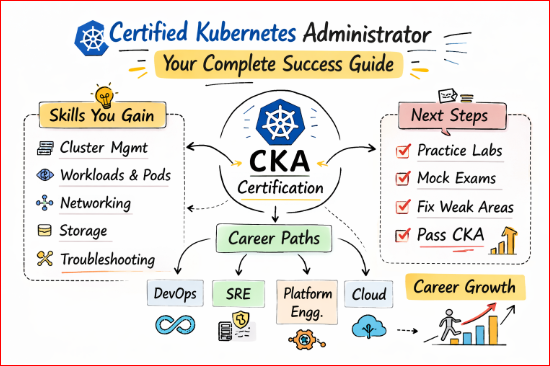
Intorduction
The Certified Kubernetes Administrator (CKA) certification is no longer just a nice-to-have; it is the ultimate proving ground for modern infrastructure engineers. While anyone can memorize flashcards to pass a multiple-choice cloud exam, the CKA drops you into a live, ticking-clock terminal environment and demands that you actively configure, secure, and rescue broken clusters. Because this 100% hands-on exam relies entirely on your technical muscle memory and real-world troubleshooting intuition, it commands unparalleled respect from hiring managers worldwide. Whether you are an experienced systems administrator pivoting to the cloud-native ecosystem, an aspiring Site Reliability Engineer looking to land a remote global role, or a software engineer determined to understand exactly how your code runs in production, this master guide will provide you with a straightforward, battle-tested roadmap to conquering the exam and using it to permanently elevate your career trajectory.
Certification Overview
Before diving into the technical weeds, here is a high-level overview of the CKA certification. This table breaks down exactly where this certification fits into your professional journey.
| Feature | Details |
|---|---|
| Track | Cloud-Native Infrastructure & Container Orchestration |
| Level | Intermediate to Advanced |
| Who it’s for | DevOps Engineers, SREs, Platform Engineers, SysAdmins, and Software Engineers |
| Prerequisites | Solid grasp of Linux command line, basic networking, and containerization fundamentals (Docker/containerd) |
| Skills covered | Cluster Architecture, Installation, Workloads, Scheduling, Services, Networking, Storage, Troubleshooting |
| Recommended order | Linux Fundamentals → Docker Basics → CKA → CKS (Security) |
| Certification Name | Certified Kubernetes Administrator (CKA) |
Deep Dive: Certified Kubernetes Administrator (CKA)
What it is
The CKA is a practical, command-line-driven exam that tests your ability to configure, manage, and troubleshoot live Kubernetes clusters. It guarantees that anyone holding the badge has the tangible, hands-on skills required to act as a Kubernetes administrator in a production environment.
Who should take it
This certification is essential for working engineers who touch infrastructure. If your title includes DevOps, Site Reliability Engineer (SRE), Cloud Engineer, or Platform Engineer, this is practically mandatory. It is also highly recommended for Software Engineers who want to understand how their containerized code behaves in production, as well as Engineering Managers who need a deep technical understanding to guide their teams effectively.
Skills you’ll gain
- Cluster Bootstrap & Upgrades: Safely installing clusters using
kubeadmand performing zero-downtime version upgrades. - Advanced Workload Scheduling: Managing how pods are assigned to nodes using node affinity, taints, and tolerations.
- Networking Mastery: Configuring cluster networking, CoreDNS, Ingress resources, and restrictive Network Policies.
- Storage Provisioning: Attaching persistent storage to applications using Persistent Volumes (PV) and Persistent Volume Claims (PVC).
- Rapid Troubleshooting: Diagnosing application failures, fixing broken control planes, and recovering crashed worker nodes.
Real-world projects you should be able to do after it
- Build a highly available, multi-node Kubernetes cluster from scratch without relying on managed cloud services like EKS or GKE.
- Implement a comprehensive disaster recovery plan, including backing up and restoring the
etcdkey-value store. - Migrate a legacy, stateful database application into Kubernetes using StatefulSets and dynamic volume provisioning.
- Secure a multi-tenant cluster by writing strict Role-Based Access Control (RBAC) rules to isolate different engineering teams.
- Debug a major production incident by systematically checking node metrics,
kubeletlogs, and application events to find the root cause.
Preparation Plan
The 7–14 Days Path (The Sprint)
Designed for seasoned engineers who already administer Kubernetes clusters daily.
- Days 1–3: Review the exam syllabus. Pinpoint areas you rarely touch in your day job (often
kubeadmupgrades or manualetcdbackups). - Days 4–9: Drill imperative commands. You must be able to generate YAML manifests instantly using
kubectl runandkubectl create --dry-run=client -o yaml. - Days 10–14: Run timed mock exams. Get comfortable using the official Kubernetes documentation search feature, as this is the only resource allowed during the test.
The 30 Days Path (The Focused Grind)
Designed for software engineers with strong Docker skills but limited cluster management experience.
- Week 1: Master the core primitives: Pods, ReplicaSets, Deployments, and Namespaces.
- Week 2: Dive into configuration management. Practice creating ConfigMaps, Secrets, Service Accounts, and defining resource limits.
- Week 3: Focus on cluster architecture. Build clusters using
kubeadm, practice upgrading control planes, and learn to back upetcd. - Week 4: Dedicate this entire week to networking and troubleshooting. Break a cluster on purpose and fix it. Take multiple practice exams.
The 60 Days Path (The Deep Foundation)
Designed for traditional SysAdmins or juniors transitioning into cloud-native roles.
- Weeks 1–2: Strengthen your prerequisites. Review Linux systemd, advanced networking, and how container runtimes work under the hood.
- Weeks 3–4: Set up a local playground using Minikube or kind. Deploy simple web applications and learn how Services expose them.
- Weeks 5–6: Move into advanced state management. Learn how Persistent Volumes work. Understand how Ingress controllers route external traffic.
- Weeks 7–8: Intensive lab practice. Focus heavily on RBAC, Network Policies, and troubleshooting broken nodes. Simulate the 2-hour exam environment repeatedly.
Common mistakes
- Writing YAML from scratch: Typing YAML manually leads to syntax errors and wastes massive amounts of time. Always use imperative commands to generate base templates.
- Getting stuck on low-weight questions: The exam grades questions by weight (e.g., 4% vs. 8%). Do not spend 20 minutes debugging a 4% question while ignoring easy, high-value tasks.
- Working in the wrong context: The exam uses multiple clusters. If you forget to run the provided context-switching command before starting a task, you will receive zero points, even if your answer is perfect.
- Ignoring the
kube-systemnamespace: When a cluster is failing, the problem is often a crashed CoreDNS or weave-net pod. Always check the system components first.
Best next certification after this
Once you pass the CKA, the natural progression is the Certified Kubernetes Security Specialist (CKS). It uses the CKA as a foundation and dives deep into securing the software supply chain, hardening clusters, and defending against runtime threats.
Choose Your Path
Kubernetes is vast, and different engineering domains use it differently. Here is how CKA empowers you based on your chosen career path:
DevOps
For a DevOps engineer, Kubernetes is the ultimate deployment target. The CKA teaches you how to structure deployment manifests, manage rolling updates, and safely roll back failed releases. You will understand how to integrate CI/CD pipelines (like Jenkins or GitLab CI) directly with the cluster API to achieve fully automated deployments.
DevSecOps
Security professionals cannot defend a system they do not understand. CKA provides the architectural baseline needed for DevSecOps. You will learn how the API server authenticates requests, how RBAC restricts user permissions, and how Network Policies act as internal firewalls between microservices. This makes you capable of locking down clusters from the inside out.
SRE (Site Reliability Engineering)
SREs are obsessed with uptime, latency, and incident response. The CKA is arguably the most valuable certification for an SRE because of its heavy focus on troubleshooting. When a node goes offline at 3:00 AM, the CKA ensures you know exactly how to SSH into the machine, read journalctl logs for the kubelet, and restore service rapidly.
AIOps / MLOps
Modern artificial intelligence and machine learning models require massive, scalable compute power. These workloads are almost exclusively containerized and run on Kubernetes. CKA empowers AIOps and MLOps engineers to manage resource quotas, schedule heavy processing pods onto GPU-enabled nodes, and scale infrastructure dynamically as training data grows.
DataOps
Managing data in a stateless environment is notoriously difficult. DataOps engineers need Kubernetes to run complex data pipelines like Apache Kafka, Spark, or Airflow. The CKA teaches you the intricacies of StatefulSets and Persistent Volumes, ensuring that your databases and message queues survive pod restarts without data loss.
FinOps
Cloud computing is expensive, and unoptimized Kubernetes clusters can drain a company’s budget overnight. A FinOps practitioner with CKA knowledge can audit clusters for wasted resources. By understanding how to implement LimitRanges, ResourceQuotas, and Horizontal Pod Autoscaling, you can dramatically reduce cloud spend without impacting application performance.
Role → Recommended Certifications Mapping
| Job Role | Step 1 (Foundation) | Step 2 (Core Competency) | Step 3 (Advanced Specialization) |
|---|---|---|---|
| DevOps Engineer | Linux Foundation Certified SysAdmin (LFCS) | Certified Kubernetes Administrator (CKA) | HashiCorp Certified: Terraform Associate |
| SRE (Site Reliability Engineer) | Certified Kubernetes Administrator (CKA) | Certified Kubernetes Security Specialist (CKS) | AWS Certified DevOps Engineer – Professional |
| Platform Engineer | Certified Kubernetes Application Developer (CKAD) | Certified Kubernetes Administrator (CKA) | Certified Kubernetes Security Specialist (CKS) |
| Cloud Engineer | AWS Certified Solutions Architect – Associate | Certified Kubernetes Administrator (CKA) | Azure Solutions Architect Expert |
| Security Engineer | CompTIA Security+ | Certified Kubernetes Administrator (CKA) | Certified Kubernetes Security Specialist (CKS) |
| Data Engineer | AWS Certified Data Analytics | Certified Kubernetes Administrator (CKA) | Confluent Certified Developer (Kafka) |
| FinOps Practitioner | FinOps Certified Practitioner (FOCP) | AWS Certified Cloud Practitioner | Certified Kubernetes Administrator (CKA) |
| Engineering Manager | Certified Kubernetes Administrator (CKA) (For tech depth) | Certified ScrumMaster (CSM) | ITIL 4 Foundation |
Next Certifications to Take
Passing the CKA is a massive achievement, but technology never stops evolving. Based on your career trajectory, here are the three best paths to take next:
1. Same Track (Deep Specialization):
Certified Kubernetes Security Specialist (CKS). If you want to remain a hands-on technical expert in the container space, this is the ultimate goal. The CKS proves you can defend Kubernetes against hackers, secure container images, and implement rigorous runtime security policies.
2. Cross-Track (Broad Architecture):
AWS Certified Solutions Architect – Professional (or Azure/GCP equivalent). Kubernetes does not exist in a vacuum; it runs on cloud infrastructure. By combining your deep container knowledge with a broad understanding of cloud networking, managed databases, and global load balancing, you become an elite Cloud Architect.
3. Leadership (Strategic Management):
FinOps Certified Professional or PMP. If your goal is to transition from configuring nodes to leading departments, you need to master business value. These certifications teach you how to align infrastructure costs with business goals, manage large-scale engineering projects, and lead agile teams effectively.
Top Institutions for CKA Training and Certification
Mastering a performance-based exam requires world-class, hands-on training. Below are the top institutions that provide excellent CKA training programs.
- DevOpsSchool
DevOpsSchool is highly respected globally for its immersive, real-world curriculum. Their instructors are veteran engineers who focus heavily on production-grade scenarios, ensuring you learn not just to pass the exam, but to actually manage clusters at an enterprise level. - Cotocus
Cotocus specializes in high-end corporate training and team upskilling. Their CKA modules are specifically designed to help traditional enterprise IT teams migrate legacy monolithic applications into modern, agile Kubernetes environments safely and efficiently. - Scmgalaxy
Scmgalaxy brings a strong community-driven approach to Kubernetes education. Their platform provides extensive, hands-on lab environments and focuses deeply on automation scripts, making it highly effective for engineers who learn best by breaking and fixing things. - BestDevOps
BestDevOps focuses strictly on the modern infrastructure stack. Their CKA training is famous for its intensive time-management drills, forcing students to rely on imperative commands and rapid documentation navigation to beat the exam’s strict clock. - devsecopsschool.com
While covering all standard CKA requirements, devsecopsschool.com injects a “security-first” mindset into every lesson. This institution is the perfect choice for engineers who plan to immediately pursue the CKS certification right after passing the CKA. - sreschool.com
Built by and for Site Reliability Engineers, sreschool.com approaches Kubernetes from a pure uptime and resilience perspective. Their labs focus heavily on cluster disaster recovery, backing upetcd, and debugging critically failed worker nodes. - aiopsschool.com
This cutting-edge institution bridges container orchestration with artificial intelligence. Their CKA curriculum highlights how to optimize Kubernetes configurations specifically for heavy data processing, MLOps pipelines, and automated, AI-driven infrastructure scaling. - dataopsschool.com
DataOpsSchool teaches Kubernetes with a heavy slant toward data persistence. Students gain mastery over Persistent Volumes, StatefulSets, and storage classes, ensuring they can reliably host databases and big data tools inside containers. - finopsschool.com
FinOpsSchool brings a much-needed financial perspective to Kubernetes. Their unique CKA training teaches engineers how to spin up clusters while aggressively implementing resource quotas, limit ranges, and autoscaling to minimize cloud billing waste.
Frequently Asked Questions (FAQs) on CKA
1. Is the CKA exam multiple-choice or practical?
The CKA is 100% practical. There are no multiple-choice questions. You are provided with a browser-based terminal connected to live clusters, and you must solve 15 to 20 real-world configuration and troubleshooting tasks.
2. How difficult is the CKA compared to AWS or Azure certs?
It is fundamentally different. Cloud certifications often test your memorization of services and architectures via multiple-choice questions. The CKA tests your muscle memory and actual terminal skills. Many find it significantly harder because you cannot guess the answer.
3. What are the strict prerequisites to take the exam?
The Linux Foundation does not require you to hold any other certifications before sitting for the CKA. However, a strong baseline in Linux administration, text editing (Vim/Nano), and container basics is practically required to succeed.
4. How much time will I have during the exam?
You have exactly 2 hours to complete all tasks. Time management is usually the biggest hurdle for candidates, which is why practicing imperative commands is universally recommended.
5. Are we allowed to use Google during the exam?
No. You are not allowed to use Google, StackOverflow, or any AI assistants. You are only permitted to open one additional browser tab to access the official Kubernetes documentation (kubernetes.io/docs) and its directly related subdomains.
6. What sequence of certifications should a beginner follow?
If you are entirely new to this space, do not start with CKA. Start with a Linux fundamentals course, followed by a Docker/Containers basics course. Once you understand containers, move on to the CKA.
7. How does the CKA impact career outcomes and salary?
Because the CKA is notoriously difficult to fake, it carries immense weight with hiring managers. It frequently serves as a gateway to Senior DevOps or SRE roles, often resulting in significant salary bumps and opportunities in remote, global tech companies.
8. What happens if I fail the exam on my first try?
The exam purchase usually includes one free retake. If you fail, you can review the domains where you scored poorly, practice those specific areas in a lab, and schedule your retake within 12 months.
9. Do I need to know how to code in Python or Go?
No programming experience is required for the CKA. However, you must be extremely comfortable reading and writing YAML files, as well as executing shell scripts and utilizing basic Linux utilities like grep and awk.
10. Will the CKA teach me how to use Helm or CI/CD tools?
No. The CKA curriculum strictly focuses on “vanilla” upstream Kubernetes architecture. Tools like Helm, Jenkins, or ArgoCD are part of the broader ecosystem but are not tested on this specific exam.
11. Does the CKA cover cloud-specific implementations like AWS EKS?
The exam is vendor-neutral. It tests your ability to build and manage clusters from scratch using kubeadm on standard Linux nodes. It does not test AWS, Azure, or GCP-specific configurations.
12. How long is the CKA certification valid?
The certification is valid for 2 years. To keep your certification active, you must pass the exam again or pass a higher-level exam (like the CKS) before your current CKA expiration date.
FAQs on Certified Kubernetes Administrator (CKA)
1. Is the CKA harder than traditional AWS or Azure cloud certifications?
It is a different kind of difficulty. Most cloud provider exams are multiple-choice and test your breadth of knowledge across dozens of services. The CKA tests your depth and execution speed. You cannot guess your way through a broken cluster; you must actually fix it in a live Linux terminal.
2. How many hours of hands-on lab practice do I actually need?
If you are relatively new to Kubernetes administration, aim for at least 50 to 60 hours of pure, hands-on terminal time. Watching video tutorials will not be enough to pass. You need to build muscle memory for typing kubectl commands and debugging YAML formatting errors under pressure.
3. Do I need to know programming languages like Python or Go to pass?
No. The CKA is an infrastructure and operations exam, not a coding test. You do not need to write software. However, you must be extremely comfortable reading and editing YAML files, as well as navigating Linux directories and text editors (like vim) via the command line.
4. Will getting a CKA immediately land me a DevOps job as a fresher?
It is a massive advantage, but it is not a magic bullet. Engineering managers love the CKA because it proves you have real, un-faked practical skills. To seal the deal, combine your CKA with a solid GitHub portfolio showing a fully deployed application using Kubernetes, Docker, and a CI/CD pipeline.
5. Does the CKA exam cover external tools like Helm, Prometheus, or Jenkins?
No. The CKA focuses strictly on vanilla, core Kubernetes components (such as etcd, kube-apiserver, and kubelet) and standard resources (Pods, Deployments, Network Policies). Third-party tools like Helm, service meshes, or external monitoring stacks are entirely outside the scope of this specific exam.
6. What is the passing score, and what happens if I fail my first attempt?
You need a score of 66% or higher to pass the CKA. The excellent news is that your initial exam registration includes one free retake. If you fail, use the diagnostic report provided by the Linux Foundation to identify your weakest domains, practice those specific areas, and try again without paying extra.
7. I just passed the CKA. Should I learn Terraform or take the CKS next?
It depends entirely on your chosen career track. If you want to specialize deeply in Kubernetes and DevSecOps, go straight for the Certified Kubernetes Security Specialist (CKS). If you want to be a generalist Platform or Cloud Engineer, mastering Infrastructure as Code (Terraform) is the better immediate next step to broaden your toolchain.
8. What is the absolute best way to manage time during the live exam?
Master imperative commands. Never write a YAML configuration file from scratch if you can avoid it. Use commands like kubectl run pod-name --image=nginx --dry-run=client -o yaml > pod.yaml to generate your base templates instantly. Also, skip low-weight questions (e.g., 4%) that seem too complex and return to them only after securing the easy points.
Testimonials
“I spent three years deploying applications to managed Kubernetes clusters, but I never truly understood what was happening under the hood. The CKA preparation forced me to learn the control plane components. Two months after getting certified, I diagnosed a complex DNS routing issue that was causing random timeouts in production. The ROI on this cert is unmatched.”
— Senior Site Reliability Engineer, Global E-Commerce Firm
“When interviewing candidates for our platform engineering team, a CKA badge immediately puts an application at the top of the pile. Multiple-choice certs show me you read a book; the CKA shows me you can actually do the job when production goes down.”
— Director of Engineering, India-based FinTech Startup
“The time pressure is the real test. My training at DevOpsSchool drilled imperative commands into my brain. During the exam, my hands were shaking on the first question, but the muscle memory took over. Passing the CKA gave me the confidence to completely redesign our CI/CD deployment strategy.”
— DevOps Consultant
Conclusion
The Certified Kubernetes Administrator (CKA) is far more than a resume booster. It is a transformative learning experience that bridges the gap between basic container usage and deep, architectural system mastery. In an industry moving rapidly toward distributed microservices, holding this certification proves you have the technical grit, the hands-on capability, and the troubleshooting intuition to keep mission-critical systems running. Whether you are charting a path toward DevSecOps, building massive data pipelines, or optimizing enterprise cloud costs, the knowledge gained from the CKA will be the foundation of your success. Set up your home lab, read the official docs, and embrace the challenge. The cloud-native world is yours to build.