Upgrade & Secure Your Future with DevOps, SRE, DevSecOps, MLOps!
We spend hours scrolling social media and waste money on things we forget, but won’t spend 30 minutes a day earning certifications that can change our lives.
Master in DevOps, SRE, DevSecOps & MLOps by DevOps School!
Learn from Guru Rajesh Kumar and double your salary in just one year.
Introduction
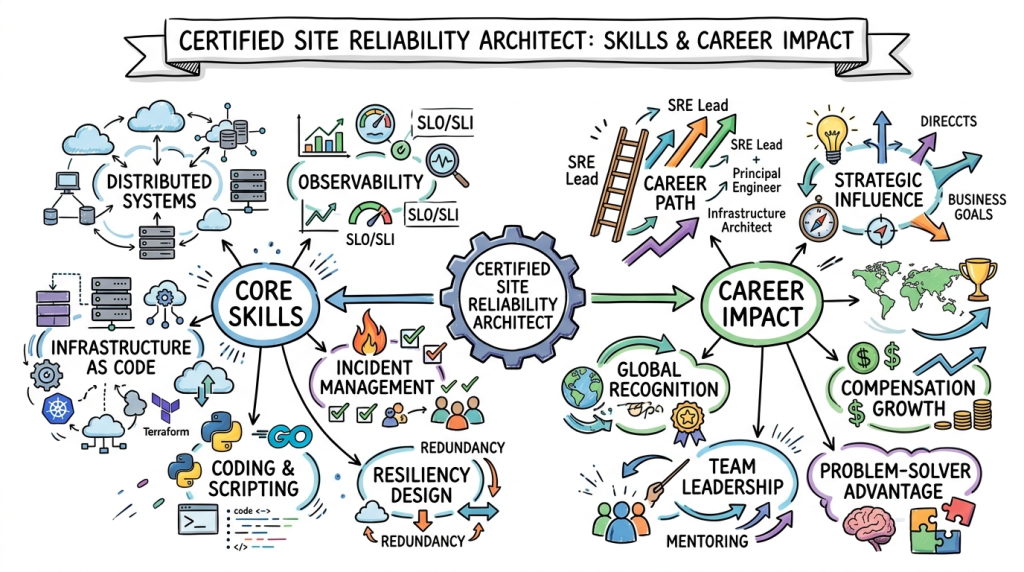
Modern software delivery demands more than just writing code; it requires a deep understanding of how systems behave under stress. The Certified Site Reliability Architect is a professional milestone designed for those who wish to master the bridge between development and operations. This guide is crafted for engineers who are looking to move beyond basic automation and into the realm of designing resilient, self-healing systems.
At Sreschool, the focus is on providing a structured path for professionals to validate their expertise in site reliability engineering. This guide matters today because the industry is shifting away from reactive troubleshooting toward proactive system design. Whether you are a cloud engineer or a technical leader, understanding the architectural requirements of reliability is essential for long-term career growth. Navigating the landscape of cloud-native engineering requires a clear roadmap, and this document serves as that blueprint. By the end of this guide, you will have a clear understanding of the certification landscape and how to align these credentials with your personal professional goals. Making informed decisions about your learning path is the first step toward becoming a principal-level contributor in the global tech ecosystem.
What is the Certified Site Reliability Architect?
The Certified Site Reliability Architect represents a shift in focus from standard operations to high-level system design. It exists to bridge the gap between theoretical SRE concepts and the actual implementation of large-scale, production-grade distributed systems. Unlike basic certifications that focus on tool-specific commands, this architect-level program emphasizes the philosophy of building for failure.
In modern engineering workflows, the architect is responsible for ensuring that reliability is not an afterthought but a core feature of the product. This certification validates an individual’s ability to design frameworks that support Service Level Objectives and Error Budgets. It is built on the reality of enterprise practices, where uptime and performance are directly tied to business revenue and user trust.
The curriculum is designed to reflect the complexities of multi-cloud and hybrid environments that most large organizations use. It provides a structured methodology for handling technical debt, managing toil, and implementing automated incident response. This is a production-focused learning experience that ensures an engineer can lead a team through the most challenging operational hurdles.
Who Should Pursue Certified Site Reliability Architect?
Software engineers who find themselves spending more time on infrastructure and scaling issues than feature development will find immense value here. Site Reliability Engineers and Platform Engineers are the primary candidates, as the curriculum directly addresses their daily challenges. It is also highly beneficial for Cloud Architects who need to ensure their designs are operationally sound and cost-effective.
Security professionals and Data Engineers are increasingly moving toward SRE-based models to manage their specific workloads. For these roles, the certification provides the operational rigor needed to manage sensitive data and secure environments at scale. Even engineering managers and technical leaders should pursue this knowledge to better understand how to resource their teams and set realistic performance targets.
In terms of career progression, this path is suitable for both mid-level engineers looking to specialize and senior professionals aiming for principal roles. The relevance is global, with high demand in tech hubs across North America, Europe, and India. As organizations in India continue to lead global digital transformation, the need for certified architects who can manage massive scale is higher than ever.
Why Certified Site Reliability Architect is Valuable
The demand for reliability expertise is not tied to a single tool or cloud provider, making this certification a long-term career investment. As enterprises adopt cloud-native technologies, the complexity of their systems increases exponentially, creating a permanent need for those who can manage that complexity. This certification helps professionals stay relevant even as specific technologies like Kubernetes or Terraform evolve.
Longevity in a technical career comes from mastering principles rather than just syntax. By focusing on the architectural side of SRE, you learn how to think about systems in a way that is applicable across different stacks and industries. This high-level perspective is what separates senior architects from junior operators, leading to better compensation and more influential roles within an organization.
Enterprise adoption of SRE principles is no longer optional for companies operating at scale. Organizations are actively looking for validated proof that an engineer can handle the responsibility of their production environments. The return on time invested in this certification is reflected in the ability to drive significant operational improvements that save companies millions in potential downtime.
Certified Site Reliability Architect Certification Overview
The program is delivered via the official portal and is hosted on the primary website of the provider. The certification is structured to move from foundational concepts to advanced architectural patterns through a series of rigorous assessments. It is designed to be a comprehensive journey that validates both knowledge and the practical application of SRE principles.
The ownership of the certification lies with an organization dedicated to the advancement of site reliability standards globally. The structure is practical, focusing on case studies and scenarios that mimic real-world outages and scaling bottlenecks. Candidates are expected to demonstrate not just what a tool does, but why a specific architectural choice is superior for reliability.
The assessment approach is designed to filter for professionals who can think critically under pressure. It covers a wide range of topics, including observability frameworks, capacity planning, and the cultural aspects of SRE such as blameless post-mortems. By maintaining a high bar for certification, the program ensures that the credential remains a prestigious marker of professional excellence.
Certified Site Reliability Architect Certification Tracks & Levels
The certification is divided into three primary levels: Foundation, Professional, and Advanced. The Foundation level focuses on the vocabulary and core metrics of SRE, ensuring everyone on a team speaks the same language. It covers the basics of SLIs, SLOs, and the concept of an Error Budget as a tool for balancing innovation and stability.
The Professional level moves into the “how” of SRE, focusing on the implementation of automation and observability stacks. This track is where engineers learn to build the tooling that supports reliable systems, such as automated deployment pipelines and self-healing infrastructure. It aligns with the mid-career stage where an engineer is expected to take ownership of specific services.
The Advanced or Architect level is where the focus shifts to broad system design and cross-team leadership. At this level, the specialization tracks allow professionals to align their SRE skills with other domains like FinOps or DevSecOps. This level is intended for those who will set the strategy for an entire engineering organization’s reliability posture.
Complete Certified Site Reliability Architect Certification Table
| Track | Level | Who it’s for | Prerequisites | Skills Covered | Recommended Order |
| Core SRE | Foundation | Junior Engineers, Managers | Basic Linux/Cloud knowledge | SLIs, SLOs, Toil Management | First |
| SRE Implementation | Professional | DevOps Engineers, SREs | Foundation Cert, Scripting | Observability, Incident Response | Second |
| SRE Architecture | Advanced | Senior SREs, Architects | Professional Cert, System Design | Distributed Systems, Capacity Planning | Third |
| Reliability Security | Specialization | Security Engineers | Professional Cert | Chaos Security, Automated Auditing | Optional |
| Reliability Finance | Specialization | FinOps Practitioners | Foundation Cert | Cost-aware Scaling, Cloud ROI | Optional |
Detailed Guide for Each Certified Site Reliability Architect Certification
Certified Site Reliability Architect – Foundation Level
What it is
This certification validates a candidate’s understanding of the fundamental principles of SRE as defined by industry leaders. It ensures that the individual understands the cultural shift required to move from traditional operations to a reliability-focused model.
Who should take it
This is ideal for junior engineers, project managers, and even seasoned developers who are new to the SRE philosophy. It serves as the baseline for anyone working in a modern cloud-native environment.
Skills you’ll gain
- Defining Service Level Indicators and Objectives.
- Understanding the math behind Error Budgets.
- Identifying and eliminating operational toil.
- Participating in blameless post-mortems.
Real-world projects you should be able to do
- Create a reliability dashboard for a microservice.
- Draft a basic incident response playbook.
- Conduct a post-mortem analysis for a minor outage.
Preparation plan
- 7–14 days: Review the core SRE handbook and official study guide.
- 30 days: Implement basic SLOs for a personal or test project.
- 60 days: Not required for this level unless the candidate is completely new to IT.
Common mistakes
- Focusing only on tools instead of the underlying philosophy.
- Confusing SLAs with SLOs during the assessment.
Best next certification after this
- Same-track option: SRE Professional
- Cross-track option: DevOps Foundation
- Leadership option: Digital Leader Certification
Certified Site Reliability Architect – Professional Level
What it is
This level validates the technical ability to implement SRE practices using automation and monitoring tools. It proves that an engineer can build the systems that keep services running smoothly.
Who should take it
Working DevOps and SRE professionals with at least two years of experience in production environments. It is the gold standard for those who manage high-traffic applications.
Skills you’ll gain
- Building advanced observability stacks with tracing and logging.
- Implementing automated canary deployments and rollbacks.
- Developing self-healing infrastructure scripts.
- Managing complex incident response lifecycles.
Real-world projects you should be able to do
- Setup a Prometheus and Grafana stack for a Kubernetes cluster.
- Automate a blue-green deployment strategy for a web app.
- Write custom exporters for legacy application metrics.
Preparation plan
- 7–14 days: Focus on practice labs and command-line proficiency.
- 30 days: Deep dive into monitoring and alerting configuration.
- 60 days: Complete a full end-to-end automation project on a cloud provider.
Common mistakes
- Underestimating the depth of the networking and protocol questions.
- Failing to account for the impact of automation on system state.
Best next certification after this
- Same-track option: Site Reliability Architect
- Cross-track option: Certified DevSecOps Professional
- Leadership option: Engineering Manager Track
Certified Site Reliability Architect – Architect Level
What it is
The highest level of validation, focusing on the design of large-scale distributed systems. It confirms that the architect can create structures that are resilient by design across multiple regions and providers.
Who should take it
Principal engineers, Lead SREs, and System Architects. Candidates should have extensive experience managing large-scale infrastructure and leading technical teams.
Skills you’ll gain
- Designing for multi-region disaster recovery.
- Architecting global load balancing and traffic management.
- Managing large-scale data consistency and reliability.
- Leading organizational change toward a reliability-first culture.
Real-world projects you should be able to do
- Design a 99.99% available architecture for a global fintech app.
- Create a multi-cloud failover strategy for a critical database.
- Audit an entire enterprise stack for reliability bottlenecks.
Preparation plan
- 7–14 days: Review complex architectural patterns and case studies.
- 30 days: Practice designing systems on a whiteboard or diagramming tool.
- 60 days: Mentor a junior team through a reliability improvement project.
Common mistakes
- Focusing on a single-cloud solution instead of being provider-agnostic.
- Ignoring the human and organizational factors of system reliability.
Best next certification after this
- Same-track option: Specialized Chaos Engineering
- Cross-track option: FinOps Certified Professional
- Leadership option: CTO/VPE Leadership Program
Choose Your Learning Path
DevOps Path
For those in the DevOps path, the focus is on the integration of SRE into the CI/CD pipeline. This journey starts with the Foundation level to understand the metrics that should govern the deployment speed. The goal is to create a feedback loop where reliability data informs the development cycle directly. Professionals here will eventually move into Platform Engineering roles where they provide reliable tools for developers.
DevSecOps Path
The DevSecOps path emphasizes that a system cannot be reliable if it is not secure. This track involves taking SRE principles and applying them to security scanning and threat response. It focuses on automating security checks so they become a standard part of the reliability checks. Engineers on this path work toward a “Security-as-Code” model where the architect ensures the infrastructure is both resilient and hardened.
SRE Path
The pure SRE path is the most direct route to the Architect certification, focusing heavily on operational excellence. It is designed for those who want to be the ultimate guardians of production environments. The path moves through all three levels of certification, building a deep expertise in automation and observability. This is the ideal route for those aiming for high-level individual contributor roles in major tech companies.
AIOps Path
The AIOps path is for engineers looking to use machine learning to manage system reliability. This involves using AI to analyze vast amounts of log and metric data to predict and prevent outages. It requires a baseline SRE knowledge followed by specialized training in data patterns and automated anomaly detection. The focus here is on reducing the time it takes to identify the root cause of complex, distributed system issues.
MLOps Path
The MLOps path focuses specifically on the reliability of machine learning models in production. This is distinct from standard software because it involves managing data drift and model performance over time. An SRE in this path ensures that the infrastructure supporting ML models is stable and that the pipelines are monitored for accuracy. It is a rapidly growing field that combines data science with rigorous operational standards.
DataOps Path
The DataOps path applies SRE principles to data pipelines and large-scale data warehouses. Reliability in this context means ensuring data integrity, low latency, and high availability of data for business intelligence. Engineers on this path focus on building resilient ETL processes and monitoring the health of data flows. The goal is to treat data pipelines with the same operational rigor as any other critical software service.
FinOps Path
The FinOps path merges financial accountability with the operational scale of SRE. It is focused on ensuring that the pursuit of reliability does not lead to uncontrolled cloud spending. Professionals on this path use SRE metrics to drive cost-efficiency, ensuring that every dollar spent on infrastructure contributes to the required level of service. It is an essential track for architects who need to justify their technical decisions to business stakeholders.
Role → Recommended Certifications
| Role | Recommended Certifications |
| DevOps Engineer | SRE Foundation, SRE Professional |
| SRE | Foundation, Professional, Architect |
| Platform Engineer | SRE Professional, Site Reliability Architect |
| Cloud Engineer | SRE Foundation, SRE Professional |
| Security Engineer | SRE Foundation, DevSecOps Professional |
| Data Engineer | SRE Foundation, DataOps Specialist |
| FinOps Practitioner | SRE Foundation, FinOps Certified |
| Engineering Manager | SRE Foundation, SRE Architect (Audit level) |
Next Certifications to Take After Certified Site Reliability Architect
Same Track Progression
After achieving the Architect level, the natural next step is to go deeper into specialized areas of reliability. This might include certifications in Chaos Engineering, where you learn to proactively inject failures into systems to test their resilience. Another option is to focus on specific high-scale technologies like Kubernetes at an expert level. Deep specialization ensures that you remain at the top of the technical hierarchy for your specific domain.
Cross-Track Expansion
Broadening your skills into adjacent fields can make you a more versatile leader. Taking a FinOps certification after SRE helps you understand the business side of cloud engineering, while a DevSecOps certification strengthens your security posture. This cross-pollination of skills is what defines a truly “T-shaped” professional who can contribute across the entire technical organization. It allows you to speak the language of different teams and bridge organizational silos.
Leadership & Management Track
For those looking to move into management, the technical foundation provided by the Architect level is invaluable. The next step would be certifications focused on technical leadership, team building, and strategic planning. Transitioning to leadership requires a shift from doing the work to enabling others to do the work. Having a high-level technical certification ensures you maintain the respect of your engineering teams while you manage the broader business goals.
Training & Certification Support Providers for Certified Site Reliability Architect
DevOpsSchool
DevOpsSchool has established itself as a major hub for technical training, offering a wide array of courses that cater to the evolving needs of the industry. They provide a community-driven learning environment where students can interact with experts and peers. Their curriculum for SRE and related fields is designed to be highly practical, ensuring that learners can apply what they’ve learned to their current roles immediately. With a focus on hands-on labs and real-world scenarios, they help bridge the gap between classroom learning and production-grade engineering tasks.
Cotocus
Cotocus focuses on providing high-quality consulting and training services that are tailored to the needs of modern enterprises. They specialize in helping organizations adopt DevOps and SRE practices at scale, making them a valuable partner for both individual learners and large teams. Their training programs are often integrated with actual project work, allowing students to gain experience on live systems. This approach ensures that the knowledge gained is not just theoretical but grounded in the practical realities of managing complex infrastructure in a business environment.
Scmgalaxy
Scmgalaxy is a comprehensive resource for professionals looking to stay updated on the latest trends in software configuration management and DevOps. They offer a vast library of tutorials, articles, and training programs that cover everything from basic version control to advanced site reliability architecture. Their focus is on providing detailed technical documentation that serves as a constant reference for engineers. By fostering a culture of knowledge sharing, Scmgalaxy helps the global engineering community stay informed about the tools and methodologies that drive modern software delivery.
BestDevOps
BestDevOps focuses on the career development aspect of technical training, providing mentorship and guidance alongside their certification programs. They understand that a certification is only one part of a professional’s journey and offer support in resume building and interview preparation. Their courses are designed to highlight the skills that are currently in highest demand by top-tier tech companies. This career-centric approach makes them an excellent choice for engineers who are looking to make a significant move in their professional lives and want a partner in their growth.
devsecopsschool.com
Devsecopsschool.com is dedicated to the integration of security into the modern engineering lifecycle. They provide specialized training that teaches SREs and DevOps engineers how to automate security checks and maintain a strong defensive posture. Their curriculum is essential for anyone working in highly regulated industries or managing sensitive user data. By emphasizing that security is a shared responsibility, they help organizations build more resilient and trustworthy systems. Their courses are a vital resource for anyone looking to specialize in the intersection of reliability and security.
sreschool.com
Sreschool.com is the primary destination for those seeking to master the principles of site reliability engineering and architecture. Their programs are specifically designed around the SRE handbook and industry best practices, providing a direct path to certification. They offer a range of levels, from foundation to advanced architect, ensuring that there is a learning path for every stage of a career. The focus here is entirely on reliability, observability, and system design, making it the most specialized resource for professionals in this field.
aiopsschool.com
Aiopsschool.com addresses the growing intersection of artificial intelligence and IT operations. They provide the training necessary to implement AI-driven monitoring and automated incident response systems. As systems become more complex, the ability to use ML to manage them becomes a critical skill, and this provider is at the forefront of that transition. Their courses cover data analysis, pattern recognition, and the implementation of self-healing systems that use AI to predict potential failures before they occur, helping engineers stay ahead of the curve.
dataopsschool.com
Dataopsschool.com focuses on the reliability and efficiency of data pipelines, which are the backbone of modern business intelligence. They teach engineers how to apply SRE principles to data management, ensuring that data is accurate, available, and delivered on time. Their training covers the entire data lifecycle, from ingestion to consumption, with a focus on automation and monitoring. For SREs who find themselves managing large-scale data infrastructure, this provider offers the specialized knowledge needed to ensure those systems are as reliable as any other part of the stack.
finopsschool.com
Finopsschool.com provides the essential training for managing the financial aspects of cloud-native engineering. As cloud costs continue to rise, the ability to optimize spending without sacrificing performance or reliability has become a key requirement for senior architects. Their courses teach the methodology of cloud financial management, including cost allocation, budgeting, and optimization strategies. By linking technical decisions to financial outcomes, they help engineers become more effective contributors to their organization’s bottom line, ensuring that cloud investments deliver maximum value.
Frequently Asked Questions (General)
1. How difficult is the architect-level certification?
The architect level is significantly more challenging than the foundation or professional levels because it requires a deep understanding of system design and organizational strategy. It is not just about knowing the tools but about making complex trade-offs between speed and stability.
2. What is the average time required to prepare for these exams?
While foundation exams can be prepared for in a few weeks, the architect level often requires months of study and hands-on experience. Most candidates spend at least 60 to 90 days of focused preparation.
3. Are there any specific prerequisites for the Certified Site Reliability Architect?
Generally, candidates must hold the professional-level certification and have several years of experience in a production SRE or DevOps role. This ensures that the candidate has the practical background needed for advanced architectural topics.
4. What is the return on investment for this certification?
Professionals with this certification often see significant salary increases and access to higher-level roles such as Principal SRE or Head of Infrastructure. The ROI is measured in both financial gain and career longevity.
5. Can I take these exams online?
Yes, most of these certifications are available through online proctored platforms, allowing professionals from all over the world to validate their skills.
6. Do these certifications expire?
Most technical certifications in this field are valid for two to three years, after which recertification or continuing education is required to keep up with industry changes.
7. Is there a specific coding language required for SRE?
While not language-specific, a strong command of Python or Go is highly recommended as they are the primary languages used for SRE automation and tool building.
8. How does SRE differ from traditional DevOps?
DevOps is a philosophy of collaboration, whereas SRE is a specific implementation of that philosophy using engineering practices to manage operations. SRE is “what happens when you ask a software engineer to design an operations team.”
9. Are these certifications recognized globally?
Yes, these certifications are recognized by major technology firms and enterprises across the globe, including in India, the US, and Europe.
10. What kind of companies hire certified architects?
Any company operating at scale, including FAANG companies, global banks, fintech startups, and large e-commerce platforms, values these credentials.
11. Is the focus more on cloud or on-premise systems?
The focus is predominantly on cloud-native and hybrid environments, as these are where the complexity and need for SRE are most prevalent today.
12. Can a project manager benefit from these certifications?
The foundation level is excellent for project managers as it helps them understand the technical constraints and metrics that their engineering teams are working with.
FAQs on Certified Site Reliability Architect
1. What makes the architect level different from the professional level?
The architect level focuses on broad system design across multiple services and regions, whereas the professional level is more focused on the implementation and automation of a single service or cluster.
2. How does the certification address multi-cloud reliability?
The curriculum includes modules on provider-agnostic design, ensuring that an architect can build systems that are resilient even if an entire cloud provider experiences an outage.
3. Is there a focus on cost management in the architect track?
Yes, at the architect level, you are expected to design systems that are not only reliable but also cost-effective, often involving principles from the FinOps domain.
4. Does the certification cover cultural aspects of SRE?
Absolutely. An architect must know how to lead teams through blameless post-mortems and how to manage the cultural shift away from a “siloed” operations model.
5. What is the role of chaos engineering in this certification?
Chaos engineering is treated as a core architectural tool for validating the resilience of a system before a real failure occurs in production.
6. How are the exams structured?
They usually consist of a combination of multiple-choice questions and scenario-based problems that require you to choose the best architectural solution.
7. Is networking a major part of the curriculum?
Yes, understanding global traffic management, DNS, and low-latency networking is essential for any site reliability architect.
8. Are there lab-based assessments?
Many higher-level certifications include a practical lab component where you must solve real-world reliability issues in a sandbox environment.
Conclusion
In the current landscape of enterprise software, reliability has become the most important feature of any product. An application that is feature-rich but frequently unavailable will quickly lose its user base. Pursuing the Certified Site Reliability Architect designation is a clear signal to the market that you have the skills to manage this critical aspect of modern technology. It is a rigorous path, but the depth of knowledge gained is what separates true experts from the rest of the field. From a mentor’s perspective, I have seen these principles transform careers. The shift in mindset from “fixing things” to “designing things that don’t break” is profound. It leads to less stressful work environments, more predictable releases, and a higher level of professional satisfaction. If you are willing to put in the work to master these architectural patterns, the certification will serve as a powerful catalyst for your growth. Ultimately, the value of any certification lies in the effort you put into the learning process. Use this guide as a starting point, but engage deeply with the community, the tools, and the real-world problems you face every day. The title of Architect is earned through experience and validated through certification. If you are ready to take the next step in your career, this is a path worth following.