Upgrade & Secure Your Future with DevOps, SRE, DevSecOps, MLOps!
We spend hours scrolling social media and waste money on things we forget, but won’t spend 30 minutes a day earning certifications that can change our lives.
Master in DevOps, SRE, DevSecOps & MLOps by DevOps School!
Learn from Guru Rajesh Kumar and double your salary in just one year.
Introduction
Personalization Engines help businesses deliver different content, products, offers, messages, and experiences to different users based on their behavior, profile, preferences, location, purchase history, or intent. In simple words, these tools help websites, apps, ecommerce stores, SaaS products, and marketing teams show the right experience to the right person at the right time.
This matters in and beyond because customers expect relevant experiences across websites, emails, mobile apps, search, product recommendations, and support journeys. Generic experiences often lead to lower engagement, weak conversions, abandoned carts, and poor retention. Modern personalization engines use AI, segmentation, real-time data, experimentation, and automation to improve customer journeys.
Common use cases include product recommendations, website personalization, email personalization, content targeting, abandoned cart recovery, upsell offers, customer journey orchestration, and account-based personalization.
Buyers should evaluate data integration, AI recommendations, targeting rules, experimentation, privacy controls, omnichannel support, ease of use, analytics, scalability, and security.
Best for: ecommerce teams, SaaS companies, digital marketers, product teams, growth teams, CRM teams, customer experience teams, and enterprises with enough traffic or customer data to personalize meaningfully.
Not ideal for: very small websites with low traffic, teams without clean customer data, businesses that only need basic email segmentation, or companies that cannot maintain consent, privacy, and personalization governance.
Key Trends in Personalization Engines
AI-driven decisioning is becoming standard as teams use machine learning to choose the best product, offer, content, or message for each user.
- Real-time personalization is now expected because customers interact across websites, mobile apps, email, SMS, search, and support channels.
- First-party data is becoming more important as companies reduce dependency on third-party cookies and build direct customer profiles.
- Composable personalization stacks are growing as teams connect CDPs, analytics, experimentation tools, CMS platforms, ecommerce systems, and recommendation APIs.
- Privacy-safe personalization is now a serious buying factor because personalization depends on behavioral and customer data.
- Search, recommendations, and merchandising are merging especially in ecommerce, where discovery experiences must balance relevance, inventory, margin, and customer intent.
- Experimentation and personalization are becoming connected because teams need to test whether personalized experiences actually improve business outcomes.
- Generative AI is entering personalization workflows through AI-generated variants, campaign ideas, product descriptions, and audience-specific messaging.
- Account-based and B2B personalization is growing as SaaS and enterprise teams personalize website content by industry, company size, intent, or account stage.
- Data governance and consent management are becoming core requirements for regulated industries and global businesses.
How We Selected These Tools
- Market recognition and adoption across ecommerce personalization, web personalization, product recommendations, customer journey personalization, and enterprise marketing.
- Feature completeness across AI recommendations, segmentation, experimentation, targeting, content delivery, and analytics.
- Fit across SMB, mid-market, enterprise, ecommerce, SaaS, B2B, and developer-led use cases.
- Strength of integrations with CDPs, CRMs, ecommerce platforms, CMS tools, data warehouses, email tools, and analytics platforms.
- Security posture signals such as access controls, permissions, data governance, audit features, and privacy controls.
- Ease of use for marketers and flexibility for technical teams.
- Scalability for high-traffic websites, large catalogs, and multi-channel customer journeys.
- Support for personalization across web, mobile, email, app, search, and commerce experiences.
- Quality of experimentation, measurement, and optimization workflows.
- Overall value compared with complexity, implementation effort, and long-term operational needs.
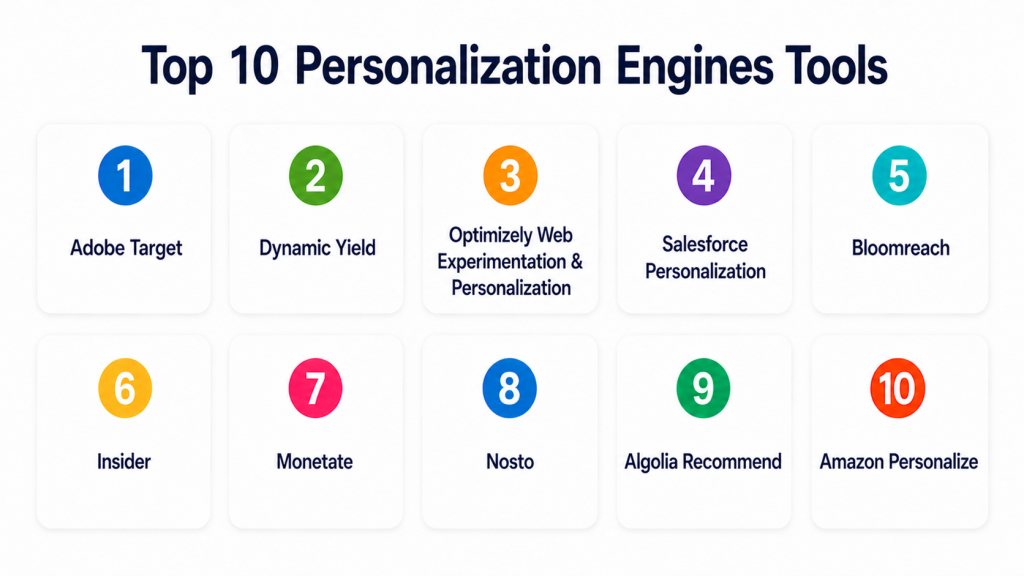
Top 10 Personalization Engines Tools
#1 — Adobe Target
Short description = Adobe Target is an enterprise personalization and testing platform for delivering targeted experiences across digital channels. It is best for large organizations already using Adobe Experience Cloud or running mature optimization programs.
Key Features
- A/B testing and multivariate testing.
- AI-assisted personalization and recommendations.
- Audience segmentation and targeting.
- Experience targeting across digital properties.
- Automated personalization workflows.
- Integration with Adobe Analytics and Adobe Experience Cloud.
- Enterprise governance and reporting features.
Pros
- Strong fit for enterprise personalization programs.
- Works well inside the Adobe ecosystem.
- Good for teams combining testing, targeting, and customer journey optimization.
Cons
- Can be complex for small teams.
- Implementation may require skilled Adobe specialists.
- Pricing and setup can be high for early-stage businesses.
Platforms / Deployment
Web
Cloud
Security & Compliance
Supports enterprise access controls, user permissions, governance features, and Adobe ecosystem security controls. Specific certifications should be validated directly.
Integrations & Ecosystem
Adobe Target is strongest when connected with Adobe’s broader digital experience and analytics stack.
- Adobe Analytics
- Adobe Experience Cloud
- Customer data platforms
- CMS platforms
- Marketing automation tools
- Ecommerce systems
Support & Community
Adobe provides enterprise support, documentation, partner implementation, customer success resources, and training. Best results usually require analytics and experimentation maturity.
#2 — Dynamic Yield
Short description = Dynamic Yield is a personalization and experience optimization platform used for product recommendations, testing, targeting, and digital experience personalization. It is especially useful for ecommerce, retail, financial services, and customer experience teams.
Key Features
- Product recommendations.
- Website and app personalization.
- A/B testing and optimization.
- Audience segmentation.
- Behavioral targeting.
- Experience management across channels.
- Personalization analytics and reporting.
Pros
- Strong ecommerce and product recommendation capabilities.
- Good balance of personalization and experimentation.
- Useful for teams with large catalogs and customer behavior data.
Cons
- May be more advanced than small teams need.
- Requires quality product and customer data.
- Implementation planning is important for strong results.
Platforms / Deployment
Web / APIs
Cloud
Security & Compliance
Supports access controls, permissions, and secure personalization workflows. Specific certifications should be validated directly.
Integrations & Ecosystem
Dynamic Yield fits ecommerce and digital experience stacks where personalization connects with product catalogs and customer behavior.
- Ecommerce platforms
- Product catalogs
- Customer data platforms
- Web analytics tools
- Email and marketing tools
- APIs
Support & Community
Dynamic Yield provides documentation, implementation support, customer success resources, and optimization guidance for personalization teams.
#3 — Optimizely Web Experimentation & Personalization
Short description = Optimizely supports web experimentation, personalization, feature experimentation, and digital experience optimization. It is best for mid-market and enterprise teams that want to test and personalize customer journeys.
Key Features
- A/B and multivariate testing.
- Website personalization.
- Audience targeting.
- Feature experimentation.
- Experiment reporting.
- CMS and digital experience integrations.
- Governance for experimentation programs.
Pros
- Strong experimentation and optimization capabilities.
- Good fit for mature testing programs.
- Useful for both marketing and product teams.
Cons
- May require implementation planning.
- Advanced features can be complex for small teams.
- Best value comes with structured experimentation processes.
Platforms / Deployment
Web / APIs / SDKs
Cloud
Security & Compliance
Supports access controls, permissions, SSO/SAML options, and enterprise governance features. Specific certifications should be validated directly.
Integrations & Ecosystem
Optimizely works well in digital experience stacks where experimentation and personalization need to work together.
- CMS platforms
- Analytics tools
- Customer data platforms
- Ecommerce tools
- Feature flag workflows
- APIs and SDKs
Support & Community
Optimizely provides documentation, customer support, partner services, onboarding resources, and experimentation education.
#4 — Salesforce Personalization
Short description= Salesforce Personalization helps businesses deliver real-time personalized experiences across websites, apps, email, and customer journeys. It is best for organizations already using Salesforce for CRM, marketing, commerce, and customer data.
Key Features
- Real-time customer interaction tracking.
- Web and app personalization.
- Product and content recommendations.
- Customer journey personalization.
- Segmentation and targeting.
- Integration with Salesforce ecosystem.
- AI-driven decisioning capabilities.
Pros
- Strong fit for Salesforce-centered organizations.
- Useful for customer journey and CRM-driven personalization.
- Good for connecting personalization with sales, service, and marketing data.
Cons
- Best value depends on Salesforce ecosystem maturity.
- May be complex for teams outside Salesforce.
- Implementation requires clean customer data and planning.
Platforms / Deployment
Web / APIs
Cloud
Security & Compliance
Supports Salesforce ecosystem security controls such as access controls, permissions, identity features, and governance. Specific certifications depend on Salesforce products and should be validated directly.
Integrations & Ecosystem
Salesforce Personalization is strongest when connected with Salesforce customer data and marketing workflows.
- Salesforce CRM
- Salesforce Marketing Cloud
- Salesforce Commerce Cloud
- Customer data platforms
- Email and journey tools
- APIs
Support & Community
Salesforce provides documentation, customer success resources, enterprise support, partner implementation, and a large ecosystem of admins and consultants.
#5 — Bloomreach
Short description= Bloomreach provides ecommerce personalization, product discovery, search, merchandising, and customer engagement capabilities. It is best for retailers and ecommerce businesses that need product recommendations and personalized shopping journeys.
Key Features
- Ecommerce personalization.
- Product recommendations.
- Search and merchandising support.
- Customer segmentation.
- Email and campaign personalization.
- Product discovery optimization.
- Analytics for commerce experiences.
Pros
- Strong fit for ecommerce and retail.
- Combines search, merchandising, and personalization.
- Useful for teams managing large catalogs and customer journeys.
Cons
- Best suited for commerce use cases.
- May be too specialized for simple content websites.
- Implementation requires good product and customer data.
Platforms / Deployment
Web / APIs
Cloud
Security & Compliance
Supports access controls, permissions, and commerce data governance features. Specific certifications should be validated directly.
Integrations & Ecosystem
Bloomreach fits commerce stacks where product discovery, search, and customer engagement must work together.
- Ecommerce platforms
- Product catalogs
- Customer data platforms
- Email marketing tools
- Analytics systems
- APIs
Support & Community
Bloomreach provides documentation, onboarding help, customer success support, and commerce-focused implementation guidance.
#6 — Insider
Short description= Insider is a customer experience and personalization platform for web, mobile app, email, SMS, push, and omnichannel marketing. It is best for growth and marketing teams that want personalized journeys across multiple customer touchpoints.
Key Features
- Web and mobile personalization.
- Customer journey orchestration.
- AI-based recommendations.
- Email, SMS, push, and messaging personalization.
- Audience segmentation.
- Predictive customer behavior features.
- Campaign analytics and optimization.
Pros
- Strong omnichannel personalization focus.
- Useful for growth, retention, and lifecycle marketing.
- Good fit for brands managing multiple customer touchpoints.
Cons
- May be broader than teams needing only website personalization.
- Requires data and campaign governance.
- Implementation effort can vary by channel complexity.
Platforms / Deployment
Web / iOS / Android / APIs
Cloud
Security & Compliance
Supports access controls, secure campaign workflows, and customer data governance features. Specific certifications should be validated directly.
Integrations & Ecosystem
Insider connects personalization with marketing channels and customer journey workflows.
- Ecommerce platforms
- CRM systems
- Email tools
- SMS and push workflows
- Customer data platforms
- APIs
Support & Community
Insider provides onboarding, customer success resources, documentation, and campaign support for marketing and growth teams.
#7 — Monetate
Short description= Monetate is a personalization and testing platform focused on ecommerce, retail, and digital experience optimization. It is useful for teams that want to personalize content, offers, and product experiences across digital channels.
Key Features
- Website personalization.
- Product recommendations.
- A/B testing.
- Audience segmentation.
- Targeted content delivery.
- Ecommerce personalization.
- Analytics and reporting.
Pros
- Strong fit for retail and ecommerce personalization.
- Combines testing and targeting.
- Useful for teams optimizing conversion and customer experience.
Cons
- May be less suitable for non-commerce use cases.
- Requires traffic and customer data to show strong value.
- Advanced setup may need optimization expertise.
Platforms / Deployment
Web / APIs
Cloud
Security & Compliance
Supports access controls, permissions, and secure personalization workflows. Specific certifications should be validated directly.
Integrations & Ecosystem
Monetate fits teams that personalize ecommerce and digital shopping experiences.
- Ecommerce platforms
- Product catalogs
- Analytics tools
- Customer data platforms
- Marketing tools
- APIs
Support & Community
Monetate provides customer support, implementation guidance, documentation, and personalization strategy assistance.
#8 — Nosto
Short description = Nosto is an ecommerce personalization platform focused on product recommendations, merchandising, segmentation, content personalization, and user-generated content workflows. It is best for online retailers and DTC brands.
Key Features
- Product recommendations.
- Ecommerce personalization.
- Segmentation and targeting.
- Merchandising controls.
- Personalized content and popups.
- Search and discovery support.
- Performance analytics.
Pros
- Strong for ecommerce brands and online stores.
- Practical for product recommendations and merchandising.
- More approachable than some enterprise-only platforms.
Cons
- Best suited for ecommerce use cases.
- Less ideal for B2B SaaS personalization.
- Advanced customization may require technical support.
Platforms / Deployment
Web / APIs
Cloud
Security & Compliance
Supports secure account controls and ecommerce personalization workflows. Specific certifications are not publicly stated here.
Integrations & Ecosystem
Nosto works well for ecommerce platforms and retail marketing teams.
- Ecommerce platforms
- Product catalogs
- Email tools
- User-generated content workflows
- Analytics systems
- APIs
Support & Community
Nosto provides documentation, customer support, ecommerce guidance, and onboarding assistance for online retail teams.
#9 — Algolia Recommend
Short description = Algolia Recommend helps teams add AI-powered recommendations to ecommerce and digital product discovery experiences. It is best for organizations already using Algolia search or needing fast recommendation experiences tied to product data.
Key Features
- Product recommendations.
- Related products and frequently bought together recommendations.
- Personalization for search and discovery.
- API-first recommendation delivery.
- Integration with Algolia search.
- Relevance and ranking controls.
- Analytics for recommendation performance.
Pros
- Strong fit for search-led ecommerce experiences.
- Developer-friendly APIs.
- Good for fast product discovery workflows.
Cons
- Best value often comes when used with Algolia search.
- Less broad than full omnichannel personalization suites.
- Requires product catalog and event data quality.
Platforms / Deployment
Web / APIs
Cloud
Security & Compliance
Supports API security, account access controls, and secure hosted workflows. Specific certifications should be validated directly.
Integrations & Ecosystem
Algolia Recommend fits teams that want recommendations closely tied to search and product discovery.
- Ecommerce platforms
- Product catalogs
- Search experiences
- APIs and SDKs
- Analytics tools
- Custom web and mobile apps
Support & Community
Algolia provides documentation, SDK guides, developer resources, support options, and a strong developer community.
#10 — Amazon Personalize
Short description= Amazon Personalize is a machine learning recommendation service for building personalized product, content, and user experience recommendations. It is best for developer-led teams and AWS users that want to build custom recommendation systems.
Key Features
- Machine learning-based recommendations.
- User personalization.
- Similar item recommendations.
- Personalized ranking.
- Real-time recommendation APIs.
- Integration with AWS data services.
- Custom recommendation workflows.
Pros
- Strong for developer-led personalization.
- Good fit for AWS-native teams.
- Flexible for custom recommendation use cases.
Cons
- Requires technical setup and data preparation.
- Not a marketer-friendly no-code personalization suite.
- Activation across channels may require additional tools.
Platforms / Deployment
Web / APIs
Cloud
Security & Compliance
Supports AWS identity, access controls, encryption, logging, and cloud governance features. Specific compliance depends on AWS configuration and region.
Integrations & Ecosystem
Amazon Personalize fits teams building custom recommendation systems inside AWS-based architectures.
- AWS data services
- Ecommerce applications
- Content platforms
- APIs
- Data pipelines
- Custom applications
Support & Community
AWS provides documentation, SDKs, cloud support plans, training resources, and a large developer ecosystem.
Comparison Table
| Tool Name | Best For | Platform(s) Supported | Deployment | Standout Feature | Public Rating |
|---|---|---|---|---|---|
| Adobe Target | Enterprise personalization and testing | Web | Cloud | AI-assisted testing and personalization in Adobe ecosystem | N/A |
| Dynamic Yield | Ecommerce and experience optimization | Web, APIs | Cloud | Product recommendations and experience personalization | N/A |
| Optimizely Web Experimentation & Personalization | Testing-led personalization | Web, APIs, SDKs | Cloud | Experimentation plus personalization governance | N/A |
| Salesforce Personalization | CRM-driven personalization | Web, APIs | Cloud | Real-time customer journey personalization | N/A |
| Bloomreach | Ecommerce search and personalization | Web, APIs | Cloud | Commerce personalization with product discovery | N/A |
| Insider | Omnichannel personalization | Web, iOS, Android, APIs | Cloud | Personalized journeys across marketing channels | N/A |
| Monetate | Retail and ecommerce personalization | Web, APIs | Cloud | Ecommerce testing and targeted experiences | N/A |
| Nosto | DTC and ecommerce brands | Web, APIs | Cloud | Product recommendations and merchandising | N/A |
| Algolia Recommend | Search-led recommendations | Web, APIs | Cloud | API-first product recommendations | N/A |
| Amazon Personalize | Developer-led recommendation systems | Web, APIs | Cloud | Custom ML recommendation engine on AWS | N/A |
Evaluation & Scoring of Personalization Engines
| Tool Name | Core (25%) | Ease (15%) | Integrations (15%) | Security (10%) | Performance (10%) | Support (10%) | Value (15%) | Weighted Total (0–10) |
|---|---|---|---|---|---|---|---|---|
| Adobe Target | 9 | 6 | 9 | 9 | 8 | 9 | 6 | 7.95 |
| Dynamic Yield | 9 | 7 | 8 | 8 | 8 | 8 | 7 | 7.95 |
| Optimizely Web Experimentation & Personalization | 8 | 7 | 9 | 8 | 8 | 8 | 7 | 7.85 |
| Salesforce Personalization | 9 | 6 | 9 | 9 | 8 | 9 | 6 | 7.95 |
| Bloomreach | 8 | 7 | 8 | 8 | 8 | 8 | 7 | 7.70 |
| Insider | 8 | 7 | 8 | 8 | 8 | 8 | 7 | 7.70 |
| Monetate | 8 | 7 | 8 | 8 | 8 | 8 | 7 | 7.70 |
| Nosto | 8 | 8 | 7 | 7 | 8 | 7 | 8 | 7.65 |
| Algolia Recommend | 8 | 8 | 8 | 8 | 9 | 8 | 7 | 8.00 |
| Amazon Personalize | 9 | 5 | 8 | 9 | 9 | 8 | 8 | 7.95 |
These scores are comparative and should be treated as a decision guide, not a fixed ranking. Adobe Target and Salesforce Personalization fit mature enterprise ecosystems. Dynamic Yield, Bloomreach, Monetate, and Nosto are strong for ecommerce personalization. Algolia Recommend is practical for search-led product discovery, while Amazon Personalize fits developer-led recommendation systems.
Which Personalization Engines Tool Is Right for You?
Solo / Freelancer
Solo users usually do not need a full personalization engine. Basic website rules, email segmentation, or simple product recommendations may be enough.
Good options:
- Nosto for small ecommerce personalization.
- Algolia Recommend if using search-led ecommerce workflows.
- Basic ecommerce platform recommendations for small stores.
- Amazon Personalize only if there is developer support and enough data.
SMB
SMBs should focus on ease of use, quick setup, product recommendations, basic segmentation, and campaign impact. They should avoid enterprise platforms unless they have enough data, traffic, and team maturity.
Good options:
- Nosto for ecommerce brands.
- Bloomreach for growing commerce teams.
- Dynamic Yield for more advanced ecommerce personalization.
- Insider for omnichannel marketing personalization.
Mid-Market
Mid-market businesses often need stronger testing, segmentation, recommendations, campaign orchestration, and analytics. They should choose tools based on whether the main goal is ecommerce, SaaS, content, or customer journey personalization.
Good options:
- Dynamic Yield for ecommerce and digital experience optimization.
- Optimizely for experimentation-led personalization.
- Bloomreach for commerce search and personalization.
- Insider for lifecycle and omnichannel campaigns.
- Algolia Recommend for product discovery.
Enterprise
Enterprises need scalable decisioning, governance, privacy controls, complex integrations, AI recommendations, experimentation, and multi-channel support.
Good options:
- Adobe Target for Adobe ecosystem enterprises.
- Salesforce Personalization for Salesforce-driven customer journeys.
- Dynamic Yield for enterprise ecommerce.
- Optimizely for experimentation and personalization programs.
- Amazon Personalize for custom AWS-based recommendation systems.
Budget vs Premium
Budget-focused teams should start with simple recommendations, segmentation, and campaign personalization. Premium tools are better when personalization affects revenue, retention, customer experience, and omnichannel engagement.
Budget-friendly scenarios:
- Small ecommerce recommendations.
- Basic website personalization.
- Simple audience segments.
- Email personalization.
- Low-to-medium traffic websites.
Premium scenarios:
- Large ecommerce catalogs.
- Real-time personalization.
- Omnichannel customer journeys.
- Enterprise experimentation.
- AI recommendation engines.
- CRM and CDP-connected personalization.
Feature Depth vs Ease of Use
Ease of use matters when marketing teams own personalization. Feature depth matters when personalization uses AI, customer data, large catalogs, APIs, and real-time decisions.
Choose ease of use when:
- You have a small team.
- You need product recommendations quickly.
- Your personalization rules are simple.
- You do not have data engineers.
Choose feature depth when:
- You need real-time decisions.
- You run many experiments.
- You have large customer datasets.
- You need omnichannel campaigns.
- You need data warehouse or CDP integration.
- You need custom recommendation models.
Integrations & Scalability
Personalization engines are only as strong as the data they can use and the channels they can activate. Buyers should test integrations early.
Important integrations include:
- Customer data platforms
- CRM systems
- Ecommerce platforms
- Product catalogs
- CMS platforms
- Email marketing tools
- SMS and push platforms
- Web analytics tools
- Product analytics tools
- Data warehouses
- APIs and SDKs
Security & Compliance Needs
Personalization uses customer behavior, identity, purchase history, segments, and sometimes sensitive profile attributes. Security and privacy should be reviewed before launch.
Important checks include:
- Consent management.
- Data minimization.
- Role-based access control.
- SSO/SAML.
- MFA.
- Audit logs.
- Data retention settings.
- Data residency.
- Encryption.
- Customer deletion workflows.
- Vendor compliance documentation.
Frequently Asked Questions
What is a Personalization Engine?
A Personalization Engine is software that uses customer data, behavior, rules, and AI to deliver relevant content, products, offers, or messages to each user.
How does personalization improve customer experience?
Personalization helps users see more relevant products, content, offers, and journeys. This can reduce friction, improve engagement, and make digital experiences feel more useful.
What is the difference between personalization and recommendations?
Recommendations are usually product or content suggestions. Personalization is broader and can include website layout, messages, offers, campaigns, timing, channels, and customer journeys.
What pricing models are common?
Pricing may be based on monthly visitors, profiles, events, channels, modules, API usage, catalog size, or enterprise contracts. Pricing varies, so buyers should confirm directly with vendors.
How much data do I need for personalization?
Basic rule-based personalization can start with limited data. AI-based recommendations usually need enough traffic, events, products, purchases, or behavioral data to learn useful patterns.
What is the biggest mistake in personalization?
The biggest mistake is personalizing without clear goals or clean data. Poor segmentation, bad product data, and weak consent practices can reduce trust and performance.
Can personalization engines support A/B testing?
Yes, many personalization engines include A/B testing or integrate with experimentation platforms. Testing is important to prove whether personalization actually improves outcomes.
Are personalization engines secure?
Many tools include permissions, access controls, encryption, and governance features. Buyers should validate security and privacy controls before sending customer data into any platform.
What industries use personalization engines most?
Ecommerce, retail, SaaS, media, banking, travel, telecom, healthcare, education, and B2B software companies commonly use personalization engines.
Can small businesses use personalization engines?
Yes, but small businesses should start simple. Basic product recommendations, email segmentation, and rule-based website personalization may be enough before adopting enterprise platforms.
What are alternatives to personalization engines?
Alternatives include manual segmentation, email marketing tools, ecommerce recommendation plugins, CDPs, A/B testing tools, product analytics tools, and custom machine learning systems.
How should a company start with personalization?
Start with one clear use case, such as product recommendations, homepage personalization, abandoned cart recovery, or audience-based landing pages. Measure results before expanding.
Conclusion
Personalization Engines help businesses move from generic digital experiences to more relevant customer journeys. The best tool depends on your data maturity, traffic volume, business model, channels, and team skills. Adobe Target and Salesforce Personalization are strong for enterprises already using those ecosystems. Dynamic Yield, Bloomreach, Monetate, and Nosto are strong for ecommerce and retail. Optimizely is useful when experimentation drives personalization. Insider is practical for omnichannel marketing journeys. Algolia Recommend and Amazon Personalize fit teams that need recommendation engines connected to search, product data, or custom applications.
