Upgrade & Secure Your Future with DevOps, SRE, DevSecOps, MLOps!
We spend hours scrolling social media and waste money on things we forget, but won’t spend 30 minutes a day earning certifications that can change our lives.
Master in DevOps, SRE, DevSecOps & MLOps by DevOps School!
Learn from Guru Rajesh Kumar and double your salary in just one year.
Introduction
Enterprise Service Bus (ESB) platforms help organizations connect applications, databases, APIs, legacy systems, cloud services, and business workflows through a central integration layer. In simple terms, an ESB acts like a communication backbone that allows different systems to exchange data, route messages, transform formats, apply rules, and keep business processes connected.
ESB platforms matter because many enterprises still run a mix of old systems, modern cloud apps, SaaS tools, ERP platforms, CRM systems, banking systems, healthcare applications, and custom internal software. Without a proper integration layer, teams often deal with point-to-point connections, duplicate data, fragile workflows, and poor visibility.
Common use cases include ERP-to-CRM integration, banking transaction routing, healthcare system connectivity, order processing, legacy modernization, message transformation, API orchestration, and hybrid cloud integration.
Buyers should evaluate connector depth, message routing, transformation support, API management, security controls, monitoring, scalability, deployment flexibility, DevOps readiness, vendor support, and total ownership cost.
Best for: enterprise architects, integration teams, IT leaders, platform engineers, middleware teams, financial services, healthcare, telecom, manufacturing, government, and large companies with complex system integration needs.
Not ideal for: small teams with simple SaaS automation needs, startups that only need lightweight API integration, businesses without legacy systems, or projects where an iPaaS, API gateway, message broker, or workflow automation tool is enough.
Key Trends in Enterprise Service Bus (ESB) Platforms
- Hybrid integration is now a major requirement: Enterprises need to connect on-premises systems, cloud services, SaaS apps, containers, APIs, and legacy platforms without creating fragile point-to-point connections.
- ESB and API management are becoming closely connected: Many teams now expect ESB platforms to work with API gateways, API lifecycle tools, developer portals, and secure API exposure patterns.
- Cloud-native deployment is more important: Enterprises increasingly want integration platforms that can run in containers, Kubernetes, private cloud, public cloud, and hybrid environments.
- Event-driven architecture is growing: ESB platforms are being used alongside message brokers, event streams, and pub/sub tools to support real-time business events.
- Legacy modernization is still a core driver: Many organizations need ESB platforms to connect mainframes, ERP systems, older databases, and modern applications during phased modernization.
- Security and governance expectations are stronger: Buyers now look for SSO, RBAC, encryption, audit logs, policy control, secure connectors, and governance across integrations.
- Observability is becoming essential: Integration teams need dashboards, logs, traces, error handling, message tracking, replay, and alerting to manage critical business flows.
- Low-code integration design is becoming common: Visual flow builders, reusable connectors, templates, and mapping tools help teams reduce manual integration work.
- AI-assisted integration is emerging: Some platforms are beginning to support smarter mapping, anomaly detection, workflow suggestions, documentation support, and operational troubleshooting.
- Cost and complexity are under review: Enterprises are comparing traditional ESB platforms with iPaaS, API gateways, event brokers, and microservices-based integration patterns to avoid unnecessary middleware complexity.
How We Selected These Tools
The tools in this list were selected based on practical ESB and enterprise integration needs, market recognition, platform depth, and fit for different organization sizes.
- Market adoption and recognition among enterprise integration teams, architects, and middleware professionals.
- Support for message routing, transformation, orchestration, mediation, and protocol bridging.
- Ability to connect legacy systems, SaaS tools, APIs, databases, ERPs, CRMs, and cloud platforms.
- Deployment flexibility across cloud, self-hosted, hybrid, containerized, and enterprise environments.
- Security posture signals such as access control, encryption, identity integration, audit logs, and policy enforcement.
- Reliability and performance for mission-critical integration workloads.
- Monitoring, logging, error handling, retry, and operational visibility.
- Developer and integration team experience through visual design tools, templates, SDKs, connectors, and documentation.
- Support ecosystem, community maturity, professional services, and enterprise vendor assistance.
- Overall value based on scalability, governance, long-term maintainability, and integration breadth.
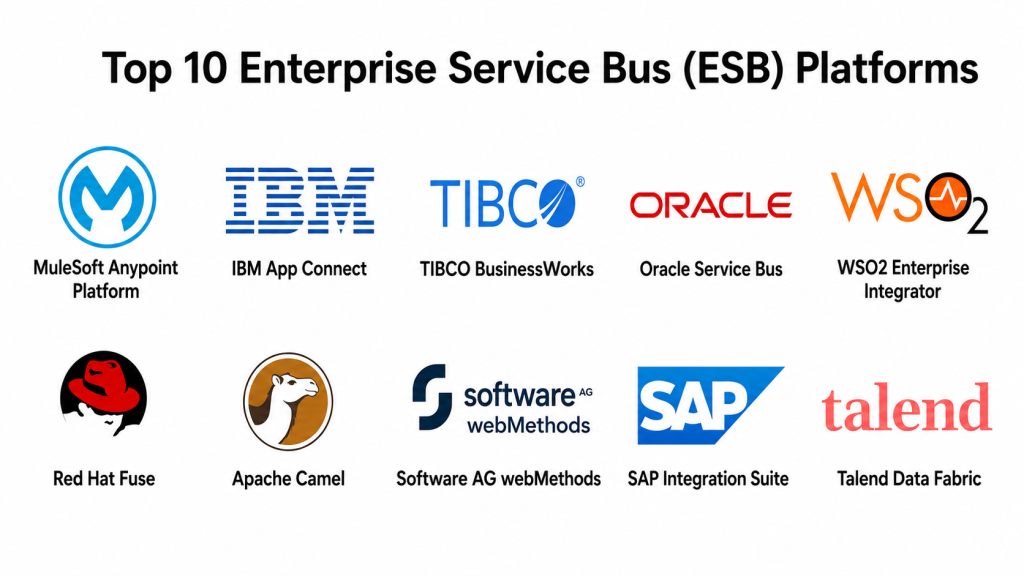
Top 10 Enterprise Service Bus (ESB) Platforms
#1 — MuleSoft Anypoint Platform
Short description: MuleSoft Anypoint Platform is a widely recognized enterprise integration platform used for API-led connectivity, application integration, data integration, and hybrid system connectivity. It is best for organizations that need strong integration governance, reusable APIs, and enterprise-grade connectivity.
Key Features
- API-led integration and connectivity model.
- Application, data, and system integration support.
- Large connector ecosystem for enterprise systems.
- API design, management, and lifecycle capabilities.
- Data transformation and mapping tools.
- Cloud and hybrid deployment options.
- Monitoring, governance, and reusable integration assets.
Pros
- Strong enterprise integration and API management combination.
- Good fit for large organizations with complex integration portfolios.
- Reusable API-led approach helps reduce duplicate integration work.
Cons
- Can be costly for smaller teams.
- Requires skilled architects and governance planning.
- Platform complexity may be high for simple integration needs.
Platforms / Deployment
Web / Linux / Windows.
Cloud / Self-hosted / Hybrid.
Security & Compliance
Enterprise security features may be available depending on plan and deployment. Confirm SSO/SAML, MFA, RBAC, audit logs, encryption, SOC 2, ISO 27001, GDPR, HIPAA, data residency, and compliance requirements directly with the vendor.
Integrations & Ecosystem
MuleSoft has a broad enterprise integration ecosystem and is useful for organizations that need reusable, governed connectivity across many systems.
- ERP and CRM systems.
- Databases and data warehouses.
- SaaS platforms.
- APIs and microservices.
- Mainframe and legacy systems.
- Cloud services and DevOps tools.
Support & Community
MuleSoft offers enterprise documentation, training resources, partner ecosystem support, professional services, and customer success options. It is best for organizations with mature integration programs.
#2 — IBM App Connect
Short description: IBM App Connect is an enterprise integration platform designed to connect applications, data, APIs, events, and enterprise systems. It is suitable for organizations that need hybrid integration, strong enterprise support, and connectivity across modern and legacy environments.
Key Features
- Application and data integration workflows.
- API and event-driven integration support.
- Prebuilt connectors for common enterprise systems.
- Data mapping and transformation tools.
- Hybrid deployment support.
- Integration with IBM middleware and cloud ecosystem.
- Monitoring and management capabilities.
Pros
- Strong enterprise middleware heritage.
- Good fit for hybrid and legacy-heavy environments.
- Useful for organizations already using IBM integration technologies.
Cons
- May feel complex for smaller teams.
- Best value often comes in enterprise IBM environments.
- Implementation may require specialized integration expertise.
Platforms / Deployment
Web / Linux / Windows.
Cloud / Self-hosted / Hybrid.
Security & Compliance
Enterprise security capabilities may be available depending on configuration and plan. Confirm SSO/SAML, MFA, RBAC, audit logs, encryption, GDPR, SOC 2, ISO 27001, HIPAA, and industry-specific controls directly with the vendor.
Integrations & Ecosystem
IBM App Connect works well in enterprise environments where integration must connect SaaS, cloud, legacy systems, databases, messaging platforms, and APIs.
- IBM middleware tools.
- SaaS applications.
- Databases.
- APIs.
- Message queues.
- ERP and CRM platforms.
Support & Community
IBM provides enterprise documentation, support, partner services, training, and professional consulting options. It is best for organizations needing stable enterprise integration support.
#3 — TIBCO BusinessWorks
Short description: TIBCO BusinessWorks is an enterprise integration and service orchestration platform used for connecting systems, automating business processes, and integrating APIs, data, and services. It is suitable for large enterprises with complex integration and event-driven needs.
Key Features
- Integration flow design and orchestration.
- Support for APIs, services, events, and messaging.
- Data mapping and transformation.
- Enterprise connectors and adapters.
- Hybrid deployment support.
- Monitoring and operational management.
- Integration with broader TIBCO ecosystem.
Pros
- Strong fit for enterprise-grade integration workloads.
- Good for complex process and service orchestration.
- Useful in organizations with existing TIBCO investments.
Cons
- Can require specialized skills.
- May be too heavy for lightweight integration needs.
- Licensing and modernization planning should be reviewed carefully.
Platforms / Deployment
Linux / Windows.
Cloud / Self-hosted / Hybrid.
Security & Compliance
Security capabilities may vary by deployment and edition. Confirm SSO, MFA, RBAC, audit logs, encryption, GDPR, SOC 2, ISO 27001, HIPAA, and compliance documentation with the vendor.
Integrations & Ecosystem
TIBCO BusinessWorks is useful when enterprises need deep connectivity across applications, services, message systems, and business processes.
- Messaging systems.
- APIs and web services.
- Databases.
- ERP and CRM systems.
- Event-driven platforms.
- Enterprise monitoring tools.
Support & Community
TIBCO provides enterprise documentation, professional services, partner support, and customer assistance. It is strongest in enterprise integration teams with established middleware practices.
#4 — Oracle Service Bus
Short description: Oracle Service Bus is an enterprise service bus platform used for service mediation, routing, transformation, and integration within Oracle-centered enterprise environments. It is useful for organizations that need strong service-oriented architecture support and Oracle ecosystem integration.
Key Features
- Service routing and mediation.
- Message transformation and enrichment.
- Protocol bridging.
- Integration with Oracle middleware.
- Policy-based service management.
- Monitoring and operational controls.
- Support for enterprise service-oriented architecture.
Pros
- Strong fit for Oracle-heavy environments.
- Useful for service mediation and legacy integration.
- Good for enterprises with established SOA architecture.
Cons
- Less suitable for lightweight cloud-native teams.
- Requires Oracle middleware expertise.
- May feel complex compared with newer integration platforms.
Platforms / Deployment
Linux / Windows.
Self-hosted / Hybrid.
Security & Compliance
Security depends on Oracle middleware configuration, deployment, identity systems, and enterprise setup. Confirm SSO, RBAC, audit logs, encryption, GDPR, SOC 2, ISO 27001, HIPAA, and compliance requirements directly with the vendor.
Integrations & Ecosystem
Oracle Service Bus works well when integrated with Oracle applications, databases, and middleware environments.
- Oracle Fusion Middleware.
- Oracle databases.
- Enterprise applications.
- SOAP and REST services.
- Messaging systems.
- Legacy service environments.
Support & Community
Oracle provides enterprise documentation, support, professional services, and partner ecosystem coverage. It is best for organizations already invested in Oracle technology.
#5 — WSO2 Enterprise Integrator
Short description: WSO2 Enterprise Integrator is an integration platform for connecting applications, services, data, APIs, and cloud systems. It is suitable for teams that want open-source-friendly enterprise integration with deployment flexibility.
Key Features
- ESB and integration runtime capabilities.
- API and service integration.
- Message routing and transformation.
- Connectors for enterprise systems.
- Cloud and self-hosted deployment options.
- Support for integration flows and mediation.
- Open-source-friendly ecosystem.
Pros
- Flexible deployment model.
- Good fit for teams wanting control and openness.
- Strong integration with the broader WSO2 ecosystem.
Cons
- May require technical expertise for setup and operations.
- Enterprise support may be needed for critical workloads.
- Smaller teams may find configuration depth challenging.
Platforms / Deployment
Linux / Windows / macOS.
Cloud / Self-hosted / Hybrid.
Security & Compliance
Security features may depend on edition and deployment. Confirm SSO/SAML, MFA, RBAC, audit logs, encryption, GDPR, SOC 2, ISO 27001, HIPAA, and data governance needs with the vendor.
Integrations & Ecosystem
WSO2 Enterprise Integrator fits teams that want flexible integration across APIs, services, cloud platforms, and enterprise systems.
- APIs and microservices.
- Databases.
- SaaS applications.
- Message brokers.
- Identity systems.
- WSO2 API and identity tools.
Support & Community
WSO2 has documentation, community resources, enterprise support, and professional services. It is suitable for teams comfortable with open-source-style enterprise software.
#6 — Red Hat Fuse
Short description: Red Hat Fuse is an integration platform based on Apache Camel and related open-source technologies. It is used for connecting applications, services, APIs, and data across hybrid environments, especially where open-source integration patterns and container platforms matter.
Key Features
- Apache Camel-based integration routes.
- Support for enterprise integration patterns.
- Connectors and components for many systems.
- Cloud-native and container-friendly deployment.
- Integration with Red Hat OpenShift.
- API and messaging integration support.
- Developer-oriented integration workflows.
Pros
- Strong open-source foundation.
- Good fit for container and Kubernetes environments.
- Useful for teams already using Red Hat technologies.
Cons
- Requires integration and Camel expertise.
- Less beginner-friendly than visual iPaaS tools.
- Best value comes with skilled DevOps and platform teams.
Platforms / Deployment
Linux / Kubernetes.
Cloud / Self-hosted / Hybrid.
Security & Compliance
Security depends on deployment, Red Hat platform configuration, identity integration, and operational practices. Confirm SSO, MFA, RBAC, audit logs, encryption, GDPR, SOC 2, ISO 27001, HIPAA, and compliance needs with the vendor.
Integrations & Ecosystem
Red Hat Fuse works well in open-source and cloud-native enterprise environments.
- Apache Camel components.
- Red Hat OpenShift.
- Message brokers.
- APIs and microservices.
- Databases.
- Cloud-native DevOps pipelines.
Support & Community
Red Hat Fuse benefits from Apache Camel community knowledge and Red Hat enterprise support. It is suitable for technical teams that want open integration patterns with enterprise backing.
#7 — Apache Camel
Short description: Apache Camel is an open-source integration framework that implements enterprise integration patterns. It is often used by developers to build routing, transformation, mediation, and messaging flows without adopting a full commercial ESB suite.
Key Features
- Enterprise integration pattern support.
- Large library of components and connectors.
- Routing and transformation logic.
- Java and DSL-based integration development.
- Works with messaging, APIs, files, databases, and cloud services.
- Flexible embedding in applications and platforms.
- Strong open-source community.
Pros
- Highly flexible and widely used by developers.
- Strong connector ecosystem.
- Good option for teams that want code-based integration control.
Cons
- Not a full ESB product by itself.
- Requires developer expertise.
- Operations, monitoring, and governance need additional tooling.
Platforms / Deployment
Linux / Windows / macOS / Kubernetes.
Self-hosted / Hybrid.
Security & Compliance
Not publicly stated as a standalone compliance platform. Security depends on the application, runtime, infrastructure, authentication, encryption, monitoring, and deployment controls used with Camel.
Integrations & Ecosystem
Apache Camel is highly flexible for building custom integration routes and connecting different systems.
- Message brokers.
- Databases.
- APIs.
- File systems.
- Cloud services.
- Enterprise applications.
Support & Community
Apache Camel has strong open-source documentation, community examples, and broad developer adoption. Enterprise support may be available through vendors that package or support Camel-based platforms.
#8 — Software AG webMethods
Short description: Software AG webMethods is an enterprise integration platform used for application integration, B2B integration, API management, and hybrid connectivity. It is suitable for large organizations with complex enterprise and partner integration requirements.
Key Features
- Application and B2B integration.
- ESB-style message routing and transformation.
- API management capabilities.
- Hybrid integration support.
- Enterprise connectors and adapters.
- Monitoring and operational visibility.
- Support for complex enterprise workflows.
Pros
- Strong for large enterprise integration programs.
- Useful for B2B, partner, and legacy connectivity.
- Mature integration platform with broad enterprise use cases.
Cons
- May be expensive or complex for smaller organizations.
- Requires experienced integration teams.
- Modernization strategy should be planned carefully.
Platforms / Deployment
Linux / Windows.
Cloud / Self-hosted / Hybrid.
Security & Compliance
Security features may be available depending on edition and deployment. Confirm SSO/SAML, MFA, RBAC, audit logs, encryption, GDPR, SOC 2, ISO 27001, HIPAA, and compliance needs directly with the vendor.
Integrations & Ecosystem
webMethods is useful for enterprise integration teams managing many internal and external business connections.
- B2B partner systems.
- ERP and CRM platforms.
- APIs and services.
- Databases.
- Legacy systems.
- Cloud and SaaS applications.
Support & Community
Software AG provides enterprise support, documentation, professional services, training, and partner ecosystem assistance. It is best for organizations with mature integration operations.
#9 — SAP Integration Suite
Short description: SAP Integration Suite is an enterprise integration platform used to connect SAP and non-SAP systems, APIs, business processes, and cloud services. It is best for organizations with strong SAP environments and complex business process integration needs.
Key Features
- Cloud-based integration flows.
- SAP and non-SAP system connectivity.
- API management capabilities.
- Event-driven integration support.
- Prebuilt integration content.
- B2B integration support.
- Monitoring and lifecycle management.
Pros
- Strong fit for SAP-heavy enterprises.
- Useful for connecting business processes across cloud and on-premises systems.
- Prebuilt integration content can reduce implementation effort.
Cons
- Best value is often within SAP environments.
- Non-SAP-heavy organizations may prefer more neutral platforms.
- Requires integration and SAP process knowledge.
Platforms / Deployment
Web.
Cloud / Hybrid.
Security & Compliance
Enterprise security capabilities may be available through SAP cloud and platform controls. Confirm SSO, MFA, RBAC, audit logs, encryption, GDPR, SOC 2, ISO 27001, HIPAA, and region-specific compliance directly with the vendor.
Integrations & Ecosystem
SAP Integration Suite is strongest when connecting SAP applications, business processes, APIs, and external systems.
- SAP applications.
- Non-SAP enterprise systems.
- APIs.
- B2B workflows.
- Cloud services.
- Event-driven business processes.
Support & Community
SAP provides enterprise documentation, support plans, implementation partners, community resources, and professional services. It is best for organizations with SAP-centered architecture.
#10 — Talend Data Fabric
Short description: Talend Data Fabric is commonly used for data integration, data quality, data governance, and application connectivity. While it is not a traditional ESB in the strictest sense, it is relevant for enterprises that need data movement, transformation, and integration across systems.
Key Features
- Data integration and transformation.
- Data quality and governance capabilities.
- Connectors for databases, cloud apps, and enterprise systems.
- Batch and real-time data integration options.
- API and application integration use cases.
- Monitoring and operational visibility.
- Support for hybrid data environments.
Pros
- Strong for data-centric integration.
- Useful where data quality and governance matter.
- Good fit for analytics, migration, and data pipeline use cases.
Cons
- Not a classic ESB replacement for every service mediation use case.
- May require data engineering expertise.
- Best for data integration rather than broad service bus architecture.
Platforms / Deployment
Web / Linux / Windows.
Cloud / Self-hosted / Hybrid.
Security & Compliance
Security and compliance capabilities may vary by plan and deployment. Confirm SSO, MFA, RBAC, audit logs, encryption, GDPR, SOC 2, ISO 27001, HIPAA, and data governance needs directly with the vendor.
Integrations & Ecosystem
Talend works well for data-heavy environments where integration is centered on movement, quality, transformation, and governance.
- Databases.
- Data warehouses.
- Cloud storage.
- SaaS platforms.
- APIs.
- Data governance workflows.
Support & Community
Talend has documentation, enterprise support, learning resources, and a data integration community. It is best for teams that need strong data integration and governance capabilities.
Comparison Table: Top 10
| Tool Name | Best For | Platform(s) Supported | Deployment | Standout Feature | Public Rating |
|---|---|---|---|---|---|
| MuleSoft Anypoint Platform | Enterprise API-led integration | Web, Linux, Windows | Cloud / Self-hosted / Hybrid | API-led connectivity and reusable integration assets | N/A |
| IBM App Connect | Hybrid enterprise integration | Web, Linux, Windows | Cloud / Self-hosted / Hybrid | Strong enterprise and legacy integration | N/A |
| TIBCO BusinessWorks | Complex service orchestration | Linux, Windows | Cloud / Self-hosted / Hybrid | Enterprise process and service integration | N/A |
| Oracle Service Bus | Oracle-centered SOA integration | Linux, Windows | Self-hosted / Hybrid | Service mediation in Oracle environments | N/A |
| WSO2 Enterprise Integrator | Flexible open enterprise integration | Linux, Windows, macOS | Cloud / Self-hosted / Hybrid | Open-source-friendly integration platform | N/A |
| Red Hat Fuse | Apache Camel-based integration | Linux, Kubernetes | Cloud / Self-hosted / Hybrid | Open integration patterns with Red Hat support | N/A |
| Apache Camel | Developer-led integration framework | Linux, Windows, macOS, Kubernetes | Self-hosted / Hybrid | Enterprise integration patterns in code | N/A |
| Software AG webMethods | Large-scale B2B and enterprise integration | Linux, Windows | Cloud / Self-hosted / Hybrid | Mature enterprise and partner integration | N/A |
| SAP Integration Suite | SAP and business process integration | Web | Cloud / Hybrid | SAP-centered integration content and flows | N/A |
| Talend Data Fabric | Data-centric integration and governance | Web, Linux, Windows | Cloud / Self-hosted / Hybrid | Data integration with quality and governance | N/A |
Evaluation & Scoring of Enterprise Service Bus (ESB) Platforms
| Tool Name | Core (25%) | Ease (15%) | Integrations (15%) | Security (10%) | Performance (10%) | Support (10%) | Value (15%) | Weighted Total (0–10) |
|---|---|---|---|---|---|---|---|---|
| MuleSoft Anypoint Platform | 10 | 7 | 10 | 9 | 9 | 9 | 7 | 8.80 |
| IBM App Connect | 9 | 7 | 9 | 9 | 8 | 9 | 7 | 8.35 |
| TIBCO BusinessWorks | 9 | 6 | 9 | 8 | 9 | 8 | 7 | 8.10 |
| Oracle Service Bus | 8 | 6 | 8 | 8 | 8 | 8 | 7 | 7.55 |
| WSO2 Enterprise Integrator | 8 | 7 | 8 | 8 | 8 | 8 | 8 | 7.90 |
| Red Hat Fuse | 8 | 6 | 9 | 8 | 8 | 8 | 8 | 7.90 |
| Apache Camel | 8 | 5 | 9 | 7 | 8 | 7 | 9 | 7.55 |
| Software AG webMethods | 9 | 6 | 9 | 8 | 8 | 8 | 7 | 8.00 |
| SAP Integration Suite | 9 | 7 | 9 | 9 | 8 | 9 | 7 | 8.35 |
| Talend Data Fabric | 8 | 7 | 8 | 8 | 8 | 8 | 8 | 7.90 |
These scores are comparative and should be treated as a shortlist guide, not a universal ranking. MuleSoft may be stronger for API-led enterprise integration, SAP Integration Suite may be better for SAP-heavy environments, Apache Camel may be better for developer-led open integration, and Talend may be better for data-centric integration. The right platform depends on your architecture, existing systems, skills, budget, and governance needs.
Which Enterprise Service Bus (ESB) Platform Is Right for You?
Solo / Freelancer
Solo consultants and freelancers rarely need a full enterprise ESB unless they are working on client integration projects. For developer-led integration work, Apache Camel is a practical option because it provides strong enterprise integration patterns without requiring a large commercial platform.
If the freelancer works with open-source-friendly enterprise clients, WSO2 Enterprise Integrator or Red Hat Fuse may be useful. For SAP, Oracle, or IBM-heavy client projects, the best choice usually depends on the client’s existing enterprise stack.
Recommended tools: Apache Camel, WSO2 Enterprise Integrator, Red Hat Fuse.
SMB
Small and mid-sized businesses should be careful before adopting a heavy ESB platform. If the business only needs SaaS automation, a lighter iPaaS or workflow automation tool may be enough. However, if the SMB has multiple systems, databases, APIs, and legacy applications, an ESB-style platform may help.
WSO2 Enterprise Integrator, Red Hat Fuse, Apache Camel, and Talend Data Fabric can be practical options depending on internal skills. If the SMB is already committed to SAP, SAP Integration Suite may be a better fit.
Recommended tools: WSO2 Enterprise Integrator, Apache Camel, Red Hat Fuse, Talend Data Fabric, SAP Integration Suite.
Mid-Market
Mid-market organizations often need stronger integration governance, better monitoring, reusable connectors, and support for hybrid systems. MuleSoft, IBM App Connect, WSO2 Enterprise Integrator, SAP Integration Suite, and Talend Data Fabric are strong candidates depending on the business environment.
If the company is moving from point-to-point integrations to a governed integration layer, MuleSoft or IBM App Connect can provide structure. If the company is more developer-led and open-source-focused, Red Hat Fuse or Apache Camel may be better.
Recommended tools: MuleSoft Anypoint Platform, IBM App Connect, WSO2 Enterprise Integrator, Red Hat Fuse, Talend Data Fabric.
Enterprise
Enterprise teams usually need governance, performance, observability, compliance, support, lifecycle management, and integration across legacy, cloud, SaaS, and business-critical systems. MuleSoft Anypoint Platform is strong for API-led integration. IBM App Connect is valuable for hybrid enterprise integration. TIBCO BusinessWorks and Software AG webMethods are strong in mature middleware environments.
SAP Integration Suite is highly relevant for SAP-centered enterprises, while Oracle Service Bus is best for organizations deeply invested in Oracle middleware. Red Hat Fuse and Apache Camel are useful for cloud-native and developer-led integration teams.
Recommended tools: MuleSoft Anypoint Platform, IBM App Connect, TIBCO BusinessWorks, Software AG webMethods, SAP Integration Suite, Oracle Service Bus.
Budget vs Premium
Budget-conscious teams should evaluate Apache Camel, WSO2 Enterprise Integrator, Red Hat Fuse, and Talend Data Fabric depending on skill availability and support needs. Open-source or open-source-based options can reduce licensing pressure, but they require stronger internal expertise.
Premium buyers should evaluate MuleSoft, IBM App Connect, TIBCO BusinessWorks, Software AG webMethods, Oracle Service Bus, and SAP Integration Suite when they need enterprise support, vendor accountability, governance, and mission-critical reliability.
Feature Depth vs Ease of Use
For feature depth, MuleSoft, IBM App Connect, TIBCO BusinessWorks, Software AG webMethods, and SAP Integration Suite are strong enterprise choices. They support broad integration portfolios, governance, connectors, monitoring, and enterprise operations.
For technical flexibility, Apache Camel, Red Hat Fuse, and WSO2 Enterprise Integrator can be strong choices. They may require more engineering skill but give teams more control over integration patterns and deployment.
Integrations & Scalability
If your business depends on SAP, SAP Integration Suite is often a natural choice. If your organization uses Oracle middleware heavily, Oracle Service Bus may fit better. If you need broad API-led connectivity, MuleSoft is a strong candidate.
For open-source and Kubernetes-friendly integration, Red Hat Fuse and Apache Camel are useful. For data-heavy integration, Talend Data Fabric is worth evaluating. For mature enterprise middleware environments, IBM App Connect, TIBCO BusinessWorks, and webMethods are strong options.
Security & Compliance Needs
Security and compliance are critical for ESB platforms because they often handle sensitive business data, customer records, financial transactions, health information, and operational workflows. Teams should review identity integration, SSO, MFA, RBAC, audit logs, encryption, message-level security, data masking, key management, data retention, and compliance documentation.
Regulated industries should involve security, legal, enterprise architecture, and procurement teams before choosing an ESB platform. The platform must fit not only functional needs but also governance, monitoring, and operational controls.
Frequently Asked Questions (FAQs)
What is an Enterprise Service Bus platform?
An Enterprise Service Bus platform is integration middleware that connects different systems, applications, services, databases, and APIs. It helps route messages, transform data, apply rules, and manage communication between systems.
Is ESB still relevant?
Yes, ESB platforms are still relevant in enterprises with legacy systems, hybrid architecture, complex business workflows, and many system integrations. However, some teams now combine ESB with APIs, event streaming, iPaaS, and microservices patterns.
What is the difference between ESB and API gateway?
An ESB focuses on system integration, message routing, transformation, and orchestration. An API gateway focuses on securing, managing, and routing API traffic between clients and backend services.
What is the difference between ESB and iPaaS?
ESB platforms are often deeper middleware platforms for enterprise integration. iPaaS tools are usually cloud-based integration platforms that focus on connecting SaaS apps, workflows, and APIs with less infrastructure management.
Which ESB platform is best for enterprises?
MuleSoft, IBM App Connect, TIBCO BusinessWorks, Software AG webMethods, SAP Integration Suite, and Oracle Service Bus are strong enterprise options. The best choice depends on existing systems, architecture, and support needs.
Which ESB platform is best for open-source-friendly teams?
Apache Camel, Red Hat Fuse, and WSO2 Enterprise Integrator are strong options for teams that prefer open-source or open-source-based integration approaches.
Do ESB platforms support cloud integration?
Yes, many ESB and integration platforms support cloud, hybrid, and self-hosted deployment models. Buyers should confirm support for containers, Kubernetes, cloud connectors, API management, and monitoring.
Are ESB platforms secure?
They can be secure when configured properly. Security depends on identity integration, encryption, access control, audit logs, message protection, network design, and operational governance.
What are common mistakes when adopting an ESB?
Common mistakes include over-centralizing logic, creating bottlenecks, skipping governance, ignoring monitoring, building too many custom transformations, and using ESB where a simpler API or event-driven pattern would work better.
How are ESB platforms priced?
Pricing varies by vendor, deployment model, runtime usage, connectors, environments, support level, transaction volume, and enterprise contract. Buyers should calculate total cost including licensing, infrastructure, training, and operations.
When should a company switch from an old ESB?
A company should consider switching when the current ESB is too costly, hard to maintain, weak in cloud integration, poor in observability, difficult to scale, or unable to support modern API and event-driven patterns.
What are alternatives to ESB platforms?
Alternatives include iPaaS platforms, API gateways, message brokers, event streaming platforms, microservices integration, workflow automation tools, data integration platforms, and custom integration services.
Conclusion
Enterprise Service Bus platforms remain important for organizations that need reliable, governed, and scalable integration across legacy systems, cloud applications, SaaS tools, APIs, databases, and business workflows. However, the best ESB platform depends on context. MuleSoft is strong for API-led integration. IBM App Connect is useful for hybrid enterprise connectivity. TIBCO BusinessWorks and Software AG webMethods are strong for mature middleware environments. Oracle Service Bus fits Oracle-heavy organizations. SAP Integration Suite is a natural choice for SAP-centered enterprises. WSO2, Red Hat Fuse, and Apache Camel are practical for teams that value open and developer-led integration patterns. Talend Data Fabric is better for data-centric integration and governance.
