Upgrade & Secure Your Future with DevOps, SRE, DevSecOps, MLOps!
We spend hours scrolling social media and waste money on things we forget, but won’t spend 30 minutes a day earning certifications that can change our lives.
Master in DevOps, SRE, DevSecOps & MLOps by DevOps School!
Learn from Guru Rajesh Kumar and double your salary in just one year.
Introduction
GraphQL tooling tools help developers design, build, test, secure, document, monitor, and scale GraphQL APIs. In plain English, these tools make it easier to manage how frontend apps, mobile apps, backend services, and third-party systems request data through GraphQL.
GraphQL is useful because it allows clients to ask for exactly the data they need, instead of receiving fixed API responses. However, GraphQL also brings new challenges around schema design, query performance, security, caching, federation, developer experience, and production monitoring. That is why teams need the right GraphQL tooling stack.
Real-world use cases include:
- Building GraphQL APIs for web and mobile apps
- Creating schema-first backend services
- Managing federated GraphQL architectures
- Generating typed client and server code
- Testing queries and mutations
- Monitoring GraphQL performance and errors
- Securing GraphQL endpoints from abuse
- Connecting databases, REST APIs, and microservices through GraphQL
Buyers should evaluate:
- Schema design and governance features
- Query testing and debugging experience
- Type generation and developer productivity
- Federation and multi-service support
- Security controls and query protection
- Performance monitoring and observability
- Integration with databases and APIs
- CI/CD workflow support
- Community and documentation quality
- Deployment flexibility and enterprise readiness
Best for: GraphQL tooling tools are best for backend developers, frontend developers, platform engineers, API teams, DevOps teams, SaaS companies, enterprise architects, and product engineering teams building data-driven applications.
Not ideal for: GraphQL tooling may not be ideal for very small apps with simple REST APIs, teams without GraphQL expertise, or projects where a standard REST API is easier, faster, and more maintainable.
Key Trends in GraphQL Tooling Tools
- Schema governance is becoming more important. Teams need safe schema changes, breaking-change detection, contract checks, version control, and review workflows before changes reach production.
- Federated GraphQL is growing in larger teams. Enterprises and SaaS companies are splitting GraphQL APIs across teams and services while exposing one unified graph to clients.
- Typed GraphQL development is now expected. Tools that generate TypeScript, Java, Kotlin, Swift, and other types from schemas and operations reduce manual work and prevent runtime errors.
- Security is a serious concern. GraphQL APIs need query depth limits, cost analysis, authentication, authorization, rate limiting, persisted queries, introspection control, and abuse protection.
- Developer experience is a major differentiator. Interactive explorers, autocomplete, schema documentation, local development tools, and testing environments make GraphQL easier for teams.
- Observability is becoming essential. Teams need visibility into slow resolvers, query patterns, failed requests, schema usage, deprecated fields, and client behavior.
- GraphQL is connecting more data sources. Modern GraphQL tooling often connects databases, REST APIs, microservices, event streams, and third-party APIs into one graph layer.
- AI-assisted development is entering GraphQL workflows. Teams are starting to use AI for schema suggestions, query generation, documentation drafts, test creation, and error explanation.
- Open-source and commercial tooling are often mixed. Many teams use open-source tools for development and paid platforms for governance, observability, security, and collaboration.
- Performance planning is becoming more mature. Teams are paying more attention to caching, batching, query planning, persisted operations, and resolver efficiency.
How We Selected These Tools
This Top 10 list was selected using practical buyer-focused evaluation logic:
- Market adoption and recognition among GraphQL developers, SaaS teams, enterprise API teams, and frontend engineers
- Feature completeness across schema design, development, testing, code generation, security, federation, and observability
- Reliability and production usage signals for serious GraphQL applications
- Security posture signals such as authentication support, access controls, query protection, and governance features
- Integration ecosystem with databases, REST APIs, microservices, CI/CD, frontend frameworks, and cloud platforms
- Fit across solo developers, SMBs, mid-market teams, and enterprises
- Developer experience through documentation, explorers, IDEs, autocomplete, and generated types
- Deployment flexibility across cloud, self-hosted, hybrid, and open-source workflows
- Community strength, maintainability, plugin ecosystem, and learning resources
- Practical value based on use case, technical depth, and long-term scalability
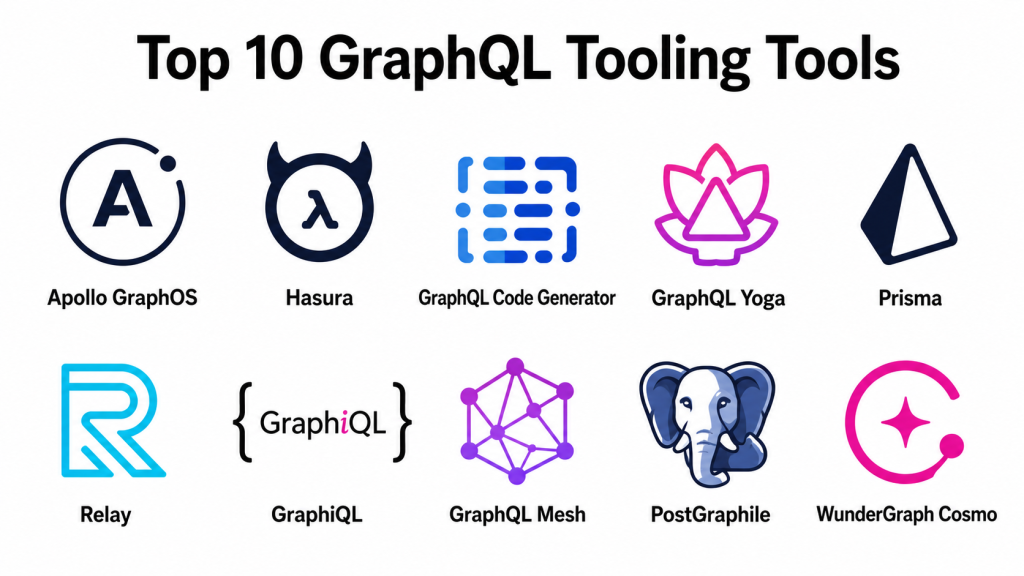
Top 10 GraphQL Tooling Tools
#1 — Apollo GraphOS
Short description: Apollo GraphOS is a GraphQL platform for building, managing, observing, and scaling production GraphQL APIs. It is especially useful for teams using federation, schema governance, client awareness, and enterprise GraphQL architecture.
Key Features
- GraphQL schema registry
- Federation and supergraph support
- Schema checks and governance
- GraphQL observability
- Client awareness and usage tracking
- Developer portal and graph collaboration
- Support for production GraphQL workflows
Pros
- Strong fit for enterprise and large-scale GraphQL teams.
- Useful for managing federated GraphQL architectures.
- Good observability and schema governance capabilities.
Cons
- May be more than needed for small projects.
- Some advanced features may require paid plans.
- Teams need GraphQL architecture knowledge to use it well.
Platforms / Deployment
Web
Cloud / Hybrid
Security & Compliance
Apollo GraphOS supports enterprise GraphQL governance and access control workflows. Specific details such as SSO, audit logs, SOC 2, ISO 27001, HIPAA, encryption, and RBAC should be verified directly based on plan and deployment model. If unclear, use Not publicly stated.
Integrations & Ecosystem
Apollo GraphOS fits well into production GraphQL stacks where teams need schema management, federation, and observability.
- Apollo Router
- Apollo Server
- Apollo Client
- CI/CD workflows
- Monitoring tools
- Developer portals
Support & Community
Apollo has strong documentation, learning resources, community adoption, enterprise support options, and a mature GraphQL ecosystem. It is one of the most recognized GraphQL platforms for production use.
#2 — Hasura
Short description: Hasura is a GraphQL engine that helps teams create instant GraphQL APIs over databases and services. It is useful for developers, startups, and enterprises that want fast API delivery with permissions, metadata, and event-driven capabilities.
Key Features
- Instant GraphQL APIs over databases
- Role-based permissions
- Remote schemas and actions
- Event triggers
- Metadata-driven API management
- Support for multiple data sources
- Cloud and self-hosted deployment options
Pros
- Very fast for building data-driven GraphQL APIs.
- Strong permission model for business applications.
- Useful for rapid backend development and internal tools.
Cons
- Best results require careful database design.
- Complex business logic may need custom services.
- Teams must understand permissions and metadata management.
Platforms / Deployment
Web / Linux / Kubernetes
Cloud / Self-hosted / Hybrid
Security & Compliance
Hasura supports role-based permissions, authentication integration patterns, authorization rules, and access controls. Specific compliance details such as SOC 2, ISO 27001, HIPAA, SSO, audit logs, encryption, and enterprise RBAC should be verified directly by edition and deployment model.
Integrations & Ecosystem
Hasura works well with databases, backend services, and modern cloud-native workflows.
- PostgreSQL
- SQL databases
- REST APIs
- Remote schemas
- Authentication providers
- Event-driven workflows
Support & Community
Hasura has strong documentation, community support, enterprise options, examples, and adoption among teams that want database-backed GraphQL APIs quickly.
#3 — GraphQL Code Generator
Short description: GraphQL Code Generator is a developer tool that generates typed code from GraphQL schemas and operations. It is best for teams that want safer frontend, backend, and full-stack development with fewer manual type errors.
Key Features
- Type generation from schemas and operations
- Support for TypeScript and multiple languages
- Client and server code generation
- Plugin-based architecture
- Framework-specific presets
- CI/CD-friendly workflows
- Support for typed GraphQL documents
Pros
- Reduces manual typing and boilerplate code.
- Helps catch schema and query mismatches earlier.
- Strong fit for TypeScript-heavy teams.
Cons
- Requires setup and configuration discipline.
- Generated code structure must be maintained carefully.
- Teams need to understand schema and operation workflows.
Platforms / Deployment
Windows / macOS / Linux
Self-hosted / Local development workflow
Security & Compliance
GraphQL Code Generator is a development tool, not a hosted compliance platform. Security depends on how generated code is used, how schemas are accessed, and how credentials are managed in CI/CD. Enterprise compliance items such as SOC 2, ISO 27001, HIPAA, SSO, audit logs, and RBAC are Not publicly stated.
Integrations & Ecosystem
GraphQL Code Generator integrates deeply with modern GraphQL development stacks.
- Apollo Client
- React
- Vue
- Angular
- urql
- TypeScript projects
- CI/CD pipelines
Support & Community
GraphQL Code Generator has strong open-source adoption, active community usage, documentation, plugins, and ecosystem support. It is a practical tool for almost any serious GraphQL project.
#4 — GraphQL Yoga
Short description: GraphQL Yoga is a GraphQL server framework focused on simplicity, flexibility, and modern GraphQL server development. It is useful for developers building custom GraphQL APIs with Node.js and related JavaScript or TypeScript stacks.
Key Features
- GraphQL server framework
- Simple setup for APIs
- Plugin-friendly architecture
- Envelop ecosystem support
- Subscriptions support
- TypeScript-friendly development
- Works with different schema and resolver patterns
Pros
- Lightweight and developer-friendly.
- Good for custom GraphQL servers.
- Flexible enough for many backend architectures.
Cons
- Requires backend development knowledge.
- Does not provide full enterprise governance by itself.
- Observability and security may require additional tools.
Platforms / Deployment
Windows / macOS / Linux
Self-hosted / Cloud / Hybrid
Security & Compliance
GraphQL Yoga itself is a server framework. Security depends on authentication, authorization, validation, query limits, middleware, infrastructure, and deployment choices. Specific compliance details such as SOC 2, ISO 27001, HIPAA, SSO, audit logs, and RBAC are Not publicly stated at the framework level.
Integrations & Ecosystem
GraphQL Yoga fits well into JavaScript and TypeScript backend ecosystems.
- Node.js
- Envelop plugins
- GraphQL Armor
- REST APIs
- Databases
- Authentication middleware
Support & Community
GraphQL Yoga has strong open-source documentation and community support through the wider GraphQL and The Guild ecosystem. It is a strong choice for developers who want a clean server framework.
#5 — Prisma
Short description: Prisma is a database toolkit and ORM often used with GraphQL servers to simplify database access, schema modeling, and type-safe queries. It is not only a GraphQL tool, but it is commonly used in GraphQL backend stacks.
Key Features
- Type-safe database client
- Schema-based data modeling
- Database migrations
- Query builder experience
- Works well with GraphQL resolvers
- Supports multiple databases
- Developer-friendly workflow
Pros
- Improves database productivity in GraphQL backends.
- Strong TypeScript developer experience.
- Helps reduce common database access mistakes.
Cons
- Not a complete GraphQL API management platform.
- Complex database queries may need careful handling.
- Adds another abstraction layer to backend architecture.
Platforms / Deployment
Windows / macOS / Linux
Self-hosted / Cloud-supported development workflow
Security & Compliance
Prisma is a development and database access tool. Security depends on database configuration, application code, secrets management, access controls, encryption, and deployment environment. Compliance details such as SOC 2, ISO 27001, HIPAA, SSO, audit logs, and RBAC are Not publicly stated at the tool level.
Integrations & Ecosystem
Prisma works well with modern backend frameworks and GraphQL server stacks.
- PostgreSQL
- MySQL
- SQLite
- SQL Server
- GraphQL Yoga
- Apollo Server
- TypeScript backends
Support & Community
Prisma has strong documentation, examples, community usage, and developer adoption. It is especially useful for teams building type-safe APIs and GraphQL backends with relational databases.
#6 — Relay
Short description: Relay is a GraphQL client framework built for React applications that need strong data consistency, performance, and structured client-side GraphQL workflows. It is best for teams building large React apps with complex data requirements.
Key Features
- GraphQL client for React
- Colocation of data requirements
- Compiler-based workflow
- Fragment-based data management
- Strong cache management
- Pagination patterns
- Performance-focused client architecture
Pros
- Strong for large React applications.
- Encourages disciplined GraphQL query patterns.
- Helps manage complex frontend data dependencies.
Cons
- Steeper learning curve than simpler clients.
- Requires strict GraphQL and compiler workflow.
- May be too heavy for small apps.
Platforms / Deployment
Web / Windows / macOS / Linux
Self-hosted frontend development workflow
Security & Compliance
Relay is a client-side development framework. Security depends on backend API authorization, authentication, token handling, data exposure rules, and frontend implementation. Compliance details such as SOC 2, ISO 27001, HIPAA, SSO, audit logs, and RBAC are Not publicly stated at the tool level.
Integrations & Ecosystem
Relay fits best in React and GraphQL-first frontend architectures.
- React
- GraphQL schemas
- GraphQL servers
- Type generation workflows
- CI/CD pipelines
- Frontend build systems
Support & Community
Relay has documentation, examples, community usage, and adoption in teams with advanced React and GraphQL needs. It is best suited for engineering teams comfortable with structured frontend architecture.
#7 — GraphiQL
Short description: GraphiQL is an interactive in-browser GraphQL IDE used for exploring schemas, writing queries, testing mutations, viewing documentation, and improving developer experience. It is one of the most common tools for GraphQL exploration.
Key Features
- Interactive GraphQL query editor
- Schema documentation explorer
- Autocomplete support
- Query validation
- Mutation and query testing
- Developer-friendly interface
- Embeddable GraphQL IDE experience
Pros
- Very useful for learning and testing GraphQL APIs.
- Lightweight and easy to use.
- Strong fit for developer portals and API exploration.
Cons
- Not a full API management platform.
- Production exposure should be controlled carefully.
- Security and access control depend on implementation.
Platforms / Deployment
Web
Self-hosted / Embedded / Cloud-supported workflow
Security & Compliance
GraphiQL is an API exploration interface. Security depends on where it is hosted, who can access it, whether introspection is enabled, and how authentication is handled. Specific compliance features such as SSO, audit logs, SOC 2, ISO 27001, HIPAA, and RBAC are Not publicly stated at the tool level.
Integrations & Ecosystem
GraphiQL is commonly embedded into GraphQL servers, developer portals, and documentation workflows.
- GraphQL APIs
- Developer portals
- Local development servers
- API documentation tools
- Authentication middleware
- Schema explorers
Support & Community
GraphiQL has broad recognition in the GraphQL community. It is widely used by developers, API teams, and educators for query testing and schema exploration.
#8 — GraphQL Mesh
Short description: GraphQL Mesh helps teams create GraphQL APIs over different sources such as REST APIs, databases, SOAP services, gRPC services, and existing GraphQL APIs. It is useful for teams that want to unify many backend systems behind a GraphQL layer.
Key Features
- GraphQL layer over multiple data sources
- REST, SOAP, gRPC, and GraphQL integration support
- Schema stitching and source transformation
- Plugin-based architecture
- Type generation support
- API gateway-style data access
- Works with existing backend systems
Pros
- Strong for integration-heavy environments.
- Useful when migrating from REST to GraphQL.
- Helps unify different backend services.
Cons
- Configuration can become complex.
- Requires careful schema design and governance.
- Performance depends on backend sources and query patterns.
Platforms / Deployment
Windows / macOS / Linux
Self-hosted / Cloud / Hybrid
Security & Compliance
GraphQL Mesh is an integration and GraphQL tooling layer. Security depends on authentication, authorization, backend access rules, API credentials, query limits, deployment environment, and infrastructure controls. Specific compliance items such as SOC 2, ISO 27001, HIPAA, SSO, audit logs, and RBAC are Not publicly stated at the tool level.
Integrations & Ecosystem
GraphQL Mesh is built for connecting multiple data and API sources into a GraphQL experience.
- REST APIs
- SOAP services
- gRPC services
- Databases
- Existing GraphQL APIs
- TypeScript and Node.js workflows
Support & Community
GraphQL Mesh has documentation and open-source community support through The Guild ecosystem. It is especially useful for technical teams modernizing API access across many systems.
#9 — PostGraphile
Short description: PostGraphile creates a GraphQL API from a PostgreSQL database. It is useful for teams that want to expose database-backed GraphQL APIs quickly while staying close to PostgreSQL schemas, roles, and database-driven logic.
Key Features
- Automatic GraphQL API from PostgreSQL
- Schema-driven API generation
- PostgreSQL function support
- Plugin system
- GraphQL query support
- Works with database permissions
- Suitable for database-first GraphQL workflows
Pros
- Fast way to create GraphQL APIs from PostgreSQL.
- Good for teams with strong database design.
- Reduces boilerplate resolver development.
Cons
- Mainly focused on PostgreSQL.
- Complex business logic may need custom extensions.
- Teams must understand database design and permissions.
Platforms / Deployment
Windows / macOS / Linux
Self-hosted / Cloud / Hybrid
Security & Compliance
PostGraphile security depends on PostgreSQL permissions, authentication setup, API layer configuration, deployment environment, and access rules. Specific compliance details such as SOC 2, ISO 27001, HIPAA, SSO, audit logs, encryption, and RBAC are Not publicly stated at the tool level.
Integrations & Ecosystem
PostGraphile is well suited for PostgreSQL-first GraphQL architectures.
- PostgreSQL
- Node.js
- GraphQL clients
- Authentication middleware
- Custom plugins
- CI/CD workflows
Support & Community
PostGraphile has documentation, open-source community support, examples, and adoption among developers who prefer database-driven GraphQL API generation.
#10 — WunderGraph Cosmo
Short description: WunderGraph Cosmo is a GraphQL federation and platform tooling option focused on managing federated graphs, routers, schema changes, and collaborative GraphQL workflows. It is useful for teams that want open and flexible supergraph management.
Key Features
- Federated GraphQL platform tooling
- Schema registry and checks
- Graph routing workflows
- Collaboration features
- Observability and graph insights
- CI/CD-friendly schema workflows
- Open tooling focus
Pros
- Good fit for federated GraphQL teams.
- Useful for teams comparing alternatives to large commercial GraphQL platforms.
- Supports modern schema collaboration and graph workflows.
Cons
- May require GraphQL federation knowledge.
- Smaller ecosystem than older GraphQL platforms.
- Teams should validate enterprise support and roadmap fit.
Platforms / Deployment
Web / Linux / Kubernetes
Cloud / Self-hosted / Hybrid
Security & Compliance
WunderGraph Cosmo supports graph management and federation workflows, but specific security and compliance items such as SSO, audit logs, SOC 2, ISO 27001, HIPAA, encryption, and RBAC should be verified directly based on edition and deployment model. If unclear, use Not publicly stated.
Integrations & Ecosystem
WunderGraph Cosmo fits into modern federated GraphQL and platform engineering workflows.
- Federated GraphQL services
- Graph routers
- CI/CD systems
- Kubernetes
- Observability tools
- Schema registry workflows
Support & Community
WunderGraph Cosmo has documentation, community resources, and support options. It is best suited for technical teams exploring federation, schema collaboration, and flexible graph infrastructure.
Comparison Table
| Tool Name | Best For | Platform(s) Supported | Deployment | Standout Feature | Public Rating |
|---|---|---|---|---|---|
| Apollo GraphOS | Enterprise GraphQL governance and federation | Web | Cloud / Hybrid | Schema registry, federation, and observability | N/A |
| Hasura | Fast database-backed GraphQL APIs | Web / Linux / Kubernetes | Cloud / Self-hosted / Hybrid | Instant GraphQL APIs with permissions | N/A |
| GraphQL Code Generator | Type-safe GraphQL development | Windows / macOS / Linux | Self-hosted / Local workflow | Generates typed code from schemas and operations | N/A |
| GraphQL Yoga | Custom GraphQL server development | Windows / macOS / Linux | Self-hosted / Cloud / Hybrid | Lightweight GraphQL server framework | N/A |
| Prisma | Type-safe database access for GraphQL backends | Windows / macOS / Linux | Self-hosted / Cloud-supported workflow | Type-safe ORM for backend resolvers | N/A |
| Relay | Large React GraphQL applications | Web / Windows / macOS / Linux | Self-hosted frontend workflow | Compiler-driven GraphQL client architecture | N/A |
| GraphiQL | Query testing and schema exploration | Web | Self-hosted / Embedded | Interactive GraphQL IDE | N/A |
| GraphQL Mesh | Unified GraphQL layer over many sources | Windows / macOS / Linux | Self-hosted / Cloud / Hybrid | Connects REST, SOAP, gRPC, and GraphQL sources | N/A |
| PostGraphile | PostgreSQL-backed GraphQL APIs | Windows / macOS / Linux | Self-hosted / Cloud / Hybrid | Automatic GraphQL API from PostgreSQL | N/A |
| WunderGraph Cosmo | Federated graph management | Web / Linux / Kubernetes | Cloud / Self-hosted / Hybrid | Open supergraph and schema workflow tooling | N/A |
Evaluation & Scoring of GraphQL Tooling Tools
| Tool Name | Core (25%) | Ease (15%) | Integrations (15%) | Security (10%) | Performance (10%) | Support (10%) | Value (15%) | Weighted Total (0–10) |
|---|---|---|---|---|---|---|---|---|
| Apollo GraphOS | 10 | 7 | 9 | 9 | 9 | 9 | 7 | 8.65 |
| Hasura | 9 | 8 | 9 | 8 | 8 | 8 | 8 | 8.35 |
| GraphQL Code Generator | 8 | 8 | 9 | 6 | 8 | 8 | 10 | 8.20 |
| GraphQL Yoga | 8 | 8 | 8 | 6 | 8 | 8 | 9 | 7.85 |
| Prisma | 8 | 8 | 8 | 6 | 8 | 9 | 9 | 7.95 |
| Relay | 8 | 6 | 8 | 6 | 9 | 8 | 8 | 7.55 |
| GraphiQL | 6 | 9 | 7 | 5 | 7 | 8 | 10 | 7.35 |
| GraphQL Mesh | 8 | 6 | 10 | 6 | 7 | 8 | 8 | 7.65 |
| PostGraphile | 8 | 7 | 7 | 7 | 8 | 7 | 9 | 7.65 |
| WunderGraph Cosmo | 8 | 7 | 8 | 8 | 8 | 7 | 8 | 7.75 |
These scores are comparative and should not be treated as a universal ranking. Apollo GraphOS scores strongly for enterprise governance and federation. Hasura is strong for fast database-backed APIs. GraphQL Code Generator is excellent for type safety and developer productivity. GraphiQL is simple and valuable for exploration but is not a full management platform. The right tool depends on whether your main need is schema governance, API generation, type safety, client development, federation, or developer experience.
Which GraphQL Tooling Tool Is Right for You?
Solo / Freelancer
Solo developers usually need fast setup, simple debugging, and productivity tools. GraphiQL, GraphQL Yoga, GraphQL Code Generator, Prisma, and Hasura are strong choices.
Choose GraphiQL for testing and exploring queries. Choose GraphQL Yoga if you want to build a custom GraphQL server. Choose GraphQL Code Generator if you want safer typed development. Choose Hasura if you want to create APIs quickly from databases.
SMB
Small and medium businesses usually need practical GraphQL development without heavy enterprise complexity. Hasura, GraphQL Code Generator, Prisma, GraphQL Yoga, and PostGraphile are good options.
Choose Hasura for quick database-backed APIs. Choose Prisma with GraphQL Yoga for custom backend development. Choose PostGraphile if PostgreSQL is central to your architecture. Add GraphQL Code Generator to reduce frontend and backend type mistakes.
Mid-Market
Mid-market teams often need schema consistency, CI/CD checks, stronger monitoring, and better collaboration. Apollo GraphOS, Hasura, GraphQL Code Generator, GraphQL Mesh, and WunderGraph Cosmo are practical options.
Choose Apollo GraphOS if your team needs governance and observability. Choose GraphQL Mesh if you need to connect different API types into one GraphQL layer. Choose WunderGraph Cosmo if federation and supergraph management are important.
Enterprise
Enterprise teams should focus on schema governance, security, federation, access control, auditability, performance, and developer onboarding. Apollo GraphOS, Hasura Enterprise-style deployments, WunderGraph Cosmo, GraphQL Mesh, and strong internal tooling around GraphQL Code Generator can fit different enterprise needs.
Choose Apollo GraphOS for mature graph governance and observability. Choose WunderGraph Cosmo for federated graph workflows with flexible infrastructure. Choose Hasura when database-backed GraphQL APIs and permission control are central. Choose GraphQL Mesh when many legacy and modern systems must be unified.
Budget vs Premium
For budget-conscious teams, open-source tools such as GraphQL Yoga, GraphQL Code Generator, GraphiQL, Prisma, PostGraphile, and GraphQL Mesh can provide strong value. However, teams must still manage hosting, security, monitoring, upgrades, and support.
Premium platforms such as Apollo GraphOS, commercial Hasura options, and commercial federation platforms may cost more, but they can provide stronger governance, collaboration, observability, and enterprise support.
Feature Depth vs Ease of Use
If ease of use matters most, GraphiQL, Hasura, and GraphQL Code Generator are good starting points. They help developers move faster without building every workflow manually.
If feature depth matters more, Apollo GraphOS, GraphQL Mesh, WunderGraph Cosmo, Relay, and PostGraphile offer stronger architecture patterns for serious GraphQL applications. These tools may require more technical expertise but provide better long-term control.
Integrations & Scalability
GraphQL tooling must fit your stack. Frontend teams may need Relay, Apollo Client, GraphQL Code Generator, and GraphiQL. Backend teams may need GraphQL Yoga, Prisma, PostGraphile, or Hasura. Platform teams may need Apollo GraphOS, WunderGraph Cosmo, or GraphQL Mesh.
Before choosing, test schema changes, query performance, authentication, authorization, generated types, CI/CD checks, developer portal needs, and observability workflows.
Security & Compliance Needs
GraphQL security requires more than login protection. Teams should review query depth limits, query complexity limits, persisted queries, authentication, authorization, introspection exposure, schema visibility, rate limiting, input validation, audit logging, and data access rules.
For regulated environments, involve security and compliance teams early. GraphQL can expose powerful data access patterns, so schema design, resolver permissions, database access, and monitoring must be handled carefully.
Frequently Asked Questions
What is GraphQL tooling?
GraphQL tooling refers to the tools used to build, test, manage, secure, monitor, and scale GraphQL APIs. This includes servers, clients, code generators, schema registries, IDEs, gateways, federation tools, and observability platforms.
Is GraphQL tooling only for backend developers?
No. Backend developers, frontend developers, platform engineers, DevOps teams, API teams, and security teams all use GraphQL tooling. Frontend teams often use tools for query testing, typed code generation, and client caching.
Which GraphQL tool is best for beginners?
GraphiQL, GraphQL Yoga, Hasura, and GraphQL Code Generator are good starting points. GraphiQL helps users test queries, while Hasura and GraphQL Yoga help teams create GraphQL APIs faster.
Which tool is best for enterprise GraphQL governance?
Apollo GraphOS is a strong option for schema governance, federation, usage tracking, and observability. WunderGraph Cosmo may also be considered for federated graph workflows depending on infrastructure preference.
What is GraphQL Code Generator used for?
GraphQL Code Generator creates typed code from GraphQL schemas and queries. It helps developers reduce manual type definitions, avoid mismatches, and improve frontend and backend reliability.
Is Hasura good for production GraphQL APIs?
Hasura can be used for production GraphQL APIs when properly configured. Teams should carefully design database schemas, permissions, authentication, metadata workflows, security rules, and observability.
What is the difference between GraphQL Yoga and Apollo GraphOS?
GraphQL Yoga is a GraphQL server framework used to build APIs. Apollo GraphOS is a broader platform for managing, observing, and governing production GraphQL graphs, especially federated architectures.
Is Prisma a GraphQL tool?
Prisma is not only a GraphQL tool. It is a database toolkit and ORM often used inside GraphQL backend stacks to simplify database access and provide type-safe queries.
What are common GraphQL security mistakes?
Common mistakes include exposing introspection publicly without review, missing authorization checks, allowing very deep queries, ignoring query cost, weak resolver permissions, and not monitoring unusual traffic patterns.
Can GraphQL replace REST APIs?
GraphQL can replace some REST APIs, but not always. REST may still be better for simple resources, caching-heavy public APIs, file downloads, and teams that do not need flexible client-driven queries.
What is GraphQL federation?
GraphQL federation allows multiple teams or services to contribute parts of a larger graph while exposing a unified API to clients. It is useful for large organizations with many backend teams.
How should teams choose GraphQL tooling?
Teams should first define their main problem: API creation, code generation, schema governance, testing, database access, federation, or observability. Then they should test two or three tools with a real schema and real query workflows.
Conclusion
GraphQL tooling helps teams move from basic API development to reliable, secure, and scalable GraphQL delivery. However, the best tool depends on the problem you are solving. Apollo GraphOS is strong for enterprise governance and federated graph management. Hasura is excellent for fast database-backed GraphQL APIs. GraphQL Code Generator improves type safety and developer productivity. GraphQL Yoga is useful for custom server development. Prisma helps backend teams work with databases more safely. Relay is strong for complex React applications. GraphiQL is ideal for query testing and schema exploration. GraphQL Mesh helps unify many backend sources. PostGraphile works well for PostgreSQL-first GraphQL APIs. WunderGraph Cosmo is useful for teams exploring federated graph workflows and flexible supergraph management.
