Upgrade & Secure Your Future with DevOps, SRE, DevSecOps, MLOps!
We spend hours scrolling social media and waste money on things we forget, but won’t spend 30 minutes a day earning certifications that can change our lives.
Master in DevOps, SRE, DevSecOps & MLOps by DevOps School!
Learn from Guru Rajesh Kumar and double your salary in just one year.
Introduction
API management platforms help organizations design, publish, secure, monitor, version, analyze, and govern APIs from one central layer. In simple terms, they help businesses control how applications, partners, developers, customers, and internal systems access services and data through APIs.
These platforms matter because modern businesses depend heavily on APIs for digital products, mobile apps, partner integrations, microservices, SaaS platforms, AI workflows, ecommerce, fintech, healthcare systems, and enterprise automation. Without proper API management, teams can face security gaps, poor developer experience, weak monitoring, inconsistent access control, and unreliable integration performance.
Real-world use cases include:
- Publishing APIs for internal developers
- Managing partner and third-party API access
- Securing microservices and backend APIs
- Building developer portals and API catalogs
- Monitoring traffic, latency, errors, and usage
- Monetizing APIs through plans, limits, and subscriptions
- Standardizing API governance across teams
Buyers should evaluate:
- API gateway performance
- Authentication and authorization support
- Rate limiting and throttling
- Developer portal quality
- API analytics and monitoring
- Lifecycle and versioning support
- Policy management and governance
- Cloud, self-hosted, and hybrid deployment options
- Integration with CI/CD and DevOps workflows
- Security, compliance, and access control features
Best for: API management platforms are best for platform engineering teams, DevOps teams, backend developers, API product managers, security teams, enterprise architects, SaaS companies, fintech teams, healthcare technology teams, ecommerce platforms, and organizations building API-first systems.
Not ideal for: These tools may not be ideal for very small projects with only one or two private APIs, teams that only need a simple reverse proxy, or organizations that do not yet have enough API traffic, partners, developers, or governance needs to justify a full API management platform.
Key Trends in API Management Platforms Tools
- API security is becoming a board-level concern. Teams are focusing more on authentication, authorization, rate limits, API abuse protection, token validation, schema validation, and threat detection.
- Hybrid and multi-cloud API management is now important. Many organizations run APIs across public cloud, private cloud, Kubernetes, edge environments, and legacy data centers.
- Developer experience is becoming a differentiator. Good documentation, API catalogs, sandbox access, onboarding flows, SDKs, and self-service portals can improve API adoption.
- API governance is moving earlier in the lifecycle. Teams are applying API design standards, approval workflows, linting, versioning policies, and security rules before APIs reach production.
- Kubernetes-native API management is growing. More organizations want API gateways and policies that work naturally with containers, service meshes, GitOps, and cloud-native deployment models.
- AI and automation are entering API operations. Teams are starting to use AI-assisted documentation, API discovery, anomaly detection, traffic analysis, testing support, and policy recommendations.
- API monetization is expanding. Businesses are packaging APIs into products with usage plans, quotas, subscriptions, developer portals, and billing workflows.
- Observability is becoming essential. API teams need visibility into latency, error rates, usage patterns, failed authentication attempts, consumer behavior, and backend performance.
- Zero-trust API access is gaining importance. Organizations increasingly require identity-based access, short-lived credentials, mTLS, OAuth, OpenID Connect, and strong policy enforcement.
- Open standards matter more. Support for OpenAPI, GraphQL, REST, gRPC, OAuth, OpenID Connect, and modern cloud-native patterns is becoming a key selection factor.
How We Selected These Tools
This Top 10 list was created using practical buyer-focused evaluation logic:
- Market adoption and recognition among enterprises, cloud teams, platform teams, API teams, and developers
- Feature completeness across gateway, security, analytics, developer portal, lifecycle management, and governance
- Support for modern API standards such as REST, OpenAPI, OAuth, GraphQL, and cloud-native deployment patterns
- Reliability and performance signals for production API traffic
- Security posture signals such as SSO, RBAC, audit logs, rate limiting, authentication, encryption, and policy management
- Integration ecosystem with cloud platforms, Kubernetes, CI/CD, identity providers, observability tools, and DevOps workflows
- Fit across SMB, mid-market, enterprise, SaaS, fintech, ecommerce, and regulated industries
- Deployment flexibility across cloud, self-hosted, hybrid, and Kubernetes environments
- Developer experience through portals, documentation, onboarding, API catalogs, and sandbox workflows
- Support resources, documentation, community strength, and enterprise service availability
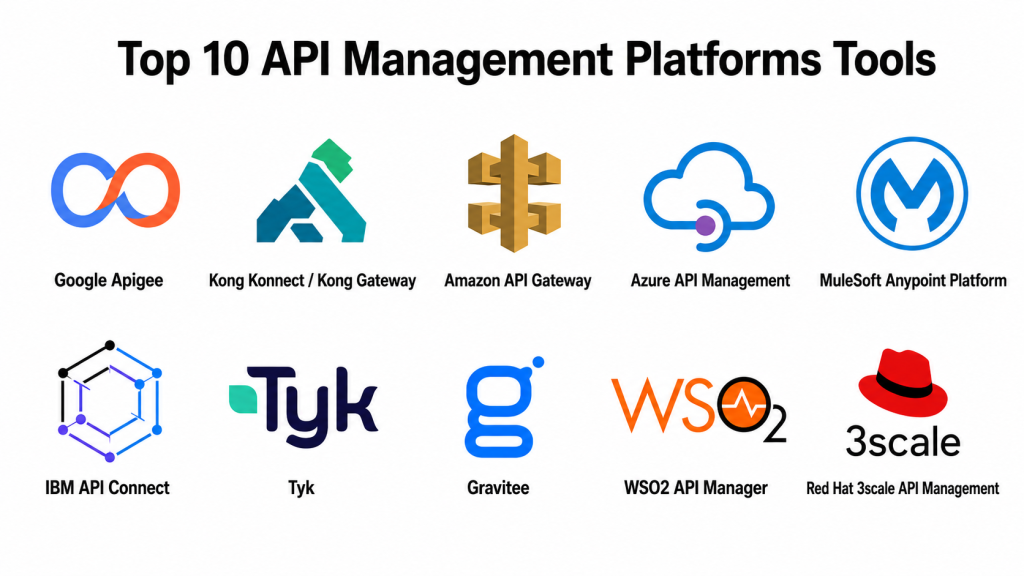
Top 10 API Management Platforms Tools
#1 — Google Apigee
Short description: Google Apigee is an enterprise API management platform used to secure, publish, analyze, and monetize APIs. It is best for large organizations, API-first businesses, and teams that need strong lifecycle governance, analytics, developer portals, and hybrid deployment options.
Key Features
- API gateway and traffic management
- API security policies
- Developer portal capabilities
- API analytics and monitoring
- API monetization support
- Hybrid deployment options
- API lifecycle and governance features
Pros
- Strong enterprise API management capabilities.
- Good fit for organizations with large API programs.
- Useful for analytics, monetization, and developer ecosystem management.
Cons
- May be too complex for small teams.
- Pricing and setup can require careful planning.
- Best value appears when API strategy is mature.
Platforms / Deployment
Web
Cloud / Hybrid
Security & Compliance
Apigee supports enterprise API security capabilities such as authentication policies, authorization controls, traffic protection, rate limiting, and identity integration patterns. Specific compliance details such as SOC 2, ISO 27001, HIPAA, audit logs, SSO, and RBAC should be verified directly based on deployment and plan.
Integrations & Ecosystem
Apigee fits well into enterprise and cloud-native API ecosystems where APIs connect many internal and external systems.
- Google Cloud services
- Identity providers
- CI/CD pipelines
- Monitoring and logging tools
- Developer portals
- API monetization workflows
Support & Community
Apigee has enterprise documentation, Google Cloud support options, partner support, and a strong presence in large-scale API programs. It is best suited for teams with formal API strategy and governance needs.
#2 — Kong Konnect / Kong Gateway
Short description: Kong is an API gateway and API management platform used by platform teams, DevOps teams, and cloud-native organizations. It is known for high-performance API gateway capabilities, plugin-based extensibility, Kubernetes support, and flexible deployment models.
Key Features
- API gateway
- Plugin-based policy management
- Kubernetes-native support
- Service connectivity features
- Authentication and rate limiting
- Developer portal options
- Cloud and self-managed deployment choices
Pros
- Strong fit for cloud-native and microservices environments.
- Flexible plugin ecosystem.
- Good choice for teams using Kubernetes and platform engineering practices.
Cons
- Advanced setup may require platform engineering skills.
- Some enterprise features depend on selected edition or plan.
- Governance workflows may need careful configuration.
Platforms / Deployment
Web / Linux / Kubernetes
Cloud / Self-hosted / Hybrid
Security & Compliance
Kong supports security policies such as authentication, authorization, rate limiting, traffic control, and plugin-based enforcement. Specific compliance features such as SSO, audit logs, SOC 2, ISO 27001, HIPAA, encryption controls, and RBAC should be verified directly by edition and deployment model.
Integrations & Ecosystem
Kong has a strong ecosystem for API gateway, microservices, Kubernetes, and service connectivity workflows.
- Kubernetes
- Service mesh patterns
- Identity providers
- Observability tools
- CI/CD pipelines
- Plugin ecosystem
Support & Community
Kong has strong documentation, open-source community presence, enterprise support options, and adoption among platform teams. It is a strong choice for technical teams that want flexibility and cloud-native architecture.
#3 — Amazon API Gateway
Short description: Amazon API Gateway is a managed API gateway service for creating, publishing, securing, monitoring, and scaling APIs in AWS environments. It is best for teams building serverless apps, microservices, backend APIs, and cloud-native architectures on AWS.
Key Features
- Managed API gateway service
- REST and HTTP API support
- WebSocket API support
- AWS Lambda integration
- Authentication and authorization options
- Throttling and rate limiting
- Monitoring through AWS services
Pros
- Strong fit for AWS-native applications.
- Good for serverless and microservices architectures.
- Reduces infrastructure management effort.
Cons
- Best suited for AWS-heavy environments.
- Cross-cloud portability may require extra planning.
- Pricing depends on usage and architecture patterns.
Platforms / Deployment
Web
Cloud
Security & Compliance
Amazon API Gateway supports security controls through AWS identity, authorization, resource policies, throttling, logging, and encryption patterns. Specific compliance requirements such as SOC 2, ISO 27001, HIPAA, audit logs, SSO, and RBAC should be verified through AWS compliance documentation and account configuration.
Integrations & Ecosystem
Amazon API Gateway works deeply within the AWS ecosystem.
- AWS Lambda
- AWS IAM
- Amazon CloudWatch
- Amazon Cognito
- AWS WAF
- VPC and backend services
Support & Community
AWS provides extensive documentation, support plans, architecture guidance, and a large developer ecosystem. Amazon API Gateway is a strong option for teams already building on AWS.
#4 — Azure API Management
Short description: Azure API Management is Microsoft’s API management platform for publishing, securing, transforming, monitoring, and managing APIs. It is useful for enterprises, cloud teams, and organizations already using Microsoft Azure and Microsoft identity services.
Key Features
- API gateway
- Developer portal
- API policy management
- Authentication and authorization support
- API analytics and monitoring
- Versioning and revision support
- Integration with Azure services
Pros
- Strong fit for Microsoft and Azure environments.
- Good enterprise governance and identity integration.
- Useful for hybrid and cloud API programs.
Cons
- Best value appears inside the Azure ecosystem.
- Setup and policy design can require expertise.
- Pricing tiers and capacity planning need review.
Platforms / Deployment
Web
Cloud / Hybrid
Security & Compliance
Azure API Management supports policy-based security, identity integration, authentication, authorization, subscription keys, rate limiting, and monitoring. Specific compliance items such as SOC 2, ISO 27001, HIPAA, SSO, audit logs, encryption, and RBAC should be verified through Microsoft’s compliance and Azure configuration details.
Integrations & Ecosystem
Azure API Management works well with Microsoft enterprise and cloud services.
- Microsoft Entra ID
- Azure Functions
- Azure Monitor
- Azure Logic Apps
- Azure Kubernetes Service
- CI/CD tools
Support & Community
Azure API Management benefits from Microsoft documentation, Azure support plans, partner ecosystem, and large enterprise adoption. It is a practical choice for teams already standardized on Azure.
#5 — MuleSoft Anypoint Platform
Short description: MuleSoft Anypoint Platform is an integration and API management platform used by enterprises to connect applications, data, services, and APIs. It is best for organizations that need API management along with enterprise integration, reusable connectors, and lifecycle governance.
Key Features
- API management
- Integration platform capabilities
- API design and lifecycle tools
- Developer portal and exchange
- Policy enforcement
- Monitoring and analytics
- Connectors for enterprise systems
Pros
- Strong for enterprise integration and API-led connectivity.
- Useful for complex application and data integration needs.
- Good fit for large organizations with many systems.
Cons
- Can be complex for smaller teams.
- Implementation may require skilled integration architects.
- Pricing and governance need careful planning.
Platforms / Deployment
Web
Cloud / Hybrid
Security & Compliance
MuleSoft supports enterprise security patterns such as policy enforcement, identity integration, access control, API protection, and monitoring. Specific compliance details such as SOC 2, ISO 27001, HIPAA, SSO, audit logs, encryption, and RBAC should be verified directly based on deployment and plan.
Integrations & Ecosystem
MuleSoft is especially strong in enterprise integration environments.
- CRM systems
- ERP platforms
- Databases
- SaaS applications
- Legacy systems
- API-led integration workflows
Support & Community
MuleSoft offers enterprise support, documentation, training, certifications, partner ecosystem, and a strong integration-focused community. It is best for organizations where APIs and integrations are part of a larger enterprise architecture strategy.
#6 — IBM API Connect
Short description: IBM API Connect is an API management platform for creating, securing, managing, socializing, and analyzing APIs. It is suitable for enterprises, regulated industries, hybrid cloud environments, and organizations that need strong governance and lifecycle control.
Key Features
- API gateway
- API lifecycle management
- Developer portal
- API analytics
- Security policies
- Productization and API packaging
- Hybrid deployment support
Pros
- Strong enterprise and regulated-industry fit.
- Good API lifecycle and governance features.
- Useful for hybrid environments and complex IT landscapes.
Cons
- May be too heavy for small API programs.
- Setup and administration may require experienced teams.
- Pricing and deployment planning should be reviewed carefully.
Platforms / Deployment
Web
Cloud / Self-hosted / Hybrid
Security & Compliance
IBM API Connect supports enterprise API security patterns such as authentication, authorization, rate limiting, access control, policy enforcement, and governance. Specific compliance requirements such as SOC 2, ISO 27001, HIPAA, audit logs, SSO, encryption, and RBAC should be verified directly based on deployment model and plan.
Integrations & Ecosystem
IBM API Connect works well in enterprise environments with hybrid systems and regulated workloads.
- IBM Cloud
- Kubernetes
- Enterprise identity systems
- Monitoring tools
- Backend services
- API developer portals
Support & Community
IBM provides enterprise documentation, support, consulting, partner services, and ecosystem resources. It is suited for organizations that need formal API governance and enterprise-grade operations.
#7 — Tyk
Short description: Tyk is an API management platform and gateway known for flexibility, open-source options, cloud deployment, self-managed deployment, and developer-friendly API management. It is useful for teams that want control, extensibility, and flexible deployment.
Key Features
- API gateway
- Developer portal
- API analytics
- Rate limiting and quota controls
- Authentication support
- Open-source and enterprise options
- Cloud, self-managed, and hybrid deployment choices
Pros
- Flexible deployment options.
- Good for teams that want open-source-friendly API management.
- Useful for modern API and microservices environments.
Cons
- Advanced operations may require technical expertise.
- Enterprise features depend on selected edition.
- Larger governance programs need thoughtful setup.
Platforms / Deployment
Web / Linux / Kubernetes
Cloud / Self-hosted / Hybrid
Security & Compliance
Tyk supports API security features such as authentication, rate limiting, quota control, access policies, and traffic management. Specific compliance items such as SOC 2, ISO 27001, HIPAA, SSO, audit logs, encryption, and RBAC should be verified directly based on edition and deployment.
Integrations & Ecosystem
Tyk fits into cloud-native and API-first environments with flexible integration needs.
- Kubernetes
- Identity providers
- Monitoring tools
- CI/CD pipelines
- Backend APIs
- Developer portal workflows
Support & Community
Tyk has documentation, open-source community resources, enterprise support, and developer-focused guidance. It is a strong option for teams that value flexibility and deployment control.
#8 — Gravitee
Short description: Gravitee is an API management and event-native API platform that supports API gateway, API design, security, developer portals, monitoring, and governance. It is useful for organizations managing REST, event-driven, and modern API ecosystems.
Key Features
- API gateway
- Developer portal
- API design and lifecycle management
- Event-native API support
- Access management options
- Analytics and monitoring
- Policy management
Pros
- Strong support for modern and event-driven API patterns.
- Flexible deployment options.
- Useful for organizations managing diverse API styles.
Cons
- May require learning for teams new to API governance.
- Advanced use cases need skilled setup.
- Enterprise capabilities vary by edition and plan.
Platforms / Deployment
Web / Linux / Kubernetes
Cloud / Self-hosted / Hybrid
Security & Compliance
Gravitee supports security features such as API policies, access control, authentication patterns, and traffic management. Specific compliance details such as SOC 2, ISO 27001, HIPAA, SSO, audit logs, encryption, and RBAC should be verified directly.
Integrations & Ecosystem
Gravitee fits well into environments managing APIs across multiple protocols and deployment models.
- REST APIs
- Event-driven APIs
- Identity providers
- Kubernetes
- Observability tools
- Developer portals
Support & Community
Gravitee provides documentation, community resources, support options, and enterprise services. It is a strong fit for teams that want modern API management beyond traditional REST-only use cases.
#9 — WSO2 API Manager
Short description: WSO2 API Manager is an open-source and enterprise API management platform for designing, publishing, securing, monitoring, and analyzing APIs. It is useful for organizations that want strong API management capabilities with flexible deployment options.
Key Features
- API gateway
- API publisher and developer portal
- API analytics
- Security and policy management
- Lifecycle management
- Monetization support
- Cloud and self-managed options
Pros
- Strong open-source and enterprise flexibility.
- Good feature depth for API lifecycle management.
- Useful for organizations that want deployment control.
Cons
- Setup and administration may require experienced teams.
- User experience may feel more technical than simpler platforms.
- Enterprise support and implementation planning may be needed.
Platforms / Deployment
Web / Linux / Kubernetes
Cloud / Self-hosted / Hybrid
Security & Compliance
WSO2 API Manager supports API authentication, authorization, throttling, access control, policy enforcement, and governance features. Specific compliance requirements such as SOC 2, ISO 27001, HIPAA, SSO, audit logs, encryption, and RBAC should be verified directly based on deployment and support plan.
Integrations & Ecosystem
WSO2 API Manager fits enterprise and technical environments that need flexible API lifecycle management.
- Identity providers
- Kubernetes
- Databases
- Monitoring tools
- CI/CD pipelines
- Enterprise backend systems
Support & Community
WSO2 has documentation, open-source community resources, enterprise support options, and implementation partners. It is a practical option for teams that want API management flexibility and ownership.
#10 — Red Hat 3scale API Management
Short description: Red Hat 3scale API Management helps teams share, secure, distribute, control, and monetize APIs. It is especially relevant for organizations using Red Hat technologies, Kubernetes, OpenShift, and enterprise cloud-native environments.
Key Features
- API gateway and management
- Developer portal
- API access policies
- Rate limits and quotas
- API analytics
- Monetization support
- OpenShift and Kubernetes alignment
Pros
- Strong fit for Red Hat and OpenShift environments.
- Useful for enterprise API governance.
- Good for organizations that need hybrid and cloud-native API control.
Cons
- Best suited for teams already using Red Hat ecosystem.
- Setup may require platform engineering knowledge.
- Smaller teams may prefer simpler managed API platforms.
Platforms / Deployment
Web / Linux / Kubernetes
Cloud / Self-hosted / Hybrid
Security & Compliance
Red Hat 3scale supports API access control, policy enforcement, rate limiting, authentication patterns, and enterprise deployment workflows. Specific compliance requirements such as SOC 2, ISO 27001, HIPAA, SSO, audit logs, encryption, and RBAC should be verified based on deployment and Red Hat subscription details.
Integrations & Ecosystem
Red Hat 3scale fits well into Kubernetes, OpenShift, and enterprise API ecosystems.
- Red Hat OpenShift
- Kubernetes
- Identity providers
- Monitoring tools
- Backend APIs
- Developer portal workflows
Support & Community
Red Hat provides enterprise support, documentation, consulting, partner ecosystem, and strong alignment with OpenShift-based platform engineering environments.
Comparison Table
| Tool Name | Best For | Platform(s) Supported | Deployment | Standout Feature | Public Rating |
|---|---|---|---|---|---|
| Google Apigee | Enterprise API programs | Web | Cloud / Hybrid | API analytics, monetization, and governance | N/A |
| Kong Konnect / Kong Gateway | Cloud-native API gateway teams | Web / Linux / Kubernetes | Cloud / Self-hosted / Hybrid | Plugin-based gateway and Kubernetes support | N/A |
| Amazon API Gateway | AWS-native APIs and serverless apps | Web | Cloud | Managed AWS API gateway service | N/A |
| Azure API Management | Microsoft and Azure enterprises | Web | Cloud / Hybrid | Azure-native API policies and developer portal | N/A |
| MuleSoft Anypoint Platform | Enterprise integration and API-led connectivity | Web | Cloud / Hybrid | API management with integration platform depth | N/A |
| IBM API Connect | Regulated and hybrid enterprise environments | Web | Cloud / Self-hosted / Hybrid | API lifecycle governance and enterprise control | N/A |
| Tyk | Flexible and open-source-friendly API teams | Web / Linux / Kubernetes | Cloud / Self-hosted / Hybrid | Flexible deployment and gateway control | N/A |
| Gravitee | Modern and event-driven API ecosystems | Web / Linux / Kubernetes | Cloud / Self-hosted / Hybrid | Event-native API management support | N/A |
| WSO2 API Manager | Open-source and enterprise API programs | Web / Linux / Kubernetes | Cloud / Self-hosted / Hybrid | Full API lifecycle with deployment flexibility | N/A |
| Red Hat 3scale API Management | OpenShift and Red Hat environments | Web / Linux / Kubernetes | Cloud / Self-hosted / Hybrid | API management aligned with OpenShift | N/A |
Evaluation & Scoring of API Management Platforms Tools
| Tool Name | Core (25%) | Ease (15%) | Integrations (15%) | Security (10%) | Performance (10%) | Support (10%) | Value (15%) | Weighted Total (0–10) |
|---|---|---|---|---|---|---|---|---|
| Google Apigee | 10 | 7 | 9 | 9 | 9 | 9 | 7 | 8.65 |
| Kong Konnect / Kong Gateway | 9 | 7 | 9 | 8 | 9 | 8 | 8 | 8.35 |
| Amazon API Gateway | 8 | 8 | 9 | 9 | 9 | 8 | 8 | 8.40 |
| Azure API Management | 9 | 8 | 9 | 9 | 8 | 9 | 8 | 8.60 |
| MuleSoft Anypoint Platform | 10 | 7 | 10 | 9 | 8 | 9 | 6 | 8.45 |
| IBM API Connect | 9 | 7 | 8 | 9 | 8 | 9 | 7 | 8.15 |
| Tyk | 8 | 7 | 8 | 8 | 8 | 8 | 9 | 8.00 |
| Gravitee | 8 | 7 | 8 | 8 | 8 | 8 | 8 | 7.85 |
| WSO2 API Manager | 8 | 6 | 8 | 8 | 8 | 8 | 9 | 7.85 |
| Red Hat 3scale API Management | 8 | 7 | 8 | 8 | 8 | 8 | 7 | 7.75 |
These scores are comparative and should be read in context. Apigee, Azure API Management, MuleSoft, and IBM API Connect are strong for enterprise API programs. Kong, Tyk, Gravitee, WSO2, and Red Hat 3scale are attractive when deployment flexibility and cloud-native control matter. Amazon API Gateway is highly practical for AWS-native systems. The best choice depends on API volume, cloud strategy, governance needs, team skills, security requirements, and budget.
Which API Management Platforms Tool Is Right for You?
Solo / Freelancer
Solo developers and freelancers usually do not need a heavy enterprise API management platform unless they are building API products or managing client API programs. For smaller use cases, Amazon API Gateway, Kong Gateway, Tyk, or WSO2 API Manager may be practical choices depending on technical comfort and deployment needs.
Choose Amazon API Gateway if your project is already on AWS. Choose Kong or Tyk if you want gateway flexibility. Choose WSO2 API Manager if you want broader API lifecycle features and are comfortable with a more technical setup.
SMB
Small and medium businesses need API security, rate limiting, developer access control, analytics, and simple integration with cloud services. Amazon API Gateway, Azure API Management, Kong, Tyk, and Gravitee are strong options.
Choose Amazon API Gateway for AWS-native teams. Choose Azure API Management for Microsoft environments. Choose Kong if your team is building microservices or Kubernetes-based systems. Choose Tyk or Gravitee when flexibility and deployment choice matter.
Mid-Market
Mid-market organizations often need stronger governance, developer portals, API analytics, identity integration, versioning, and lifecycle management. Apigee, Azure API Management, Kong, MuleSoft, Gravitee, and IBM API Connect are practical choices.
Choose Apigee if API strategy, analytics, monetization, and developer ecosystems are important. Choose MuleSoft if API management is part of a larger integration strategy. Choose Kong or Gravitee if cloud-native gateway flexibility is more important than a traditional enterprise suite.
Enterprise
Enterprise buyers should prioritize governance, security, hybrid deployment, identity integration, auditability, compliance evidence, developer experience, lifecycle management, and operational reliability. Google Apigee, MuleSoft Anypoint Platform, Azure API Management, IBM API Connect, and Red Hat 3scale are strong enterprise-oriented options.
Choose Apigee for API productization, analytics, and enterprise API programs. Choose MuleSoft for API-led integration across many business systems. Choose Azure API Management for Microsoft-heavy organizations. Choose IBM API Connect for hybrid and regulated enterprise environments. Choose Red Hat 3scale when OpenShift and Red Hat platform alignment are important.
Budget vs Premium
If budget is a major concern, open-source-friendly or flexible platforms such as Kong Gateway, Tyk, WSO2 API Manager, and Gravitee may be attractive. However, buyers should include infrastructure, operations, support, security review, and internal expertise in the total cost.
Premium platforms such as Apigee, MuleSoft, IBM API Connect, and enterprise editions of other tools may cost more, but they often provide stronger governance, support, analytics, lifecycle controls, and enterprise integration depth.
Feature Depth vs Ease of Use
If ease of use matters most, managed cloud options like Amazon API Gateway and Azure API Management can reduce infrastructure burden. They are especially useful when teams are already standardized on those cloud platforms.
If feature depth matters more, Apigee, MuleSoft, IBM API Connect, Kong, Gravitee, and WSO2 API Manager provide broader control across gateway, portal, analytics, governance, security, and deployment models.
Integrations & Scalability
API management platforms must connect with identity providers, monitoring tools, Kubernetes, CI/CD systems, cloud services, databases, security platforms, developer portals, and backend services.
Choose MuleSoft when enterprise system integration is central. Choose Kong, Tyk, or Gravitee for cloud-native and microservices environments. Choose Amazon API Gateway or Azure API Management when you want tight integration with a specific cloud provider. Choose Apigee for broader API strategy and analytics maturity.
Security & Compliance Needs
Security and compliance should be central to API management selection. Review OAuth, OpenID Connect, mTLS, API keys, JWT validation, SSO, RBAC, audit logs, rate limiting, quotas, DDoS protection, schema validation, encryption, logging, and access governance.
For regulated industries, involve security, legal, compliance, and architecture teams early. Do not choose an API management platform only based on gateway performance or pricing. API governance, policy enforcement, auditability, and data protection are equally important.
Frequently Asked Questions
What is an API management platform?
An API management platform helps teams publish, secure, monitor, govern, and analyze APIs. It usually includes an API gateway, developer portal, access control, traffic policies, analytics, and lifecycle management features.
How is an API gateway different from API management?
An API gateway handles runtime traffic such as routing, authentication, rate limiting, and policy enforcement. API management is broader and includes developer portals, lifecycle governance, documentation, analytics, monetization, versioning, and access workflows.
Which API management platform is best for enterprises?
Google Apigee, MuleSoft Anypoint Platform, Azure API Management, IBM API Connect, and Red Hat 3scale are strong enterprise options. The best fit depends on cloud strategy, integration needs, governance model, and security requirements.
Which API management tool is best for AWS users?
Amazon API Gateway is a practical choice for AWS-native teams because it integrates deeply with AWS services. However, teams may still consider Kong, Apigee, Tyk, or other platforms if they need multi-cloud or hybrid flexibility.
Which API management platform is best for Kubernetes?
Kong, Tyk, Gravitee, WSO2 API Manager, and Red Hat 3scale can fit Kubernetes-oriented environments. The right choice depends on gateway architecture, policy needs, operational skills, and enterprise support expectations.
Do API management platforms improve security?
Yes, they can improve API security by enforcing authentication, authorization, rate limiting, quotas, threat protection, token validation, and policy controls. However, they must be configured correctly and aligned with backend security practices.
What are common mistakes when choosing API management software?
Common mistakes include focusing only on gateway speed, ignoring developer experience, underestimating governance needs, skipping security review, not planning versioning, and choosing a platform that does not match the organization’s cloud strategy.
Can API management platforms support monetization?
Yes, some platforms support API monetization through products, plans, quotas, subscriptions, usage tracking, and billing-related workflows. Apigee, MuleSoft, WSO2, Red Hat 3scale, and others may support API productization depending on configuration.
Are open-source API management tools good for production?
Open-source-friendly platforms can work well in production if teams have the right operations skills, security practices, monitoring, support model, and upgrade process. Enterprise support may be important for critical workloads.
What pricing factors should buyers check?
Buyers should check API call volume, gateway instances, environments, developer portal access, analytics retention, security features, support levels, self-hosting costs, cloud infrastructure costs, and enterprise add-ons.
How hard is it to switch API management platforms?
Switching can be complex because teams may need to migrate policies, developer portals, credentials, documentation, analytics, routing rules, API products, and consumer onboarding flows. A phased migration is usually safer.
Do small teams need API management?
Small teams may not need a full API management suite at the beginning. A managed API gateway or lightweight gateway may be enough until API traffic, security needs, developer onboarding, or partner access becomes more complex.
Conclusion
API management platforms are essential for organizations that rely on APIs to connect applications, customers, partners, developers, microservices, and business systems. However, there is no single best platform for every team. Google Apigee is strong for mature enterprise API programs. Kong is powerful for cloud-native gateway and Kubernetes use cases. Amazon API Gateway is practical for AWS-native teams. Azure API Management fits Microsoft and Azure environments. MuleSoft is strong when API management and enterprise integration need to work together. IBM API Connect is useful for governed and hybrid enterprise environments. Tyk, Gravitee, and WSO2 offer flexible options for teams that want deployment control. Red Hat 3scale is a strong fit for Red Hat and OpenShift-aligned organizations.
