Upgrade & Secure Your Future with DevOps, SRE, DevSecOps, MLOps!
We spend hours scrolling social media and waste money on things we forget, but won’t spend 30 minutes a day earning certifications that can change our lives.
Master in DevOps, SRE, DevSecOps & MLOps by DevOps School!
Learn from Guru Rajesh Kumar and double your salary in just one year.
Introduction
AdTech platforms help businesses plan, buy, manage, optimize, and measure digital advertising campaigns across channels such as search, display, video, mobile, social, connected TV, and programmatic media. In simple terms, they help advertisers reach the right audience with the right message at the right time while tracking performance and spend.
AdTech matters because digital advertising is becoming more data-driven, privacy-aware, and automated. Businesses now need platforms that can manage campaigns efficiently while respecting consent, data rules, identity changes, and performance expectations.
Common use cases include:
- Programmatic ad buying
- Campaign planning and optimization
- Audience targeting and segmentation
- Cross-channel advertising management
- Attribution and performance reporting
Buyers should evaluate audience targeting, privacy controls, integrations, analytics, automation, AI features, inventory quality, brand safety, fraud protection, scalability, support, and total cost.
Best for: Marketing teams, media buyers, agencies, enterprise advertisers, eCommerce brands, app marketers, and performance marketing teams.
Not ideal for: Very small businesses with simple ad needs, teams without campaign strategy, or companies that only need basic boosting inside social platforms.
Key Trends in AdTech Platforms
AI-based campaign optimization: Platforms are using AI to improve bidding, audience selection, creative testing, and budget allocation.
- Privacy-first targeting: Third-party cookie changes and privacy rules are pushing advertisers toward first-party data and contextual targeting.
- Connected TV growth: CTV advertising is becoming a key channel for brands that want digital-style targeting with video reach.
- Retail media expansion: Retailers are building ad networks that combine shopping data with sponsored placements.
- Clean rooms and data collaboration: Brands are using privacy-safe environments to match and analyze audience data.
- Creative automation: Dynamic creative optimization is helping teams personalize ad creatives at scale.
- Fraud and brand safety focus: Advertisers are demanding stronger protection against invalid traffic and unsafe placements.
- Cross-channel measurement: Teams want one view of campaign performance across display, video, search, social, mobile, and CTV.
- Self-serve platforms: More platforms are becoming easier for SMBs and mid-market teams to use without heavy agency support.
- Outcome-based buying: Advertisers are focusing more on conversions, revenue, qualified leads, and measurable business results.
How We Selected These Tools
The tools below were selected using a practical buyer-focused methodology:
- Market recognition and adoption among advertisers, agencies, and media teams
- Strength of campaign buying, targeting, optimization, and reporting features
- Support for multiple advertising channels and campaign types
- Reliability, scale, and performance signals
- Audience data, identity, and targeting capabilities
- Brand safety, fraud protection, and compliance posture
- Integration ecosystem with analytics, CRM, CDP, and data platforms
- Suitability across SMB, mid-market, enterprise, and agency use cases
- Support quality, onboarding maturity, and documentation availability
- Overall value compared with complexity and cost
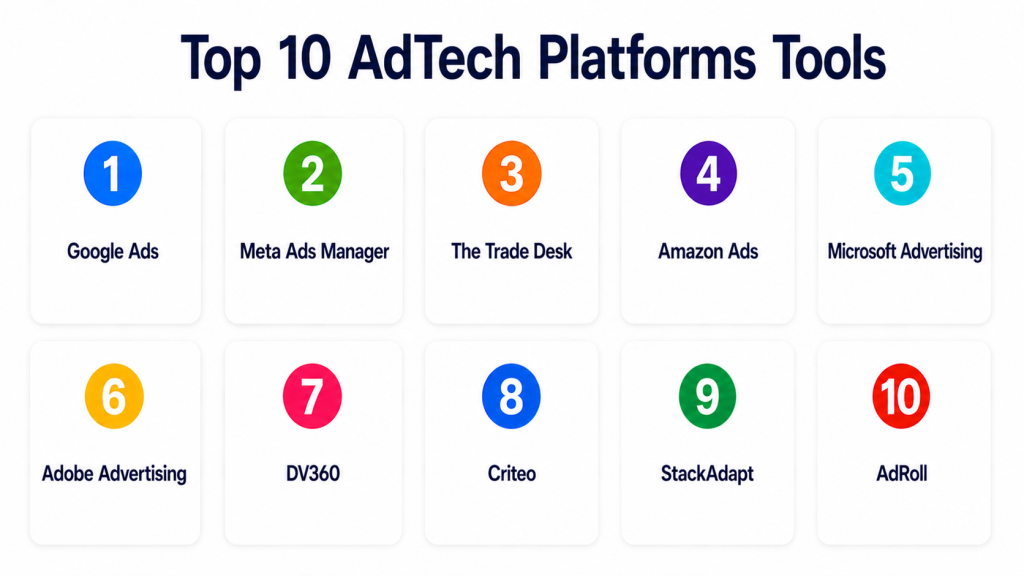
Top 10 AdTech Platforms Tools
#1 — Google Ads
Short description = Google Ads is one of the most widely used digital advertising platforms for search, display, shopping, video, app, and performance campaigns. It is suitable for businesses of nearly all sizes that want measurable digital advertising reach.
Key Features
- Search, display, shopping, video, and app campaign support
- AI-powered bidding and campaign optimization
- Keyword targeting and audience targeting
- Conversion tracking and performance reporting
- Remarketing and customer match capabilities
- Integration with Google Analytics and other Google tools
- Broad advertiser reach across Google properties
Pros
- Very strong reach and advertiser adoption
- Good for performance marketing and demand capture
- Strong reporting and optimization ecosystem
Cons
- Competitive keywords can be expensive
- Campaign setup requires careful management
- Automation may reduce manual control in some campaign types
Platforms / Deployment
Web / iOS / Android
Cloud
Security & Compliance
Supports account security controls such as MFA, user access permissions, and privacy-related advertising controls. Specific enterprise compliance details vary by Google service and account configuration.
Integrations & Ecosystem
Google Ads integrates strongly with analytics, measurement, CRM, and conversion tracking workflows.
- Google Analytics
- Google Tag Manager
- CRM systems
- eCommerce platforms
- Data import tools
- Attribution and reporting tools
Support & Community
Google Ads has extensive documentation, learning resources, community forums, partner agencies, and advertiser support options.
#2 — Meta Ads Manager
Short description= Meta Ads Manager helps businesses run advertising campaigns across Facebook, Instagram, Messenger, and Meta Audience Network. It is widely used for consumer marketing, lead generation, app campaigns, and eCommerce advertising.
Key Features
- Facebook and Instagram campaign management
- Audience targeting and lookalike audiences
- AI-assisted campaign optimization
- Creative testing and placement control
- Conversion tracking with pixel and events
- Lead generation campaign support
- Campaign reporting and budget management
Pros
- Strong reach across social audiences
- Useful for visual, creator, and eCommerce campaigns
- Powerful audience and creative testing options
Cons
- Performance can depend heavily on creative quality
- Privacy changes can affect tracking accuracy
- Interface and policy rules can be challenging for beginners
Platforms / Deployment
Web / iOS / Android
Cloud
Security & Compliance
Supports business account permissions, two-factor authentication, role-based access, and advertising policy controls. Specific compliance certifications are not stated here.
Integrations & Ecosystem
Meta Ads Manager connects well with eCommerce, analytics, CRM, and tracking systems.
- Meta Pixel and conversion events
- eCommerce platforms
- CRM tools
- Analytics platforms
- Creative tools
- Lead management systems
Support & Community
Meta provides documentation, advertiser education, business help resources, and agency partner support. Community knowledge is broad due to high platform usage.
#3 — The Trade Desk
Short description= The Trade Desk is a major demand-side platform used for programmatic advertising across display, video, audio, mobile, native, and connected TV. It is mainly suited for agencies, enterprise advertisers, and advanced media buying teams.
Key Features
- Programmatic media buying
- Cross-channel campaign management
- Connected TV and video advertising support
- Audience targeting and data marketplace access
- AI-assisted bidding and optimization
- Measurement and attribution tools
- Brand safety and inventory quality controls
Pros
- Strong programmatic buying capabilities
- Good for advanced cross-channel media strategies
- Strong fit for agencies and enterprise advertisers
Cons
- Not ideal for beginners or very small budgets
- Requires programmatic media buying expertise
- Pricing and access may depend on business arrangement
Platforms / Deployment
Web
Cloud
Security & Compliance
Enterprise-grade access controls and privacy-focused advertising controls are commonly available. Specific certifications should be validated during procurement.
Integrations & Ecosystem
The Trade Desk works across a broad programmatic ecosystem with data, measurement, and media partners.
- Data providers
- Measurement platforms
- CTV inventory partners
- Brand safety tools
- Attribution platforms
- Agency reporting workflows
Support & Community
Support is typically enterprise and agency-oriented, with onboarding, account teams, documentation, and professional guidance.
#4 — Amazon Ads
Short description = Amazon Ads helps brands advertise across Amazon shopping placements, display, video, streaming, and other media formats. It is especially valuable for eCommerce brands, marketplace sellers, and retail-focused advertisers.
Key Features
- Sponsored Products, Sponsored Brands, and Sponsored Display
- Retail media advertising
- Shopping intent-based targeting
- Amazon DSP access for programmatic campaigns
- Video and streaming ad options
- Campaign reporting and retail insights
- Brand store and product-focused ad formats
Pros
- Strong shopping intent data
- Useful for eCommerce and retail media campaigns
- Good fit for brands selling on Amazon
Cons
- Best value often depends on Amazon marketplace presence
- Campaign complexity can increase across formats
- Competitive categories may require high budgets
Platforms / Deployment
Web
Cloud
Security & Compliance
Supports business account security, user permissions, and platform advertising controls. Specific compliance certifications are not stated here.
Integrations & Ecosystem
Amazon Ads connects strongly with retail, commerce, and measurement workflows.
- Amazon Seller and Vendor tools
- Amazon DSP
- Retail analytics
- Attribution tools
- Creative services
- Third-party campaign management tools
Support & Community
Amazon Ads provides documentation, learning resources, account support options, and agency ecosystem support.
#5 — Microsoft Advertising
Short description= Microsoft Advertising helps businesses run search, audience, shopping, and display campaigns across Microsoft’s search and partner ecosystem. It is useful for advertisers who want to expand beyond Google search.
Key Features
- Search advertising
- Shopping campaigns
- Audience targeting
- LinkedIn profile targeting options in selected contexts
- Import tools from other ad platforms
- Conversion tracking
- Campaign analytics and reporting
Pros
- Useful additional search reach
- Often less crowded than some Google Ads auctions
- Good integration with Microsoft ecosystem
Cons
- Lower search volume than Google in many markets
- Advanced features may vary by region
- Requires separate optimization strategy
Platforms / Deployment
Web
Cloud
Security & Compliance
Supports account-level security, permissions, and access controls. Specific compliance certifications are not stated here.
Integrations & Ecosystem
Microsoft Advertising works well for search marketers and B2B advertisers using Microsoft ecosystem data.
- Microsoft tools
- Analytics platforms
- CRM systems
- Import from Google Ads
- Shopping feeds
- Reporting dashboards
Support & Community
Microsoft provides advertiser documentation, learning resources, support options, and agency partner assistance.
#6 — Adobe Advertising
Short description = Adobe Advertising is an enterprise advertising platform focused on cross-channel campaign management, programmatic buying, search, TV, and connected advertising workflows. It is best for large advertisers already using Adobe’s experience and analytics ecosystem.
Key Features
- Cross-channel advertising management
- Programmatic media buying
- Search advertising workflows
- TV and connected TV support
- Audience and data integrations
- Campaign optimization
- Reporting and measurement tools
Pros
- Strong fit for enterprise marketing stacks
- Works well with Adobe ecosystem products
- Good for complex cross-channel campaigns
Cons
- Can be complex for smaller teams
- Requires mature campaign operations
- Pricing and packaging may not suit SMBs
Platforms / Deployment
Web
Cloud
Security & Compliance
Adobe enterprise products commonly support access controls, permissions, encryption, and compliance-oriented features. Specific certifications should be validated with the vendor.
Integrations & Ecosystem
Adobe Advertising connects well with Adobe Experience Cloud and enterprise marketing systems.
- Adobe Analytics
- Customer data platforms
- Creative tools
- DSP and media systems
- Reporting tools
- Enterprise data workflows
Support & Community
Adobe offers enterprise documentation, professional services, partner support, and account management options.
#7 — DV360
Short description= Display & Video 360 is Google’s enterprise demand-side platform for programmatic display, video, audio, native, and connected TV advertising. It is designed for advanced advertisers, agencies, and enterprise media teams.
Key Features
- Programmatic display and video buying
- Connected TV and audio campaign support
- Advanced audience targeting
- Campaign planning and forecasting
- Creative management
- Brand safety controls
- Measurement and reporting integrations
Pros
- Strong programmatic ecosystem access
- Good integration with Google advertising stack
- Useful for enterprise media buying
Cons
- Not ideal for beginners
- Requires programmatic buying expertise
- Access may depend on business eligibility or partner arrangement
Platforms / Deployment
Web
Cloud
Security & Compliance
Supports Google account security, permissions, and enterprise access controls. Specific certifications should be validated by buyers.
Integrations & Ecosystem
DV360 integrates deeply with Google Marketing Platform and media buying workflows.
- Campaign Manager
- Google Analytics
- Creative tools
- Data platforms
- Measurement partners
- Brand safety solutions
Support & Community
Support is typically enterprise-focused, with documentation, partner support, training resources, and account services.
#8 — Criteo
Short description= Criteo is an AdTech platform known for commerce media, retargeting, retail media, and performance advertising. It is useful for eCommerce brands, retailers, and advertisers focused on shopper behavior.
Key Features
- Commerce media campaigns
- Retargeting and customer acquisition
- Retail media solutions
- Product recommendation ads
- Shopper audience targeting
- Campaign optimization
- Performance reporting
Pros
- Strong eCommerce and commerce media focus
- Useful for product-based advertising
- Good retargeting and shopper insights
Cons
- Best suited for commerce-driven businesses
- Performance depends on data quality and product catalog setup
- May be less relevant for non-retail brands
Platforms / Deployment
Web
Cloud
Security & Compliance
Access controls and privacy-related advertising practices are available. Specific compliance certifications are not stated here.
Integrations & Ecosystem
Criteo fits well into commerce and retail advertising ecosystems.
- eCommerce platforms
- Product catalogs
- Retail media networks
- Data partners
- Measurement platforms
- Campaign management tools
Support & Community
Criteo provides advertiser support, documentation, managed services, and partner guidance.
#9 — StackAdapt
Short description = StackAdapt is a programmatic advertising platform used for native, display, video, connected TV, audio, and digital out-of-home campaigns. It is popular among agencies and performance-focused marketing teams.
Key Features
- Programmatic campaign management
- Native, display, video, audio, and CTV support
- Audience targeting
- Contextual targeting
- Campaign analytics
- Creative testing
- Optimization tools
Pros
- User-friendly compared with some enterprise DSPs
- Strong multi-channel programmatic support
- Good fit for agencies and mid-market teams
Cons
- Still requires programmatic campaign knowledge
- Advanced enterprise needs may require deeper evaluation
- Pricing and access may vary by region and arrangement
Platforms / Deployment
Web
Cloud
Security & Compliance
Security controls are available, but specific certifications should be validated during vendor review.
Integrations & Ecosystem
StackAdapt works with media, analytics, creative, and campaign reporting ecosystems.
- Programmatic inventory partners
- Analytics platforms
- Creative tools
- Reporting systems
- Data providers
- Agency workflows
Support & Community
StackAdapt provides onboarding, documentation, customer support, and training resources for advertisers and agencies.
#10 — AdRoll
Short description= AdRoll is an advertising and marketing platform focused on retargeting, display ads, social ads, email support, and cross-channel performance campaigns. It is often used by eCommerce and growth marketing teams.
Key Features
- Retargeting campaigns
- Display advertising
- Social ad support
- Audience targeting
- Cross-channel campaign management
- Campaign reporting
- eCommerce-focused workflows
Pros
- Good for retargeting and performance campaigns
- Practical for eCommerce and SMB growth teams
- Easier than complex enterprise DSPs
Cons
- Not as deep as enterprise programmatic platforms
- Best performance depends on traffic and audience volume
- Advanced analytics may be limited for large enterprises
Platforms / Deployment
Web
Cloud
Security & Compliance
Common account security controls are available. Specific compliance certifications are not publicly stated here.
Integrations & Ecosystem
AdRoll connects with eCommerce, analytics, and campaign tracking workflows.
- eCommerce platforms
- CRM tools
- Analytics platforms
- Social advertising channels
- Email marketing tools
- Product catalog systems
Support & Community
AdRoll provides documentation, customer support, onboarding guidance, and resources for performance marketers.
Comparison Table (Top 10)
| Tool Name | Best For | Platform(s) Supported | Deployment | Standout Feature | Public Rating |
|---|---|---|---|---|---|
| Google Ads | Search, display, shopping, video campaigns | Web / iOS / Android | Cloud | Large intent-based advertising reach | N/A |
| Meta Ads Manager | Social and visual advertising | Web / iOS / Android | Cloud | Facebook and Instagram audience reach | N/A |
| The Trade Desk | Enterprise programmatic advertising | Web | Cloud | Advanced cross-channel DSP capabilities | N/A |
| Amazon Ads | Retail media and eCommerce advertising | Web | Cloud | Shopping intent-based advertising | N/A |
| Microsoft Advertising | Search and audience campaigns | Web | Cloud | Microsoft search and audience reach | N/A |
| Adobe Advertising | Enterprise cross-channel advertising | Web | Cloud | Adobe ecosystem integration | N/A |
| DV360 | Enterprise display and video programmatic | Web | Cloud | Google Marketing Platform DSP | N/A |
| Criteo | Commerce media and retargeting | Web | Cloud | Shopper-based performance advertising | N/A |
| StackAdapt | Programmatic campaigns for agencies | Web | Cloud | Multi-channel programmatic buying | N/A |
| AdRoll | Retargeting and SMB performance ads | Web | Cloud | Cross-channel retargeting workflows | N/A |
Evaluation & Scoring of AdTech Platforms
| Tool Name | Core (25%) | Ease (15%) | Integrations (15%) | Security (10%) | Performance (10%) | Support (10%) | Value (15%) | Weighted Total (0–10) |
|---|---|---|---|---|---|---|---|---|
| Google Ads | 9 | 8 | 9 | 8 | 9 | 8 | 8 | 8.50 |
| Meta Ads Manager | 8 | 8 | 8 | 8 | 8 | 7 | 8 | 7.95 |
| The Trade Desk | 9 | 6 | 9 | 8 | 9 | 8 | 7 | 8.05 |
| Amazon Ads | 8 | 7 | 8 | 8 | 8 | 8 | 8 | 7.85 |
| Microsoft Advertising | 7 | 8 | 8 | 8 | 8 | 8 | 8 | 7.65 |
| Adobe Advertising | 9 | 6 | 9 | 9 | 8 | 8 | 6 | 7.95 |
| DV360 | 9 | 6 | 9 | 8 | 9 | 8 | 7 | 8.05 |
| Criteo | 8 | 7 | 8 | 7 | 8 | 7 | 8 | 7.60 |
| StackAdapt | 8 | 8 | 7 | 7 | 8 | 8 | 8 | 7.75 |
| AdRoll | 7 | 8 | 7 | 7 | 7 | 7 | 8 | 7.30 |
These scores are comparative and should not be treated as universal rankings. Enterprise DSPs often score higher for depth and scalability, while self-serve platforms may score better for ease of use and accessibility. A platform with a lower score may still be the right choice if it matches your audience, budget, campaign type, and internal skill level.
Which AdTech Platforms Tool Is Right for You?
Solo / Freelancer
Solo marketers and freelancers usually need simple campaign setup, manageable budgets, and clear performance reporting. Google Ads, Meta Ads Manager, Microsoft Advertising, and AdRoll are practical choices because they are easier to access than enterprise DSPs.
SMB
SMBs should focus on platforms that provide measurable performance without heavy technical setup. Google Ads is strong for search intent, Meta Ads Manager is strong for visual and social campaigns, Amazon Ads is useful for retail sellers, and AdRoll can help with retargeting.
Mid-Market
Mid-market companies often need stronger cross-channel campaigns, audience segmentation, analytics, and retargeting. StackAdapt, Criteo, DV360, Google Ads, Meta Ads Manager, and Amazon Ads can be useful depending on media strategy and internal expertise.
Enterprise
Enterprise advertisers usually need scale, brand safety, governance, reporting, data integrations, and multi-channel buying. The Trade Desk, DV360, Adobe Advertising, Amazon Ads, and Google Ads are strong options for larger advertising teams.
Budget vs Premium
Budget-focused advertisers should start with Google Ads, Meta Ads Manager, Microsoft Advertising, or AdRoll. Premium buyers with larger budgets and advanced programmatic needs should evaluate The Trade Desk, DV360, Adobe Advertising, StackAdapt, and Amazon DSP.
Feature Depth vs Ease of Use
Google Ads and Meta Ads Manager offer strong features with relatively accessible interfaces. The Trade Desk, DV360, and Adobe Advertising provide deeper programmatic capabilities but require more expertise. AdRoll and StackAdapt can be easier starting points for performance and programmatic campaigns.
Integrations & Scalability
For deep analytics and measurement, Google Ads and DV360 work well within the Google ecosystem. Adobe Advertising fits better for Adobe-heavy enterprises. Amazon Ads is strong for retail media, while Criteo is useful for commerce-driven campaigns.
Security & Compliance Needs
Enterprise buyers should review user permissions, SSO, MFA, audit logs, data handling, privacy controls, brand safety, fraud protection, and vendor compliance documentation. Regulated industries should validate these details before campaign launch.
Frequently Asked Questions (FAQs)
1. What is an AdTech platform?
An AdTech platform helps businesses buy, manage, optimize, and measure digital advertising. It can support search ads, display ads, video ads, programmatic buying, social ads, retail media, and connected TV campaigns.
2. How much do AdTech platforms cost?
Pricing varies by platform. Some tools use auction-based media spend, while enterprise DSPs may involve managed service fees, minimum spend, platform fees, or custom contracts.
3. Which AdTech platform is best for beginners?
Google Ads and Meta Ads Manager are common starting points because they are widely used and have accessible self-serve interfaces. Beginners should start with small budgets and clear conversion tracking.
4. Which platform is best for programmatic advertising?
The Trade Desk, DV360, Adobe Advertising, StackAdapt, and Amazon DSP are strong programmatic options. The best choice depends on budget, inventory needs, data strategy, and media buying expertise.
5. What is the biggest mistake in AdTech buying?
A common mistake is launching campaigns without proper tracking, audience strategy, creative testing, or conversion goals. Without measurement, optimization becomes guesswork.
6. Are AdTech platforms secure?
Most major platforms provide security controls, but depth varies. Buyers should review user access, permissions, privacy controls, data handling, fraud protection, and compliance documentation.
7. How important is brand safety?
Brand safety is very important, especially for enterprise advertisers. It helps prevent ads from appearing near unsafe, harmful, misleading, or unsuitable content.
8. Can AdTech platforms support AI optimization?
Yes. Many modern platforms use AI or machine learning for bidding, targeting, creative optimization, budget allocation, and performance prediction. Human strategy is still needed to guide goals and evaluate results.
9. Can I switch from one AdTech platform to another?
Yes, but switching requires planning. Teams need to migrate tracking, audiences, creatives, conversion goals, reporting dashboards, and budget structures.
10. What are alternatives to AdTech platforms?
Alternatives include direct media buying, influencer marketing platforms, affiliate marketing platforms, social media boosting, organic marketing, SEO, email marketing, and content partnerships.
11. Which platform is best for eCommerce advertising?
Google Ads, Meta Ads Manager, Amazon Ads, Criteo, and AdRoll are strong eCommerce-oriented choices. The best option depends on product category, catalog quality, budget, and target audience.
12. What should buyers check before choosing an AdTech platform?
Buyers should check audience reach, targeting quality, reporting, conversion tracking, fraud protection, brand safety, integrations, privacy controls, support, pricing model, and campaign scalability.
Conclusion
AdTech platforms help businesses reach audiences, manage advertising spend, optimize campaigns, and measure performance across digital channels. However, the best platform depends on the advertiser’s goals, budget, audience, internal skills, and channel strategy. A small business may get strong value from Google Ads, Meta Ads Manager, Microsoft Advertising, or AdRoll, while an enterprise advertiser may need The Trade Desk, DV360, Adobe Advertising, or Amazon Ads for advanced programmatic and cross-channel buying.
