Upgrade & Secure Your Future with DevOps, SRE, DevSecOps, MLOps!
We spend hours scrolling social media and waste money on things we forget, but won’t spend 30 minutes a day earning certifications that can change our lives.
Master in DevOps, SRE, DevSecOps & MLOps by DevOps School!
Learn from Guru Rajesh Kumar and double your salary in just one year.
Introduction
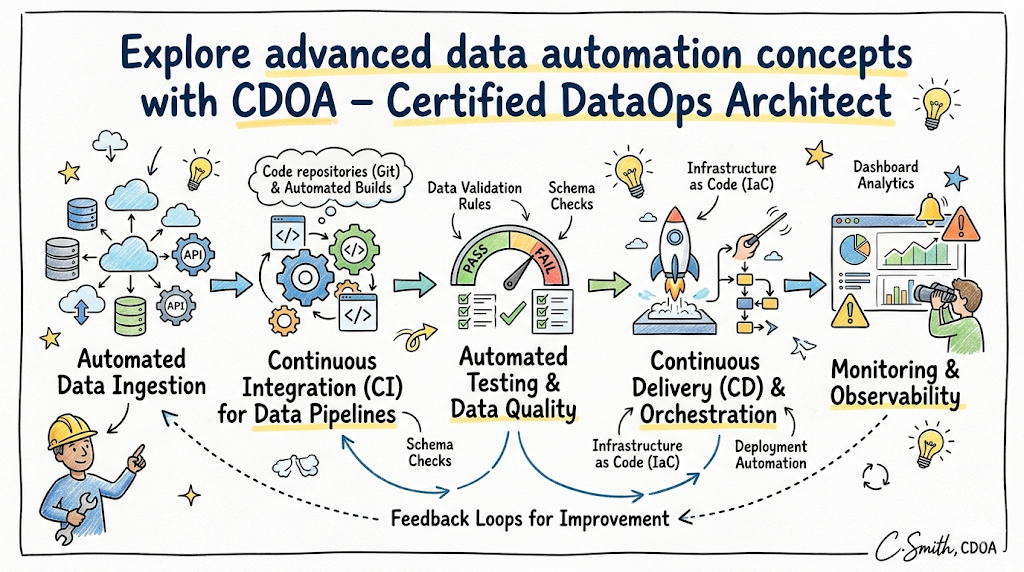
The CDOA – Certified DataOps Architect is a professional credential designed to bridge the gap between data engineering and operational excellence. This guide is crafted for engineers and managers who want to move beyond basic data handling and master the art of automated, scalable, and reliable data pipelines. As the industry shifts toward data-driven decision-making, the role of a DataOps Architect has become a cornerstone of modern platform engineering and cloud-native environments.
Navigating the landscape of data certifications can be overwhelming, but this guide provides a clear roadmap to help you make informed career decisions. By understanding the core competencies of the Dataopsschool program, you can determine how this track fits into your professional growth. Whether you are coming from a DevOps background or a data science role, this certification helps you align technical skills with business value and operational efficiency.
What is the CDOA – Certified DataOps Architect?
The CDOA – Certified DataOps Architect represents a fundamental shift from traditional data management to an agile, automated approach to data delivery. It exists to address the friction often found between data producers and data consumers in large-scale enterprise environments. Instead of focusing solely on theory, this program emphasizes production-focused learning, where the goal is to create repeatable and resilient data workflows.
This certification aligns perfectly with modern engineering workflows by applying DevOps principles—such as continuous integration and continuous delivery—to the data lifecycle. It focuses on the infrastructure, tools, and cultural changes necessary to ensure data quality, speed, and reliability. For professionals working in enterprise practices, it provides a standardized framework for managing complex data ecosystems effectively.
Who Should Pursue CDOA – Certified DataOps Architect?
The CDOA track is highly beneficial for a variety of technical roles, including Data Engineers, Site Reliability Engineers, and Cloud Architects. It is specifically designed for those who find themselves responsible for the reliability and scalability of data platforms and pipelines. Software engineers looking to specialize in the data layer will find the curriculum particularly relevant to their daily challenges and career growth.
In addition to individual contributors, engineering managers and technical leaders can gain immense value from understanding the DataOps framework to lead their teams. Beginners with a strong foundation in Linux and cloud basics can use this as a launchpad, while experienced professionals can use it to formalize their industry expertise. The certification has significant global relevance, especially in tech hubs across India and the global market where data-intensive applications are the norm.
Why CDOA – Certified DataOps Architect is Valuable and Beyond
The demand for DataOps professionals is growing as enterprises realize that data silos and manual processes are no longer sustainable for growth. This certification ensures longevity in your career because it focuses on architectural principles rather than just specific, fleeting tools that may change. As companies adopt more complex cloud-native architectures, the ability to manage data at scale becomes a primary competitive advantage for any organization.
Staying relevant in the technology sector requires a commitment to learning how different domains, like data and operations, intersect in a modern environment. The CDOA program offers a high return on time investment by providing the skills needed to lead large-scale digital transformation projects. It prepares you for a future where data is treated as code, ensuring your expertise remains in high demand regardless of shifts in the vendor landscape.
CDOA – Certified DataOps Architect Certification Overview
The CDOA program is delivered via the official course platform and is hosted on the DataOpsSchool website. The program is structured to provide a logical progression from foundational concepts to advanced architectural design for complex systems. It uses a practical, assessment-based approach to ensure that candidates can actually perform the tasks required in a real-world production environment.
Ownership of the learning process is a key theme, as the certification encourages professionals to take charge of the entire data lifecycle. The levels are clearly defined to help candidates track their progress and identify specific areas for further specialization or improvement. By focusing on practical outcomes, the program ensures that the certification holds weight with hiring managers and technical peers in the industry.
CDOA – Certified DataOps Architect Certification Tracks & Levels
The certification is organized into three primary levels: Foundation, Professional, and Advanced to cater to different stages of an engineer’s career. The Foundation level introduces the core philosophy of DataOps and the basic tooling required for automated pipelines and data management. This level is essential for anyone new to the domain, providing a common language and set of principles to build upon as they progress.
As you move to the Professional and Advanced levels, the focus shifts toward specialized tracks like SRE for Data, FinOps for Data, and automated quality control. These levels align with career progression, moving from individual task execution to high-level system architecture and strategic leadership. This structured path allows professionals to broaden their skills across multiple domains while maintaining a deep focus on data operations.
Complete CDOA – Certified DataOps Architect Certification Table
| Track | Level | Who it’s for | Prerequisites | Skills Covered | Recommended Order |
| DataOps Core | Foundation | Beginners, Junior Engineers | Basic Linux, Cloud basics | CI/CD, GitOps, Data Basics | 1st |
| DataOps Engineering | Professional | Data Engineers, DevOps | Foundation Cert, Python | Orchestration, Airflow, Spark | 2nd |
| DataOps Architecture | Advanced | Senior Engineers, Architects | Professional Cert, Experience | System Design, Scalability, Security | 3rd |
| Data Reliability | Professional | SREs, Platform Engineers | Foundation Cert, Monitoring | SLIs/SLOs, Observability, Logging | 2nd (Optional) |
| Data Governance | Professional | Security, Compliance Officers | Foundation Cert | Encryption, Access Control, Auditing | 2nd (Optional) |
Detailed Guide for Each CDOA – Certified DataOps Architect Certification
CDOA – Foundation Level
What it is
This certification validates a candidate’s understanding of the basic DataOps lifecycle and the application of DevOps principles to data workflows. It serves as the primary entry point for the entire curriculum, ensuring a solid grasp of automation fundamentals.
Who should take it
It is suitable for junior developers, data analysts, and system administrators who want to understand how data is managed in an automated environment. It is also ideal for managers who need a high-level overview of DataOps principles and terminology.
Skills you’ll gain
- Understanding the DataOps Manifesto and core principles.
- Version control for data and configuration management using Git.
- Basic CI/CD pipeline construction for simple data projects.
- Understanding containerization with Docker in data contexts.
Real-world projects you should be able to do
- Set up a basic Git-based workflow for data transformation scripts.
- Containerize a simple data processing application for deployment.
- Automate a basic data ingestion task using shell scripts or simple CI tools.
Preparation plan
- 7-14 Days: Review the official study guide and familiarize yourself with Git and basic Linux commands.
- 30 Days: Complete the hands-on labs provided by the training partner and take practice exams to gauge readiness.
- 60 Days: This timeframe is usually for those starting from zero technical knowledge to build a foundation.
Common mistakes
- Underestimating the importance of version control basics in a data context.
- Focusing too much on specific tools rather than the underlying architectural principles.
- Skipping the practical labs and relying solely on theoretical reading and documentation.
Best next certification after this
- Same-track option: CDOA Professional Level.
- Cross-track option: Certified Kubernetes Administrator.
- Leadership option: Project Management Professional or specialized management training.
CDOA – Professional Level
What it is
The Professional level validates the ability to design and implement complex data pipelines using industry-standard orchestration and processing tools. It focuses on the engineering aspect of DataOps, requiring significant hands-on proficiency and troubleshooting skills.
Who should take it
This is meant for mid-level Data Engineers and DevOps Engineers who are responsible for building and maintaining production-grade data systems. Candidates should have a year of practical experience in a professional field.
Skills you’ll gain
- Advanced pipeline orchestration using tools like Apache Airflow or Prefect.
- Implementing automated data quality testing and validation frameworks.
- Managing distributed data processing frameworks like Spark or Flink.
- Integrating security and compliance into the automated data pipeline.
Real-world projects you should be able to do
- Build a multi-stage ETL pipeline with automated error handling and retries.
- Implement a data monitoring dashboard with real-time alerting for pipeline failures.
- Design a scalable data lake architecture on a major cloud provider like AWS or Azure.
Preparation plan
- 7-14 Days: Deep dive into orchestration tool documentation and advanced SQL query optimization.
- 30 Days: Focus on building end-to-end projects and troubleshooting common pipeline bottlenecks.
- 60 Days: Extensive lab work, including performance tuning and cost optimization exercises for large datasets.
Common mistakes
- Ignoring data quality checks within the automated pipeline architecture.
- Failing to account for scale when designing data transformation logic and storage.
- Over-complicating the architecture with unnecessary tools that increase maintenance overhead.
Best next certification after this
- Same-track option: CDOA Advanced Level.
- Cross-track option: AWS Certified Data Engineer – Associate.
- Leadership option: Team Lead or Engineering Manager workshops and certifications.
Choose Your Learning Path
DevOps Path
The DevOps path focuses on the integration of data workflows into existing software delivery pipelines. Professionals in this track learn how to treat data infrastructure as code and apply the same rigor to data as they do to application code. It is ideal for those who want to ensure that data systems are as agile and resilient as the microservices they support in production.
DevSecOps Path
In the DevSecOps path, the primary focus is on the security and compliance aspects of data operations. This includes automating data masking, implementing fine-grained access control, and ensuring that data at rest and in transit is always encrypted. It is a critical path for professionals working in highly regulated industries like finance, insurance, and healthcare.
SRE Path
The SRE path applies site reliability engineering principles to the data domain, focusing on uptime, performance, and latency. Engineers on this path learn how to define SLIs and SLOs for data pipelines and implement advanced observability across the stack. The goal is to minimize manual intervention and maximize the reliability of the entire data ecosystem.
AIOps Path
The AIOps path explores how machine learning and artificial intelligence can be used to improve IT operations and monitoring. This involves using automated data analysis to predict system failures and automate root cause analysis for faster resolution. It is a forward-looking track for engineers who want to stay at the cutting edge of operational intelligence and automation.
MLOps Path
The MLOps path is dedicated to the lifecycle management of machine learning models from development to production. It covers the transition of models ensuring that they are scalable, monitorable, and reproducible in different environments. This is essential for organizations that are looking to operationalize their data science efforts and achieve real business value.
DataOps Path
The pure DataOps path focuses on the holistic management of data as a strategic asset for the organization. It emphasizes the cultural and process changes needed to align data teams with business objectives and delivery timelines. This path is perfect for those who want to lead the implementation of DataOps frameworks across an entire large-scale organization.
FinOps Path
The FinOps path for data focuses on the cloud economics of data processing and storage in modern environments. As data volumes grow, managing the costs of cloud-native data services becomes a specialized and highly valued skill. Engineers learn how to optimize resource usage and align technical decisions with budgetary constraints and business goals.
Role → Recommended CDOA – Certified DataOps Architect Certifications
| Role | Recommended Certifications |
| DevOps Engineer | CDOA Foundation, CDOA Professional |
| SRE | CDOA Foundation, SRE for Data Specialization |
| Platform Engineer | CDOA Foundation, CDOA Advanced |
| Cloud Engineer | CDOA Foundation, Cloud-Native Data Certs |
| Security Engineer | CDOA Foundation, Data Governance Track |
| Data Engineer | CDOA Professional, CDOA Advanced |
| FinOps Practitioner | CDOA Foundation, FinOps for Data |
| Engineering Manager | CDOA Foundation, Leadership Workshops |
Next Certifications to Take After CDOA – Certified DataOps Architect
Same Track Progression
Once you have achieved the Advanced level of the CDOA, the next step is to focus on deep specialization in specific data technologies. This could include master-level certifications in specific cloud data platforms or advanced distributed systems design. The goal is to become the go-to expert for complex, large-scale data architecture challenges within your organization or as a consultant.
Cross-Track Expansion
Broadening your skills into adjacent domains like Kubernetes or advanced security is a great way to increase your professional value. For example, gaining a security-focused certification allows you to bridge the gap between data architecture and enterprise risk management. This cross-pollination of skills makes you a more versatile engineer capable of handling diverse and challenging projects.
Leadership & Management Track
For those looking to move away from purely technical tasks, the leadership track offers a path into engineering management. This involves learning about team dynamics, project budgeting, and strategic planning for large departments. A background in DataOps provides a unique perspective that is highly valued in technical leadership roles, as you understand both the technical and business sides.
Training & Certification Support Providers for CDOA – Certified DataOps Architect
DevOpsSchool
DevOpsSchool is a premier training organization that specializes in delivering high-impact technical education for modern IT professionals. They offer a range of programs specifically designed to help students master the DataOps lifecycle through practical, hands-on experience and expert-led sessions. Their curriculum is meticulously crafted to cover everything from foundational principles to advanced architectural strategies used in the industry today. Students benefit from a rich community of mentors and peers who provide ongoing support and guidance throughout their learning journey. By focusing on real-world scenarios and production-grade tools, DevOpsSchool ensures that graduates are well-prepared to tackle the challenges of a fast-paced technology environment and achieve their career goals.
Cotocus
Cotocus is a leading provider of professional training and consulting services that focus on enabling organizations to adopt agile and automated workflows. Their approach to DataOps certification training is deeply rooted in practical application, moving beyond theoretical concepts to solve actual engineering problems faced by modern enterprises. They offer a variety of learning paths that cater to different skill levels, ensuring that every student can find a program that meets their specific needs. Cotocus trainers are seasoned industry experts who bring years of experience to the classroom, providing valuable insights and best practices. Their commitment to student success is evident in their comprehensive study materials and dedicated support for certification preparation.
Scmgalaxy
Scmgalaxy is a widely recognized resource and training hub for professionals in the fields of software configuration management, DevOps, and now DataOps. They provide an extensive library of tutorials, guides, and courses that help engineers stay ahead of the curve in a rapidly evolving industry. Their DataOps training programs are designed to be accessible and engaging, focusing on the fundamental skills required to build and manage automated data pipelines. Scmgalaxy emphasizes the importance of version control and continuous integration, providing students with a solid foundation for more advanced topics. Their community-driven approach fosters collaboration and knowledge sharing, making them an excellent choice for self-paced learners and teams looking to upskill.
BestDevOps
BestDevOps is dedicated to providing high-quality, affordable technical training that helps professionals advance their careers in the cloud and data domains. They understand the unique challenges faced by working engineers and offer flexible learning options that fit into busy schedules. Their DataOps certification programs are concise and focused on the practical skills that are in high demand in the job market today. BestDevOps provides students with access to state-of-the-art lab environments where they can practice their skills in a safe and controlled setting. Their goal is to empower students with the knowledge and confidence they need to pass their exams and deliver exceptional value to their organizations.
Devsecopsschool.com
Devsecopsschool.com is the leading authority on integrating security into the development and operational lifecycles of modern software and data systems. Their specialized training programs help professionals understand how to automate security checks and compliance requirements within the DataOps pipeline. By focusing on data privacy, encryption, and access control, they ensure that engineers can build systems that are both agile and secure. Their curriculum is designed to meet the needs of professionals working in highly regulated industries where security is a top priority. Devsecopsschool.com provides the expert guidance and practical tools needed to become a leader in the field of secure data operations.
Sreschool.com
Sreschool.com is a specialized training platform that focuses on the principles and practices of site reliability engineering for cloud-native environments. They offer comprehensive courses that help engineers apply SRE concepts to the data domain, ensuring that pipelines are performant, scalable, and highly available. Their training covers essential topics such as monitoring, observability, and incident response, providing students with a well-rounded understanding of system reliability. Sreschool.com leverages the expertise of experienced SREs to deliver practical, experience-driven education that is directly applicable to the job. Their programs are ideal for anyone looking to bridge the gap between operations and data engineering to drive operational excellence.
Aiopsschool.com
Aiopsschool.com is at the forefront of the emerging field of artificial intelligence for IT operations, providing cutting-edge training for forward-thinking professionals. Their courses explore how machine learning and AI can be used to automate complex operational tasks and improve system visibility. In the context of DataOps, they teach students how to use AI to analyze pipeline performance and predict potential failures before they occur. Aiopsschool.com provides a unique learning experience that combines data science principles with traditional IT operations. Their graduates are equipped with the skills needed to lead the next generation of automated and intelligent data platforms in large-scale enterprise environments.
Dataopsschool.com
Dataopsschool.com is the primary provider and official host for the CDOA certification program, offering the most direct path to mastering this domain. Their training is specifically designed to align with the certification requirements, ensuring that students are fully prepared for the assessment. They provide a comprehensive range of resources, including official study guides, practice exams, and interactive lab sessions led by industry experts. Dataopsschool.com focuses on the core manifesto and principles of DataOps, providing a deep dive into the cultural and technical aspects of the field. Their platform is a one-stop-shop for anyone looking to build a career as a Certified DataOps Architect and achieve professional recognition.
Finopsschool.com
Finopsschool.com provides specialized training on the financial management of cloud-native infrastructure and services, a critical skill for modern data professionals. Their courses help engineers and managers understand the cost implications of their technical decisions and implement strategies for cloud cost optimization. In the DataOps domain, they focus on managing the expenses associated with large-scale data storage and processing. Finopsschool.com teaches a collaborative approach to financial accountability, aligning technical teams with business goals to ensure long-term sustainability. Their graduates are highly valued for their ability to deliver high-performance data systems that are also cost-effective and efficient.
Frequently Asked Questions
- What is the primary goal of the CDOA certification?The goal is to validate your ability to design and manage automated data pipelines that are reliable, scalable, and efficient in a production environment.
- Is there a specific prerequisite for the Foundation level?There are no formal prerequisites, but a basic understanding of Linux and cloud concepts is highly recommended for a smoother learning experience.
- How long does it take to complete the Professional level?Most professionals with some technical background can complete the training and pass the exam within 30 to 45 days of focused study.
- What is the difference between DevOps and DataOps?DevOps focuses on software delivery, while DataOps applies similar automation principles specifically to the data lifecycle, quality, and management.
- Will this certification help me get a job in India?Yes, there is significant demand for DataOps professionals in India’s growing technology sector, particularly within cloud and data analytics firms.
- Do I need to know how to code to take this certification?A basic understanding of scripting, specifically Python or Bash, is necessary for the Professional and Advanced levels to complete the practical labs.
- How are the exams conducted for this certification?The exams are typically conducted online through a proctored platform to ensure integrity while providing accessibility for global candidates.
- What is the validity period of the CDOA certification?Most certifications in this track are valid for two to three years, after which recertification or moving to a higher level is required.
- Can an Engineering Manager benefit from the Foundation level?Absolutely, it provides the necessary framework to lead data teams and understand the modern technical challenges and terminology they use.
- What tools are covered in the CDOA curriculum?The program covers a wide range of industry-standard tools including Git, Docker, Apache Airflow, and various cloud-native data services.
- Is the CDOA certification recognized globally?Yes, the principles and skills covered are based on global industry standards and are applicable in any modern technology environment worldwide.
- What is the return on investment for getting a CDOA certification?The ROI is reflected in increased salary potential, better career opportunities, and the ability to lead high-impact data transformation projects.
FAQs on CDOA – Certified DataOps Architect
- How does CDOA address data quality issues in a pipeline?The certification teaches you how to implement automated testing and validation gates at every stage of the data lifecycle to ensure accuracy. This ensures that errors are caught early, reducing the risk of downstream failures and building trust with data consumers.
- Can I transition from a traditional DBA role to DataOps?Yes, the CDOA provides the perfect bridge for Database Administrators to modernize their skills toward automation and cloud-native practices. You will learn how to move from manual database management to automated, code-driven infrastructure which is essential for today’s market.
- What is the role of orchestration in a DataOps architecture?Orchestration is the backbone of any DataOps system, as it manages the complex dependencies between different data tasks and tools. The CDOA program focuses on using tools like Airflow to automate and monitor these workflows for seamless delivery.
- How does the CDOA program handle cloud-native data services?The curriculum is designed to be cloud-agnostic but provides deep dives into how to use services from major providers like AWS, Azure, and Google Cloud. You will learn how to choose the right storage and processing tools for your specific organizational needs.
- Is DataOps only for large enterprises?While large enterprises benefit greatly, DataOps principles are equally valuable for startups and mid-sized companies that need to scale their data efforts. Implementing automation early can prevent technical debt and allow smaller teams to manage larger data volumes effectively.
- What is the importance of “Data as Code”?Data as Code is a core principle taught in CDOA, emphasizing that data pipelines and infrastructure should be versioned and tested just like software code. This approach increases transparency, reproducibility, and reliability across the entire data engineering department.
- How does DataOps help with regulatory compliance?By automating data lineage and access controls, DataOps makes it easier to comply with regulations like GDPR or HIPAA. The certification covers how to build these requirements directly into the pipeline, reducing manual audit overhead and risk.
- What is the difference between an Engineer and an Architect in this track?An engineer focuses on building and maintaining specific pipelines, while an architect focuses on the high-level design, scalability, and integration of the entire data ecosystem. The CDOA prepares you for both roles as you progress through the levels.
Final Thoughts: Is CDOA – Certified DataOps Architect Worth It?
From a career mentorship perspective, the CDOA is a solid investment for anyone serious about the future of data engineering and operations. It moves past the hype and focuses on the structural changes needed to make data operations work efficiently in the real world. While tools will always change, the architectural principles you learn here will remain relevant for many years to come.
The real value of this certification lies in its ability to change how you think about data delivery as a whole. It encourages a shift from being a reactive engineer to an architect who builds resilient, self-healing systems that provide business value. If you want to move into high-level roles and lead significant technical projects, the CDOA provides the roadmap and credibility you need.
