Upgrade & Secure Your Future with DevOps, SRE, DevSecOps, MLOps!
We spend hours scrolling social media and waste money on things we forget, but won’t spend 30 minutes a day earning certifications that can change our lives.
Master in DevOps, SRE, DevSecOps & MLOps by DevOps School!
Learn from Guru Rajesh Kumar and double your salary in just one year.
Introduction
Mobile app development platforms are tools, frameworks, and environments that help teams design, build, test, deploy, and maintain mobile applications for Android, iOS, and sometimes web or desktop platforms. These platforms may include coding frameworks, low-code builders, backend services, testing workflows, UI components, analytics, authentication, database tools, and deployment support.
They matter because mobile apps are now central to customer experience, internal operations, ecommerce, fintech, healthcare, education, logistics, media, and service delivery. A good mobile development platform can reduce build time, improve app quality, support cross-platform development, and help teams manage performance, security, integrations, and release cycles.
Real-world use cases include:
- Consumer mobile apps
- Ecommerce and shopping apps
- Banking, fintech, and wallet apps
- Internal field workforce apps
- Healthcare and appointment apps
- Learning and training apps
- Delivery, logistics, and tracking apps
- SaaS companion mobile apps
Buyers should evaluate:
- Android and iOS support
- Development speed
- UI and design flexibility
- Performance and reliability
- Backend and API integration
- Testing and debugging support
- Security and compliance readiness
- Developer ecosystem and community
- Deployment and release management
- Long-term scalability and maintenance
Best for: Mobile app development platforms are best for mobile developers, product teams, startups, agencies, enterprise IT teams, SaaS companies, ecommerce brands, and businesses that need reliable mobile experiences across Android and iOS.
Not ideal for: They may not be ideal for teams that only need a simple mobile-friendly website, businesses without a clear app use case, or projects where native device performance, custom hardware access, or strict compliance needs require a fully custom engineering approach.
Key Trends in Mobile App Development Platforms
- Cross-platform development is becoming a major priority. Teams want to build once and ship across Android and iOS while keeping performance, design quality, and maintainability under control.
- AI-assisted development is becoming more common. Developers increasingly use AI tools for code generation, debugging, UI suggestions, test creation, documentation, and faster prototyping.
- Backend-as-a-service is gaining importance. Mobile teams want ready-made authentication, databases, storage, push notifications, analytics, and cloud functions instead of building every backend feature from scratch.
- Security is now a core selection factor. Buyers look for encryption support, secure authentication, access control, app signing, API protection, secrets management, and compliance-ready workflows.
- Low-code and enterprise mobile platforms are growing. Business teams want internal apps, workflows, and mobile tools without long development cycles.
- Performance testing is more important. Apps must run smoothly across different devices, screen sizes, networks, and operating system versions.
- Offline-first capabilities are valuable. Field service, logistics, retail, healthcare, and remote workforce apps often need offline data capture and later synchronization.
- Integration depth is critical. Mobile apps must connect with CRMs, ERPs, payment systems, analytics tools, identity providers, messaging systems, maps, and internal APIs.
- Design systems are becoming standard. Teams want reusable UI components, consistent design patterns, accessibility support, and brand control across mobile apps.
- Release automation is becoming essential. Continuous integration, automated testing, app signing, beta distribution, and app store deployment workflows help teams release faster and with fewer errors.
How We Selected These Tools
This Top 10 list was created using practical buyer-focused evaluation logic:
- Market adoption and recognition among mobile developers, product teams, agencies, and enterprises
- Feature completeness across app development, testing, deployment, UI, backend, and integrations
- Support for Android, iOS, and cross-platform workflows
- Reliability and performance signals for production apps
- Security posture signals such as authentication, app signing, encryption, permissions, and enterprise controls
- Developer ecosystem, documentation, templates, plugins, and community strength
- Fit for different customer segments, including startups, SMBs, mid-market teams, and enterprises
- Ability to support modern mobile app patterns such as offline sync, push notifications, APIs, analytics, and cloud backends
- Flexibility for both custom engineering and faster low-code development
- Long-term maintainability, scalability, and support options
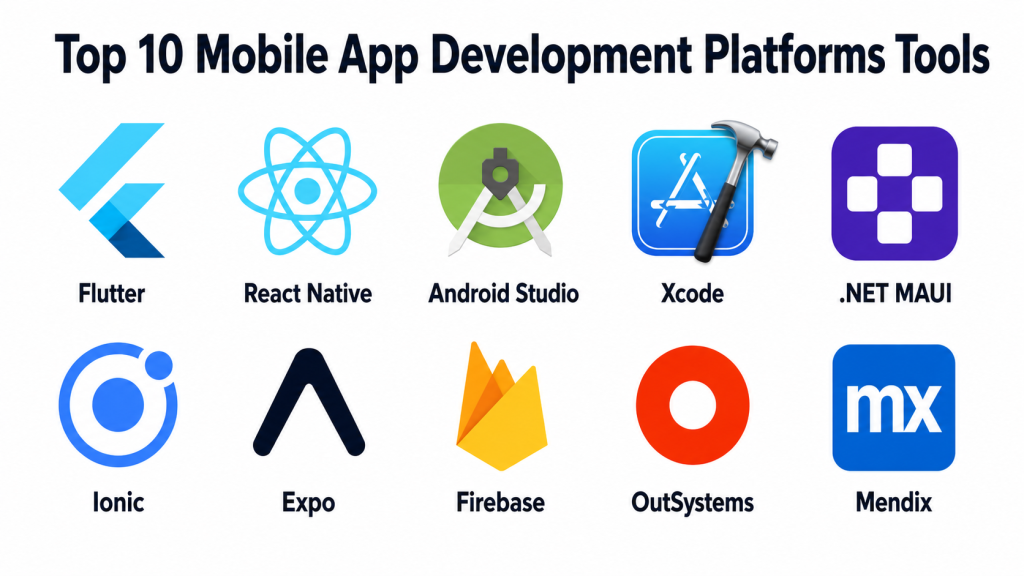
Top 10 Mobile App Development Platforms Tools
#1 — Flutter
Short description: Flutter is a cross-platform app development framework used to build mobile, web, and desktop apps from a single codebase. It is popular with startups, agencies, and product teams that want strong UI control and fast cross-platform delivery.
Key Features
- Single codebase for Android and iOS apps
- Rich UI widget system
- Strong performance for cross-platform apps
- Hot reload for faster development
- Custom animations and design flexibility
- Large package ecosystem
- Support for mobile, web, and desktop targets
Pros
- Strong UI consistency across platforms.
- Good performance for many production app use cases.
- Large developer community and growing ecosystem.
Cons
- Requires Dart knowledge.
- Native platform-specific features may need extra packages or custom code.
- App size and architecture need careful planning for large projects.
Platforms / Deployment
Web / Windows / macOS / Linux / iOS / Android
Cloud / Self-managed development workflow
Security & Compliance
Flutter itself is a development framework, not a compliance platform. App security depends on how teams implement authentication, storage, API calls, encryption, permissions, and backend controls. Specific compliance such as SOC 2, ISO 27001, HIPAA, SSO, and audit logs depends on the supporting infrastructure and services used.
Integrations & Ecosystem
Flutter has a strong ecosystem for UI, backend, analytics, payments, maps, authentication, testing, and device features.
- Firebase
- REST APIs
- GraphQL APIs
- Payment gateways
- Analytics tools
- Native platform plugins
Support & Community
Flutter has strong documentation, active community support, package libraries, learning resources, and broad adoption among developers. It is a strong choice for teams that want polished cross-platform apps.
#2 — React Native
Short description: React Native is a cross-platform mobile app development framework that allows developers to build Android and iOS apps using JavaScript or TypeScript. It is widely used by teams that already work with React and want shared mobile development skills.
Key Features
- Cross-platform mobile app development
- JavaScript and TypeScript support
- Native component rendering
- Large package ecosystem
- Strong community support
- Reusable business logic
- Integration with native modules
Pros
- Good fit for teams already using React.
- Large ecosystem and strong hiring availability.
- Flexible for both startup and enterprise apps.
Cons
- Native module management can add complexity.
- Performance tuning may be needed for heavy apps.
- Dependency management can require careful maintenance.
Platforms / Deployment
Web development environment / iOS / Android
Cloud / Self-managed development workflow
Security & Compliance
React Native is a development framework, so security depends on app architecture, libraries, backend systems, authentication, secure storage, API handling, and release processes. Specific compliance such as SOC 2, ISO 27001, HIPAA, SSO, and audit logs is Not publicly stated at the framework level and must be handled through the broader solution.
Integrations & Ecosystem
React Native has a large ecosystem and works well with modern frontend, backend, and cloud services.
- REST APIs
- GraphQL APIs
- Firebase
- Payment tools
- Analytics SDKs
- Native modules and device APIs
Support & Community
React Native has a large global developer community, broad documentation, open-source packages, and strong hiring availability. It is suitable for teams that want cross-platform apps with web development skill reuse.
#3 — Android Studio
Short description: Android Studio is the official development environment for building Android apps. It is best for developers and teams creating native Android apps with deep access to Android platform features, performance tools, testing, and debugging.
Key Features
- Native Android app development
- Kotlin and Java support
- Android emulator
- Layout editor
- Performance profiling tools
- Debugging and testing tools
- App packaging and signing support
Pros
- Best fit for native Android development.
- Strong debugging and profiling capabilities.
- Deep access to Android platform features.
Cons
- Focused mainly on Android, not cross-platform delivery.
- Requires proper development skills.
- Native app development can take more time than no-code or cross-platform tools.
Platforms / Deployment
Windows / macOS / Linux / Android
Self-managed development workflow
Security & Compliance
Android Studio supports secure app development workflows such as app signing and debugging controls, but compliance depends on the app, backend, data handling, authentication, and deployment process. Specific compliance certifications are Not publicly stated at the IDE level.
Integrations & Ecosystem
Android Studio integrates strongly with the Android ecosystem and common development tools.
- Android SDK
- Gradle
- Firebase
- Google Play workflows
- Testing frameworks
- Device and emulator tools
Support & Community
Android Studio has strong official documentation, developer guides, learning resources, and community support. It is the standard choice for native Android development.
#4 — Xcode
Short description: Xcode is the official development environment for building apps for Apple platforms, including iOS. It is best for teams building native iPhone and iPad apps that need strong performance, platform-native design, and deep Apple ecosystem support.
Key Features
- Native iOS app development
- Swift and Objective-C support
- Interface Builder and SwiftUI workflows
- Simulator support
- Debugging and performance tools
- App signing and distribution workflows
- Apple platform SDK integration
Pros
- Best fit for native iOS development.
- Deep integration with Apple platform features.
- Strong performance and native user experience.
Cons
- Focused on Apple platforms.
- Requires macOS for development.
- Native iOS development can require specialized skills.
Platforms / Deployment
macOS / iOS
Self-managed development workflow
Security & Compliance
Xcode supports app signing, provisioning, secure build workflows, and platform-level development features. However, app security and compliance depend on implementation, backend services, authentication, storage, encryption, and data handling. Specific compliance certifications are Not publicly stated at the IDE level.
Integrations & Ecosystem
Xcode is deeply connected with Apple development workflows.
- Apple SDKs
- SwiftUI
- App Store deployment workflows
- Testing tools
- Device simulators
- Apple developer services
Support & Community
Xcode has official documentation, Apple developer resources, tutorials, forums, and a large iOS developer community. It is the primary tool for native Apple platform development.
#5 — .NET MAUI
Short description: .NET MAUI is a cross-platform framework for building mobile and desktop apps using C# and .NET. It is useful for teams already invested in Microsoft technologies and developers who want to share code across Android, iOS, Windows, and macOS apps.
Key Features
- Cross-platform app development
- C# and .NET support
- Shared UI and business logic
- Native platform access
- Visual Studio integration
- Support for Android and iOS
- Desktop app support
Pros
- Strong fit for Microsoft and .NET teams.
- Allows shared code across multiple platforms.
- Useful for enterprise business apps.
Cons
- Smaller ecosystem than some mobile frameworks.
- Learning curve exists for teams new to .NET.
- Some platform-specific features may need custom handling.
Platforms / Deployment
Windows / macOS / iOS / Android
Cloud / Self-managed development workflow
Security & Compliance
.NET MAUI is a development framework. Security depends on implementation, backend services, authentication, secure storage, permissions, and deployment practices. Compliance requirements such as SOC 2, ISO 27001, HIPAA, SSO, audit logs, and RBAC depend on the broader app architecture and services used.
Integrations & Ecosystem
.NET MAUI works well in Microsoft-heavy environments and enterprise development stacks.
- .NET ecosystem
- Azure services
- REST APIs
- Authentication providers
- Enterprise databases
- Visual Studio tooling
Support & Community
.NET MAUI benefits from Microsoft documentation, Visual Studio support, developer communities, and the broader .NET ecosystem. It is a strong option for teams already using Microsoft technologies.
#6 — Ionic
Short description: Ionic is a cross-platform app development framework that helps teams build mobile apps using web technologies such as HTML, CSS, and JavaScript. It is useful for web teams that want to create mobile apps with familiar frontend skills.
Key Features
- Cross-platform app development
- Web technology-based development
- UI component library
- Android and iOS support
- Progressive web app support
- Capacitor integration
- Plugin ecosystem for native features
Pros
- Good fit for web development teams.
- Supports mobile apps and progressive web apps.
- Faster learning path for teams with web skills.
Cons
- May not match fully native performance for demanding apps.
- Native feature access may require plugins.
- UI and performance need careful optimization.
Platforms / Deployment
Web / iOS / Android
Cloud / Self-managed development workflow
Security & Compliance
Ionic is a development framework, so security depends on app implementation, backend services, authentication, API protection, local storage practices, and plugin usage. Specific compliance details are Not publicly stated at the framework level.
Integrations & Ecosystem
Ionic works well with modern web and mobile development stacks.
- Angular
- React
- Vue
- Capacitor plugins
- REST APIs
- Firebase and cloud services
Support & Community
Ionic has strong documentation, community resources, UI components, templates, and commercial support options. It is practical for teams that want to reuse web skills for mobile delivery.
#7 — Expo
Short description: Expo is a development platform and toolchain for React Native apps. It helps teams build, preview, test, and deploy React Native apps with a smoother developer experience and managed workflows.
Key Features
- React Native development workflow
- Managed app development tools
- Fast preview and testing
- App build services
- Over-the-air update support
- Device API access
- Deployment workflow support
Pros
- Speeds up React Native development.
- Reduces native setup complexity.
- Good for teams building cross-platform apps quickly.
Cons
- Some advanced native customizations may require extra setup.
- Teams must understand React Native fundamentals.
- Managed workflows may not fit every highly custom app.
Platforms / Deployment
Web / iOS / Android
Cloud / Self-managed development workflow
Security & Compliance
Expo provides development and deployment tooling, but app security depends on how the app handles authentication, storage, APIs, permissions, secrets, and backend services. Specific enterprise compliance such as SOC 2, ISO 27001, HIPAA, SSO, and audit logs should be verified directly for selected services and plans.
Integrations & Ecosystem
Expo fits naturally into React Native and JavaScript-based mobile development workflows.
- React Native libraries
- Device APIs
- Build services
- Authentication tools
- Analytics SDKs
- Backend services
Support & Community
Expo has strong documentation, active community usage, examples, and learning resources. It is especially useful for teams that want to move faster with React Native.
#8 — Firebase
Short description: Firebase is a backend and app development platform that provides services for authentication, databases, hosting, cloud functions, analytics, crash reporting, messaging, and app performance. It is useful for mobile teams that need backend capabilities without building everything from scratch.
Key Features
- Authentication
- Realtime database and cloud database options
- Cloud functions
- Push notifications
- Analytics
- Crash reporting
- Performance monitoring
Pros
- Strong backend support for mobile apps.
- Good for rapid MVPs and production apps.
- Useful analytics, messaging, and crash reporting capabilities.
Cons
- Data modeling needs careful planning.
- Costs can grow with usage if not monitored.
- Vendor lock-in may be a concern for some teams.
Platforms / Deployment
Web / iOS / Android
Cloud
Security & Compliance
Firebase supports authentication, security rules, and cloud-based access control patterns. Compliance details depend on the specific services used, account configuration, region, data handling, and Google Cloud setup. SOC 2, ISO 27001, HIPAA, GDPR, and other requirements should be verified directly for the selected services and use case.
Integrations & Ecosystem
Firebase is widely used with mobile and web applications that need managed backend services.
- Android apps
- iOS apps
- Flutter
- React Native
- Web apps
- Google Cloud services
Support & Community
Firebase has strong documentation, SDKs, tutorials, developer forums, and wide adoption among mobile developers. It is a common backend choice for app teams that need speed and managed infrastructure.
#9 — OutSystems
Short description: OutSystems is a low-code application development platform used by enterprises and larger teams to build web and mobile apps faster. It is designed for business applications, workflow apps, customer portals, internal apps, and enterprise-grade development.
Key Features
- Low-code app development
- Mobile and web app support
- Visual development environment
- Workflow automation
- Enterprise integrations
- Security and governance features
- Lifecycle management tools
Pros
- Strong for enterprise application delivery.
- Good governance and lifecycle management capabilities.
- Useful for teams building many business apps.
Cons
- May be too heavy for simple mobile app projects.
- Pricing and implementation can be complex.
- Best suited for organizations with structured IT processes.
Platforms / Deployment
Web / iOS / Android
Cloud / Hybrid
Security & Compliance
OutSystems supports enterprise-oriented security and governance capabilities, but specific certifications and controls such as SOC 2, ISO 27001, HIPAA, SSO, audit logs, and RBAC should be verified directly based on plan and deployment model.
Integrations & Ecosystem
OutSystems works well in enterprise environments where mobile apps must connect to existing systems.
- Enterprise APIs
- Databases
- Identity providers
- Workflow systems
- CRM and ERP tools
- Cloud services
Support & Community
OutSystems provides enterprise support, documentation, training, partner ecosystem, and community resources. It is suitable for organizations that need scalable low-code mobile and web app delivery.
#10 — Mendix
Short description: Mendix is a low-code application development platform used to build enterprise-grade web and mobile apps. It is suitable for organizations that need faster application delivery, business and IT collaboration, governance, integrations, and scalable development workflows.
Key Features
- Low-code app development
- Mobile and web app support
- Visual modeling
- Workflow and process automation
- Enterprise integration support
- Governance and lifecycle controls
- Collaboration between business and IT teams
Pros
- Strong for enterprise-grade app development.
- Good for business process apps and internal tools.
- Supports collaboration between technical and non-technical teams.
Cons
- May be more complex than lightweight no-code tools.
- Enterprise platform adoption requires planning.
- Not ideal for very small teams needing a simple app builder.
Platforms / Deployment
Web / iOS / Android
Cloud / Hybrid
Security & Compliance
Mendix provides enterprise-oriented development and governance capabilities. Specific security and compliance items such as SSO, audit logs, SOC 2, ISO 27001, HIPAA, encryption, and RBAC should be verified directly based on the selected plan, deployment model, and organizational requirements.
Integrations & Ecosystem
Mendix is designed for enterprise integration-heavy environments.
- Enterprise systems
- APIs
- Databases
- Identity providers
- Workflow tools
- Cloud platforms
Support & Community
Mendix provides documentation, training, community resources, enterprise support, and partner support. It is a strong fit for organizations looking for structured low-code mobile and web development.
Comparison Table
| Tool Name | Best For | Platform(s) Supported | Deployment | Standout Feature | Public Rating |
|---|---|---|---|---|---|
| Flutter | Cross-platform apps with strong UI control | Web / Windows / macOS / Linux / iOS / Android | Self-managed / Cloud-supported | Single codebase with rich UI widgets | N/A |
| React Native | JavaScript and React-based mobile teams | iOS / Android | Self-managed / Cloud-supported | Cross-platform development with React skills | N/A |
| Android Studio | Native Android app development | Windows / macOS / Linux / Android | Self-managed | Official Android development environment | N/A |
| Xcode | Native iOS app development | macOS / iOS | Self-managed | Official Apple development environment | N/A |
| .NET MAUI | Microsoft and .NET teams | Windows / macOS / iOS / Android | Self-managed / Cloud-supported | Shared C# code across platforms | N/A |
| Ionic | Web teams building mobile apps | Web / iOS / Android | Self-managed / Cloud-supported | Mobile apps using web technologies | N/A |
| Expo | Faster React Native workflows | Web / iOS / Android | Cloud / Self-managed | Simplified React Native build and preview workflow | N/A |
| Firebase | Mobile backend and app services | Web / iOS / Android | Cloud | Authentication, database, messaging, and analytics | N/A |
| OutSystems | Enterprise low-code mobile apps | Web / iOS / Android | Cloud / Hybrid | Enterprise low-code lifecycle management | N/A |
| Mendix | Enterprise web and mobile apps | Web / iOS / Android | Cloud / Hybrid | Business and IT low-code collaboration | N/A |
Evaluation & Scoring of Mobile App Development Platforms Tools
| Tool Name | Core (25%) | Ease (15%) | Integrations (15%) | Security (10%) | Performance (10%) | Support (10%) | Value (15%) | Weighted Total (0–10) |
|---|---|---|---|---|---|---|---|---|
| Flutter | 9 | 7 | 8 | 7 | 9 | 9 | 9 | 8.40 |
| React Native | 9 | 7 | 9 | 7 | 8 | 9 | 9 | 8.35 |
| Android Studio | 9 | 6 | 8 | 8 | 10 | 9 | 9 | 8.45 |
| Xcode | 9 | 6 | 8 | 8 | 10 | 9 | 8 | 8.30 |
| .NET MAUI | 8 | 7 | 8 | 8 | 8 | 8 | 8 | 7.85 |
| Ionic | 8 | 8 | 8 | 7 | 7 | 8 | 8 | 7.75 |
| Expo | 8 | 9 | 8 | 7 | 8 | 8 | 8 | 8.05 |
| Firebase | 9 | 8 | 9 | 8 | 8 | 9 | 8 | 8.45 |
| OutSystems | 9 | 7 | 9 | 9 | 8 | 9 | 6 | 8.20 |
| Mendix | 9 | 7 | 9 | 9 | 8 | 9 | 6 | 8.20 |
These scores are comparative and should be interpreted based on your app type, team skill level, architecture, and security needs. Android Studio and Xcode score strongly for native performance, but they require platform-specific development. Flutter and React Native score well for cross-platform delivery. Firebase is not a full frontend framework, but it is very strong as a mobile backend platform. OutSystems and Mendix are stronger for enterprise low-code needs, but they may not be ideal for small teams with simple app goals.
Which Mobile App Development Platforms Tool Is Right for You?
Solo / Freelancer
Solo developers and freelancers usually need tools that help them build fast without managing too much complexity. Flutter, React Native, Expo, Ionic, and Firebase are practical choices.
Choose Flutter if you want strong UI control and cross-platform delivery. Choose React Native or Expo if you already know JavaScript or React. Choose Ionic if you come from a web development background. Choose Firebase if you need authentication, database, push notifications, and analytics without building a full backend from scratch.
SMB
Small and medium businesses need mobile apps that are reliable, affordable, and easy to maintain. Flutter, React Native, Firebase, Ionic, and .NET MAUI are strong options.
Choose Flutter or React Native for customer-facing apps. Choose Firebase for backend acceleration. Choose Ionic if your team has strong web skills. Choose .NET MAUI if your business already works with Microsoft and .NET technologies.
Mid-Market
Mid-market teams often need stronger architecture, backend integration, release management, analytics, user management, and security review. Flutter, React Native, Firebase, .NET MAUI, Android Studio, and Xcode are practical choices.
Choose native Android Studio and Xcode when app performance, platform-specific features, and device-level control are critical. Choose Flutter or React Native when shared code and faster cross-platform delivery matter. Use Firebase or other backend services when speed and managed infrastructure are important.
Enterprise
Enterprise mobile app development requires governance, security, compliance review, identity integration, auditability, backend connectivity, and lifecycle control. OutSystems, Mendix, Microsoft-oriented .NET MAUI workflows, native Android Studio, Xcode, and Firebase with enterprise cloud governance can be suitable depending on the organization.
Choose OutSystems or Mendix when the business needs low-code enterprise app delivery. Choose native development when deep platform control and high performance are required. Choose cross-platform frameworks when development speed and shared code are priorities.
Budget vs Premium
For budget-conscious teams, open-source frameworks such as Flutter, React Native, Ionic, and .NET MAUI provide strong value, but teams still need skilled developers, testing, backend services, and deployment workflows.
Premium platforms like OutSystems and Mendix may cost more, but they provide enterprise governance, lifecycle management, low-code delivery, and business collaboration features. They are better suited for larger organizations with structured IT needs.
Feature Depth vs Ease of Use
If feature depth and technical control matter most, choose Android Studio, Xcode, Flutter, or React Native. These tools provide strong control over app architecture, performance, and platform-specific features.
If ease of delivery matters more, choose Expo, Ionic, Firebase, OutSystems, or Mendix depending on your team type. Expo simplifies React Native workflows. Firebase simplifies backend needs. OutSystems and Mendix simplify enterprise app delivery.
Integrations & Scalability
Mobile apps rarely work alone. They need authentication, databases, APIs, notifications, analytics, payments, maps, chat, CRM, ERP, and cloud services.
Choose Firebase for managed mobile backend services. Choose React Native, Flutter, or Ionic when you need wide API and SDK integration. Choose OutSystems or Mendix when enterprise integrations and governance are priorities. Choose native Android Studio and Xcode when direct access to platform SDKs is required.
Security & Compliance Needs
Security should be a major selection factor when mobile apps handle customer data, payments, health information, financial records, employee records, or internal business workflows.
Review authentication, secure storage, encryption, app signing, API security, certificate handling, secrets management, device permissions, audit logging, access control, backend compliance, and data retention. For regulated industries, involve security, legal, IT, and compliance teams before choosing a platform.
Frequently Asked Questions
What is a mobile app development platform?
A mobile app development platform is a tool, framework, or environment used to build mobile apps for Android, iOS, or both. It may include UI tools, coding frameworks, backend services, testing tools, deployment workflows, and integrations.
What is the difference between native and cross-platform development?
Native development uses platform-specific tools like Android Studio for Android and Xcode for iOS. Cross-platform development uses frameworks like Flutter, React Native, Ionic, or .NET MAUI to share code across platforms.
Which mobile app development platform is best for beginners?
Expo, Flutter, Ionic, and Firebase are good starting points depending on your skills. Expo is helpful for React developers, Flutter is strong for visual app development, Ionic is practical for web developers, and Firebase helps with backend services.
Which platform is best for high-performance apps?
Native development with Android Studio and Xcode is usually best for apps that need deep platform control, advanced graphics, hardware access, or maximum performance. Flutter can also perform well for many production apps.
Which tool is best for cross-platform mobile apps?
Flutter and React Native are two of the strongest cross-platform choices. Flutter is strong for custom UI and consistent design. React Native is strong for teams already familiar with JavaScript and React.
Is Firebase a mobile app development platform?
Firebase is not a frontend framework, but it is a mobile app development platform for backend services. It provides authentication, databases, cloud functions, messaging, analytics, crash reporting, and performance monitoring.
Are low-code platforms good for mobile app development?
Yes, low-code platforms like OutSystems and Mendix can be useful for enterprise mobile apps, internal tools, workflows, and business applications. They are especially helpful when speed, governance, and business collaboration matter.
What are common mistakes in mobile app development?
Common mistakes include choosing the wrong platform, ignoring performance testing, weak API security, poor offline handling, unclear app architecture, too many dependencies, and skipping real-device testing.
How important is app security?
App security is very important, especially when apps collect user data, payments, location, health details, business records, or login credentials. Teams should review authentication, encryption, secure storage, API security, and permissions.
Can I switch mobile app platforms later?
Switching is possible but can be expensive. You may need to rebuild UI, business logic, integrations, testing workflows, and deployment processes. Choose carefully before scaling a production app.
What pricing factors should buyers check?
Check licensing, developer seats, backend usage, build minutes, cloud usage, storage, database reads, push notifications, enterprise support, app store deployment costs, and maintenance effort.
Which platform is best for enterprise mobile apps?
OutSystems, Mendix, native Android Studio and Xcode workflows, .NET MAUI, Flutter, React Native, and Firebase can all fit enterprise use cases depending on security, governance, integration, and performance needs.
Conclusion
Mobile app development platforms help teams build better apps faster, but the best choice depends on your team, product goals, user experience needs, security requirements, and long-term maintenance strategy. Flutter and React Native are strong for cross-platform app development. Android Studio and Xcode are best when native performance and platform-specific control matter. .NET MAUI is practical for Microsoft-focused teams. Ionic is useful for web developers moving into mobile. Expo improves React Native workflows. Firebase supports mobile backend development with authentication, databases, analytics, messaging, and crash reporting. OutSystems and Mendix are better suited for enterprise low-code mobile app delivery.
