Upgrade & Secure Your Future with DevOps, SRE, DevSecOps, MLOps!
We spend hours scrolling social media and waste money on things we forget, but won’t spend 30 minutes a day earning certifications that can change our lives.
Master in DevOps, SRE, DevSecOps & MLOps by DevOps School!
Learn from Guru Rajesh Kumar and double your salary in just one year.
Introduction
iOS app builder tools help individuals, startups, agencies, developers, and businesses create apps for iPhone and iPad using visual builders, templates, drag-and-drop editors, low-code workflows, or professional development environments. In simple words, these tools reduce the time and technical effort needed to design, build, test, and launch iOS apps.
These platforms matter because mobile apps are now important for customer engagement, online services, eCommerce, education, internal operations, communities, bookings, loyalty programs, and digital products. Many teams want to launch iOS apps faster without building everything from scratch.
Common use cases include business apps, customer portals, eCommerce apps, restaurant apps, fitness apps, education apps, internal workflow apps, event apps, community apps, and startup MVPs.
Buyers should evaluate iOS publishing support, design flexibility, native app quality, integrations, backend features, scalability, App Store readiness, security controls, pricing, support, and long-term ownership.
Best for: founders, startups, agencies, small businesses, product teams, developers, marketers, eCommerce brands, educators, service providers, and companies that need iOS apps without a fully custom development cycle.
Not ideal for: teams building highly complex gaming apps, advanced real-time systems, deeply custom native apps, performance-heavy apps, or products that require full control over every native iOS layer.
Key Trends in iOS App Builders Tools
- AI-assisted app creation is becoming more useful: Many platforms are adding AI support for layout generation, content creation, workflow suggestions, app logic, and faster prototyping.
- No-code app builders are becoming more business-friendly: Small teams can now build booking apps, directory apps, eCommerce apps, membership apps, and content apps without hiring a large development team.
- Low-code tools are improving developer control: More platforms now allow custom code, API connections, reusable components, and advanced logic for teams that need flexibility.
- Cross-platform app creation is now expected: Businesses often want iOS and Android apps from the same project to reduce cost and maintenance effort.
- App Store readiness is a key buying factor: Teams need help with app packaging, submission, icons, screenshots, privacy details, and publishing workflows.
- Backend features matter more: Modern app builders are expected to support databases, authentication, push notifications, file storage, user roles, payments, and workflow automation.
- Integrations are critical: iOS apps often need to connect with CRM, payment gateways, analytics, email tools, spreadsheets, databases, APIs, and marketing platforms.
- Security expectations are stronger: Buyers should look for user permissions, authentication, encryption, access controls, data privacy settings, and safe API handling.
- Template-based apps are becoming more specialized: App builders now offer templates for restaurants, fitness, events, directories, communities, eCommerce, education, and service businesses.
- Ownership and scalability are becoming serious questions: Teams are paying more attention to export options, platform lock-in, custom code access, hosting model, and long-term maintenance.
How We Selected These Tools
The tools in this list were selected based on practical iOS app-building needs, market recognition, feature depth, and fit for different types of users.
- Market adoption and recognition among founders, agencies, developers, startups, and business teams.
- Strength of iOS app creation, publishing support, design control, and mobile-focused workflows.
- Availability of no-code, low-code, or developer-friendly app-building capabilities.
- Support for common app features such as authentication, databases, payments, notifications, forms, and content management.
- Integration ecosystem with APIs, spreadsheets, CRMs, analytics, payment tools, and third-party services.
- Customer fit across solo users, SMBs, mid-market teams, and enterprise use cases.
- Security posture signals where details are clearly available or plan-dependent.
- Scalability for MVPs, business apps, internal tools, and customer-facing mobile apps.
- Support resources, documentation, templates, onboarding, and community activity.
- Overall value based on speed, flexibility, app quality, maintainability, and platform fit.
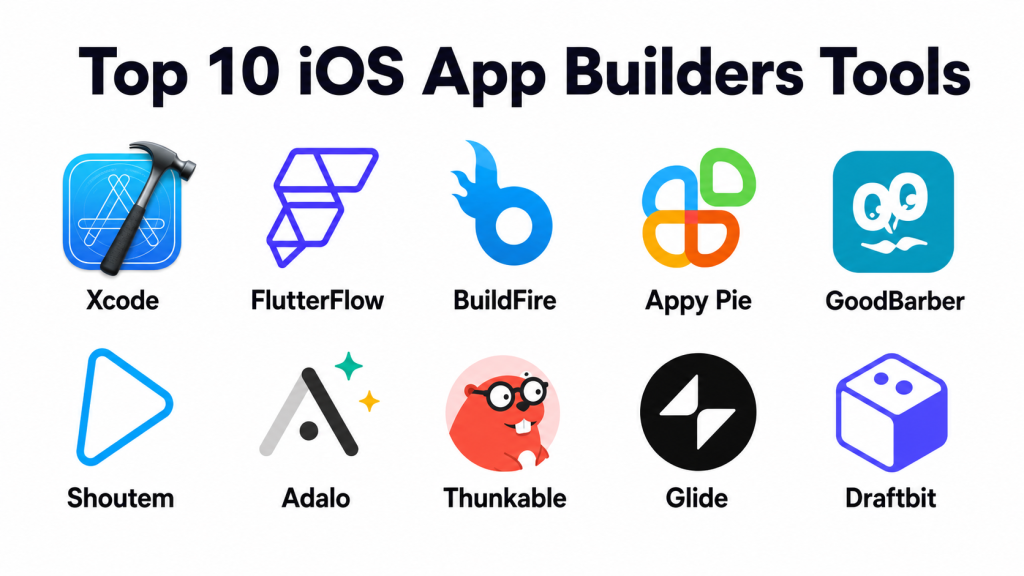
Top 10 iOS App Builders Tools
#1 — Xcode
Short description: Xcode is Apple’s official development environment for building native iOS, iPadOS, macOS, watchOS, and tvOS apps. It is best for developers and teams that want full control over native app design, performance, code, testing, and publishing.
Key Features
- Native iOS app development with Swift and SwiftUI.
- Interface design tools for Apple platforms.
- Simulator support for testing apps.
- Debugging, profiling, and performance tools.
- App signing and publishing workflow support.
- Full access to Apple platform capabilities.
- Strong fit for professional iOS development.
Pros
- Best native control for iOS apps.
- Strong performance and platform-level access.
- Required for many serious iOS development workflows.
Cons
- Requires programming knowledge.
- Not suitable for non-technical users who want drag-and-drop building.
- Development can take longer than no-code or low-code platforms.
Platforms / Deployment
macOS.
Native development environment.
Security & Compliance
Security depends on the app architecture, code quality, backend setup, authentication method, data handling, and Apple platform practices. SSO, MFA, RBAC, audit logs, SOC 2, ISO 27001, GDPR, and HIPAA are not platform-level guarantees for every app and must be handled based on the app and backend stack.
Integrations & Ecosystem
Xcode is strongest when teams need complete native development control and direct access to Apple’s ecosystem.
- Apple SDKs and frameworks.
- Swift and SwiftUI.
- App Store publishing workflows.
- Testing and debugging tools.
- Backend APIs.
- Third-party iOS libraries.
Support & Community
Xcode has extensive official documentation, developer resources, sample projects, community forums, tutorials, and a large professional iOS developer ecosystem.
#2 — FlutterFlow
Short description: FlutterFlow is a visual app builder based on Flutter that helps teams create mobile and web apps with low-code workflows. It is useful for startups, agencies, product builders, and teams that want visually designed apps with more flexibility than basic template builders.
Key Features
- Visual app design interface.
- iOS and Android app creation from one project.
- Firebase and backend integration options.
- API connections and custom actions.
- UI components and responsive layouts.
- App preview and testing workflows.
- Code export options depending on plan and setup.
Pros
- Good balance of visual building and developer flexibility.
- Useful for MVPs and production-ready app concepts.
- Strong fit for teams that want cross-platform mobile apps.
Cons
- Advanced apps may require technical knowledge.
- Complex logic and custom features can need developer support.
- Platform learning curve is higher than simple template app builders.
Platforms / Deployment
Web.
Cloud.
Security & Compliance
Not publicly stated in full detail for every plan and use case. Security depends on app setup, backend configuration, authentication, database rules, API handling, and deployment choices. Confirm SSO, MFA, RBAC, audit logs, GDPR, SOC 2, ISO 27001, and data privacy needs directly with the vendor and backend provider.
Integrations & Ecosystem
FlutterFlow works well for teams that need visual app building with external services and backend logic.
- Firebase.
- REST APIs.
- Authentication services.
- Payment integrations.
- Custom code actions.
- Third-party app services.
Support & Community
FlutterFlow has documentation, tutorials, templates, learning resources, and an active builder community. It is popular among no-code builders, startup founders, and developers who want faster mobile app delivery.
#3 — BuildFire
Short description: BuildFire is an app builder platform for creating business, community, content, eCommerce, event, and service apps. It is useful for businesses and agencies that want iOS and Android apps with templates, plugins, and managed app-building workflows.
Key Features
- App builder for iOS and Android.
- Plugin-based app functionality.
- Business and community app templates.
- Push notification support.
- Content, media, and user engagement features.
- App publishing support.
- Custom development options in some cases.
Pros
- Good for business and community apps.
- Plugin-based model can speed up app creation.
- Helpful for teams that need publishing support.
Cons
- Customization may be limited compared with native development.
- Advanced unique app logic may require custom work.
- Pricing should be reviewed carefully for long-term use.
Platforms / Deployment
Web / iOS / Android.
Cloud.
Security & Compliance
Not publicly stated in full detail. Confirm SSO, MFA, RBAC, encryption, audit logs, GDPR, SOC 2, ISO 27001, HIPAA, and data handling requirements directly with the vendor.
Integrations & Ecosystem
BuildFire works well for app use cases that can be supported through plugins, content modules, and business app features.
- Push notifications.
- Content management.
- Media tools.
- eCommerce-related workflows.
- Membership and community features.
- Custom plugin options.
Support & Community
BuildFire provides documentation, customer support, onboarding resources, and app-building assistance. It is suitable for businesses that want guided app creation rather than purely self-managed development.
#4 — Appy Pie
Short description: Appy Pie is a no-code app builder that helps users create mobile apps for business, education, events, eCommerce, and service use cases. It is best for beginners and small teams that want a simple way to create apps without coding.
Key Features
- Drag-and-drop app builder.
- iOS and Android app creation.
- Templates for common business use cases.
- Push notifications.
- Forms, pages, and content features.
- Basic eCommerce and service app support.
- App submission assistance depending on plan.
Pros
- Beginner-friendly app-building experience.
- Useful for simple business apps and prototypes.
- Reduces technical barriers for non-developers.
Cons
- Limited flexibility for complex custom apps.
- App quality depends on template and feature fit.
- Advanced business logic may not be suitable.
Platforms / Deployment
Web / iOS / Android.
Cloud.
Security & Compliance
Not publicly stated in full detail. Confirm SSO, MFA, RBAC, encryption, GDPR, audit logs, payment data handling, and compliance requirements directly with the vendor.
Integrations & Ecosystem
Appy Pie is focused on simple app creation and common business workflows. It can be useful when speed is more important than deep customization.
- Business app templates.
- Push notifications.
- Forms and content modules.
- Basic commerce features.
- Third-party app connections.
- App publishing support.
Support & Community
Appy Pie offers help resources, support options, and onboarding-style guidance. It is best suited for beginners, small businesses, and users creating simple apps.
#5 — GoodBarber
Short description: GoodBarber is an app builder for creating iOS and Android apps, especially for content, eCommerce, community, and local business use cases. It is suitable for small businesses, publishers, creators, and agencies.
Key Features
- iOS and Android app builder.
- Content app and eCommerce app support.
- Design templates and layout customization.
- Push notifications.
- User authentication features.
- App publishing support.
- Extensions for additional app capabilities.
Pros
- Good for content-heavy and commerce-style apps.
- Clean visual app-building experience.
- Useful for creators, publishers, and local businesses.
Cons
- Not ideal for highly custom product apps.
- Advanced logic may be limited.
- Long-term cost should be reviewed based on app needs.
Platforms / Deployment
Web / iOS / Android.
Cloud.
Security & Compliance
Not publicly stated in full detail. Confirm SSO, MFA, encryption, RBAC, audit logs, GDPR, payment handling, and data protection needs directly with the vendor.
Integrations & Ecosystem
GoodBarber works well for app projects centered on content, store experiences, communities, and customer engagement.
- Content management.
- Push notifications.
- eCommerce workflows.
- User accounts.
- Analytics tools.
- App extensions.
Support & Community
GoodBarber provides documentation, tutorials, support resources, and app-building guidance. It is useful for teams that want a polished app builder with business-focused templates.
#6 — Shoutem
Short description: Shoutem is a mobile app builder for creating apps with templates, content modules, loyalty features, community functions, and business-focused app capabilities. It is useful for agencies, small businesses, and organizations that need mobile apps quickly.
Key Features
- Visual mobile app builder.
- iOS and Android app support.
- Templates and prebuilt layouts.
- Push notifications.
- Loyalty and engagement features.
- Content and media modules.
- Extension-based app functionality.
Pros
- Useful for business, loyalty, and community apps.
- Faster than custom app development.
- Good for teams that need simple mobile engagement features.
Cons
- May not fit complex software product apps.
- Customization depth depends on available extensions.
- Advanced integrations may need extra work.
Platforms / Deployment
Web / iOS / Android.
Cloud.
Security & Compliance
Not publicly stated in full detail. Confirm SSO, MFA, RBAC, encryption, audit logs, GDPR, payment handling, and compliance needs directly with the vendor.
Integrations & Ecosystem
Shoutem works best for template-driven business apps and engagement-focused mobile experiences.
- Push notifications.
- Loyalty workflows.
- Content modules.
- Media and community features.
- Third-party integrations.
- App publishing workflows.
Support & Community
Shoutem offers documentation, support options, and app builder resources. It is suitable for users who want a practical app-building workflow without starting from code.
#7 — Adalo
Short description: Adalo is a no-code app builder for creating mobile and web apps with visual screens, databases, components, and app logic. It is useful for founders, creators, startups, and small teams building MVPs, directories, marketplaces, internal apps, and simple product apps.
Key Features
- Visual app builder.
- iOS and Android app support.
- Built-in database collections.
- User authentication.
- Component marketplace.
- Custom actions and app logic.
- External API connections.
Pros
- Good for no-code MVPs and simple product apps.
- Easy for non-developers to understand.
- Built-in database makes app creation faster.
Cons
- Complex apps can become hard to scale.
- Advanced performance needs may require another approach.
- Custom native functionality may be limited.
Platforms / Deployment
Web / iOS / Android.
Cloud.
Security & Compliance
Not publicly stated in full detail for all use cases. Confirm SSO, MFA, RBAC, encryption, audit logs, GDPR, data retention, and compliance needs directly with the vendor.
Integrations & Ecosystem
Adalo is useful for no-code builders who need app screens, database logic, user accounts, and integrations without a full engineering team.
- External APIs.
- Component marketplace.
- Database collections.
- Authentication workflows.
- Payment tools.
- Automation services.
Support & Community
Adalo has documentation, templates, learning content, and a no-code community. It is popular among founders and makers building early-stage apps.
#8 — Thunkable
Short description: Thunkable is a no-code mobile app builder that helps users create iOS and Android apps with drag-and-drop design and visual logic blocks. It is suitable for educators, students, creators, entrepreneurs, and small teams building mobile app prototypes or functional apps.
Key Features
- Drag-and-drop mobile app builder.
- Visual logic blocks.
- iOS and Android app support.
- App preview and testing tools.
- Built-in components.
- API and data source connections.
- Publishing workflow support.
Pros
- Beginner-friendly for learning app development.
- Good for prototypes, education, and simple apps.
- Visual logic helps non-coders understand app behavior.
Cons
- Less suited for complex enterprise applications.
- Advanced customization may be limited.
- Large-scale app architecture may require more technical tools.
Platforms / Deployment
Web / iOS / Android.
Cloud.
Security & Compliance
Not publicly stated in full detail. Confirm SSO, MFA, RBAC, encryption, audit logs, GDPR, data privacy, and compliance requirements directly with the vendor.
Integrations & Ecosystem
Thunkable is useful for mobile-first learning, prototyping, and simple production apps that need external data and basic workflows.
- APIs.
- Data sources.
- App components.
- Logic blocks.
- Mobile device features.
- Publishing workflows.
Support & Community
Thunkable has tutorials, documentation, educational resources, and a user community. It is especially useful for beginners and learning-focused environments.
#9 — Glide
Short description: Glide is a no-code app builder that turns data sources into business apps, portals, internal tools, and mobile-friendly experiences. It is useful for teams that want to build apps from spreadsheets, databases, and structured business data.
Key Features
- No-code app builder.
- Data-driven app creation.
- Mobile-friendly app interfaces.
- User roles and access controls.
- Forms, lists, dashboards, and workflows.
- Integrations with data sources.
- Business app and internal tool workflows.
Pros
- Very fast for building apps from structured data.
- Good for internal tools, portals, directories, and operations apps.
- Easy for business users to learn.
Cons
- Not always ideal for complex native iOS apps.
- Advanced consumer app features may be limited.
- App design depends heavily on data structure.
Platforms / Deployment
Web / iOS / Android-friendly experiences.
Cloud.
Security & Compliance
Security features may vary by plan. Confirm SSO, MFA, RBAC, audit logs, encryption, GDPR, data handling, and compliance requirements with the vendor.
Integrations & Ecosystem
Glide fits well when apps are built around business data, spreadsheets, tables, and operational workflows.
- Spreadsheets.
- Databases.
- Business data tools.
- Forms and workflows.
- User access controls.
- Automation platforms.
Support & Community
Glide has documentation, templates, support resources, and a strong no-code community. It is practical for business teams that need fast internal and data-driven apps.
#10 — Draftbit
Short description: Draftbit is a visual mobile app builder focused on creating React Native apps. It is useful for designers, developers, startups, and teams that want a visual builder with code-oriented flexibility.
Key Features
- Visual React Native app builder.
- iOS and Android app support.
- Component-based design.
- API and data connections.
- Code export options depending on workflow.
- Design customization.
- Developer-friendly mobile app structure.
Pros
- Good for teams that want visual building plus code flexibility.
- Suitable for React Native-focused workflows.
- Helps bridge design and development.
Cons
- More technical than simple no-code builders.
- Non-developers may need support for advanced app logic.
- App publishing and backend setup require planning.
Platforms / Deployment
Web / iOS / Android.
Cloud.
Security & Compliance
Not publicly stated in full detail. Security depends on app architecture, backend services, API handling, authentication, data storage, and deployment. Confirm SSO, MFA, RBAC, encryption, audit logs, GDPR, and compliance needs directly with the vendor and backend providers.
Integrations & Ecosystem
Draftbit is useful for mobile app teams that want visual development but still care about React Native structure and extensibility.
- APIs.
- React Native ecosystem.
- Backend services.
- Authentication tools.
- Data services.
- Custom code workflows.
Support & Community
Draftbit offers documentation, support resources, templates, and learning content. It is best for teams that want more technical control than basic no-code app builders provide.
Comparison Table: Top 10
| Tool Name | Best For | Platform(s) Supported | Deployment | Standout Feature | Public Rating |
|---|---|---|---|---|---|
| Xcode | Native iOS development | macOS | Native development environment | Full native Apple platform control | N/A |
| FlutterFlow | Low-code cross-platform mobile apps | Web, iOS, Android | Cloud | Visual Flutter-based app building | N/A |
| BuildFire | Business and community apps | Web, iOS, Android | Cloud | Plugin-based mobile app creation | N/A |
| Appy Pie | Beginner-friendly app building | Web, iOS, Android | Cloud | Simple drag-and-drop app builder | N/A |
| GoodBarber | Content and commerce apps | Web, iOS, Android | Cloud | Polished app templates and publishing support | N/A |
| Shoutem | Loyalty and business apps | Web, iOS, Android | Cloud | Template-based engagement apps | N/A |
| Adalo | No-code MVPs and simple apps | Web, iOS, Android | Cloud | Visual app builder with database collections | N/A |
| Thunkable | Learning, prototypes, and simple apps | Web, iOS, Android | Cloud | Visual logic block app building | N/A |
| Glide | Data-driven business apps | Web, iOS, Android-friendly experiences | Cloud | Apps built from structured data | N/A |
| Draftbit | React Native visual app building | Web, iOS, Android | Cloud | Visual builder with code-oriented flexibility | N/A |
Evaluation & Scoring of iOS App Builders Tools
| Tool Name | Core (25%) | Ease (15%) | Integrations (15%) | Security (10%) | Performance (10%) | Support (10%) | Value (15%) | Weighted Total (0–10) |
|---|---|---|---|---|---|---|---|---|
| Xcode | 10 | 5 | 9 | 9 | 10 | 9 | 9 | 8.70 |
| FlutterFlow | 9 | 8 | 8 | 7 | 8 | 8 | 8 | 8.15 |
| BuildFire | 8 | 8 | 7 | 7 | 7 | 8 | 7 | 7.50 |
| Appy Pie | 7 | 9 | 7 | 6 | 7 | 7 | 8 | 7.35 |
| GoodBarber | 8 | 8 | 7 | 7 | 7 | 8 | 8 | 7.65 |
| Shoutem | 7 | 8 | 7 | 6 | 7 | 7 | 7 | 7.05 |
| Adalo | 8 | 9 | 7 | 6 | 7 | 8 | 8 | 7.70 |
| Thunkable | 7 | 9 | 7 | 6 | 7 | 8 | 8 | 7.45 |
| Glide | 7 | 10 | 8 | 7 | 7 | 8 | 9 | 7.95 |
| Draftbit | 8 | 7 | 8 | 7 | 8 | 7 | 8 | 7.65 |
These scores are comparative and should be used as a practical shortlist guide. A higher score does not mean the tool is the best for every app idea. Xcode is strongest for native control, FlutterFlow is strong for flexible low-code apps, Glide is excellent for data-driven business apps, and Appy Pie or Thunkable may be better for beginners. Always test the platform with a real app use case before making a final decision.
Which iOS App Builders Tool Is Right for You?
Solo / Freelancer
Solo users and freelancers usually need speed, affordability, and simple workflows. Appy Pie, Thunkable, Adalo, and Glide are good options if the goal is to build simple apps without deep coding skills. These tools help users create basic business apps, data apps, directories, prototypes, and service apps quickly.
If the freelancer has development knowledge or wants stronger app quality, FlutterFlow or Draftbit can be better options. For professional native iOS development, Xcode remains the strongest choice, but it requires programming skills.
Recommended tools: Appy Pie, Thunkable, Adalo, Glide, FlutterFlow.
SMB
Small and mid-sized businesses need app builders that are practical, affordable, and easy to maintain. GoodBarber works well for content, commerce, and local business apps. BuildFire is useful for business, community, and engagement apps. Glide is strong for internal tools and data-driven apps.
If the SMB wants a more custom product-style app, FlutterFlow or Adalo can be useful. If the team already has technical skills, Xcode or Draftbit may provide more control.
Recommended tools: GoodBarber, BuildFire, Glide, Adalo, FlutterFlow.
Mid-Market
Mid-market companies often need stronger integrations, workflows, user roles, data handling, and long-term maintainability. FlutterFlow is a good fit when teams want flexible app building with backend integrations. Draftbit is useful for teams that want visual development with React Native flexibility.
BuildFire and GoodBarber can work well for customer engagement apps, content apps, and branded business apps. Xcode is better when the app needs deeper native iOS features, stronger performance, or highly custom user experience.
Recommended tools: FlutterFlow, Draftbit, BuildFire, GoodBarber, Xcode.
Enterprise
Enterprise teams usually need security review, governance, scalability, custom architecture, integration depth, testing discipline, and long-term ownership. Xcode is the strongest option for fully native iOS development. FlutterFlow and Draftbit may be useful for faster app development when the use case fits low-code or visual development patterns.
For enterprise customer apps, teams should carefully review platform lock-in, code ownership, security controls, data handling, backend architecture, and App Store publishing workflows. Template-based builders may be useful for simple engagement apps but may not meet complex enterprise requirements.
Recommended tools: Xcode, FlutterFlow, Draftbit, BuildFire.
Budget vs Premium
For budget-conscious users, Appy Pie, Thunkable, Adalo, Glide, and GoodBarber can be practical options depending on the app type. These platforms help users launch basic apps faster without heavy engineering costs.
Premium or professional teams should consider Xcode, FlutterFlow, Draftbit, and BuildFire when they need stronger app quality, scalability, custom logic, or publishing support.
Feature Depth vs Ease of Use
If ease of use is the main goal, Appy Pie, Thunkable, Glide, and GoodBarber are strong choices. They reduce technical complexity and allow users to build apps with templates, visual editors, and simple workflows.
If feature depth is more important, Xcode, FlutterFlow, Draftbit, and Adalo provide more flexibility. However, these tools require more planning, technical understanding, and app architecture discipline.
Integrations & Scalability
For apps that depend on external APIs, databases, authentication, payment systems, or custom workflows, FlutterFlow, Draftbit, Adalo, and Xcode are stronger options. Glide is excellent when the app is based on structured business data.
For simple content, commerce, event, or community apps, GoodBarber, BuildFire, Shoutem, and Appy Pie can be easier to manage. Always check whether your required integrations are available before choosing a tool.
Security & Compliance Needs
Security should be reviewed carefully for any iOS app that handles customer data, payments, health information, financial data, employee data, or private business information. Check authentication, user roles, encryption, data storage, API protection, audit logs, privacy controls, and vendor compliance documentation.
For serious regulated use cases, Xcode with a properly designed backend may provide the most control. For no-code and low-code platforms, confirm what the platform secures, what the app owner must configure, and how data is stored or processed.
Frequently Asked Questions (FAQs)
What is an iOS app builder?
An iOS app builder is a tool that helps users create apps for iPhone and iPad. Some builders are no-code, some are low-code, and others are professional development tools for native app creation.
Can I build an iOS app without coding?
Yes, tools like Appy Pie, Thunkable, Adalo, Glide, GoodBarber, and BuildFire allow users to build apps with visual editors and templates. However, complex apps may still need developer support.
Which iOS app builder is best for beginners?
Appy Pie, Thunkable, Glide, and GoodBarber are beginner-friendly choices. They are easier to learn and are useful for simple business apps, content apps, and prototypes.
Which tool is best for professional iOS development?
Xcode is the strongest choice for professional native iOS development. It gives developers full access to Apple platform features, performance tools, and native app-building workflows.
Which iOS app builder is best for startups?
FlutterFlow, Adalo, Draftbit, and Bubble-style low-code workflows are often useful for startups building MVPs. For fully native apps, Xcode is better, but it requires development skills.
Can iOS app builders publish apps to the App Store?
Many app builders support App Store publishing workflows or provide guidance, but requirements can vary. Teams should review app packaging, developer account needs, privacy details, screenshots, and submission support.
Are no-code iOS app builders scalable?
Some no-code apps can scale for simple and moderate use cases, but scalability depends on data structure, backend setup, app logic, traffic, integrations, and platform limits. Complex apps may need custom development.
How much do iOS app builders cost?
Pricing varies by platform, features, users, app publishing needs, storage, traffic, integrations, and support level. Some tools are affordable for beginners, while advanced platforms may require higher subscription plans.
Are iOS app builders secure?
They can be secure when configured properly, but security depends on the platform, app setup, backend, authentication, permissions, and data handling. Always review vendor security details before launching.
What are common mistakes when choosing an iOS app builder?
Common mistakes include choosing only by price, ignoring App Store requirements, skipping integration checks, underestimating scalability, not testing performance, and failing to review data security.
When should I switch from an app builder to custom development?
You should consider custom development when your app needs advanced native features, complex performance requirements, deep integrations, custom architecture, strict compliance, or full source-level control.
What are alternatives to iOS app builders?
Alternatives include custom native development with Xcode, cross-platform development with frameworks, hiring an app development agency, using internal engineering teams, or building a responsive web app instead.
Conclusion
iOS app builder tools make it easier for businesses, founders, agencies, and teams to create mobile apps without always starting from full custom development. However, the best tool depends on the type of app you want to build. Xcode is best for full native control. FlutterFlow and Draftbit are strong for flexible low-code and developer-friendly mobile apps. BuildFire, GoodBarber, and Shoutem are useful for business, content, and engagement apps. Appy Pie, Thunkable, Adalo, and Glide are good choices for beginners, prototypes, data apps, and simpler business workflows.
