Upgrade & Secure Your Future with DevOps, SRE, DevSecOps, MLOps!
We spend hours scrolling social media and waste money on things we forget, but won’t spend 30 minutes a day earning certifications that can change our lives.
Master in DevOps, SRE, DevSecOps & MLOps by DevOps School!
Learn from Guru Rajesh Kumar and double your salary in just one year.
Introduction
Business Rules and Decision Management Systems help organizations define, manage, automate, and monitor business decisions using structured rules instead of hardcoding every decision into software. In simple terms, these platforms allow teams to manage logic like loan approvals, insurance eligibility, pricing rules, fraud checks, compliance rules, discount policies, customer segmentation, and risk decisions in a controlled way.
These platforms matter because business rules change often. When decision logic is buried inside application code, every change may require developer effort, testing, deployment, and risk review. A decision management system helps business and technical teams update rules faster, improve consistency, reduce manual approvals, and maintain better governance.
Real-world use cases include:
- Loan eligibility and credit decisioning
- Insurance underwriting and claims rules
- Fraud detection and risk scoring
- Pricing, discount, and promotion rules
- Compliance and policy enforcement
- Customer segmentation and offer decisions
- Healthcare eligibility and authorization rules
- Automated approvals and exception routing
Buyers should evaluate:
- Rule authoring experience
- Decision table support
- DMN and BPMN compatibility
- Testing and simulation features
- Business-user friendliness
- API and application integration
- Audit logs and version control
- Security and access controls
- Deployment flexibility
- Scalability and performance
Best for: Business Rules and Decision Management Systems are best for banks, insurers, healthcare organizations, telecom companies, ecommerce businesses, public sector teams, SaaS companies, compliance-heavy enterprises, and operations teams that need consistent automated decisions.
Not ideal for: These platforms may not be ideal for very small teams with simple logic, projects where rules rarely change, or systems where fully custom application code is easier and more cost-effective.
Key Trends in Business Rules & Decision Management Systems Platforms
- Decision automation is becoming more business-led. Business teams want to change rules without waiting for long development cycles.
- AI and rules are being combined carefully. Organizations are using AI for prediction and rules engines for governance, control, explainability, and policy enforcement.
- Explainable decisions are becoming more important. Industries such as finance, insurance, healthcare, and public services need clear reasons behind automated decisions.
- Decision models are moving closer to APIs. Modern platforms expose decisions as services so applications can call rule logic in real time.
- Low-code decision design is growing. Business analysts and process owners want visual decision tables, rule flows, and simulation tools.
- Governance and auditability matter more. Teams need version history, approvals, testing, rollback, access control, and rule change tracking.
- Cloud and hybrid deployment are both important. Some organizations want cloud speed, while regulated teams may need self-hosted or hybrid options.
- Integration with BPM and workflow tools is expanding. Rules are often used inside broader process automation, case management, and customer journey workflows.
- Decision monitoring is becoming a core requirement. Teams need to know which rules fired, how often, with what result, and whether outcomes are fair and accurate.
- Reusable decision services are replacing scattered logic. Instead of repeating rules in many applications, teams centralize reusable business logic.
How We Selected These Tools
This Top 10 list was selected using practical buyer-focused evaluation logic:
- Market recognition among enterprise decisioning, BPM, automation, and risk teams
- Feature depth across rules authoring, decision tables, governance, testing, and deployment
- Support for business-user and developer collaboration
- Reliability and performance for real-time and batch decisions
- Security posture signals such as RBAC, audit logs, SSO, and governance workflows
- Integration options with APIs, workflow tools, enterprise systems, databases, and cloud platforms
- Fit across SMB, mid-market, enterprise, regulated, and technical use cases
- Support for standards such as DMN, BPMN, or related decision modeling approaches where relevant
- Documentation, support, community, training, and partner ecosystem
- Practical value based on maintainability, transparency, and long-term decision governance
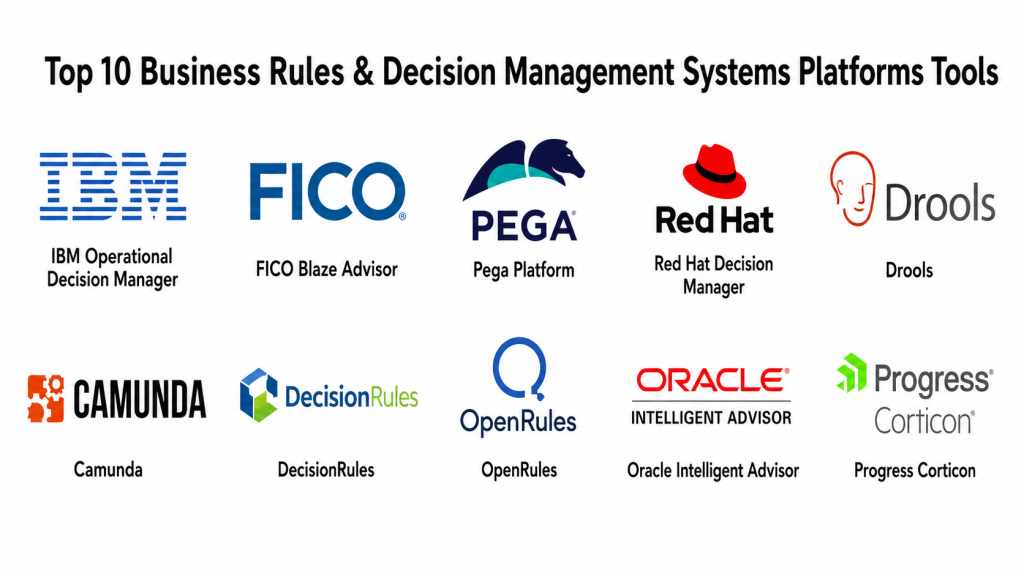
Top 10 Business Rules & Decision Management Systems Platforms Tools
#1 — IBM Operational Decision Manager
Short description: IBM Operational Decision Manager is an enterprise decision automation platform used to manage business rules, decision services, and policy logic. It is best for large organizations that need strong governance, auditability, and complex rule execution.
Key Features
- Business rules management
- Decision service deployment
- Rule authoring and governance
- Decision tables
- Testing and simulation
- Integration with enterprise systems
- Versioning and lifecycle management
Pros
- Strong fit for large enterprises and regulated industries.
- Good governance for complex rule changes.
- Useful when business policies change frequently.
Cons
- Can be complex for smaller teams.
- Implementation may require experienced architects.
- Licensing and setup should be reviewed carefully.
Platforms / Deployment
Web / Linux / Windows
Cloud / Self-hosted / Hybrid
Security & Compliance
IBM Operational Decision Manager supports enterprise access control and governance patterns. Specific details such as SSO/SAML, MFA, audit logs, RBAC, SOC 2, ISO 27001, GDPR, HIPAA, and encryption should be verified directly based on deployment and plan.
Integrations & Ecosystem
IBM ODM works well in enterprise environments where decision logic must connect with business systems and applications.
- Java applications
- Enterprise APIs
- BPM platforms
- Databases
- Mainframe and legacy systems
- IBM ecosystem tools
Support & Community
IBM provides enterprise documentation, support, professional services, and partner expertise. It is best suited for organizations with mature IT governance and decision automation needs.
#2 — FICO Blaze Advisor
Short description: FICO Blaze Advisor is a business rules management system used for decision automation, policy management, credit decisioning, fraud workflows, and risk-based decisions. It is especially relevant for financial services, insurance, lending, and compliance-heavy use cases.
Key Features
- Business rules authoring
- Decision strategy management
- Rule testing and simulation
- Policy automation
- Decision service deployment
- Risk and fraud decision support
- Enterprise integration capabilities
Pros
- Strong fit for risk, credit, and policy decisioning.
- Useful for high-volume regulated decision workflows.
- Good for organizations that need explainable automated decisions.
Cons
- May be too specialized for simple rule needs.
- Implementation may require decisioning expertise.
- Pricing and deployment details should be reviewed directly.
Platforms / Deployment
Web / Windows / Linux
Cloud / Self-hosted / Hybrid
Security & Compliance
FICO Blaze Advisor is used in regulated decisioning environments, but specific security details such as SSO/SAML, MFA, audit logs, RBAC, SOC 2, ISO 27001, GDPR, HIPAA, and encryption should be verified directly.
Integrations & Ecosystem
FICO Blaze Advisor fits well in enterprise decisioning and risk ecosystems.
- Banking systems
- Lending platforms
- Insurance systems
- Fraud tools
- APIs
- Data and analytics systems
Support & Community
FICO provides enterprise support, domain expertise, documentation, and implementation services. It is strong for organizations with serious risk and decisioning needs.
#3 — Pega Platform
Short description: Pega Platform combines decisioning, business rules, workflow automation, case management, and customer engagement. It is best for enterprises that want rules and decisions embedded inside larger business processes.
Key Features
- Business rules and decisioning
- Case management
- Workflow automation
- Customer decisioning
- Low-code app development
- AI-assisted decision support
- Enterprise governance controls
Pros
- Strong for customer service, operations, and case workflows.
- Combines rules, process, and decisioning in one platform.
- Good fit for large process-driven enterprises.
Cons
- May be too broad for teams needing only a standalone rules engine.
- Implementation can require platform expertise.
- Best value appears in larger transformation programs.
Platforms / Deployment
Web
Cloud / Hybrid
Security & Compliance
Pega supports enterprise security and governance controls depending on deployment and configuration. Specific items such as SSO/SAML, MFA, audit logs, RBAC, SOC 2, ISO 27001, GDPR, HIPAA, and encryption should be verified directly.
Integrations & Ecosystem
Pega fits well where decision rules are part of workflow, case management, or customer engagement systems.
- CRM systems
- Case management workflows
- Enterprise APIs
- Databases
- Legacy systems
- Customer service platforms
Support & Community
Pega offers documentation, training, partner services, enterprise support, and implementation expertise. It is strong for organizations that need decisioning with process automation.
#4 — Red Hat Decision Manager
Short description: Red Hat Decision Manager is a business rules and decision management platform built around open-source decision technologies. It is useful for enterprises that want standards-based decision automation with developer control and enterprise support.
Key Features
- Business rules management
- DMN decision modeling
- Rules engine capabilities
- Decision tables
- Business process integration
- Container-friendly deployment
- Enterprise support options
Pros
- Strong fit for open-source-friendly enterprises.
- Good for technical teams using Java and Red Hat platforms.
- Supports standards-based decision modeling.
Cons
- Requires technical skills for best results.
- Business-user experience may need configuration and training.
- Smaller teams may find simpler platforms easier.
Platforms / Deployment
Web / Linux / Kubernetes
Cloud / Self-hosted / Hybrid
Security & Compliance
Red Hat Decision Manager supports enterprise deployment patterns, but specific details such as SSO/SAML, MFA, audit logs, RBAC, SOC 2, ISO 27001, GDPR, HIPAA, and encryption should be verified based on subscription and deployment.
Integrations & Ecosystem
Red Hat Decision Manager works well in Java, Kubernetes, and enterprise architecture environments.
- Red Hat OpenShift
- Java applications
- APIs
- BPM workflows
- Enterprise services
- CI/CD pipelines
Support & Community
Red Hat provides enterprise support, documentation, training, and open-source ecosystem alignment. It is strong for technical teams that want rule automation with platform control.
#5 — Drools
Short description: Drools is an open-source business rules engine used by developers to implement rule-based logic in Java applications. It is best for technical teams that want flexible rule execution without buying a full enterprise decision suite.
Key Features
- Open-source rules engine
- Rule authoring with DRL
- Decision tables
- Complex event processing support
- Java ecosystem integration
- Rule execution engine
- Developer-focused customization
Pros
- Strong value for technical teams.
- Flexible and open-source.
- Good fit for Java-based rule automation.
Cons
- Requires developer expertise.
- Less business-user friendly than commercial platforms.
- Governance, UI, and enterprise operations may require extra tooling.
Platforms / Deployment
Linux / Windows / macOS
Self-hosted / Cloud / Hybrid
Security & Compliance
Drools is a rules engine, not a hosted compliance platform. Security depends on how it is embedded, deployed, authenticated, logged, and governed. Specific compliance details such as SSO/SAML, MFA, audit logs, RBAC, SOC 2, ISO 27001, GDPR, and HIPAA are Not publicly stated at the tool level.
Integrations & Ecosystem
Drools integrates well into developer-controlled Java application environments.
- Java applications
- Spring-based systems
- APIs
- Databases
- Event processing workflows
- Custom enterprise services
Support & Community
Drools has open-source community support, documentation, examples, and developer adoption. Enterprise support may be available through related commercial offerings.
#6 — Camunda
Short description: Camunda is a process orchestration and automation platform that supports BPMN, DMN, and workflow automation. It is useful for teams that need decision logic inside process automation, microservice orchestration, and business workflows.
Key Features
- BPMN process orchestration
- DMN decision tables
- Workflow automation
- Process monitoring
- API-driven architecture
- Cloud and self-managed deployment options
- Developer-friendly orchestration patterns
Pros
- Strong for decision logic inside workflow orchestration.
- Good fit for microservices and process automation.
- Supports standards-based modeling.
Cons
- Not only a business rules platform.
- Requires process and technical modeling skills.
- Complex environments need careful architecture.
Platforms / Deployment
Web / Linux / Kubernetes
Cloud / Self-hosted / Hybrid
Security & Compliance
Camunda supports enterprise process automation and access control patterns depending on deployment. Specific details such as SSO/SAML, MFA, audit logs, RBAC, SOC 2, ISO 27001, GDPR, HIPAA, and encryption should be verified directly.
Integrations & Ecosystem
Camunda works well in process-heavy and microservice-driven environments.
- REST APIs
- Microservices
- Java applications
- Kubernetes
- BPMN workflows
- DMN decision models
Support & Community
Camunda provides documentation, training, community resources, enterprise support, and partner services. It is a strong option when business decisions are part of larger workflows.
#7 — DecisionRules
Short description: DecisionRules is a cloud-based rules and decision management platform designed to help teams create, manage, test, and deploy decision tables and business rules through APIs. It is useful for SaaS teams, product teams, and businesses that want modern rule services.
Key Features
- Decision tables
- Rule authoring
- API-based decision execution
- Testing and simulation
- Versioning
- Team collaboration
- Cloud-focused deployment
Pros
- Modern and API-friendly.
- Easier to start than heavy enterprise platforms.
- Good for SaaS and digital product teams.
Cons
- May not match large enterprise suites in breadth.
- Advanced governance requirements should be validated.
- Fit depends on required compliance and deployment needs.
Platforms / Deployment
Web
Cloud
Security & Compliance
DecisionRules supports cloud-based rule management and API execution patterns. Specific details such as SSO/SAML, MFA, audit logs, RBAC, SOC 2, ISO 27001, GDPR, HIPAA, and encryption should be verified directly.
Integrations & Ecosystem
DecisionRules fits well into API-driven application architectures.
- REST APIs
- SaaS applications
- Backend services
- Product workflows
- Decision tables
- Automation systems
Support & Community
DecisionRules provides documentation and support resources. It is useful for teams looking for a modern decision-service approach without a large enterprise platform footprint.
#8 — OpenRules
Short description: OpenRules is a business rules and decision management system focused on decision tables, rule models, and business-user-friendly rule representation. It is useful for teams that want transparent decision logic and spreadsheet-style rule management.
Key Features
- Decision tables
- Business rules modeling
- Spreadsheet-style authoring
- Java integration
- Decision modeling support
- Rule testing patterns
- Lightweight deployment options
Pros
- Transparent decision table approach.
- Good for business and technical collaboration.
- Useful for teams that prefer spreadsheet-style rule logic.
Cons
- May require technical setup.
- UI and ecosystem may be less broad than larger platforms.
- Enterprise governance should be reviewed directly.
Platforms / Deployment
Windows / macOS / Linux
Self-hosted / Cloud-supported workflow
Security & Compliance
OpenRules security depends on deployment, integration, access control, logging, and application architecture. Specific compliance details such as SSO/SAML, MFA, audit logs, RBAC, SOC 2, ISO 27001, GDPR, and HIPAA are Not publicly stated.
Integrations & Ecosystem
OpenRules works well in Java and decision table-based architectures.
- Java applications
- Spreadsheet-based rules
- APIs
- Databases
- Business applications
- Custom decision services
Support & Community
OpenRules provides documentation, examples, and support options. It is practical for teams that want clear and maintainable decision tables.
#9 — Oracle Intelligent Advisor
Short description: Oracle Intelligent Advisor helps organizations automate complex policy decisions, eligibility determinations, guided interviews, and advice-driven workflows. It is especially useful for public sector, healthcare, insurance, finance, and service-based organizations.
Key Features
- Policy automation
- Guided interviews
- Eligibility determination
- Decision explanations
- Rule modeling
- Integration with enterprise systems
- Oracle ecosystem alignment
Pros
- Strong for complex policy and eligibility workflows.
- Useful when decision explanations matter.
- Good fit for Oracle-centered enterprises.
Cons
- Best value appears inside Oracle environments.
- May be too specialized for simple rule automation.
- Implementation requires policy modeling discipline.
Platforms / Deployment
Web
Cloud / Hybrid
Security & Compliance
Oracle Intelligent Advisor is part of Oracle’s enterprise ecosystem, but specific details such as SSO/SAML, MFA, audit logs, RBAC, SOC 2, ISO 27001, GDPR, HIPAA, and encryption should be verified directly based on deployment and licensing.
Integrations & Ecosystem
Oracle Intelligent Advisor fits well with enterprise policy and Oracle application environments.
- Oracle applications
- CRM systems
- Public sector systems
- Case management workflows
- APIs
- Eligibility and policy systems
Support & Community
Oracle provides enterprise documentation, support, training resources, and partner services. It is strongest for organizations already invested in Oracle or complex policy automation.
#10 — Progress Corticon
Short description: Progress Corticon is a business rules engine and decision management platform used to automate rules, policies, and complex decision logic. It is suitable for enterprises that need rule modeling, validation, deployment, and governance.
Key Features
- Business rules engine
- Decision modeling
- Rule validation
- No-code style rule authoring
- Decision service deployment
- Rule testing and management
- Enterprise integration support
Pros
- Strong for structured business rule automation.
- Helps separate decision logic from application code.
- Useful for policy-heavy and rules-heavy systems.
Cons
- May require training for rule modeling.
- Best fit depends on rule complexity and enterprise needs.
- Pricing and deployment details should be verified.
Platforms / Deployment
Web / Windows / Linux
Cloud / Self-hosted / Hybrid
Security & Compliance
Progress Corticon supports enterprise deployment patterns, but specific details such as SSO/SAML, MFA, audit logs, RBAC, SOC 2, ISO 27001, GDPR, HIPAA, and encryption should be verified directly.
Integrations & Ecosystem
Progress Corticon works well when decision services must connect with enterprise applications and APIs.
- REST APIs
- Java and .NET applications
- Databases
- Business process systems
- Enterprise applications
- Custom services
Support & Community
Progress provides documentation, support, and enterprise services. Corticon is a strong option for organizations that need structured rule modeling and decision automation.
Comparison Table
| Tool Name | Best For | Platform(s) Supported | Deployment | Standout Feature | Public Rating |
|---|---|---|---|---|---|
| IBM Operational Decision Manager | Enterprise decision automation | Web / Linux / Windows | Cloud / Self-hosted / Hybrid | Enterprise-grade rule governance | N/A |
| FICO Blaze Advisor | Risk, credit, and policy decisioning | Web / Windows / Linux | Cloud / Self-hosted / Hybrid | Strong risk and decision strategy support | N/A |
| Pega Platform | Decisioning with workflow and case management | Web | Cloud / Hybrid | Rules, cases, and process automation together | N/A |
| Red Hat Decision Manager | Open-source-friendly enterprise rules | Web / Linux / Kubernetes | Cloud / Self-hosted / Hybrid | Standards-based decision automation | N/A |
| Drools | Developer-focused rules engine | Linux / Windows / macOS | Self-hosted / Cloud / Hybrid | Open-source Java rules engine | N/A |
| Camunda | Decisions inside process orchestration | Web / Linux / Kubernetes | Cloud / Self-hosted / Hybrid | BPMN and DMN process decisioning | N/A |
| DecisionRules | API-based decision services | Web | Cloud | Modern cloud decision tables | N/A |
| OpenRules | Spreadsheet-style rule management | Windows / macOS / Linux | Self-hosted / Cloud-supported | Transparent decision table authoring | N/A |
| Oracle Intelligent Advisor | Policy and eligibility decisions | Web | Cloud / Hybrid | Guided policy advice and explanations | N/A |
| Progress Corticon | Enterprise business rule automation | Web / Windows / Linux | Cloud / Self-hosted / Hybrid | No-code style rule modeling | N/A |
Evaluation & Scoring of Business Rules & Decision Management Systems Platforms
| Tool Name | Core (25%) | Ease (15%) | Integrations (15%) | Security (10%) | Performance (10%) | Support (10%) | Value (15%) | Weighted Total (0–10) |
|---|---|---|---|---|---|---|---|---|
| IBM Operational Decision Manager | 10 | 7 | 9 | 9 | 9 | 9 | 6 | 8.45 |
| FICO Blaze Advisor | 9 | 7 | 8 | 9 | 9 | 9 | 6 | 8.15 |
| Pega Platform | 9 | 7 | 9 | 9 | 8 | 9 | 6 | 8.20 |
| Red Hat Decision Manager | 8 | 6 | 8 | 8 | 8 | 8 | 8 | 7.65 |
| Drools | 8 | 5 | 8 | 6 | 8 | 7 | 10 | 7.45 |
| Camunda | 8 | 7 | 9 | 8 | 8 | 8 | 8 | 8.00 |
| DecisionRules | 7 | 8 | 8 | 7 | 8 | 7 | 8 | 7.60 |
| OpenRules | 7 | 7 | 7 | 6 | 7 | 7 | 8 | 7.00 |
| Oracle Intelligent Advisor | 8 | 7 | 8 | 8 | 8 | 8 | 6 | 7.55 |
| Progress Corticon | 8 | 7 | 8 | 8 | 8 | 8 | 7 | 7.75 |
These scores are comparative and should be interpreted based on your decisioning needs. IBM ODM, FICO Blaze Advisor, Pega, and Progress Corticon are strong for enterprise rule programs. Drools is powerful for developer-led rule execution. Camunda is best when decision logic is tied to process orchestration. DecisionRules and OpenRules can be more approachable for lighter or API-driven decision services.
Which Business Rules & Decision Management Systems Platforms Tool Is Right for You?
Solo / Freelancer
Solo developers and freelancers usually need lightweight, affordable, and flexible tools. Drools, OpenRules, and DecisionRules are practical options.
Choose Drools if you are comfortable with Java and want an open-source rules engine. Choose DecisionRules if you want an API-based cloud decision service. Choose OpenRules if spreadsheet-style rules are easier for your project.
SMB
Small and medium businesses need decision tools that are easier to manage and do not require a large enterprise team. DecisionRules, OpenRules, Camunda, and Progress Corticon can be considered depending on complexity.
Choose DecisionRules for cloud-based rule services. Choose Camunda if rules are connected with workflows. Choose Progress Corticon if you need more structured rule modeling.
Mid-Market
Mid-market organizations often need stronger governance, business-user collaboration, APIs, testing, and version control. Camunda, Progress Corticon, Pega, Red Hat Decision Manager, and IBM ODM can fit different needs.
Choose Camunda for process-driven decisioning. Choose Red Hat Decision Manager for open-source-friendly enterprise environments. Choose Pega if decisioning is part of case management or customer operations.
Enterprise
Enterprise buyers should focus on governance, auditability, security, scalability, versioning, approval workflows, integration depth, and decision explainability. IBM Operational Decision Manager, FICO Blaze Advisor, Pega Platform, Oracle Intelligent Advisor, and Progress Corticon are strong enterprise options.
Choose IBM ODM for broad enterprise rule governance. Choose FICO Blaze Advisor for risk, lending, and policy decisioning. Choose Oracle Intelligent Advisor for complex policy and eligibility workflows. Choose Pega when decisions must work inside broader process and case management.
Budget vs Premium
For budget-conscious teams, Drools, OpenRules, and lighter cloud decision tools may provide strong value. However, teams must manage governance, testing, documentation, and deployment carefully.
Premium platforms like IBM ODM, FICO Blaze Advisor, Pega, Oracle Intelligent Advisor, and Progress Corticon may cost more, but they provide stronger enterprise governance, support, modeling, scalability, and lifecycle management.
Feature Depth vs Ease of Use
If ease of use matters most, DecisionRules, OpenRules, and some no-code style decision platforms may be easier starting points.
If feature depth matters more, IBM ODM, FICO Blaze Advisor, Pega, Red Hat Decision Manager, Camunda, and Progress Corticon provide stronger modeling, governance, integration, and enterprise deployment capabilities.
Integrations & Scalability
If decisions must be used across many applications, APIs, workflows, and customer journeys, choose a platform that supports decision services, APIs, CI/CD, versioning, and monitoring.
Camunda is strong for process orchestration. Pega is strong for case management and customer operations. IBM ODM and Progress Corticon are strong for centralized decision services. Drools works well when developers want embedded rule execution.
Security & Compliance Needs
Decision systems often handle sensitive business logic and regulated decisions. Review SSO, MFA, RBAC, audit logs, rule change approvals, version history, encryption, data protection, testing evidence, decision explanations, and rollback options.
For regulated industries, involve compliance, legal, risk, security, and business owners before deploying automated decisions into production.
Frequently Asked Questions
What is a business rules management system?
A business rules management system helps organizations define, manage, test, and execute business logic separately from application code. It allows teams to update rules more safely and consistently.
What is decision management?
Decision management is the practice of modeling, automating, monitoring, and improving business decisions. It often uses rules, decision tables, analytics, AI models, and workflows.
How is a rules engine different from a workflow engine?
A rules engine decides what should happen based on conditions. A workflow engine manages the sequence of tasks, approvals, and process steps. Many organizations use both together.
Which platform is best for enterprises?
IBM Operational Decision Manager, FICO Blaze Advisor, Pega Platform, Oracle Intelligent Advisor, and Progress Corticon are strong enterprise options. The best choice depends on industry, governance needs, and integration requirements.
Which tool is best for developers?
Drools, Red Hat Decision Manager, and Camunda are strong for developer-led teams. They offer technical flexibility and can be integrated into modern application architectures.
What are decision tables?
Decision tables organize rules in a table format where conditions and outcomes are clearly mapped. They are useful when business logic has many combinations and needs to be reviewed by business users.
Can business users manage rules without developers?
Yes, many platforms provide business-friendly rule editors, decision tables, and approval workflows. However, IT teams should still manage governance, testing, deployment, and security.
What are common mistakes in rule management?
Common mistakes include hardcoding rules, poor version control, weak testing, unclear ownership, duplicate rules across systems, no audit trail, and allowing rule changes without approval.
Can decision management work with AI?
Yes. AI can provide predictions or scores, while business rules can apply policy, compliance, thresholds, and explainable decision logic. This combination is useful when decisions must be both smart and controlled.
What pricing factors should buyers check?
Buyers should check users, environments, decision volume, rule repositories, deployment model, support tier, enterprise features, cloud usage, and implementation services.
Is open-source rules management suitable for production?
Open-source rules engines can be suitable for production if the team has strong engineering, testing, monitoring, and governance practices. Enterprise support may be needed for critical systems.
How hard is it to switch decision platforms?
Switching can be complex because rules, decision tables, integrations, test cases, approvals, and audit history may need migration. A phased migration with strong documentation is usually safer.
Conclusion
Business Rules and Decision Management Systems help organizations separate decision logic from application code, improve governance, and automate business decisions with more consistency. The best platform depends on your business size, rule complexity, industry requirements, technical maturity, and governance needs. IBM Operational Decision Manager is strong for broad enterprise rule governance. FICO Blaze Advisor is useful for risk, credit, and policy-heavy decisioning. Pega is powerful when decisions connect with workflows and case management. Red Hat Decision Manager and Drools are strong for technical and open-source-friendly teams. Camunda is best when decision logic is part of process orchestration. DecisionRules and OpenRules offer more lightweight decision management options. Oracle Intelligent Advisor fits policy and eligibility use cases, while Progress Corticon supports structured enterprise rule automation.
