Upgrade & Secure Your Future with DevOps, SRE, DevSecOps, MLOps!
We spend hours scrolling social media and waste money on things we forget, but won’t spend 30 minutes a day earning certifications that can change our lives.
Master in DevOps, SRE, DevSecOps & MLOps by DevOps School!
Learn from Guru Rajesh Kumar and double your salary in just one year.
Introduction
Lakehouse Platforms combine the flexibility of data lakes with the performance and reliability of data warehouses. In simple terms, they allow organizations to store large volumes of structured and unstructured data in a single repository while enabling analytics, machine learning, and business intelligence workflows on top. They break traditional barriers between storage and analytics, enabling modern data-driven decision-making.
Lakehouse Platforms are essential for organizations handling large datasets, diverse data formats, and real-time insights. Businesses across industries—from finance to healthcare—are leveraging lakehouses to unify fragmented datasets, improve analytics accuracy, and accelerate decision-making.
Real-world use cases include:
- Building AI-powered customer personalization engines.
- Real-time monitoring of industrial IoT data.
- Financial fraud detection using structured and unstructured data.
- Marketing analytics and cross-channel campaign attribution.
- Genomics and healthcare research data integration.
Key evaluation criteria for buyers:
- Data ingestion and storage flexibility
- Performance for analytics and machine learning
- Scalability and cost efficiency
- Integration with BI and ML tools
- Security and compliance support
- Ease of management and automation
- Community and support ecosystem
- Multi-cloud and hybrid deployment capabilities
Best for: Data engineers, analytics teams, AI/ML practitioners, medium to large enterprises, and industries handling high-volume and diverse datasets such as finance, healthcare, retail, and manufacturing.
Not ideal for: Small businesses with minimal data needs, teams relying solely on traditional relational databases, or organizations seeking only basic reporting.
Key Trends in Lakehouse Platforms
- AI-driven query optimization for faster analytics
- Native support for real-time and streaming data pipelines
- Multi-cloud and hybrid deployments becoming standard
- Strong focus on data governance, privacy, and regulatory compliance
- Integration with MLops and BI tools for end-to-end workflows
- Adoption of open-source file formats and query engines
- Pay-as-you-go pricing models for cost efficiency
- Automation of ETL/ELT processes for reduced operational overhead
- Enhanced interoperability with existing enterprise data warehouses
- Advanced observability and monitoring for pipelines and workloads
How We Selected These Tools (Methodology)
- Reviewed market adoption and mindshare across enterprises
- Evaluated feature completeness, focusing on analytics, ML, and storage
- Analyzed performance and reliability under high-volume workloads
- Assessed security posture including encryption, access controls, and compliance certifications
- Considered integrations with BI, ML, and data engineering ecosystems
- Examined support for multi-cloud, hybrid cloud, and on-prem deployments
- Reviewed scalability, elasticity, and cost-efficiency
- Considered customer fit across solo users, SMBs, mid-market, and enterprises
- Prioritized platforms with active communities and strong documentation
- Checked for AI/ML readiness and automation capabilities
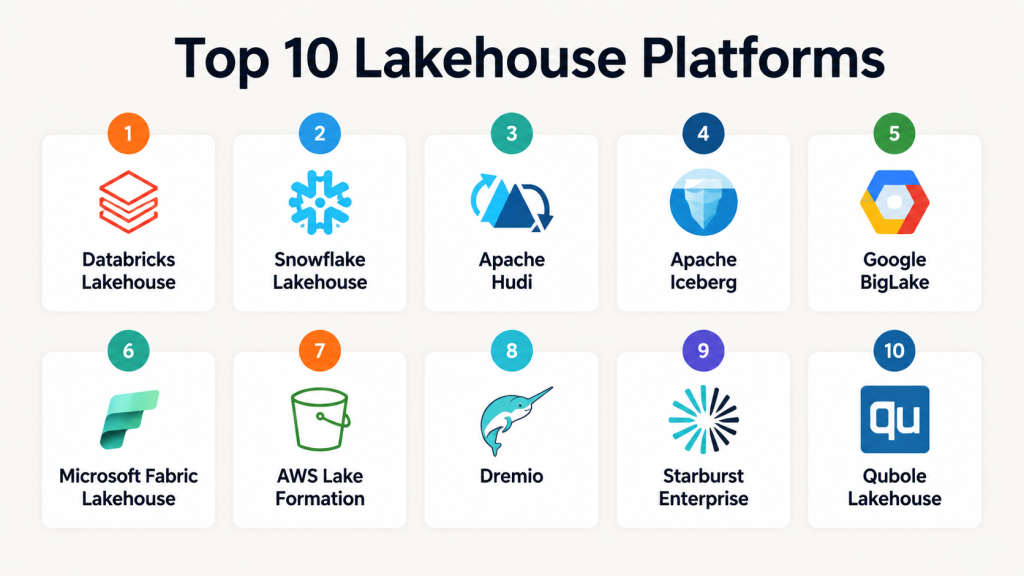
Top 10 Lakehouse Platforms
#1 — Databricks Lakehouse
Short description: Databricks Lakehouse integrates data engineering, data science, and machine learning in a single platform. Ideal for enterprises handling large-scale structured and unstructured data, supporting collaborative analytics and AI workflows.
Key Features
- Unified storage for structured and unstructured data
- Delta Lake for ACID-compliant transactions
- MLflow for machine learning lifecycle management
- Collaborative notebooks for teams
- Real-time data processing with streaming support
- Auto-scaling and workload optimization
Pros
- Enterprise-grade scalability and reliability
- Tight integration with ML and BI tools
Cons
- Higher learning curve for small teams
- Can be expensive at scale
Platforms / Deployment
- Web / Windows / macOS / Linux
- Cloud
Security & Compliance
- SSO/SAML, MFA, encryption, RBAC
- SOC 2, ISO 27001, GDPR
Integrations & Ecosystem
Integrates with a wide range of tools and APIs:
- BI: Power BI, Tableau, Looker
- ML: TensorFlow, PyTorch, Scikit-learn
- ETL: Fivetran, Airbyte
- Streaming: Kafka, Kinesis
Support & Community
- Comprehensive documentation and tutorials
- Enterprise support tiers
- Active online community
#2 — Snowflake Lakehouse
Short description: Snowflake extends its data warehouse capabilities to semi-structured and unstructured data. Suited for enterprises requiring high concurrency and compute-storage separation.
Key Features
- Multi-cluster shared data architecture
- Native support for JSON, Parquet, Avro, ORC
- Time travel and data cloning
- Cross-cloud data sharing
- Automatic scaling and optimization
Pros
- Efficient compute-storage separation
- Handles high-concurrency workloads
Cons
- Limited on-prem deployment
- Pricing can escalate with heavy compute usage
Platforms / Deployment
- Web / Windows / macOS / Linux
- Cloud
Security & Compliance
- SSO/SAML, MFA, encryption
- SOC 2, ISO 27001, GDPR
Integrations & Ecosystem
- BI: Power BI, Tableau, Looker
- ETL: Talend, Fivetran
- ML integration through external notebooks
Support & Community
- Robust documentation
- Enterprise support plans
- Active community
#3 — Apache Hudi
Short description: Apache Hudi is an open-source lakehouse platform offering transactional capabilities. Ideal for developers needing incremental data processing and real-time ingestion.
Key Features
- ACID transactions
- Incremental ingestion and change data capture
- Spark and Presto integration
- Multi-table support
- Real-time query capabilities
Pros
- Open-source and community-driven
- Supports streaming and batch processing
Cons
- Requires engineering expertise
- Limited out-of-the-box BI integration
Platforms / Deployment
- Web / Linux
- Self-hosted / Cloud
Security & Compliance
- Not publicly stated
Integrations & Ecosystem
- Spark, Presto, Hive
- Kafka for streaming
- Cloud storage: S3, GCS, ADLS
Support & Community
- Active open-source community
- Documentation varies
#4 — Apache Iceberg
Short description: Apache Iceberg is an open table format optimized for large analytic datasets. Supports both batch and streaming queries for high-performance lakehouse operations.
Key Features
- Schema evolution without downtime
- Hidden partitioning for efficient queries
- Snapshot isolation for consistent reads
- Integration with Spark, Trino, Flink
- Optimized for petabyte-scale datasets
Pros
- Handles very large datasets efficiently
- Strong schema management features
Cons
- Technical expertise required
- Limited commercial support
Platforms / Deployment
- Web / Linux
- Self-hosted / Cloud
Security & Compliance
- Not publicly stated
Integrations & Ecosystem
- Spark, Flink, Trino/Presto
- Cloud storage: S3, ADLS, GCS
- APIs for table management
Support & Community
- Open-source community support
- Documentation is growing
#5 — Google BigLake
Short description: Google BigLake enables unified queries across lakes and warehouses without duplication. Ideal for teams needing seamless analytics.
Key Features
- Unified access to BigQuery and data lakes
- Storage-agnostic queries
- Integration with AI/ML services
- Fine-grained access control
- Serverless scaling for analytics
Pros
- Seamless Google Cloud integration
- Simplifies governance and access control
Cons
- Limited adoption outside Google Cloud
- Dependent on cloud-native services
Platforms / Deployment
- Web / Linux
- Cloud
Security & Compliance
- SSO/SAML, encryption, RBAC
- SOC 2, ISO 27001, GDPR
Integrations & Ecosystem
- BigQuery, Vertex AI, Looker
- Dataflow, Dataproc
- APIs for ETL/analytics
Support & Community
- Strong documentation
- Enterprise support via Google Cloud
#6 — Microsoft Fabric Lakehouse
Short description: Microsoft Fabric Lakehouse offers integrated analytics across OneLake storage. Supports BI, AI, and data engineering workflows natively.
Key Features
- Integration with Power BI and Azure Synapse
- Delta-like transactional support
- Streaming and batch processing
- Fine-grained access controls
- Built-in AI/ML integration
Pros
- Excellent for Microsoft ecosystem users
- Strong analytics and reporting capabilities
Cons
- Limited flexibility outside Microsoft services
- Pricing can be high at scale
Platforms / Deployment
- Web / Windows / Linux
- Cloud
Security & Compliance
- SSO/SAML, MFA, encryption, RBAC
- SOC 2, ISO 27001, GDPR, HIPAA
Integrations & Ecosystem
- Power BI, Azure Synapse, Azure ML
- Event Hub, Data Factory
- REST APIs for custom integrations
Support & Community
- Comprehensive Microsoft support
- Large user and partner ecosystem
#7 — AWS Lake Formation
Short description: AWS Lake Formation simplifies secure data lake creation. Integrates storage, cataloging, and access control for AWS-heavy environments.
Key Features
- Centralized data catalog
- Fine-grained access policies
- Automated ingestion and ETL
- Integration with Athena, Redshift, SageMaker
- Serverless scaling
Pros
- Strong AWS integration
- Simplifies security and governance
Cons
- AWS-centric, limited multi-cloud flexibility
- Learning curve for complex workflows
Platforms / Deployment
- Web / Linux
- Cloud
Security & Compliance
- SSO/SAML, encryption, audit logs
- SOC 2, ISO 27001, GDPR, HIPAA
Integrations & Ecosystem
- Athena, Redshift, SageMaker
- Glue ETL, QuickSight
- APIs for programmatic access
Support & Community
- AWS documentation and forums
- Enterprise support plans
#8 — Dremio
Short description: Dremio Lakehouse provides self-service analytics with high-performance query acceleration. Ideal for enterprises seeking rapid insights.
Key Features
- Data virtualization
- Columnar cloud caching
- SQL-based query acceleration
- Integration with BI/ML tools
- Real-time analytics
Pros
- Fast queries over large datasets
- Strong analytics and ML integration
Cons
- Requires configuration tuning
- Enterprise support can be costly
Platforms / Deployment
- Web / Linux
- Cloud / Self-hosted / Hybrid
Security & Compliance
- SSO/SAML, encryption
- SOC 2, GDPR
Integrations & Ecosystem
- Tableau, Power BI, Looker
- Spark, ML frameworks
- REST APIs
Support & Community
- Active community
- Paid enterprise support available
#9 — Starburst Enterprise
Short description: Starburst extends Trino (Presto) to lakehouse architectures, enabling distributed SQL queries across multiple data sources.
Key Features
- Distributed SQL query engine
- Multi-cloud and on-prem support
- Security and governance features
- High-performance query optimization
- Integration with BI and analytics tools
Pros
- Excellent for complex queries
- Scalable for enterprise workloads
Cons
- Technical expertise required
- Licensing can be expensive
Platforms / Deployment
- Web / Linux
- Cloud / On-prem / Hybrid
Security & Compliance
- SSO/SAML, encryption
- SOC 2, GDPR
Integrations & Ecosystem
- BI tools: Tableau, Power BI
- ML frameworks and ETL pipelines
- API connectors for data sources
Support & Community
- Enterprise support offered
- Active technical community
#10 — Qubole Lakehouse
Short description: Qubole Lakehouse combines data engineering, analytics, and AI on a cloud-native platform. Designed for operational simplicity and multi-cloud flexibility.
Key Features
- Auto-scaling compute clusters
- Multi-format data support
- Integrated ML workflows
- ETL and pipeline automation
- Security and governance controls
Pros
- Simplifies large-scale data processing
- Flexible multi-cloud deployment
Cons
- Can be costly for small teams
- Requires cloud proficiency
Platforms / Deployment
- Web / Linux
- Cloud
Security & Compliance
- SSO/SAML, encryption, audit logs
- SOC 2, ISO 27001, GDPR
Integrations & Ecosystem
- Spark, Presto, BI tools
- ETL and workflow automation connectors
- APIs for extensibility
Support & Community
- Enterprise support and onboarding
- Community forum and documentation
Comparison Table (Top 10)
| Tool Name | Best For | Platform(s) Supported | Deployment | Standout Feature | Public Rating |
|---|---|---|---|---|---|
| Databricks | Enterprise ML/AI workflows | Web / Windows / macOS / Linux | Cloud | Delta Lake ACID transactions | N/A |
| Snowflake | Multi-cloud analytics | Web / Windows / macOS / Linux | Cloud | Compute-storage separation | N/A |
| Apache Hudi | Real-time ingestion | Web / Linux | Cloud / Self-hosted | Incremental data processing | N/A |
| Apache Iceberg | Large-scale datasets | Web / Linux | Cloud / Self-hosted | Schema evolution & snapshots | N/A |
| Google BigLake | Unified lake & warehouse | Web / Linux | Cloud | Storage-agnostic queries | N/A |
| Microsoft Fabric | Microsoft ecosystem | Web / Windows / Linux | Cloud | OneLake integration | N/A |
| AWS Lake Formation | AWS-centric lakehouse | Web / Linux | Cloud | Centralized security & catalog | N/A |
| Dremio | Self-service analytics | Web / Linux | Cloud / Self-hosted / Hybrid | Query acceleration | N/A |
| Starburst Enterprise | Distributed SQL queries | Web / Linux | Cloud / On-prem / Hybrid | Multi-source SQL engine | N/A |
| Qubole | Cloud-native data processing | Web / Linux | Cloud | Auto-scaling compute clusters | N/A |
Evaluation & Scoring
| Tool Name | Core | Ease | Integrations | Security | Performance | Support | Value | Weighted Total |
|---|---|---|---|---|---|---|---|---|
| Databricks | 9 | 8 | 9 | 9 | 9 | 8 | 7 | 8.7 |
| Snowflake | 8 | 9 | 8 | 8 | 8 | 7 | 8 | 8.1 |
| Apache Hudi | 7 | 6 | 7 | 6 | 7 | 6 | 8 | 6.9 |
| Apache Iceberg | 7 | 6 | 6 | 6 | 7 | 6 | 7 | 6.6 |
| Google BigLake | 8 | 8 | 8 | 8 | 8 | 7 | 7 | 7.9 |
| Microsoft Fabric | 8 | 8 | 8 | 9 | 8 | 8 | 7 | 8.1 |
| AWS Lake Formation | 7 | 7 | 7 | 8 | 7 | 7 | 7 | 7.2 |
| Dremio | 8 | 7 | 7 | 7 | 8 | 7 | 7 | 7.5 |
| Starburst Enterprise | 8 | 7 | 8 | 7 | 8 | 7 | 7 | 7.7 |
| Qubole | 8 | 7 | 7 | 7 | 8 | 7 | 7 | 7.5 |
Interpretation: Weighted totals indicate overall strength; higher scores reflect stronger capability for enterprise lakehouse use cases.
Which Lakehouse Platform Is Right for You?
Solo / Freelancer
- Open-source tools like Apache Hudi or Iceberg
- Databricks Community Edition for small projects and learning
SMB
- Snowflake or Dremio for strong analytics without heavy engineering
- Focus on cloud-managed services for simplicity
Mid-Market
- Databricks or Microsoft Fabric for balance of performance, automation, and integration
- Consider platforms with ML integration
Enterprise
- Databricks, Snowflake, AWS Lake Formation, Microsoft Fabric for multi-cloud and governance
- Security and compliance are key
Budget vs Premium
- Open-source for cost-conscious teams
- Managed platforms for automation, support, and advanced features
Feature Depth vs Ease of Use
- Deep features: Databricks, Snowflake, Microsoft Fabric
- Ease of use: Dremio, Google BigLake
Integrations & Scalability
- Enterprises: Databricks, Snowflake, Microsoft Fabric
- Mid-market: Dremio or Qubole
Security & Compliance Needs
- Prioritize SOC 2, ISO 27001, GDPR, HIPAA
- Databricks, Snowflake, Microsoft Fabric, AWS Lake Formation lead
Frequently Asked Questions (FAQs)
What is a Lakehouse Platform?
A lakehouse platform unifies data lakes and warehouses, supporting storage, analytics, and AI workflows for both structured and unstructured data.
How much do these platforms cost?
Pricing varies by platform, deployment, compute, and storage. Cloud-managed platforms charge based on usage.
Can I deploy on-premises?
Open-source platforms like Hudi, Iceberg, Dremio, and Starburst support self-hosting; others are cloud-native.
Which platform is best for AI/ML workloads?
Databricks and Microsoft Fabric offer integrated ML tools and lifecycle management.
Are these platforms secure and compliant?
Enterprise platforms provide SSO/SAML, encryption, RBAC, and certifications like SOC 2, ISO 27001, GDPR, HIPAA.
How do these platforms handle real-time data?
Platforms like Databricks, Hudi, and BigLake support streaming ingestion and real-time analytics.
Can small teams benefit from lakehouses?
Yes, open-source or lighter cloud-managed versions are cost-effective for small teams.
How do I integrate with BI tools?
Most platforms support Tableau, Power BI, Looker, and APIs for custom integrations.
Is multi-cloud supported?
Snowflake, Databricks, Qubole, and Starburst provide multi-cloud flexibility. Others are platform-specific.
Can lakehouse platforms replace traditional data warehouses?
They can supplement or replace warehouses, especially for analytics and AI on diverse datasets.
Conclusion
Lakehouse Platforms unify lakes and warehouses, enabling advanced analytics, AI, and real-time insights. Selection depends on organization size, expertise, ecosystem, and budget. Solo developers can start with open-source options, SMBs and mid-market teams benefit from cloud-managed platforms, and enterprises need integrated, multi-cloud solutions with strong security. The best approach is to shortlist 2–3 platforms, run pilot projects, and validate integrations and compliance before full-scale adoption.
