Upgrade & Secure Your Future with DevOps, SRE, DevSecOps, MLOps!
We spend hours scrolling social media and waste money on things we forget, but won’t spend 30 minutes a day earning certifications that can change our lives.
Master in DevOps, SRE, DevSecOps & MLOps by DevOps School!
Learn from Guru Rajesh Kumar and double your salary in just one year.
Introduction
Natural Language Processing (NLP) toolkits help software understand, process, analyze, and generate human language. In simple words, these tools help developers and data teams work with text, speech transcripts, documents, customer feedback, search queries, chat messages, emails, and knowledge bases. NLP toolkits are used for tasks such as sentiment analysis, named entity recognition, text classification, summarization, translation, question answering, and chatbot development.
NLP matters now because businesses are using more AI-powered products, customer support automation, document intelligence, search systems, and generative AI workflows. Teams need reliable NLP foundations to clean text, extract meaning, build models, and connect language data with business applications.
Common use cases include:
- Sentiment analysis for customer feedback
- Document classification and extraction
- Chatbot and virtual assistant development
- Search and recommendation systems
- Text summarization and topic detection
Buyers should evaluate:
- Language and model support
- Ease of use
- Developer ecosystem
- Custom model training
- Performance and scalability
- Integration options
- Open-source vs managed service
- Security and privacy controls
- Documentation quality
- Cost and licensing
Best for: data scientists, NLP engineers, AI developers, product teams, research teams, SaaS companies, contact centers, media companies, legal teams, healthcare teams, and enterprises working with large text datasets.
Not ideal for: teams that only need simple keyword search, very small text tasks, or businesses that prefer fully managed AI apps instead of building NLP workflows themselves.
Key Trends in Natural Language Processing (NLP) Toolkits
- NLP toolkits are increasingly used with large language models and retrieval-augmented generation workflows.
- Teams are combining traditional NLP with generative AI for better text understanding and automation.
- Multilingual NLP is becoming more important for global products and support teams.
- Lightweight and efficient models are gaining attention for edge and private deployments.
- Enterprise buyers now expect stronger governance, privacy, and explainability around language AI.
- Open-source NLP remains strong because teams want flexibility, transparency, and control.
- Vector search, embeddings, and semantic retrieval are now common parts of NLP pipelines.
- Domain-specific NLP is growing in healthcare, finance, legal, ecommerce, and cybersecurity.
- API-based NLP is popular for fast implementation, while toolkits remain important for customization.
- Integration with MLOps, data pipelines, and monitoring tools is becoming a key buying factor.
How We Selected These Tools
The tools in this list were selected using practical evaluation logic:
- Recognition and adoption in the NLP and AI community
- Support for common NLP tasks and modern language workflows
- Fit for developers, researchers, startups, and enterprises
- Flexibility for custom model development
- Integration with Python, ML frameworks, and production pipelines
- Documentation quality and community strength
- Support for multilingual and domain-specific use cases
- Ability to work in cloud, self-hosted, or hybrid environments
- Practical value across traditional NLP and modern AI use cases
- Long-term ecosystem relevance and extensibility
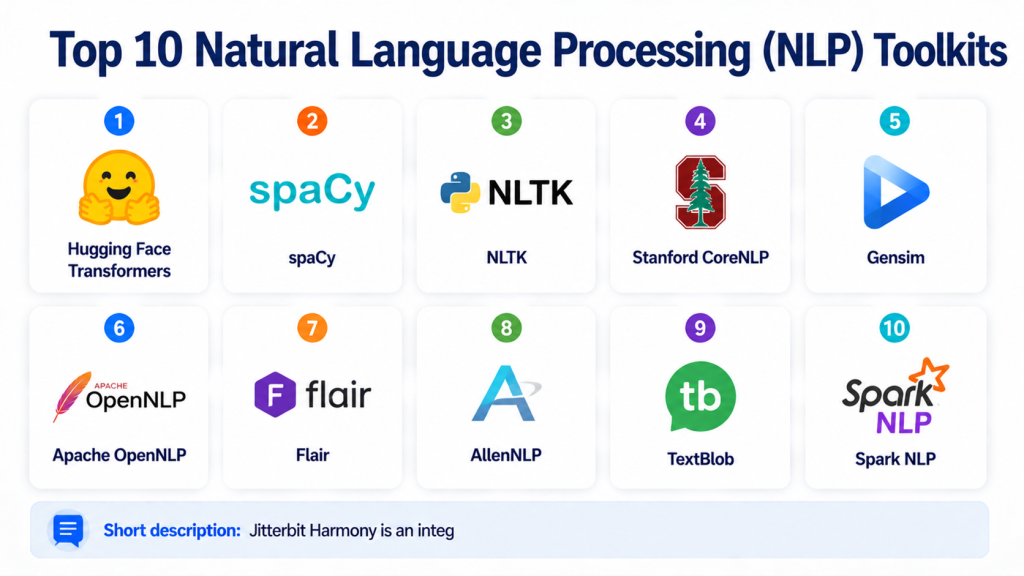
Top 10 Natural Language Processing (NLP) Toolkits
#1 — Hugging Face Transformers
Short description: Hugging Face Transformers is one of the most widely used open-source libraries for modern NLP and transformer-based AI models. It supports tasks such as text classification, summarization, translation, question answering, token classification, embeddings, and text generation. The toolkit is useful for researchers, developers, data scientists, and enterprises building NLP or generative AI applications. It provides access to a large ecosystem of pre-trained models and supports popular deep learning frameworks. Teams can fine-tune models for domain-specific tasks and deploy them in custom environments. It is especially strong for modern NLP workflows involving transformers and large language models.
Key Features
- Large collection of transformer models
- Support for text classification, translation, summarization, and generation
- Works with PyTorch, TensorFlow, and JAX
- Model fine-tuning support
- Tokenizers and pipelines for faster development
- Strong model hub ecosystem
- Useful for NLP and generative AI workflows
Pros
- Very strong open-source ecosystem
- Excellent for modern NLP and LLM workflows
- Large community and documentation support
Cons
- Can require deep ML knowledge for advanced use
- Large models may need strong compute resources
- Production deployment needs careful optimization
Platforms / Deployment
Windows / macOS / Linux / Cloud / Self-hosted / Hybrid
Security & Compliance
Not publicly stated for open-source usage. Security depends on deployment environment, model choice, data handling, and infrastructure controls.
Integrations & Ecosystem
Hugging Face Transformers fits into modern AI and NLP workflows.
- Python
- PyTorch
- TensorFlow
- JAX
- MLOps pipelines
- Vector databases
Support & Community
Very strong documentation, tutorials, open-source community, and commercial support options through related offerings.
#2 — spaCy
Short description: spaCy is an open-source NLP library designed for practical, production-ready text processing. It is widely used by developers and data scientists for tasks such as tokenization, named entity recognition, part-of-speech tagging, dependency parsing, text classification, and rule-based matching. spaCy is known for speed, clean APIs, and production-friendly design. It is useful for teams building information extraction systems, document processing workflows, search pipelines, and custom NLP applications. spaCy supports multiple languages and allows custom pipeline components. It is a strong choice when teams need efficient and structured NLP processing rather than only large generative models.
Key Features
- Tokenization and linguistic processing
- Named entity recognition
- Text classification
- Rule-based matching
- Custom pipeline components
- Multi-language support
- Fast production-oriented performance
Pros
- Fast and practical for production NLP
- Good for information extraction workflows
- Clean developer experience
Cons
- Not focused mainly on generative AI
- Advanced custom training needs NLP knowledge
- Some use cases may need additional model tooling
Platforms / Deployment
Windows / macOS / Linux / Self-hosted / Cloud
Security & Compliance
Not publicly stated. Security depends on where and how spaCy is deployed.
Integrations & Ecosystem
spaCy works well in Python-based NLP and data workflows.
- Python
- Machine learning pipelines
- Data processing workflows
- Search systems
- Annotation workflows
- Custom APIs
Support & Community
Strong documentation, active open-source community, tutorials, and commercial ecosystem support.
#3 — NLTK
Short description: NLTK, or Natural Language Toolkit, is one of the oldest and most well-known Python libraries for NLP education, research, and experimentation. It provides tools for tokenization, stemming, tagging, parsing, classification, corpora access, and linguistic analysis. NLTK is especially useful for students, researchers, educators, and teams learning NLP fundamentals. It is not always the fastest option for production systems, but it remains valuable for learning and prototyping. The toolkit includes many classic NLP algorithms and datasets. It is a good choice when users want to understand language processing concepts deeply before moving to production-focused tools.
Key Features
- Tokenization and text processing
- Stemming and lemmatization support
- Part-of-speech tagging
- Parsing and classification tools
- Access to corpora and lexical resources
- Strong educational value
- Python-based workflow
Pros
- Excellent for learning NLP concepts
- Large collection of classic NLP tools
- Useful for research and experimentation
Cons
- Not ideal for high-performance production workloads
- Modern deep learning support is limited
- Interface may feel less streamlined than newer libraries
Platforms / Deployment
Windows / macOS / Linux / Self-hosted
Security & Compliance
Not publicly stated. Security depends on user environment and data handling practices.
Integrations & Ecosystem
NLTK fits into Python learning, research, and prototyping workflows.
- Python
- Jupyter
- Research notebooks
- Text preprocessing pipelines
- Educational projects
- Linguistic datasets
Support & Community
Large educational community, extensive documentation, and many learning resources.
#4 — Stanford CoreNLP
Short description: Stanford CoreNLP is a Java-based NLP toolkit developed for linguistic analysis and natural language understanding tasks. It supports tokenization, sentence splitting, part-of-speech tagging, named entity recognition, parsing, sentiment analysis, coreference resolution, and other NLP tasks. It is useful for researchers, developers, and enterprises that need a mature and linguistically rich NLP pipeline. Stanford CoreNLP has been widely used in academic and enterprise environments. It is suitable for teams that need rule-based and statistical NLP capabilities. The toolkit can be used through Java and server-based workflows. It is especially valuable for structured linguistic processing.
Key Features
- Tokenization and sentence splitting
- Part-of-speech tagging
- Named entity recognition
- Dependency parsing
- Sentiment analysis
- Coreference resolution
- Java-based NLP pipeline
Pros
- Mature and linguistically rich toolkit
- Strong academic foundation
- Useful for structured NLP analysis
Cons
- Java-based setup may not fit every team
- Less focused on modern transformer workflows
- Can be heavier than lightweight NLP libraries
Platforms / Deployment
Windows / macOS / Linux / Self-hosted
Security & Compliance
Not publicly stated. Security depends on deployment environment and data processing controls.
Integrations & Ecosystem
Stanford CoreNLP fits into Java and server-based NLP workflows.
- Java applications
- Server APIs
- Research pipelines
- Linguistic analysis systems
- Document processing workflows
- Enterprise text systems
Support & Community
Strong academic documentation, long-standing community usage, and research-oriented support resources.
#5 — Gensim
Short description: Gensim is an open-source Python library focused on topic modeling, document similarity, and vector space modeling. It is useful for data scientists, researchers, and developers working with large text collections. Gensim is commonly used for tasks such as topic modeling, word embeddings, document similarity, and semantic analysis. It is especially practical for teams that need to analyze large document sets efficiently. While it is not a full NLP platform, it remains valuable for text mining and unsupervised NLP workflows. Gensim is suitable for search, recommendation, clustering, and knowledge discovery projects. It works well in Python-based analytics environments.
Key Features
- Topic modeling
- Word embedding workflows
- Document similarity analysis
- Large corpus processing
- Unsupervised text analysis
- Python-based APIs
- Efficient streaming design
Pros
- Strong for topic modeling and similarity
- Good for large text collections
- Lightweight and practical for analytics
Cons
- Not a complete NLP toolkit for all tasks
- Less focused on modern LLM workflows
- Requires technical NLP understanding
Platforms / Deployment
Windows / macOS / Linux / Self-hosted
Security & Compliance
Not publicly stated. Security depends on the deployment and data environment.
Integrations & Ecosystem
Gensim fits into Python analytics and text mining workflows.
- Python
- Pandas
- NumPy
- Jupyter
- Search systems
- Document analytics pipelines
Support & Community
Good documentation, open-source community, and long-standing adoption in topic modeling use cases.
#6 — Apache OpenNLP
Short description: Apache OpenNLP is an open-source toolkit for machine learning-based natural language processing. It supports common NLP tasks such as tokenization, sentence detection, part-of-speech tagging, named entity recognition, chunking, parsing, and coreference resolution. OpenNLP is useful for Java developers, enterprise teams, and organizations that prefer Apache ecosystem tools. It can be used for document processing, search enhancement, information extraction, and text analytics. The toolkit is suitable for teams that need a traditional NLP pipeline with open-source flexibility. It may require more setup than newer Python-first libraries. It is a practical option for Java-based NLP environments.
Key Features
- Sentence detection
- Tokenization
- Part-of-speech tagging
- Named entity recognition
- Chunking and parsing
- Model training support
- Java-based open-source toolkit
Pros
- Good fit for Java teams
- Open-source and Apache ecosystem-friendly
- Supports core NLP pipeline tasks
Cons
- Less modern than transformer-first libraries
- Setup may require Java experience
- Smaller ecosystem compared with Python NLP tools
Platforms / Deployment
Windows / macOS / Linux / Self-hosted
Security & Compliance
Not publicly stated. Security depends on deployment architecture and data controls.
Integrations & Ecosystem
Apache OpenNLP works well in Java and enterprise text systems.
- Java applications
- Apache ecosystem tools
- Search platforms
- Document processing systems
- Server-side NLP workflows
- Custom APIs
Support & Community
Apache documentation and open-source community support are available. Enterprise support depends on third-party arrangements.
#7 — Flair
Short description: Flair is an open-source NLP framework built for text classification, named entity recognition, sequence labeling, and embeddings. It is useful for researchers, developers, and data scientists who want modern NLP models with a clean Python interface. Flair supports different embedding types and is commonly used for sequence labeling tasks. It can be helpful for custom NLP applications involving entity extraction, classification, and text tagging. The toolkit is less broad than some larger platforms but useful for focused NLP modeling. It works well in research and applied machine learning workflows. Flair is a good choice for teams needing flexible NLP model training in Python.
Key Features
- Named entity recognition
- Text classification
- Sequence labeling
- Embedding support
- Custom model training
- Python-based workflow
- Research-friendly design
Pros
- Strong for sequence labeling tasks
- Easy Python interface
- Useful for research and applied NLP
Cons
- Smaller ecosystem than Hugging Face or spaCy
- Production deployment may need extra work
- Not a complete enterprise NLP platform
Platforms / Deployment
Windows / macOS / Linux / Self-hosted / Cloud
Security & Compliance
Not publicly stated. Security depends on implementation and deployment environment.
Integrations & Ecosystem
Flair fits into Python machine learning and NLP workflows.
- Python
- PyTorch
- Jupyter
- ML pipelines
- Custom APIs
- Research environments
Support & Community
Open-source documentation and community support are available. Community size is moderate compared with larger NLP frameworks.
#8 — AllenNLP
Short description: AllenNLP is an open-source NLP research library built on PyTorch. It is designed for building and evaluating deep learning models for natural language understanding tasks. AllenNLP is useful for researchers, advanced NLP practitioners, and teams working on custom model architectures. It supports structured experimentation and model development for tasks such as reading comprehension, semantic role labeling, textual entailment, and other research-heavy workflows. It is not usually the simplest choice for beginners or business users. However, it can be valuable for teams that need research flexibility. AllenNLP is best suited for advanced NLP model development rather than simple plug-and-play text processing.
Key Features
- PyTorch-based NLP research framework
- Support for custom model development
- Natural language understanding tasks
- Experiment configuration workflows
- Model evaluation utilities
- Research-focused architecture
- Extensible components
Pros
- Strong for advanced NLP research
- Good PyTorch integration
- Useful for custom model experimentation
Cons
- Not beginner-friendly
- Less suitable for simple production NLP tasks
- Smaller practical ecosystem than broader NLP platforms
Platforms / Deployment
Windows / macOS / Linux / Self-hosted / Cloud
Security & Compliance
Not publicly stated. Security depends on deployment and data handling practices.
Integrations & Ecosystem
AllenNLP fits into research and advanced deep learning workflows.
- Python
- PyTorch
- Research pipelines
- Custom model training
- Experiment workflows
- Academic NLP projects
Support & Community
Documentation and open-source resources are available. Community activity may vary by use case.
#9 — TextBlob
Short description: TextBlob is a simple Python library for basic NLP tasks and text processing. It is useful for beginners, educators, analysts, and developers who need quick sentiment analysis, part-of-speech tagging, noun phrase extraction, translation-style workflows, and simple text operations. TextBlob is not designed for advanced production NLP or large-scale model development. However, it is practical for small projects, prototypes, tutorials, and lightweight text analysis. It has a friendly interface and can help users start quickly without deep NLP knowledge. TextBlob is best when ease of use matters more than advanced model control. It is a good entry-level NLP toolkit.
Key Features
- Simple text processing
- Sentiment analysis
- Part-of-speech tagging
- Noun phrase extraction
- Tokenization support
- Beginner-friendly Python API
- Useful for quick prototypes
Pros
- Very easy to learn
- Good for beginners and small tasks
- Fast for simple NLP experiments
Cons
- Not ideal for advanced production workloads
- Limited modern model capabilities
- Less flexible for complex NLP pipelines
Platforms / Deployment
Windows / macOS / Linux / Self-hosted
Security & Compliance
Not publicly stated. Security depends on how and where it is used.
Integrations & Ecosystem
TextBlob works well in simple Python text analysis workflows.
- Python
- Jupyter
- Educational projects
- Small analytics scripts
- Prototypes
- Lightweight dashboards
Support & Community
Good beginner resources, documentation, and community examples are available.
#10 — Spark NLP
Short description: Spark NLP is an NLP library designed for scalable natural language processing on Apache Spark. It is useful for enterprises, data engineering teams, and ML teams working with large volumes of text data. Spark NLP supports tasks such as tokenization, named entity recognition, text classification, embeddings, dependency parsing, and healthcare-specific NLP in certain offerings. It is especially relevant when teams need distributed processing for large datasets. Spark NLP fits well in big data environments where standard single-machine NLP libraries may not be enough. It can support production-scale NLP pipelines. It is a strong option for organizations already using Spark-based data infrastructure.
Key Features
- Distributed NLP processing
- Apache Spark integration
- Named entity recognition
- Text classification
- Embeddings and pipelines
- Scalable document processing
- Enterprise and domain-specific use cases
Pros
- Strong for large-scale text processing
- Good fit for Spark-based enterprises
- Useful for production NLP pipelines
Cons
- Requires Spark knowledge
- May be too heavy for small projects
- Advanced features may vary by edition
Platforms / Deployment
Windows / macOS / Linux / Cloud / Self-hosted / Hybrid
Security & Compliance
Security depends on Spark deployment, infrastructure, access controls, and edition. Specific certifications are not publicly stated here.
Integrations & Ecosystem
Spark NLP fits into big data and enterprise analytics workflows.
- Apache Spark
- Databricks
- Hadoop ecosystems
- Cloud data platforms
- ML pipelines
- Data engineering workflows
Support & Community
Documentation, community resources, and commercial support options may be available depending on edition and provider.
Comparison Table
| Tool Name | Best For | Platform(s) Supported | Deployment | Standout Feature | Public Rating |
|---|---|---|---|---|---|
| Hugging Face Transformers | Modern NLP and LLM workflows | Windows / macOS / Linux | Cloud / Self-hosted / Hybrid | Large transformer model ecosystem | N/A |
| spaCy | Production text processing | Windows / macOS / Linux | Cloud / Self-hosted | Fast NLP pipelines | N/A |
| NLTK | NLP learning and research | Windows / macOS / Linux | Self-hosted | Classic NLP education toolkit | N/A |
| Stanford CoreNLP | Linguistic NLP analysis | Windows / macOS / Linux | Self-hosted | Rich linguistic processing | N/A |
| Gensim | Topic modeling and document similarity | Windows / macOS / Linux | Self-hosted | Efficient large-corpus analysis | N/A |
| Apache OpenNLP | Java-based NLP workflows | Windows / macOS / Linux | Self-hosted | Apache-friendly NLP pipeline | N/A |
| Flair | Sequence labeling and NER | Windows / macOS / Linux | Cloud / Self-hosted | Flexible NLP model training | N/A |
| AllenNLP | Advanced NLP research | Windows / macOS / Linux | Cloud / Self-hosted | PyTorch-based research framework | N/A |
| TextBlob | Simple beginner NLP tasks | Windows / macOS / Linux | Self-hosted | Easy text analysis API | N/A |
| Spark NLP | Large-scale enterprise NLP | Windows / macOS / Linux | Cloud / Self-hosted / Hybrid | Distributed NLP on Spark | N/A |
Evaluation & Scoring of Natural Language Processing (NLP) Toolkits
| Tool Name | Core (25%) | Ease (15%) | Integrations (15%) | Security (10%) | Performance (10%) | Support (10%) | Value (15%) | Weighted Total (0–10) |
|---|---|---|---|---|---|---|---|---|
| Hugging Face Transformers | 10 | 8 | 10 | 6 | 9 | 9 | 9 | 8.90 |
| spaCy | 9 | 9 | 8 | 6 | 9 | 8 | 9 | 8.35 |
| NLTK | 7 | 8 | 7 | 5 | 6 | 8 | 9 | 7.15 |
| Stanford CoreNLP | 8 | 6 | 7 | 5 | 7 | 7 | 8 | 6.95 |
| Gensim | 7 | 7 | 7 | 5 | 8 | 7 | 9 | 7.15 |
| Apache OpenNLP | 7 | 6 | 7 | 5 | 7 | 7 | 8 | 6.65 |
| Flair | 8 | 7 | 7 | 5 | 8 | 6 | 8 | 7.10 |
| AllenNLP | 8 | 6 | 7 | 5 | 8 | 6 | 8 | 6.95 |
| TextBlob | 5 | 9 | 6 | 5 | 6 | 7 | 9 | 6.65 |
| Spark NLP | 9 | 6 | 8 | 6 | 9 | 8 | 8 | 7.90 |
These scores are comparative and should not be treated as universal rankings. Hugging Face Transformers scores high for modern NLP and AI workflows, while spaCy scores strongly for practical production pipelines. NLTK and TextBlob are valuable for learning and quick tasks, but less suitable for advanced production systems. Spark NLP is strong when scale matters, while research-focused tools are better for advanced model experimentation.
Which Natural Language Processing (NLP) Toolkit Is Right for You?
Solo / Freelancer
Solo users should choose based on skill level and project size. TextBlob and NLTK are good for learning and simple text analysis. spaCy is better for practical production-style projects. Hugging Face Transformers is ideal when modern AI, embeddings, classification, summarization, or LLM-related workflows are needed.
For freelancers building client projects, spaCy and Hugging Face Transformers offer a strong balance of quality and flexibility. Gensim is useful for topic modeling and document similarity projects.
SMB
SMBs should focus on ease of implementation, community support, and maintainability. spaCy is a strong choice for text extraction, classification, and document processing. Hugging Face Transformers is useful when the SMB needs advanced AI capabilities.
If the team works with large text collections, Gensim can help with topic modeling and similarity. If the SMB has Java developers, Apache OpenNLP or Stanford CoreNLP may fit better.
Mid-Market
Mid-market companies often need stronger pipelines, repeatability, and integration with existing systems. Hugging Face Transformers, spaCy, Spark NLP, and Gensim are practical choices depending on the use case.
For customer feedback analysis, search, support automation, and document workflows, spaCy and Hugging Face Transformers are strong candidates. For larger data engineering workflows, Spark NLP may be better.
Enterprise
Enterprises should prioritize scalability, security, governance, model lifecycle management, and integration with data infrastructure. Spark NLP, Hugging Face Transformers, spaCy, Stanford CoreNLP, and Apache OpenNLP can all fit depending on architecture.
Enterprises should also consider how models are hosted, monitored, secured, and updated. NLP toolkits are powerful, but production governance often requires additional MLOps, security, and monitoring tools.
Budget vs Premium
Most NLP toolkits in this list are open-source or have open-source foundations, which makes them attractive for budget-conscious teams. However, cost still appears through infrastructure, engineering time, model hosting, training, and maintenance.
Premium support or managed services may be useful when teams need enterprise reliability, expert guidance, advanced deployment, or compliance-friendly operations.
Feature Depth vs Ease of Use
TextBlob and NLTK are easier for beginners but less powerful for modern production needs. spaCy offers a strong balance of ease and production readiness. Hugging Face Transformers offers deep capabilities but may require more ML knowledge.
Spark NLP offers scale but needs Spark expertise. AllenNLP and Flair are better for technical users who need custom model training or research flexibility.
Integrations & Scalability
For Python-heavy teams, Hugging Face Transformers, spaCy, NLTK, Gensim, Flair, AllenNLP, and TextBlob are practical. For Java teams, Stanford CoreNLP and Apache OpenNLP may fit better. For big data teams, Spark NLP is the strongest fit.
Scalability depends on model size, inference speed, data volume, deployment environment, and engineering maturity. Teams should test real workloads before choosing.
Security & Compliance Needs
Most open-source NLP toolkits do not provide security controls by themselves. Security depends on hosting, access controls, data storage, logging, encryption, and internal governance.
For sensitive text data such as healthcare records, financial documents, legal files, and customer conversations, teams should carefully manage data access, retention, model outputs, and auditability.
Frequently Asked Questions
1. What is an NLP toolkit?
An NLP toolkit is a software library or framework that helps computers process human language. It can support tasks like tokenization, text classification, named entity recognition, summarization, translation, and question answering.
2. How are NLP toolkits priced?
Many NLP toolkits are open-source, but real costs come from hosting, training, compute, engineering time, and support. Commercial support or managed services may add subscription or usage-based costs.
3. How long does NLP implementation take?
Simple NLP tasks can be implemented quickly with libraries like spaCy, TextBlob, or Hugging Face pipelines. Larger enterprise deployments may take longer due to data preparation, model tuning, testing, security review, and integration.
4. What are common mistakes when choosing NLP tools?
Common mistakes include choosing tools only by popularity, ignoring language support, underestimating compute needs, skipping evaluation on real data, and not planning for deployment or monitoring.
5. Which NLP toolkit is best for beginners?
TextBlob and NLTK are beginner-friendly for learning NLP basics. spaCy is a better next step for practical projects, while Hugging Face Transformers is useful when learners are ready for modern deep learning NLP.
6. Which toolkit is best for production NLP?
spaCy is strong for production text pipelines, and Hugging Face Transformers is strong for advanced model-based NLP. Spark NLP is useful when large-scale distributed text processing is required.
7. Can NLP toolkits support multiple languages?
Yes, many NLP toolkits support multiple languages, but quality varies by language, task, and model availability. Teams should always test their target languages with real data before production use.
8. Are NLP toolkits secure?
Most NLP toolkits do not provide full security by themselves. Security depends on how the toolkit is deployed, where data is stored, who can access it, and how models and logs are managed.
9. Do NLP toolkits replace large language models?
No. NLP toolkits and large language models often work together. Toolkits can handle preprocessing, classification, entity extraction, embeddings, and pipelines, while LLMs can support generation, reasoning, and summarization.
10. What integrations should buyers check?
Teams should check integration with Python, Java, cloud platforms, data warehouses, search engines, vector databases, MLOps tools, APIs, and application frameworks. Integration quality affects long-term maintainability.
Conclusion
Natural Language Processing toolkits help teams turn unstructured text into useful business and product intelligence. The best toolkit depends on the use case, skill level, deployment needs, language support, budget, and production requirements. Hugging Face Transformers is a strong choice for modern NLP and LLM workflows. spaCy is excellent for practical production pipelines..
