Upgrade & Secure Your Future with DevOps, SRE, DevSecOps, MLOps!
We spend hours scrolling social media and waste money on things we forget, but won’t spend 30 minutes a day earning certifications that can change our lives.
Master in DevOps, SRE, DevSecOps & MLOps by DevOps School!
Learn from Guru Rajesh Kumar and double your salary in just one year.
Introduction
Knowledge graph construction tools help organizations build connected data models that show relationships between people, products, documents, systems, events, customers, assets, and business concepts. In simple words, a knowledge graph turns scattered information into a connected map, making it easier for teams and AI systems to understand context, relationships, and meaning.
Knowledge graph tools matter in and beyond because AI systems need better context, traceability, and trusted data. As companies adopt generative AI, enterprise search, recommendation systems, fraud detection, customer intelligence, and data governance platforms, knowledge graphs help connect structured and unstructured data in a more useful way.
Common use cases include:
- Enterprise knowledge management
- AI search and retrieval-augmented generation
- Fraud detection and risk analysis
- Customer 360 and product 360 views
- Recommendation engines
- Data lineage and governance
- Semantic data integration
Buyers should evaluate:
- Graph model support
- Query language support
- Scalability and performance
- Data integration capabilities
- Ontology and semantic standards support
- Visualization and exploration tools
- Security and access control
- Cloud, self-hosted, and hybrid deployment options
- Developer experience and APIs
- Support, documentation, and ecosystem maturity
Best for: data architects, AI teams, data engineers, knowledge management teams, search teams, compliance teams, financial services, healthcare, retail, manufacturing, telecom, public sector, and enterprises building connected intelligence systems.
Not ideal for: teams with simple tabular reporting needs, small projects that only need basic SQL queries, or organizations that do not need relationship-heavy data modeling.
Key Trends in Knowledge Graph Construction Tools
- Knowledge graphs are becoming more important for enterprise AI because they provide context, relationships, and explainability.
- Generative AI teams are using knowledge graphs to improve retrieval quality, reduce hallucination risk, and support more trustworthy answers.
- Hybrid search is growing, combining graph relationships, vector search, semantic search, and traditional keyword search.
- Enterprises are prioritizing graph-based data governance, lineage, master data management, and compliance workflows.
- Cloud-native graph databases are becoming easier to adopt, especially for teams that do not want to manage infrastructure.
- Open-source graph platforms remain attractive for developer-led teams and cost-sensitive projects.
- More organizations are connecting knowledge graphs with data warehouses, lakehouses, APIs, documents, and business applications.
- Graph analytics is becoming more practical for fraud detection, supply chain intelligence, cybersecurity, and recommendation systems.
- Security expectations are rising, including SSO, RBAC, encryption, audit logs, and fine-grained access control.
- Ontology-driven knowledge graphs are gaining attention in industries that need shared vocabulary, explainability, and semantic consistency.
How We Selected These Tools
The following tools were selected using practical SaaS, data platform, and AI infrastructure evaluation logic:
- Market adoption and recognition among data engineering, AI, and graph database teams
- Ability to construct, store, query, and manage knowledge graphs
- Support for relationship-heavy data models and semantic use cases
- Scalability for enterprise and production workloads
- Developer experience, APIs, query languages, and tooling quality
- Integration with data pipelines, cloud platforms, analytics tools, and AI workflows
- Security and governance features where publicly known
- Fit across solo users, SMBs, mid-market teams, and enterprises
- Documentation, support ecosystem, and community strength
- Practical value for AI search, recommendation, fraud, governance, and connected data applications
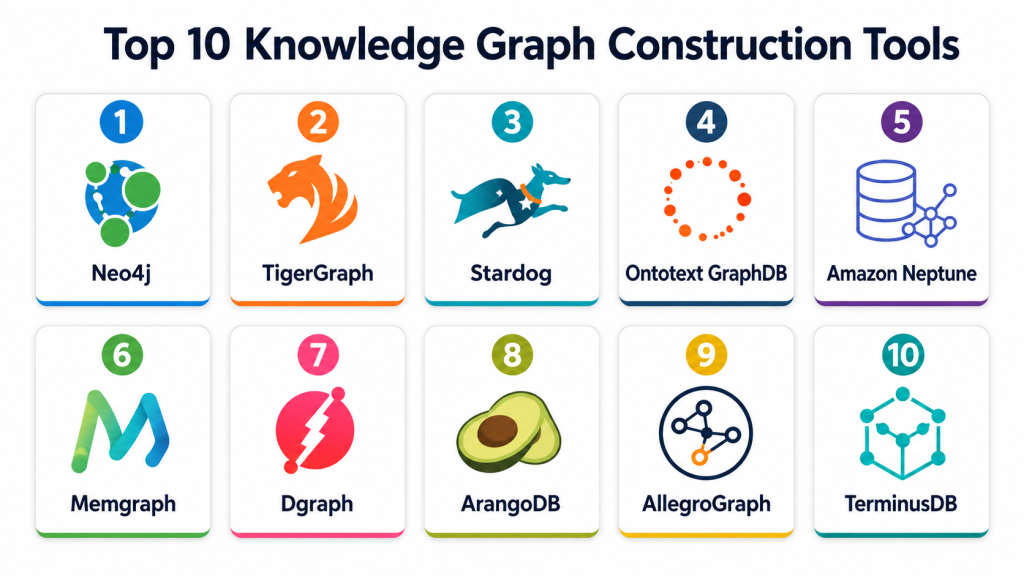
Top 10 Knowledge Graph Construction Tools
#1 — Neo4j
Short description:
Neo4j is one of the most widely recognized graph database platforms for building and querying connected data applications.
It is commonly used for knowledge graphs, fraud detection, recommendation engines, customer 360, identity graphs, network analysis, and AI-enhanced search.
Neo4j uses a property graph model and supports graph querying through Cypher.
It is suitable for developers, data engineers, data architects, AI teams, and enterprise platform teams.
The platform offers graph database capabilities, graph data science features, visualization tools, and cloud deployment options.
Neo4j is often selected when teams need mature graph tooling and a strong ecosystem.
It can support both operational graph applications and analytical graph workflows.
The platform is especially useful when relationships are central to the business problem.
Key Features
- Property graph database model
- Cypher query language
- Graph visualization and exploration tools
- Graph data science capabilities
- Cloud and self-managed deployment options
- APIs and developer tooling
- Support for connected data applications
Pros
- Mature graph database ecosystem
- Strong developer experience and documentation
- Useful for both business and technical graph use cases
Cons
- Advanced enterprise features may require paid plans
- Graph modeling requires planning and expertise
- Costs can increase with scale and enterprise workloads
Platforms / Deployment
Cloud / Self-hosted / Hybrid
Security & Compliance
Security features may include role-based access control, encryption, authentication, and enterprise access management depending on deployment and plan. Specific compliance details should be verified for the selected plan.
Integrations & Ecosystem
Neo4j has a broad ecosystem for data integration, application development, analytics, and AI workflows.
- Python and Java applications
- Data pipelines
- BI and visualization tools
- Cloud platforms
- Graph data science workflows
- AI and retrieval workflows
Support & Community
Neo4j has strong documentation, community resources, training material, and enterprise support options. Its community is one of the strongest in the graph database space.
#2 — TigerGraph
Short description:
TigerGraph is a graph analytics and graph database platform designed for large-scale connected data use cases.
It is often used for fraud detection, customer analytics, entity resolution, recommendation systems, supply chain intelligence, and risk analysis.
The platform focuses on scalable graph processing and high-performance graph queries.
TigerGraph is suitable for enterprises that need deep graph analytics across large datasets.
It supports graph algorithms and connected data exploration for operational and analytical use cases.
The platform can help organizations identify hidden relationships, patterns, and communities in complex data.
It is especially useful when graph scale and query performance are major priorities.
Teams should evaluate implementation effort and graph modeling skills before adoption.
Key Features
- Scalable graph database and analytics engine
- Graph algorithms and pattern detection
- Support for large relationship-heavy datasets
- Query and analytics capabilities
- Visualization and exploration tools
- Cloud and enterprise deployment options
- Use-case templates for business graph problems
Pros
- Strong fit for large-scale graph analytics
- Useful for fraud, recommendation, and entity relationship use cases
- Good performance focus for complex graph workloads
Cons
- Can require graph expertise for best results
- May be more platform than small teams need
- Pricing and deployment details may vary
Platforms / Deployment
Cloud / Self-hosted / Hybrid
Security & Compliance
Enterprise security controls may be available depending on deployment and plan. Specific compliance details are Not publicly stated unless confirmed by the vendor for a specific plan.
Integrations & Ecosystem
TigerGraph fits into data engineering, analytics, and enterprise AI workflows.
- Data warehouses
- Data lakes
- Cloud platforms
- Python and developer workflows
- BI and analytics tools
- Enterprise applications
Support & Community
TigerGraph provides documentation, learning resources, and enterprise support options. Community visibility is strong among graph analytics and enterprise data users.
#3 — Stardog
Short description:
Stardog is an enterprise knowledge graph platform focused on semantic data integration, reasoning, virtualization, and governance.
It is useful for organizations that want to connect data across silos without always physically moving it.
The platform supports semantic graph modeling and standards-based knowledge graph construction.
Stardog is often used in financial services, life sciences, manufacturing, data governance, and enterprise knowledge management.
It helps teams create a unified semantic layer across databases, files, applications, and business concepts.
The platform is especially strong for ontology-driven graph projects.
It can support AI and analytics workflows by providing trusted connected context.
Teams should consider Stardog when semantic consistency and enterprise integration are high priorities.
Key Features
- Enterprise knowledge graph platform
- Semantic modeling and ontology support
- Data virtualization capabilities
- Reasoning and inference support
- Query and data integration tools
- Governance-oriented workflows
- Support for connected enterprise data
Pros
- Strong semantic knowledge graph capabilities
- Useful for data integration without heavy duplication
- Good fit for governance and enterprise knowledge management
Cons
- Semantic modeling can require specialist skills
- May be complex for smaller or simpler graph projects
- Enterprise pricing may require vendor consultation
Platforms / Deployment
Cloud / Self-hosted / Hybrid
Security & Compliance
Enterprise security features may include authentication, authorization, encryption, and access management depending on plan and deployment. Specific compliance details are Not publicly stated unless confirmed for a specific agreement.
Integrations & Ecosystem
Stardog is designed for connecting enterprise data sources into a semantic layer.
- Relational databases
- Data warehouses
- Data lakes
- BI tools
- Knowledge management systems
- AI and search workflows
Support & Community
Stardog provides enterprise documentation, onboarding, and professional support. Community strength is more specialized around semantic graph and enterprise data integration users.
#4 — Ontotext GraphDB
Short description:
Ontotext GraphDB is a semantic graph database and RDF triplestore used for building knowledge graphs and linked data applications.
It is suitable for teams that need RDF, SPARQL, ontology management, semantic search, and reasoning capabilities.
GraphDB is often used in publishing, life sciences, government, cultural heritage, data governance, and enterprise knowledge projects.
The platform helps organizations build semantic layers that connect data meaningfully across sources.
It supports standards-based knowledge graph construction and semantic querying.
GraphDB is useful when teams need structured meaning, metadata management, and relationship-rich knowledge systems.
It can also support AI applications that require trusted and explainable context.
Teams should evaluate RDF expertise and semantic modeling needs before choosing it.
Key Features
- RDF graph database and triplestore
- SPARQL query support
- Ontology and semantic standards support
- Reasoning and inference features
- Data integration and linked data capabilities
- Semantic search support
- Enterprise knowledge graph workflows
Pros
- Strong standards-based semantic graph support
- Useful for ontology-driven knowledge graphs
- Good fit for linked data and semantic search use cases
Cons
- RDF and SPARQL learning curve for new teams
- May be less familiar to property graph developers
- Advanced deployment may require specialist skills
Platforms / Deployment
Cloud / Self-hosted / Hybrid
Security & Compliance
Security features may vary by edition and deployment. Specific compliance details are Not publicly stated unless confirmed by the vendor.
Integrations & Ecosystem
GraphDB fits well into semantic data, linked data, and enterprise knowledge workflows.
- RDF datasets
- Ontology tools
- SPARQL endpoints
- Semantic search workflows
- Data governance systems
- AI knowledge retrieval workflows
Support & Community
Ontotext provides documentation, enterprise support, and professional services. Community presence is strong in semantic web, RDF, and knowledge graph circles.
#5 — Amazon Neptune
Short description:
Amazon Neptune is a managed graph database service from AWS for building graph applications and knowledge graphs.
It supports both property graph and RDF graph use cases, making it flexible for different graph modeling approaches.
The platform is useful for teams already using AWS for data, applications, analytics, and AI workflows.
Amazon Neptune is commonly used for fraud detection, recommendation engines, knowledge graphs, network security, and identity graphs.
It helps reduce infrastructure management because it is a managed cloud service.
The platform fits cloud-native teams that want graph database capabilities inside the AWS ecosystem.
It is especially useful when graph workloads need to integrate with AWS data and application services.
Teams outside AWS should evaluate ecosystem dependency and migration effort.
Key Features
- Managed graph database service
- Support for property graph and RDF use cases
- Query support for graph workloads
- Cloud-native scalability
- Integration with AWS services
- Backup and operational management features
- Suitable for knowledge graph and relationship analytics
Pros
- Strong fit for AWS-based teams
- Managed infrastructure reduces operational burden
- Supports multiple graph modeling approaches
Cons
- Best suited for AWS-first organizations
- Less flexible for teams avoiding cloud lock-in
- Cost management requires usage planning
Platforms / Deployment
Cloud
Security & Compliance
Security is managed through AWS identity, access control, encryption, and cloud security features. Compliance applicability depends on configuration, region, and organizational requirements.
Integrations & Ecosystem
Amazon Neptune integrates naturally with AWS data, analytics, and application services.
- AWS IAM
- Amazon S3
- AWS Lambda
- Amazon SageMaker
- Data lake workflows
- Cloud application services
Support & Community
AWS provides documentation, support plans, training resources, and a large developer ecosystem.
#6 — Memgraph
Short description:
Memgraph is a graph database platform focused on real-time graph analytics and developer-friendly graph applications.
It is suitable for teams building fraud detection, network analysis, cybersecurity analytics, recommendation systems, and operational graph applications.
Memgraph supports Cypher-style querying and is often appealing to developers familiar with property graph databases.
The platform can be used for streaming and real-time graph use cases where data relationships change frequently.
It is useful for teams that want graph analytics with fast query performance and flexible deployment.
Memgraph can support both open-source experimentation and enterprise graph workloads.
It is especially relevant for engineering teams that need real-time connected data insights.
Teams should evaluate ecosystem fit and enterprise support needs before scaling.
Key Features
- Real-time graph database capabilities
- Property graph model
- Cypher-style query support
- Graph analytics workflows
- Streaming and dynamic data support
- Developer tools and APIs
- Cloud and self-hosted deployment options
Pros
- Good for real-time graph analytics
- Developer-friendly for property graph use cases
- Flexible for experimentation and production workflows
Cons
- Smaller ecosystem than some older graph platforms
- Advanced enterprise features may vary by plan
- Graph modeling expertise is still required
Platforms / Deployment
Cloud / Self-hosted / Hybrid
Security & Compliance
Security features may vary by deployment and edition. Specific compliance details are Not publicly stated unless confirmed by the vendor.
Integrations & Ecosystem
Memgraph fits developer and real-time analytics workflows.
- Python applications
- Streaming pipelines
- Graph analytics tools
- Cloud platforms
- Developer APIs
- Operational applications
Support & Community
Memgraph offers documentation, developer resources, and community support. Commercial support options may be available depending on plan.
#7 — Dgraph
Short description:
Dgraph is a distributed graph database designed for scalable graph applications and API-driven development.
It is suitable for teams building applications that require connected data, fast graph queries, and flexible schemas.
Dgraph is commonly considered for knowledge graphs, recommendation systems, social graphs, identity graphs, and application backends.
The platform supports graph-style data modeling and query workflows for developers.
It can be useful for engineering teams that want a graph database with distributed architecture.
Dgraph is especially relevant when application developers need graph capabilities in product systems.
It can support self-managed and cloud-oriented deployment models depending on available offerings.
Teams should evaluate project maturity, support model, and long-term operational fit.
Key Features
- Distributed graph database architecture
- Graph query capabilities
- Flexible schema support
- API-friendly development workflow
- Scalable connected data modeling
- Suitable for graph-backed applications
- Cloud and self-managed deployment options may vary
Pros
- Good for developer-led graph applications
- Flexible for connected data modeling
- Useful for scalable application backends
Cons
- Ecosystem and support should be evaluated carefully
- May require technical ownership
- Enterprise features may vary by offering
Platforms / Deployment
Cloud / Self-hosted / Hybrid options may vary
Security & Compliance
Security and compliance details are Not publicly stated unless confirmed for a specific deployment or plan.
Integrations & Ecosystem
Dgraph fits application development and graph-backed product workflows.
- Application backends
- APIs
- Cloud infrastructure
- Developer workflows
- Graph-powered search
- Recommendation applications
Support & Community
Documentation and community resources are available. Support depth may vary depending on deployment and plan.
#8 — ArangoDB
Short description:
ArangoDB is a multi-model database that supports graph, document, and key-value data models.
It is useful for teams that need graph capabilities but also want document and flexible data modeling in one platform.
ArangoDB can support knowledge graph construction, recommendation engines, fraud detection, network analysis, and application development.
Its multi-model approach makes it attractive for teams that do not want to manage separate databases for different data models.
The platform is suitable for developers, data engineers, and application teams building connected data systems.
It supports graph traversal and flexible querying across multiple data types.
ArangoDB can be used in cloud, self-hosted, and hybrid environments depending on deployment choices.
Teams should evaluate whether multi-model flexibility is more important than deep graph specialization.
Key Features
- Multi-model database support
- Graph, document, and key-value data models
- Graph traversal and query capabilities
- Flexible application development
- Cloud and self-hosted deployment options
- Developer APIs and drivers
- Suitable for connected data applications
Pros
- Combines graph and document use cases
- Flexible for application development
- Reduces need for multiple database systems
Cons
- May not offer the same semantic graph depth as RDF tools
- Advanced graph analytics may require additional design
- Teams must understand multi-model architecture
Platforms / Deployment
Cloud / Self-hosted / Hybrid
Security & Compliance
Enterprise security capabilities may be available depending on plan and deployment. Specific compliance details are Not publicly stated unless confirmed by the vendor.
Integrations & Ecosystem
ArangoDB fits modern application, data, and graph workflows.
- Application backends
- Cloud platforms
- Developer APIs
- Data pipelines
- Graph analytics use cases
- Search and recommendation workflows
Support & Community
ArangoDB provides documentation, community support, and commercial support options. Community visibility is solid among multi-model database users.
#9 — AllegroGraph
Short description:
AllegroGraph is a semantic graph database focused on RDF, linked data, reasoning, and enterprise knowledge graph use cases.
It is suitable for organizations that require semantic modeling, inference, metadata management, and standards-based graph construction.
The platform is often used in domains such as life sciences, government, publishing, intelligence, and data integration.
AllegroGraph supports knowledge graph applications that need rich relationships, ontologies, and semantic reasoning.
It can help teams build systems where meaning, context, and inference are important.
The platform is especially useful for advanced semantic graph workloads.
Teams with RDF and ontology experience may benefit most from its capabilities.
Organizations should evaluate deployment, skills, and support needs carefully.
Key Features
- RDF graph database capabilities
- Semantic reasoning and inference
- Linked data support
- SPARQL query support
- Ontology-driven knowledge graph construction
- Enterprise semantic data workflows
- Suitable for complex relationship modeling
Pros
- Strong semantic graph and reasoning capabilities
- Useful for advanced knowledge graph use cases
- Good fit for ontology-heavy environments
Cons
- Requires semantic graph expertise
- May be complex for basic graph projects
- Smaller mainstream developer mindshare than broader databases
Platforms / Deployment
Self-hosted / Hybrid / Cloud options may vary
Security & Compliance
Security and compliance details are Not publicly stated unless confirmed for a specific deployment or plan.
Integrations & Ecosystem
AllegroGraph fits semantic data, reasoning, and linked data workflows.
- RDF datasets
- Ontology tools
- SPARQL workflows
- Enterprise data integration
- Knowledge management
- AI context systems
Support & Community
Vendor documentation and support resources are available. Community is specialized around RDF, linked data, and semantic graph users.
#10 — TerminusDB
Short description:
TerminusDB is a knowledge graph and document-oriented database platform with a focus on versioning, collaboration, and structured data modeling.
It is useful for teams that need to manage evolving data models, track changes, and collaborate around connected data.
The platform supports graph-like data structures and version-controlled data workflows.
TerminusDB can be relevant for knowledge management, data integration, research, governance, and collaborative data products.
It is especially useful when teams care about data provenance and change history.
The platform can support projects where structured knowledge changes over time and needs review.
It is more specialized than general-purpose graph databases.
Teams should evaluate fit based on collaboration, versioning, and data modeling needs.
Key Features
- Knowledge graph and document-style data modeling
- Version control for data
- Collaboration-oriented workflows
- Schema and model management
- Data provenance support
- API-based workflows
- Suitable for evolving knowledge systems
Pros
- Strong focus on versioning and collaboration
- Useful for provenance-sensitive data workflows
- Good for structured knowledge management projects
Cons
- Smaller ecosystem than major graph platforms
- May not be ideal for large-scale graph analytics
- Requires careful fit assessment for enterprise deployment
Platforms / Deployment
Cloud / Self-hosted / Hybrid options may vary
Security & Compliance
Security and compliance details are Not publicly stated unless confirmed for a specific plan.
Integrations & Ecosystem
TerminusDB fits collaborative knowledge graph and data management workflows.
- Data modeling workflows
- API-based applications
- Governance systems
- Knowledge management
- Research data workflows
- Collaborative data products
Support & Community
Documentation and community resources are available. Support depth may vary by plan and deployment model.
Comparison Table
| Tool Name | Best For | Platform(s) Supported | Deployment | Standout Feature | Public Rating |
|---|---|---|---|---|---|
| Neo4j | Property graph applications and graph data science | Web / Linux / Cloud environments | Cloud / Self-hosted / Hybrid | Mature graph database ecosystem | N/A |
| TigerGraph | Large-scale graph analytics | Web / Cloud environments | Cloud / Self-hosted / Hybrid | High-performance graph analytics | N/A |
| Stardog | Enterprise semantic knowledge graphs | Web / Cloud environments | Cloud / Self-hosted / Hybrid | Semantic data virtualization | N/A |
| Ontotext GraphDB | RDF and linked data knowledge graphs | Web / Linux / Cloud environments | Cloud / Self-hosted / Hybrid | Standards-based semantic graph construction | N/A |
| Amazon Neptune | AWS-native graph applications | Web / AWS ecosystem | Cloud | Managed graph database service | N/A |
| Memgraph | Real-time graph analytics | Web / Linux / Cloud environments | Cloud / Self-hosted / Hybrid | Real-time connected data processing | N/A |
| Dgraph | Developer-led graph applications | Web / Cloud / Self-hosted environments | Cloud / Self-hosted / Hybrid | Distributed graph application backend | N/A |
| ArangoDB | Multi-model graph and document workloads | Web / Linux / Cloud environments | Cloud / Self-hosted / Hybrid | Graph, document, and key-value in one database | N/A |
| AllegroGraph | Semantic reasoning and RDF graphs | Web / Self-hosted environments | Self-hosted / Hybrid / Varies | RDF reasoning and linked data support | N/A |
| TerminusDB | Versioned knowledge graph workflows | Web / Cloud / Self-hosted environments | Cloud / Self-hosted / Hybrid | Version control for connected data | N/A |
Evaluation & Scoring of Knowledge Graph Construction Tools
| Tool Name | Core (25%) | Ease (15%) | Integrations (15%) | Security (10%) | Performance (10%) | Support (10%) | Value (15%) | Weighted Total (0–10) |
|---|---|---|---|---|---|---|---|---|
| Neo4j | 9 | 8 | 9 | 8 | 8 | 9 | 8 | 8.45 |
| TigerGraph | 9 | 7 | 8 | 8 | 9 | 8 | 7 | 8.20 |
| Stardog | 9 | 7 | 8 | 8 | 8 | 8 | 7 | 8.00 |
| Ontotext GraphDB | 8 | 7 | 8 | 7 | 8 | 8 | 8 | 7.75 |
| Amazon Neptune | 8 | 8 | 9 | 8 | 8 | 8 | 7 | 8.10 |
| Memgraph | 8 | 8 | 7 | 7 | 8 | 7 | 8 | 7.70 |
| Dgraph | 7 | 7 | 7 | 6 | 8 | 6 | 8 | 7.10 |
| ArangoDB | 8 | 8 | 8 | 7 | 8 | 8 | 8 | 7.90 |
| AllegroGraph | 8 | 6 | 7 | 7 | 8 | 7 | 7 | 7.20 |
| TerminusDB | 7 | 7 | 7 | 6 | 7 | 7 | 8 | 7.05 |
These scores are comparative and should be used as a shortlist guide, not a final buying decision.
A high score does not mean the tool is the best fit for every graph project.
Semantic graph tools are stronger for RDF, ontology, and reasoning use cases, while property graph tools are often easier for developers building applications.
Cloud-native tools reduce operational effort, while self-hosted tools provide more control.
Teams should test shortlisted tools using real data, real queries, and real integration needs.
Which Knowledge Graph Construction Tool Is Right for You?
Solo / Freelancer
Solo users should prioritize ease of setup, documentation, and community support. Neo4j, Memgraph, ArangoDB, and TerminusDB can be practical options depending on project type. If the goal is learning graph concepts or building a prototype, Neo4j and Memgraph are often easier starting points. If semantic web and RDF learning are the goal, GraphDB or AllegroGraph may be more relevant.
SMB
Small and mid-sized businesses should focus on practical implementation, clear use cases, and manageable cost. Neo4j, ArangoDB, Memgraph, and Amazon Neptune can be strong choices depending on the team’s cloud environment and engineering skills. SMBs should avoid overbuilding a semantic architecture unless they have a real need for ontology, reasoning, or governance.
Mid-Market
Mid-market companies usually need stronger integration, performance, security, and operational support. Neo4j, Amazon Neptune, TigerGraph, Stardog, and ArangoDB are strong options depending on whether the primary need is application development, graph analytics, semantic integration, or cloud-native graph infrastructure. Teams should validate query performance and data pipeline integration early.
Enterprise
Enterprises should prioritize governance, security, scalability, support, and long-term architecture fit. Neo4j, TigerGraph, Stardog, Ontotext GraphDB, Amazon Neptune, and AllegroGraph are strong candidates for larger deployments. Enterprises building AI search, semantic layers, compliance systems, fraud detection, or customer intelligence should involve data governance, security, architecture, and AI teams in the evaluation.
Budget vs Premium
Open-source and self-hosted options can reduce licensing costs but require engineering ownership. Premium enterprise platforms may cost more but often provide governance, support, scalability, and security controls. The real cost should include database hosting, engineering time, graph modeling, data integration, training, monitoring, and support.
Feature Depth vs Ease of Use
If ease of use matters most, Neo4j, ArangoDB, Memgraph, and Amazon Neptune may be easier starting points for many teams. If feature depth matters more, TigerGraph is strong for analytics, Stardog and GraphDB are strong for semantic knowledge graphs, and AllegroGraph is strong for RDF and reasoning. Teams should match the tool to the graph model they actually need.
Integrations & Scalability
Knowledge graph tools should connect with data warehouses, APIs, data lakes, CRM systems, ERP systems, BI platforms, search engines, vector databases, ML pipelines, and governance tools. Scalability should be tested using realistic query patterns, not only sample data. Relationship-heavy queries can behave differently from traditional SQL workloads.
Security & Compliance Needs
Security-focused teams should evaluate SSO, RBAC, encryption, audit logs, data residency, access policies, backup controls, and administrative visibility. This is especially important for finance, healthcare, public sector, identity systems, legal intelligence, and customer data use cases. Do not assume compliance support without verifying the exact plan and deployment model.
Frequently Asked Questions
1. What is a knowledge graph construction tool?
A knowledge graph construction tool helps teams build connected data models that represent entities and relationships. It allows organizations to connect data from different sources and make it easier to query, search, analyze, and reason over business knowledge.
2. How is a knowledge graph different from a regular database?
A regular database usually stores data in tables or documents, while a knowledge graph focuses on relationships and meaning. It is especially useful when the main question is not just “what data exists?” but “how are these things connected?”
3. What pricing models do knowledge graph tools use?
Pricing can be open-source, subscription-based, cloud-usage-based, enterprise-contract-based, or infrastructure-based. Buyers should check storage, compute, users, query volume, support level, and deployment type before estimating cost.
4. How long does implementation usually take?
A small prototype can be built quickly, but enterprise knowledge graph projects often take longer because data modeling, entity resolution, ontology design, integration, and governance need careful planning. The timeline depends on data complexity and business goals.
5. What are common mistakes when choosing a knowledge graph tool?
Common mistakes include choosing a tool before defining the graph model, ignoring data quality, underestimating ontology work, and not testing real query patterns. Teams should also avoid building a graph only because it is trendy without a clear business problem.
6. Are knowledge graph tools secure?
Many enterprise tools provide security features, but the details vary by vendor, plan, and deployment. Buyers should verify authentication, authorization, encryption, audit logs, SSO, RBAC, backup controls, and compliance requirements before adoption.
7. Which integrations matter most for knowledge graph construction?
Important integrations include data warehouses, data lakes, APIs, CRM systems, ERP platforms, document stores, BI tools, search engines, vector databases, ML pipelines, and governance systems. The best integrations depend on the graph’s purpose.
8. Should I choose RDF or property graph?
Choose RDF and semantic tools when you need ontologies, linked data, SPARQL, reasoning, and standards-based interoperability. Choose property graph tools when you need developer-friendly relationship modeling, graph applications, graph analytics, and easier application integration.
9. Can knowledge graphs improve generative AI systems?
Yes, knowledge graphs can improve generative AI by adding context, relationships, business meaning, and traceability. They can support better retrieval, reduce ambiguity, and help AI systems answer questions using connected enterprise knowledge.
10. What are alternatives to knowledge graph tools?
Alternatives include relational databases, document databases, search engines, data warehouses, vector databases, data catalogs, and business intelligence platforms. However, these alternatives may not handle complex relationships and semantic context as naturally as graph tools.
Conclusion
Knowledge graph construction tools help organizations connect data, reveal relationships, improve search, support AI systems, and create a more meaningful view of enterprise knowledge. The best tool depends on the graph model, team skills, business use case, deployment preference, security needs, and integration requirements. Neo4j is a strong general-purpose graph platform, TigerGraph is useful for large-scale graph analytics, Stardog and GraphDB are strong for semantic knowledge graphs, Amazon Neptune fits AWS-native teams, and ArangoDB offers flexible multi-model capabilities. Memgraph, Dgraph, AllegroGraph, and TerminusDB are also valuable depending on real-time analytics, application development, semantic reasoning, or versioned knowledge needs.
