Upgrade & Secure Your Future with DevOps, SRE, DevSecOps, MLOps!
We spend hours scrolling social media and waste money on things we forget, but won’t spend 30 minutes a day earning certifications that can change our lives.
Master in DevOps, SRE, DevSecOps & MLOps by DevOps School!
Learn from Guru Rajesh Kumar and double your salary in just one year.
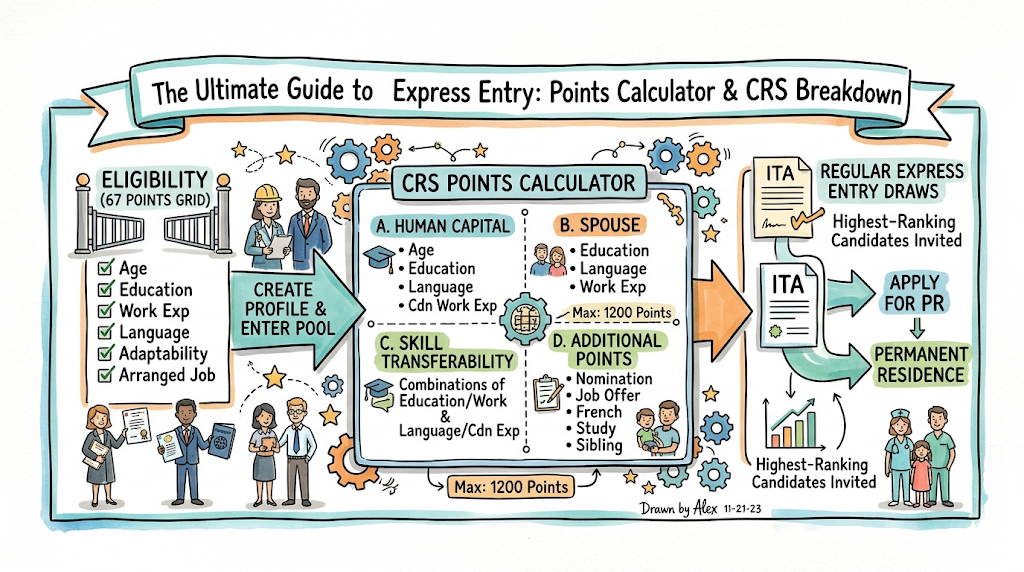
The entire system relies heavily on data and qualifications, which is where the Canada PR points calculator comes into play. Think of this tool as your personal immigration compass. For many skilled workers, IT experts, healthcare professionals, and international students, understanding immigration math can feel overwhelming. The Canadian government selects candidates based on a specific scoring mechanism, meaning a single point can make the difference between receiving a permanent residency invitation or remaining in the application pool. This comprehensive guide breaks down the Express Entry framework, unpacks the Comprehensive Ranking System (CRS), and explains exactly how to measure your profile. By the end of this article, you will know how to calculate your standing, avoid common structural errors, and optimize your profile to maximize your chances of settling in Canada. For more details, visit the Desinri Canada PR Points Calculator.
What Is Canada PR Points Calculator?
The Canada PR points calculator is an automated digital tool designed to estimate your Comprehensive Ranking System (CRS) score based on your unique profile details. Instead of manually reviewing hundreds of immigration clauses, this tool allows you to input your personal data and instantly receive your estimated point total.
The Purpose of the Calculator
Immigration, Refugees and Citizenship Canada (IRCC) uses this point allocation model to manage applications objectively. The tool evaluates your background and converts life experiences—such as your age, education, and employment history—into a definitive numerical score. This objective approach ensures that the selection process remains transparent, consistent, and fair for applicants worldwide.
Understanding the CRS Invitation Framework
A common point of confusion for beginners is the distinction between the baseline eligibility assessment and the actual invitation score.
- The Eligibility Score: This is a 100-point matrix used specifically for the Federal Skilled Worker Program. You must score at least 67 points to enter the Express Entry pool.
- The CRS Invitation Score: Once you pass the baseline gate, you enter the active competitive pool. Here, your profile is ranked out of 1,200 points. IRCC regularly conducts selection draws, issuing Invitations to Apply (ITAs) exclusively to top-ranking candidates.
To illustrate this, consider a practical example: If a candidate improves their IELTS language scores or completes an additional year of skilled employment, their overall ranking increases significantly. Passing the initial eligibility filter simply gets you into the room; optimizing your score determines whether you get selected.
How Canada PR Points System Works
The selection framework analyzes several core areas of your life, known as human capital factors. To get an accurate reading from a Canada immigration points calculator, you need to understand how points are distributed across these primary categories.
Age Points
Age plays a significant role in the ranking framework. Canada values young professionals who can contribute to the domestic economy over a long-term career. Points peak between the ages of 20 and 29, after which the point allocation gradually decreases each year.
| Age Profile | Points Allocation (With Spouse) | Points Allocation (Without Spouse) |
| Under 18 years | 0 | 0 |
| 18 to 19 years | 90 | 95 |
| 20 to 29 years | 100 | 110 |
| 30 years old | 95 | 105 |
| 35 years old | 70 | 75 |
| 40 years old | 45 | 50 |
| 45 years or older | 0 | 0 |
Education Points
Higher educational qualifications yield stronger results. To claim points for studies completed outside of Canada, you must obtain an Educational Credential Assessment (ECA) from an approved organization to verify your degrees.
- Doctoral Level (PhD): 140 points (with spouse) | 150 points (without spouse)
- Master’s Degree: 125 points (with spouse) | 135 points (without spouse)
- Two or More Degrees (with one being at least 3 years long): 119 points (with spouse) | 128 points (without spouse)
- Bachelor’s Degree (3 years or longer): 112 points (with spouse) | 120 points (without spouse)
Language Proficiency (IELTS/CELPIP/PTE)
Language skills are heavily weighted within the system. Canada assesses proficiency using the Canadian Language Benchmark (CLB) standard. Your scores in Reading, Writing, Listening, and Speaking are converted into specific point allocations.
- Reaching CLB 9 (equivalent to IELTS Listening 8.0, Reading 7.0, Writing 7.0, Speaking 7.0) unlocks a significant point bonus under the skill transferability matrix.
- Demonstrating bilingual proficiency by presenting strong French language test results (such as TEF or TCF) yields substantial additional points.
Work Experience
Your professional history is classified using the National Occupational Classification (NOC) system. Points are distributed based on your total years of continuous, full-time skilled employment.
- Foreign Work Experience: Maximum of 50 points when combined with strong language scores.
- Canadian Work Experience: Highly valued, offering direct points starting from your first year of domestic employment.
Spouse Points & Additional Categories
If you apply alongside a spouse or common-law partner, your points are slightly redistributed. Your partner can contribute to the overall score through their own educational qualifications, language proficiency, and Canadian work experience.
Additional point boosts are awarded for:
- Provincial Nomination: Automatically grants 600 points.
- Valid Job Offer: Adds 50 or 200 points depending on the managerial level of the role.
- Canadian Siblings: Grants 15 points for having a brother or sister living in Canada as a citizen or permanent resident.
Canada Express Entry System Explained
Express Entry is not an immigration program itself; it is an online application management system used by IRCC. This system coordinates three primary federal economic immigration pathways and works closely with regional provinces.
1. Federal Skilled Worker Program (FSWP)
This pathway is designed for international professionals who have significant skilled work experience but have never lived or worked in Canada before. Applicants must meet the initial 67-point baseline threshold to enter the pool.
2. Canadian Experience Class (CEC)
Tailored for individuals who have already gained at least one year of skilled professional experience inside Canada. This pathway is highly popular among international graduates holding post-graduation work permits and temporary foreign workers.
3. Federal Skilled Trades Program (FSTP)
This specialized pathway focuses on qualified industrial workers, technicians, construction professionals, and tradespersons who possess valid job offers or domestic trade certifications.
4. Provincial Nominee Program (PNP)
Most Canadian provinces operate their own immigration streams aligned with the federal system. When a province identifies a candidate in the pool who meets their specific regional labor market needs, they can issue an official nomination. This nomination instantly secures the candidate’s selection in the next federal draw.
CRS Score Breakdown
The Comprehensive Ranking System allocates points based on a structured 1,200-point matrix. The table below outlines how these components form your final score.
| CRS Core Categories | Maximum Points (With Spouse) | Maximum Points (Without Spouse) |
| A. Core Human Capital Factors (Age, Education, Languages, Experience) | 460 | 500 |
| B. Spouse/Partner Factors (Languages, Education, Experience) | 40 | 0 |
| C. Skill Transferability (Combinations of Education, Languages, Experience) | 50 | 50 |
| D. Additional Points (PNP, Job Offer, French, Siblings) | 600 | 600 |
| Total Maximum Score | 1,200 | 1,200 |
Understanding Skill Transferability
The system awards bonus points for highly adaptable profiles. For instance, if you combine a Master’s degree with CLB 9 language scores, you unlock additional points because data shows these traits lead to faster economic integration in Canada.
Step-by-Step Example Calculation
Let’s look at a realistic scenario to show how the Canada PR score calculator processes a candidate’s profile.
Candidate Profile
- Role: Software Engineer
- Age: 29 Years Old
- Marital Status: Single
- Education: Master’s Degree (ECA Verified)
- Language Test: IELTS results achieving CLB 9 across all sections
- Work History: 3 Years of continuous skilled foreign work experience
Point Allocation Breakdown
- Age Component: Being 29 years old secures the maximum possible allocation for age, adding 110 points to the profile.
- Education Component: A verified Master’s degree yields 135 points under the core human capital matrix.
- Language Component: Achieving CLB 9 across all four test sections awards 136 points.
- Skill Transferability Combinations: Combining a Master’s degree with CLB 9 language scores adds a 50-point bonus. Additionally, combining 3 years of foreign work experience with CLB 9 scores adds another 50 points.
Final Summary
- Core Human Capital Score: 381 Points
- Skill Transferability Bonus: 100 Points
- Total Estimated CRS Score: 481 Points
In the current immigration landscape, a score of 481 provides a solid foundation, making the candidate competitive for specific category-based selection draws or regional nomination consideration.
How to Improve CRS Score
If your initial calculations fall below recent draw trends, there are several practical ways to improve your profile and increase your overall score.
- Maximize Language Scores: Retaking your language test to reach CLB 9 or higher is often the fastest way to boost your score. Moving from CLB 8 to CLB 9 can add up to 50 points due to the skill transferability bonus.
- Learn French: Canada has significantly increased its focus on francophone immigration. Demonstrating intermediate or advanced French proficiency can add up to 50 bonus points to your profile.
- Acquire Additional Academic Qualifications: Completing a one-year post-graduate diploma or certificate program alongside an existing Bachelor’s degree moves your profile into the “Two or More Degrees” category, increasing your education points.
- Gain More Work Experience: Extending your skilled employment from one or two years to a full three years increases your work experience points and maximizes your transferability bonuses.
Provincial Nominee Programs (PNPs)
When looking for ways to boost your profile, regional immigration streams are incredibly valuable. The Provincial Nominee Program allows individual provinces to select candidates directly from the pool to address local labor shortages.
Receiving a provincial nomination adds 600 points to your profile. This bonus effectively guarantees that you will receive an Invitation to Apply (ITA) in the very next federal draw.
Key Provincial Streams to Watch
- Ontario Immigrant Nominee Program (OINP): Frequently targets tech professionals and healthcare workers through targeted notifications of interest.
- Alberta Advantage Immigration Program (AAIP): Offers dedicated pathways for candidates with family ties to the province or specialized skill sets.
- Saskatchewan Immigrant Nominee Program (SINP): Utilizes an in-demand occupation list to select professionals whose skills match current regional vacancies.
- British Columbia PNP (BC PNP): Features a structured points system that prioritizes technology workers, healthcare professionals, and early childhood educators.
Documents Required
To ensure your online profile matches your actual credentials, you need to collect several essential documents before using a Canada PR eligibility calculator.
- Valid Passport: Must be valid for travel and remain current throughout the application timeline.
- Educational Credential Assessment (ECA): An official verification report from an approved body like WES, IQAS, or ICAS confirming your international degrees.
- Language Test Results: Valid test certificates for IELTS, CELPIP, or PTE Core (for English), or TEF/TCF (for French). Test results must be less than two years old.
- Employment Reference Letters: Official documentation from previous employers verifying your job titles, core responsibilities, and terms of employment.
- Proof of Settlement Funds: Certified bank statements demonstrating that you meet the minimum financial requirements to support your family upon arrival.
- Police Clearance Certificates: Documented background checks from every country where you have lived for six consecutive months or longer since turning 18.
Processing Time & PR Process
The journey from creating your profile to landing in Canada involves a series of clear steps managed within a structured timeline.
- Profile Submission: You input your verified credentials into the online portal. Your profile remains active in the pool for up to 12 months.
- Receiving an ITA: When your score meets or exceeds the cutoff in a regular draw, IRCC issues an official Invitation to Apply. You then have exactly 60 calendar days to submit a complete, documented permanent residency application.
- Application Processing: IRCC processes most complete Express Entry applications within 6 to 8 months. During this step, you must complete mandatory medical examinations and submit biometric data.
- Confirmation of Permanent Residence (COPR): Once approved, you receive your official COPR document and a permanent resident entry visa, allowing you to travel to Canada to finalize your landing process.
Common Mistakes to Avoid
Even highly qualified applicants can face delays or refusals due to simple mistakes when setting up their profiles.
- Inaccurate Work Classification: Selecting an incorrect National Occupational Classification (NOC) code that does not match your actual daily responsibilities can lead to an application refusal. Do not rely solely on your official job title; align your duties with the official IRCC definitions.
- Using Expired Language Test Results: Language certificates are valid for exactly two years from the test date. If your results expire while your profile is in the pool, your profile becomes invalid.
- Overstating Work History: Miscalculating continuous employment dates or including part-time internships that do not meet the full-time criteria can lead to an unexpected drop in points during verification.
- Mismatched Document Verification: Ensure the names, birth dates, and credentials on your educational documents exactly match your passport records to avoid processing delays or misrepresentation issues.
Real-Life Case Studies
Example 1: The Young IT Professional
- Profile: A 26-year-old single software developer with a Bachelor’s degree and 2 years of foreign work experience.
- Initial Score: 415 Points.
- The Challenge: Their score was below the typical cutoff for general draws.
- Strategy Implemented: The developer retook their English language test, raising their scores from CLB 8 to CLB 9. They also gained a third year of continuous work experience.
- Final Result: These updates unlocked skill transferability bonuses, raising their score to 465 points, which led to an ITA during a targeted category-based draw for tech professionals.
Example 2: The Married Couple
- Profile: A 32-year-old marketing manager applying with their spouse.
- Initial Score: 430 Points.
- The Challenge: Age-related point deductions lowered the primary applicant’s score.
- Strategy Implemented: The spouse completed an Educational Credential Assessment for their Bachelor’s degree and retook their language test to reach CLB 8, contributing valuable additional points to the overall profile.
- Final Result: This joint effort raised the couple’s score to 452 points, making them eligible for an Ontario Tech Draw.
Example 3: The Healthcare Professional
- Profile: A 35-year-old nurse with 5 years of experience and moderate language scores.
- Initial Score: 395 Points.
- The Challenge: A lower human capital score due to age and language metrics.
- Strategy Implemented: The applicant submitted their profile directly to the healthcare-targeted streams under the Nova Scotia and Ontario PNPs.
- Final Result: Nova Scotia issued a provincial nomination, adding 600 points to the profile and instantly raising the total score to 995 points, securing an ITA in the next draw.
FAQs
What is a good CRS score for Express Entry?
A good score depends on the specific draw category you qualify for. Generally, scores above 480 are competitive for targeted or category-based draws, while scores above 500 are typically needed for general, all-program draws.
How many points are required to get Canada PR?
There is no fixed passing score for permanent residency. The required score changes with every draw based on labor market needs and the qualifications of other applicants currently in the pool.
Can I apply for Canada Express Entry without a valid job offer?
Yes, a job offer is not required. The vast majority of successful applicants receive permanent residency invitations based entirely on their education, language skills, and work experience without a Canadian employer.
Does my age affect the Canada PR points calculation?
Yes, age is a key factor. Applicants between 20 and 29 receive the maximum points. After age 30, point allocations gradually decrease each year, dropping to zero points for age once you reach 45.
Is taking an official language test mandatory for PR?
Yes, language testing is mandatory. Every applicant must submit valid test results from an approved organization (like IELTS, CELPIP, or PTE) to prove proficiency in English or French.
Can a spouse help increase my overall CRS score?
Yes, a spouse can add points to your profile. They can contribute up to 40 points through their own verified education, language test results, and any valid Canadian work experience.
Which Canadian province is considered the easiest for PR?
There is no single easiest province, as each looks for different skills. However, provinces like Ontario, Alberta, and Saskatchewan are popular because they run large, frequent draws that target a wide range of professions.
What is an Educational Credential Assessment (ECA)?
An ECA is an official evaluation used to verify that your international degree, diploma, or certificate is valid and equal to a completed Canadian qualification.
How long does an Express Entry profile remain active?
Your profile stays active in the pool for up to 12 months from the date you submit it. If you don’t receive an invitation within that year, you can simply submit a new profile.
Can I update my profile after entering the pool?
Yes, you can update your profile at any time. You can add new language test results, updated work experience, or higher educational credentials, and your score will adjust automatically.
What happens if I make a mistake on my profile?
Simple mistakes can lead to processing delays or application refusals. If you provide incorrect information that artificially inflates your score, your application could be rejected for misrepresentation.
What is the difference between FSWP and the CRS score?
The FSWP use a 100-point filter to check if you are eligible to enter the Express Entry pool. Once you are in, the CRS uses a 1,200-point system to rank your profile against other candidates.
Conclusion
Navigating the Canadian immigration system requires careful planning and a clear understanding of how your background translates into points. Using a Canada PR points calculator gives you an accurate look at where you stand, helping you turn a complex immigration framework into a manageable, step-by-step strategy.
Your initial score is simply a starting point. If your current total falls below recent draw averages, you can actively improve your profile by retaking language tests, gaining more work experience, or exploring regional provincial streams. With the right preparation, clear goal-setting, and a commitment to refining your credentials, your goal of moving to Canada is well within reach.
