Upgrade & Secure Your Future with DevOps, SRE, DevSecOps, MLOps!
We spend hours scrolling social media and waste money on things we forget, but won’t spend 30 minutes a day earning certifications that can change our lives.
Master in DevOps, SRE, DevSecOps & MLOps by DevOps School!
Learn from Guru Rajesh Kumar and double your salary in just one year.
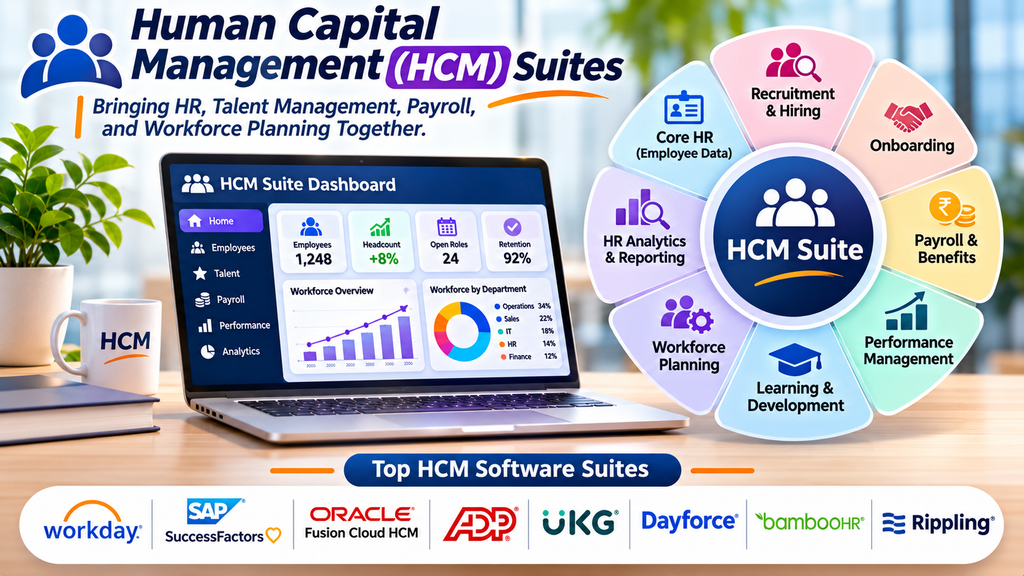
Introduction
Managing employee information, recruitment, payroll, performance, and workforce planning across separate systems can create unnecessary complexity. Human Capital Management (HCM) suites help organizations bring these processes together through a connected platform.
By centralizing HR information and automating routine workflows, HCM software can improve visibility, support informed workforce decisions, and help HR teams manage the employee lifecycle more efficiently.
What Are Human Capital Management Suites?
Human Capital Management suites are integrated software platforms that support a broad range of employee-related processes. Depending on the product and selected modules, they may include core HR, recruitment, onboarding, payroll, benefits administration, learning, performance management, analytics, and workforce planning.
Unlike a standalone HR tool, an HCM suite aims to connect multiple functions through shared employee data and coordinated workflows.
Top HCM Software Suites
1. Workday Human Capital Management
Workday HCM offers cloud-based HR capabilities covering employee data, talent management, workforce planning, and analytics.
Best for: Mid-sized and large organizations seeking connected HR processes.
2. SAP SuccessFactors
SAP SuccessFactors provides a collection of cloud HR applications covering core HR, recruiting, onboarding, learning, performance, and talent development.
Best for: Organizations requiring broad talent-management capabilities and enterprise HR integration.
3. Oracle Fusion Cloud HCM
Oracle Fusion Cloud HCM combines HR processes with talent management, workforce management, analytics, and related business applications.
Best for: Enterprises seeking an integrated cloud HCM platform.
4. ADP
ADP offers payroll, HR, benefits, talent, and workforce-management solutions. Product availability and integration options depend on the service selected and the organization’s location.
Best for: Businesses looking to connect payroll and HR administration.
5. UKG
UKG provides HR, payroll, workforce management, and employee-experience solutions across its product portfolio.
Best for: Organizations with complex scheduling, timekeeping, and workforce-management requirements.
6. Dayforce
Dayforce combines HR, payroll, talent, and workforce management in a unified platform designed to connect employee information with operational workflows.
Best for: Organizations seeking closely connected payroll and workforce processes.
7. BambooHR
BambooHR focuses on core HR, employee records, onboarding, reporting, and selected performance and employee-experience capabilities.
Best for: Small and midsize businesses prioritizing accessible HR administration.
8. Rippling
Rippling connects employee data with HR, payroll, benefits, and IT administration capabilities. Its modular approach can help businesses coordinate employee-related processes across departments.
Best for: Growing organizations looking to connect HR with employee technology administration.
Essential Features of an HCM Suite
- Core HR: Maintain employee profiles, job information, and organizational structures.
- Recruitment and onboarding: Manage candidate workflows and new-hire tasks.
- Payroll and benefits: Support salary administration and eligible benefits workflows.
- Performance management: Coordinate reviews, goals, and feedback.
- Learning and development: Organize training and employee skill development.
- Workforce management: Support scheduling, time tracking, and workforce planning.
- Analytics and reporting: Monitor HR metrics and workforce trends.
- Employee self-service: Let employees access relevant records and submit requests.
- Integration and security: Connect compatible business systems while protecting employee data.
Benefits of HCM Suites
Centralized employee information: A shared system can reduce duplicate records and fragmented information.
More efficient HR workflows: Automated approvals and employee self-service can reduce repetitive administrative tasks.
Better workforce insights: Connected reporting can help HR leaders review staffing, retention, performance, and workforce trends.
Improved employee experience: Consistent onboarding, accessible information, and clearer processes can make common HR tasks easier.
Scalability: A modular platform can support changing business requirements as an organization grows.
How to Choose the Right HCM Platform
Start by mapping your current HR processes and identifying the biggest operational challenges. Determine which capabilities are essential now and which may be needed later.
Compare implementation costs, licensing, integration requirements, reporting, user experience, mobile access, support, and data-security controls. Businesses operating in multiple countries should verify local payroll, language, currency, and compliance support.
Ask vendors to demonstrate realistic workflows using your requirements. A structured pilot or phased rollout can help reveal integration and adoption issues before full deployment.
HCM Implementation Best Practices
- Define project goals and assign clear ownership.
- Clean and validate employee records before migration.
- Document current workflows and decide which processes need improvement.
- Involve HR, payroll, IT, managers, and employees in planning.
- Test integrations, access permissions, reports, and approvals.
- Provide role-specific training and ongoing support.
- Review adoption and performance against measurable objectives.
Conclusion
Human Capital Management suites help organizations connect core HR, talent management, payroll, and workforce processes in one broader ecosystem. The best choice depends on company size, business complexity, regional requirements, budget, and existing technology. A careful evaluation and phased implementation can help organizations build a more connected and efficient HR operation.
