Upgrade & Secure Your Future with DevOps, SRE, DevSecOps, MLOps!
We spend hours scrolling social media and waste money on things we forget, but won’t spend 30 minutes a day earning certifications that can change our lives.
Master in DevOps, SRE, DevSecOps & MLOps by DevOps School!
Learn from Guru Rajesh Kumar and double your salary in just one year.
Introduction
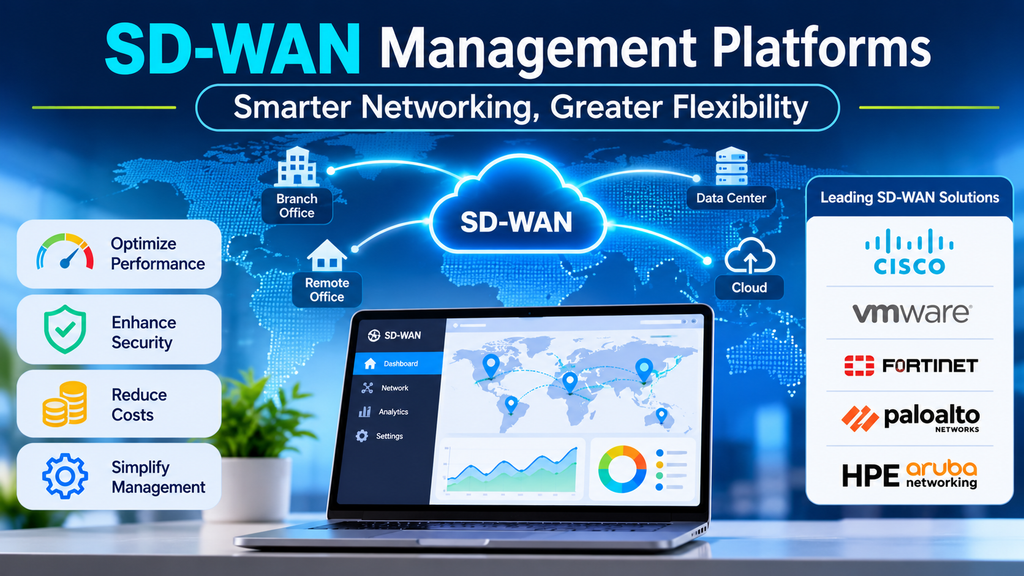
Modern businesses rely on reliable connectivity between branch offices, headquarters, cloud applications, data centers, and remote employees. Traditional wide area networks (WANs) can be expensive and difficult to manage, especially when organizations operate across multiple locations and depend on cloud-based services.
SD-WAN management platforms help address these challenges by providing centralized control over network connectivity, application traffic, policies, and performance. They allow IT teams to manage distributed networks more efficiently while making better use of available internet, broadband, and private WAN links.
In this guide, we explore what SD-WAN management platforms are, why they matter, leading solutions, essential features, selection criteria, and implementation best practices.
What Are SD-WAN Management Platforms?
Software-Defined Wide Area Networking (SD-WAN) is a networking approach that uses software-based control and policies to manage traffic across geographically distributed networks. Instead of relying entirely on traditional, manually configured WAN infrastructure, SD-WAN can intelligently direct traffic across multiple connections based on application requirements, link quality, security policies, and business priorities.
An SD-WAN management platform provides the tools to configure, monitor, troubleshoot, and optimize these network environments. Depending on the product, management capabilities may be delivered through a centralized controller, cloud portal, orchestration system, or a combination of these components.
For example, an organization could prioritize voice and video meetings over a low-latency connection while directing routine software downloads through a more economical broadband link.
Why Are SD-WAN Management Platforms Important?
1. Centralized Network Management
IT administrators can configure policies, monitor devices, and manage branch connectivity from a central interface. This reduces the need to configure every location independently.
2. Improved Application Performance
SD-WAN solutions can use information about latency, packet loss, jitter, and link availability to help direct traffic over suitable connections. This can improve the experience of latency-sensitive applications such as video conferencing and voice calls.
3. Better Cost Control
Organizations can combine different connectivity options, including broadband internet and private circuits, according to their performance and reliability needs. This may reduce dependence on more expensive dedicated links, depending on the network design.
4. Stronger Security Integration
Many SD-WAN solutions integrate with firewalls, encryption, segmentation, secure web gateways, or broader secure access service edge (SASE) architectures. The security capabilities available depend on the product and licensing.
5. Easier Scalability
Businesses can use standardized deployment workflows and reusable policies when opening new offices or expanding existing networks.
6. Greater Network Visibility
Dashboards and analytics help teams identify unhealthy links, application bottlenecks, device issues, and policy problems before they significantly affect users.
Popular SD-WAN Management Platforms
1. Cisco Catalyst SD-WAN Manager
Cisco Catalyst SD-WAN provides centralized management and orchestration for distributed enterprise networks. Administrators can use policy controls, monitoring, and analytics to manage branch connectivity and application traffic.
Key capabilities:
- Centralized configuration and policy management
- Visibility into network and application performance
- Support for distributed enterprise environments
- Integration with broader Cisco networking and security solutions
Best suited for: Enterprises with complex networks or an existing Cisco infrastructure.
2. Fortinet Secure SD-WAN
Fortinet combines SD-WAN capabilities with its security portfolio, including FortiGate appliances and centralized management options such as FortiManager.
Key capabilities:
- Integration of networking and firewall functions
- Application-aware traffic steering
- Security policy enforcement
- Centralized management across distributed locations
Best suited for: Organizations seeking closely integrated network security and WAN management.
3. HPE Aruba Networking EdgeConnect SD-WAN
HPE Aruba Networking EdgeConnect SD-WAN focuses on application-aware networking, policy-based traffic management, and connectivity across branches, cloud services, and data centers.
Key capabilities:
- Application performance optimization
- Centralized policy administration
- WAN path selection and link management
- Visibility across distributed network environments
Best suited for: Organizations looking to optimize connectivity for cloud and business applications across multiple sites.
4. VMware VeloCloud SD-WAN
VMware VeloCloud is a well-known SD-WAN technology associated with VMware’s former networking portfolio. Product ownership and branding have evolved, so buyers should verify the current vendor, product name, support arrangements, and roadmap before purchasing.
Key capabilities historically associated with the platform:
- Centralized orchestration
- Dynamic path selection
- Application-aware traffic handling
- Branch connectivity and cloud networking support
Best suited for: Organizations evaluating established SD-WAN deployments or solutions in the VeloCloud product lineage.
5. Palo Alto Networks Prisma SD-WAN
Prisma SD-WAN is part of Palo Alto Networks’ broader networking and security ecosystem. It supports centralized policy management and application-aware network operations.
Key capabilities:
- Application-centric network control
- Operational visibility and analytics
- Integration with security architecture
- Policy-based management across distributed locations
Best suited for: Enterprises aligning branch networking with a broader Palo Alto Networks security strategy.
6. Juniper SD-WAN Solutions
Juniper offers SD-WAN capabilities within its networking portfolio, including solutions associated with Session Smart Routing and centralized management. Exact capabilities depend on the selected products and architecture.
Key capabilities:
- Policy-based traffic handling
- Centralized network administration
- Routing and application performance controls
- Integration with enterprise networking environments
Best suited for: Organizations seeking policy-driven networking and flexible routing architectures.
Comparison of SD-WAN Management Platforms
| Platform | Main strength | Common use case |
|---|---|---|
| Cisco Catalyst SD-WAN | Enterprise control and visibility | Large, distributed networks |
| Fortinet Secure SD-WAN | Integrated networking and security | Security-focused branch networks |
| HPE Aruba EdgeConnect | Application and WAN optimization | Cloud-connected branch offices |
| VMware VeloCloud | Established SD-WAN technology | Existing VeloCloud environments and deployments |
| Palo Alto Prisma SD-WAN | Networking within a security ecosystem | Enterprises standardizing on Palo Alto Networks |
| Juniper SD-WAN | Policy-driven routing and network control | Complex routing environments |
This comparison is a high-level guide rather than a benchmark. Features, licensing, integrations, and availability can differ by edition and change over time.
Essential Features to Look For
Centralized Configuration
The platform should make it easy to configure devices, create policies, manage locations, and maintain consistent settings across the network.
Application-Aware Routing
Look for controls that identify business applications and select network paths based on performance, availability, and policy requirements.
Real-Time Monitoring
Useful dashboards should show link health, latency, packet loss, jitter, bandwidth use, device status, and application performance.
Automated Failover
If a connection becomes unavailable or degraded, the system should be able to redirect eligible traffic to another available path according to configured policies.
Security Integration
Evaluate encryption, segmentation, firewall integration, threat prevention, identity controls, and compatibility with the organization’s existing security architecture.
Reporting and Analytics
Historical performance data and reports help teams identify recurring issues, understand usage patterns, plan capacity, and support service-level objectives.
Role-Based Access and Auditing
Role-based access controls, configuration history, and audit logs are important for security, accountability, and change management.
Cloud and SaaS Integration
Check how the platform supports cloud workloads, SaaS applications, data centers, remote sites, and any required third-party integrations.
How to Choose the Right SD-WAN Management Platform
1. Assess Your Existing Network
Document the number of locations, current WAN links, network devices, cloud services, critical applications, and existing contracts. This provides a baseline for evaluating solutions.
2. Identify Business Requirements
Decide which applications need the most reliable performance, what availability targets matter, and whether the priority is security, cost reduction, simplified operations, or cloud connectivity.
3. Evaluate Security Requirements
Determine whether you need integrated firewall capabilities, advanced threat protection, network segmentation, SASE integration, or compatibility with existing security tools.
4. Review Total Cost of Ownership
Compare hardware, subscriptions, licensing tiers, support, connectivity costs, deployment services, and ongoing administration. A lower initial price does not always mean a lower long-term cost.
5. Test Management Usability
During a proof of concept, assess how easily administrators can onboard a site, create a policy, diagnose a degraded link, and review application performance.
6. Check Integration and Support
Verify interoperability with current routers, firewalls, identity systems, monitoring platforms, cloud providers, and service providers. Confirm support coverage and product lifecycle commitments.
7. Run a Pilot
Start with a representative branch or small group of sites. Test failover, application performance, policy enforcement, monitoring, and recovery before expanding deployment.
Best Practices for Managing an SD-WAN Environment
- Establish a baseline: Measure network performance before making changes so improvements can be evaluated accurately.
- Prioritize business-critical applications: Define appropriate policies for voice, video, business systems, and other important workloads.
- Use standardized configurations: Maintain reusable templates and consistent policies to reduce configuration drift.
- Test failover regularly: Confirm that backup links and recovery procedures work as intended.
- Monitor continuously: Review alerts, link quality, bandwidth utilization, and recurring application issues.
- Apply least-privilege access: Limit administrative permissions and review access periodically.
- Maintain change records: Document configuration changes and keep a tested rollback plan.
- Plan capacity proactively: Use historical usage and growth forecasts to determine where additional bandwidth or connectivity is needed.
- Train IT teams: Ensure network administrators understand the platform, policy model, security controls, and troubleshooting workflows.
Common Challenges
Migration Complexity
Moving from traditional WAN infrastructure may require redesigning routing, addressing, security policies, and connectivity. A phased rollout can reduce disruption.
Inconsistent Application Performance
SD-WAN cannot eliminate every performance problem. Poor application hosting, congested last-mile connections, wireless issues, or provider outages can still affect users.
Security Misconfiguration
Incorrect segmentation, firewall rules, or access policies can create gaps. Validate policies and test security controls before broad deployment.
Vendor Lock-In
Some environments rely on proprietary management systems, hardware, or licensing. Review migration options, supported standards, contract terms, and data export capabilities.
Skills and Operational Readiness
Centralized management simplifies many tasks, but teams still need expertise in routing, security, troubleshooting, and change control.
Conclusion
SD-WAN management platforms help organizations manage distributed connectivity through centralized policies, application-aware traffic handling, monitoring, and automation. They can improve visibility and operational efficiency while helping businesses balance network performance, security, and cost.
The right platform depends on the organization’s network architecture, application requirements, security strategy, budget, and internal expertise. By comparing solutions carefully, conducting a pilot, and applying consistent operational practices, businesses can build a more flexible and manageable WAN environment.
