Upgrade & Secure Your Future with DevOps, SRE, DevSecOps, MLOps!
We spend hours scrolling social media and waste money on things we forget, but won’t spend 30 minutes a day earning certifications that can change our lives.
Master in DevOps, SRE, DevSecOps & MLOps by DevOps School!
Learn from Guru Rajesh Kumar and double your salary in just one year.
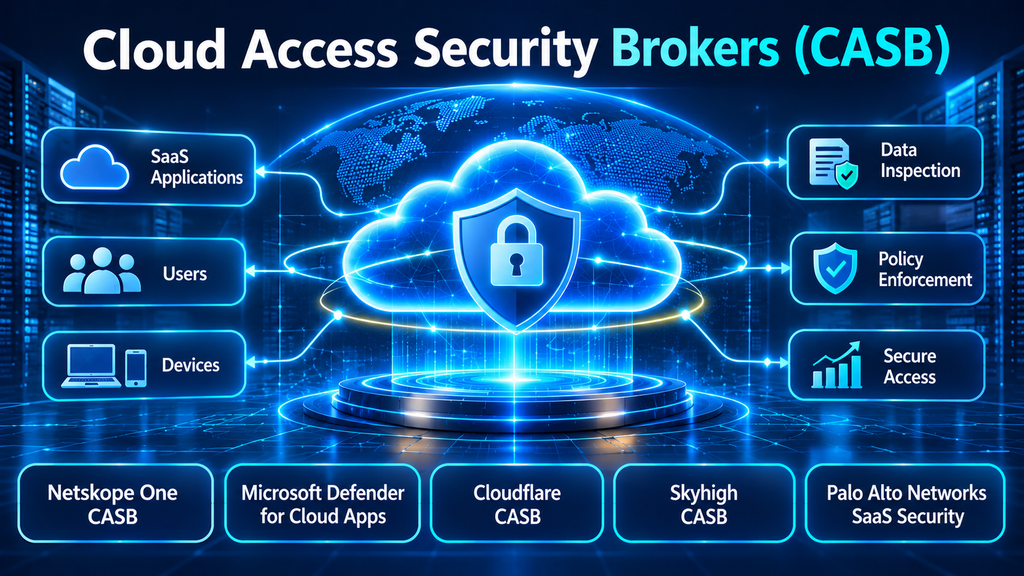
Cloud Access Security Brokers: Securing SaaS and Cloud Services Without Slowing the Business
Cloud applications have changed how organizations work. Employees collaborate through SaaS platforms, store files in cloud repositories, use browser-based business tools, and increasingly interact with generative AI services. These services improve productivity, but they also create security blind spots: sensitive information can move into personal accounts, employees may adopt unapproved applications, and cloud data can remain exposed through excessive permissions or unsafe sharing configurations.
Traditional network security controls were designed around a more centralized environment. They are not always sufficient when users access cloud services from offices, homes, mobile devices, and unmanaged networks.
A Cloud Access Security Broker (CASB) helps close this gap. It provides visibility and security controls between users and cloud services, helping organizations discover cloud application usage, enforce access policies, protect sensitive data, and identify suspicious activity.
However, CASB is no longer a single deployment model or a standalone product category. Modern platforms combine inline traffic inspection, API-based SaaS monitoring, data loss prevention, threat protection, identity context, and SaaS security posture management. Understanding these differences is essential when selecting a solution.
What Is a Cloud Access Security Broker?
A Cloud Access Security Broker is a security control layer that helps organizations monitor and govern how users interact with cloud applications and services.
A CASB can help security teams answer questions such as:
- Which cloud applications are employees using?
- Are users accessing corporate services through personal accounts?
- Is sensitive information being uploaded to unauthorized applications?
- Are files shared with external users or made publicly accessible?
- Are suspicious login patterns or risky user activities occurring?
- Do cloud applications have configuration weaknesses that could expose data?
CASB technology commonly supports four security functions:
- Visibility: Discover cloud applications, users, devices, and activities.
- Compliance: Apply organizational policies and support regulatory requirements.
- Data security: Identify and control sensitive information moving into, through, or stored in cloud services.
- Threat protection: Detect suspicious behavior, malware, compromised accounts, and risky cloud activity.
The value of a CASB is not simply that it blocks access to cloud applications. Its greater purpose is to help organizations use cloud services safely without unnecessarily disrupting legitimate business workflows.
Why Organizations Need CASB
Cloud adoption has made application usage more distributed. Employees may use approved platforms alongside personal accounts, third-party collaboration tools, file-sharing services, and AI applications.
This creates several recurring security challenges.
1. Shadow IT and unauthorized applications
Employees often adopt cloud services without waiting for formal IT approval. They may use an unfamiliar file-sharing service, online converter, project management tool, or AI assistant to complete a task.
These applications can introduce data handling, privacy, compliance, and access risks. CASB discovery capabilities help identify services in use and provide context for deciding whether to allow, restrict, or block them.
2. Data leakage through cloud applications
Sensitive information can be uploaded to personal cloud storage, copied into public collaboration spaces, or shared with unauthorized external recipients.
CASB solutions can use data classification and DLP policies to detect risky transfers and apply controls such as blocking, alerting, quarantining, or user coaching.
3. Excessive permissions and unsafe sharing
A cloud application may be approved but still contain risky configurations. Files might be shared publicly, users may have unnecessary privileges, or external integrations may have excessive access.
API-based CASB integrations can inspect supported SaaS environments and identify certain security or data exposure issues after information has been stored.
4. Compromised accounts and suspicious activity
Attackers may use stolen credentials to access legitimate cloud accounts. Unusual login locations, unexpected downloads, abnormal sharing behavior, and suspicious application activity can indicate account compromise.
CASB platforms can correlate cloud activity with identity and behavioral signals to help security teams investigate potential incidents.
5. Uncontrolled use of generative AI
Employees may paste customer information, source code, business documents, or confidential data into public AI tools.
CASB controls can help identify AI applications, distinguish approved services from unauthorized ones where supported, and enforce policies around data uploads and interactions.
How CASB Works
CASB solutions generally use two complementary approaches: inline inspection and API-based integration. Some platforms combine both.
Inline CASB
Inline CASB controls inspect cloud traffic as users access applications.
Traffic may be routed through a secure web gateway, proxy, endpoint agent, network tunnel, or other supported traffic-steering mechanism.
Depending on the product and configuration, inline inspection can support:
- Real-time application identification.
- Upload and download controls.
- Sensitive-data inspection.
- Blocking or restricting risky activities.
- Malware and threat detection.
- Differentiation between corporate and personal application instances.
- Context-aware policies based on identity, device, location, and activity.
The primary advantage is the ability to enforce policies during a user session rather than discovering every issue after the event.
The main deployment consideration is traffic visibility. Organizations must understand how traffic is routed, whether encrypted sessions can be inspected, how certificates are managed, and what happens when inspection is unavailable.
API-based CASB
API-based CASB connects directly to supported cloud applications through their APIs.
Instead of relying exclusively on traffic passing through a security gateway, it examines application data and activities through the permissions and capabilities exposed by the connected service.
Common use cases include:
- Scanning files stored in cloud repositories.
- Identifying externally shared documents.
- Detecting risky application configurations.
- Reviewing user activity.
- Identifying sensitive data at rest.
- Triggering remediation actions where supported.
API-based monitoring is particularly useful for finding risks in data that has already been uploaded or shared.
Its limitations depend on API coverage, application permissions, available event data, and the speed at which the connected service exposes changes.
Combining inline and API-based controls
Neither approach covers every security requirement.
Inline controls are useful for governing activity as it happens. API integrations help identify risks in cloud environments that may not be visible through an organization’s traffic inspection path.
A combined architecture can provide broader coverage across data in motion and data at rest. Buyers should verify exactly which applications, activities, and remediation actions each deployment mode supports.
Core CASB Capabilities to Evaluate
A useful CASB evaluation should go beyond the number of supported applications.
| Capability | What it does | Why it matters |
|---|---|---|
| Cloud discovery | Identifies cloud services and usage patterns | Reveals shadow IT and unmanaged applications |
| Risk assessment | Evaluates cloud services and activities | Helps prioritize investigation and policy decisions |
| Inline controls | Inspects user-to-cloud traffic | Enables real-time enforcement |
| API integrations | Connects to supported SaaS services | Finds stored-data and configuration risks |
| Data loss prevention | Detects sensitive information | Reduces unauthorized data transfers |
| Threat protection | Identifies malicious files and suspicious activity | Helps limit cloud-enabled attacks |
| Identity context | Connects activity to users and accounts | Supports more precise policies |
| Behavioral analytics | Detects unusual activity patterns | Helps investigate compromised accounts |
| SaaS posture monitoring | Identifies configuration and access weaknesses | Reduces exposure within approved applications |
| Reporting and integrations | Sends findings to security workflows | Supports investigation and compliance operations |
Leading Cloud Access Security Broker Platforms
The following products illustrate different approaches to CASB. Their capabilities, licensing, integrations, and deployment options should be validated against the organization’s specific requirements.
1. Netskope One CASB
Netskope One CASB is part of the broader Netskope One security platform. It focuses on cloud application visibility, data protection, application controls, and threat prevention across managed and unmanaged cloud services.
Relevant capabilities include:
- Inline and API-based CASB deployment options.
- Cloud application discovery and risk categorization.
- Context-aware data loss prevention.
- Controls for managed and personal application instances.
- Protection for SaaS, IaaS, and generative AI usage.
- Integration with the wider Netskope security service edge platform.
Netskope is worth evaluating when an organization wants cloud controls closely integrated with web security, DLP, and broader SSE capabilities. Buyers should test application-specific inspection, traffic steering, and policy behavior under real user workloads.
Official product information: Netskope One CASB.
2. Microsoft Defender for Cloud Apps
Microsoft Defender for Cloud Apps provides CASB functionality alongside SaaS security posture management, advanced threat protection, and app-to-app protection.
Its capabilities include:
- Cloud application discovery.
- Connected-app monitoring.
- Cloud activity visibility.
- Policies for identifying risky cloud behavior.
- SaaS security posture features.
- Integration with Microsoft’s broader security ecosystem.
It is a natural candidate for organizations already using Microsoft security and identity services. Evaluation should focus on the required licensing, supported third-party applications, available controls, and how well the platform covers non-Microsoft cloud environments.
Official documentation: Microsoft Defender for Cloud Apps.
3. Cloudflare CASB
Cloudflare CASB is part of Cloudflare One and focuses on identifying security posture risks across connected SaaS applications and cloud environments.
Its published capabilities include:
- API-connected discovery of cloud and SaaS findings.
- Identification of misconfigurations and exposed files.
- Visibility into certain suspicious activities.
- Support for cloud security posture findings.
- Integration with Cloudflare’s wider Zero Trust and SASE services.
It is worth considering when an organization is evaluating Cloudflare’s broader security architecture. Buyers should distinguish API-based posture discovery from inline session controls and verify which Cloudflare components are needed for each use case.
Official product information: Cloudflare CASB.
4. Skyhigh Security CASB
Skyhigh Security CASB focuses on cloud application visibility, data protection, threat controls, and cloud service risk management.
Its published capabilities include:
- Discovery of cloud services.
- Sensitive-data discovery in supported cloud environments.
- Activity monitoring and controls.
- Data loss prevention.
- Threat protection and user behavior analytics.
- API-based integrations with supported applications.
Skyhigh is a candidate for organizations that want dedicated cloud security controls and visibility into a broad range of cloud services. Buyers should assess the supported application catalog, API coverage, policy granularity, and integration with existing network security tools.
Official product information: Skyhigh Security CASB.
5. Palo Alto Networks SaaS Security and Next-Generation CASB
Palo Alto Networks provides CASB-related capabilities through its SaaS Security and Prisma Access offerings. Its architecture brings together inline and API-based controls, data security, and broader SASE capabilities.
Relevant areas to assess include:
- SaaS application discovery and control.
- Inline SaaS security capabilities.
- API-based SaaS security integrations.
- Data security and DLP functions.
- Integration with Prisma Access and the wider security management environment.
This approach may suit organizations already invested in Palo Alto Networks firewalls, Prisma Access, or its cloud-delivered security ecosystem. Buyers should carefully review product packaging, license dependencies, and the distinction between inline CASB, API-based SaaS security, and SaaS posture capabilities.
Official information: Next-Generation CASB documentation.
CASB Platform Comparison
| Platform | Notable focus | Considerations |
|---|---|---|
| Netskope One CASB | Inline and API controls, cloud DLP, application visibility | Assess traffic steering, application coverage, and SSE integration |
| Microsoft Defender for Cloud Apps | Cloud discovery, SaaS monitoring, Microsoft security integration | Review licensing and non-Microsoft application coverage |
| Cloudflare CASB | API-based cloud and SaaS posture findings | Distinguish posture visibility from inline enforcement |
| Skyhigh Security CASB | Cloud discovery, DLP, threat protection | Validate supported services and integration requirements |
| Palo Alto Networks SaaS Security | Inline and API-based SaaS security within a wider security ecosystem | Confirm licensing, deployment model, and product dependencies |
This is a capability-oriented comparison, not a universal ranking. The best choice depends on the applications in use, required enforcement points, existing security investments, and operational requirements.
CASB vs. SWG, SSE, and SSPM
CASB is frequently discussed alongside several related security technologies. They overlap, but they do not mean the same thing.
CASB vs. Secure Web Gateway (SWG): An SWG primarily protects users from web-based threats and enforces policies for internet traffic. CASB adds cloud-application-specific visibility and controls, such as identifying SaaS activity, distinguishing application instances, and inspecting cloud data interactions.
CASB vs. Security Service Edge (SSE): SSE is a broader cloud-delivered security architecture that can combine SWG, CASB, Zero Trust Network Access, and other security services. CASB may be one component within an SSE platform.
CASB vs. SaaS Security Posture Management (SSPM): SSPM focuses on the security configuration and posture of SaaS applications. It helps identify issues such as excessive permissions, risky settings, and configuration weaknesses. CASB has a wider emphasis on cloud usage, access, activity, and data protection, although modern platforms increasingly combine these functions.
CASB vs. Data Loss Prevention (DLP): DLP identifies and controls sensitive information. CASB provides cloud-specific enforcement points and context. DLP is often an important capability within a CASB rather than a direct substitute for it.
Common CASB Deployment Challenges
A CASB project can fail to deliver value if deployment is treated as a simple product installation.
Incomplete application coverage
A platform may advertise extensive cloud application support, but not every application will offer the same level of inspection or remediation. Confirm whether a service is supported through inline controls, API integration, or both.
Overly restrictive policies
Blocking every unfamiliar application can create employee frustration and encourage users to find workarounds. A more effective approach is to classify applications by risk and apply proportionate controls.
TLS inspection complexity
Inline inspection of encrypted traffic can require certificate deployment, exception management, and compatibility testing. Poor planning may break applications or degrade user experience.
Weak data classification
DLP policies are only as useful as the classification logic behind them. Organizations should test how the CASB identifies regulated information, intellectual property, source code, customer records, and other sensitive content.
Alert overload
A large volume of cloud findings can overwhelm security teams. Prioritize alerts using data sensitivity, user privileges, external exposure, application risk, and business impact.
Unclear ownership
CASB policies often affect security, IT, compliance, identity, and application owners. Define who approves cloud applications, who manages exceptions, and who is responsible for investigating incidents.
How to Implement CASB Successfully
A phased rollout helps organizations improve visibility before introducing restrictive controls.
Phase 1: Discover cloud usage
Identify the applications employees use, including unsanctioned services and personal accounts. Establish a baseline before changing access policies.
Phase 2: Classify application risk
Evaluate services based on data handling, authentication, encryption, compliance, administrative controls, and business necessity. Create categories such as approved, restricted, under review, and prohibited.
Phase 3: Connect critical SaaS applications
Begin with high-value services that store or process sensitive information. Configure API integrations and validate the permissions granted to the CASB platform.
Phase 4: Define data protection policies
Identify sensitive data types and create policies for uploads, downloads, sharing, and transfers between corporate and personal accounts.
Phase 5: Introduce inline enforcement
Where supported and required, configure traffic steering and inline inspection. Begin with monitoring or user coaching before moving to blocking policies.
Phase 6: Integrate incident response
Connect CASB alerts with SIEM, SOAR, identity, and ticketing workflows where appropriate. Establish clear procedures for investigating suspicious activity and remediating exposed data.
Phase 7: Review and improve
Monitor policy effectiveness, false positives, user experience, application coverage, and remediation outcomes. Update controls as the organization’s cloud environment changes.
Questions to Ask Before Buying a CASB
A structured proof of concept should test actual business workflows rather than rely only on vendor demonstrations.
- Does the platform discover cloud applications that are not formally approved?
- Can it distinguish corporate and personal instances of the same application?
- Which SaaS services support API integration?
- Which activities can be controlled inline?
- Can it inspect uploads, downloads, sharing, and other relevant actions?
- How does it identify sensitive information?
- Can it detect publicly exposed or externally shared files?
- What happens when API permissions change or an integration fails?
- How does TLS inspection affect performance and compatibility?
- Can alerts be sent to existing SIEM and SOAR platforms?
- What licensing is required for the features being evaluated?
- How are policy exceptions approved and audited?
A successful proof of concept should demonstrate measurable improvements in cloud visibility, data protection, and operational response without introducing unacceptable friction for employees.
The Future of CASB: AI, Identity, and Continuous Cloud Security
Cloud security is expanding beyond conventional SaaS applications. Generative AI tools, AI-enabled business applications, third-party integrations, and automated agents are creating new paths through which organizational information can move.
CASB platforms will increasingly need to understand not just which application is being accessed, but also which user or agent is interacting with it, what data is being transferred, and whether the activity is appropriate.
Identity-aware controls will remain important. A user accessing a corporate application from a managed device may require different permissions from someone using an unmanaged device or a personal account.
Organizations should also expect closer integration between CASB, DLP, SSPM, identity security, and SSE. This convergence can simplify policy management, but it makes careful evaluation of product scope and licensing even more important.
Final Thoughts
Cloud Access Security Brokers help organizations address the security gaps created by widespread SaaS and cloud adoption. They provide visibility into cloud application usage, support data protection, help identify risky activity, and enable more consistent security policies across distributed users and services.
The most important buying decision is not simply choosing a vendor with the largest application catalog. It is determining whether the solution provides the right combination of inline enforcement, API-based visibility, data protection, identity context, and operational integration.
Organizations should begin with cloud discovery, prioritize applications that handle sensitive information, and introduce controls in phases. When deployed thoughtfully, CASB can help businesses maintain control over cloud data and application access while allowing employees to continue working productively.
