Upgrade & Secure Your Future with DevOps, SRE, DevSecOps, MLOps!
We spend hours scrolling social media and waste money on things we forget, but won’t spend 30 minutes a day earning certifications that can change our lives.
Master in DevOps, SRE, DevSecOps & MLOps by DevOps School!
Learn from Guru Rajesh Kumar and double your salary in just one year.
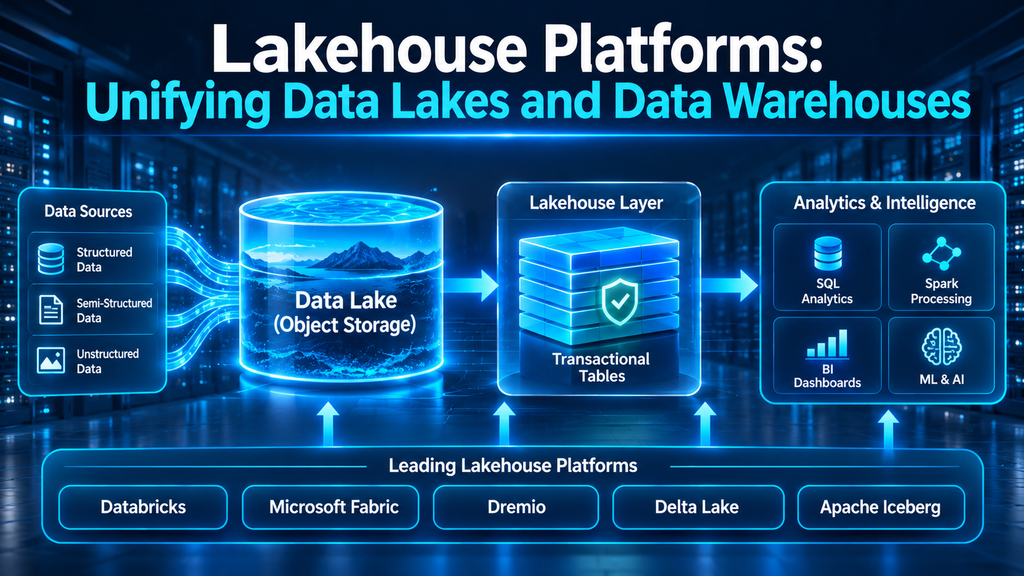
Lakehouse Platforms: Unifying Data Lakes and Data Warehouses
Organizations increasingly need one data environment to support business intelligence, data engineering, streaming applications, machine learning, and AI. Traditional architectures often separate these workloads across data lakes, warehouses, and specialized processing systems. Although each component has a purpose, moving data between them can introduce duplication, synchronization delays, governance gaps, and additional operating costs.
Lakehouse platforms aim to reduce this fragmentation by combining the flexible storage of a data lake with important warehouse capabilities, including transactional consistency, structured query access, schema management, and data governance.
The result is an architecture in which different analytical engines can work with shared, governed data rather than maintaining separate copies for every workload.
However, lakehouse platforms are not identical. Some provide an integrated environment with proprietary management services, while others emphasize open table formats and interoperability between independent processing engines.
Understanding those differences is essential before choosing a platform.
What Is a Lakehouse Platform?
A lakehouse is a data architecture that combines characteristics of data lakes and data warehouses.
A traditional data lake can store large volumes of structured, semi-structured, and unstructured information in relatively inexpensive object storage. However, managing files as analytical tables can require additional mechanisms for transactions, schema enforcement, metadata, and concurrent access.
A traditional data warehouse provides managed analytical tables and SQL query capabilities, but its storage and processing architecture may be less flexible for some data science, machine learning, and unstructured-data workloads.
A lakehouse introduces a table-management layer and associated services that make data stored in a lake more reliable and accessible to multiple workloads.
A modern lakehouse commonly includes:
- Object storage: Stores files and analytical data at scale.
- Open or managed table formats: Organize files into tables and manage changes.
- Processing engines: Support SQL, batch processing, and streaming.
- Catalog and metadata services: Track datasets, schemas, permissions, and locations.
- Governance controls: Manage access, auditing, discovery, and lineage.
- Analytics integrations: Connect BI tools, notebooks, applications, and machine learning systems.
The architectural goal is to make data reusable across workloads without creating unnecessary copies.
How Lakehouse Architecture Works
A lakehouse is more than a storage bucket containing Parquet files. Its reliability depends on the interaction between storage, table formats, catalogs, compute engines, and governance.
1. Object storage
The underlying data is commonly stored in cloud object storage, such as Amazon S3, Azure Data Lake Storage, or Google Cloud Storage.
Object storage provides scalable capacity for large datasets, including structured tables, JSON records, logs, images, documents, and other file types.
2. Table formats
A table format adds database-like management capabilities to files stored in object storage.
Two important technologies are:
- Delta Lake: An open-source storage framework that adds ACID transactions, schema enforcement, time travel, and batch and streaming integration to data lakes. <Cite refs={[“turn221106search0”]}/>
- Apache Iceberg: An open table format designed for large analytical datasets, supporting features such as schema evolution, partition evolution, snapshots, and time travel. <Cite refs={[“turn221106search12″,”turn221106search14”]}/>
Apache Hudi is another open table format used in data lake architectures, particularly for workloads involving incremental data processing and record-level updates.
These formats are not interchangeable in every situation. Their capabilities, implementation details, and support across processing engines differ.
3. Catalog and metadata management
A catalog records information about datasets, tables, schemas, ownership, and access policies.
It helps processing engines locate and interpret tables without relying on manually maintained file paths.
Catalog interoperability is particularly important when organizations want multiple query engines to access the same data.
4. Processing and query engines
Different engines can perform different tasks against lakehouse data.
Examples include SQL analytics, distributed data processing, streaming ingestion, machine learning, and reporting.
The ability to share data between engines depends on the table format, catalog, supported features, and consistency guarantees.
5. Governance and security
A production lakehouse needs centralized or coordinated controls for permissions, data discovery, lineage, auditing, and sensitive information.
Without governance, a shared data environment can quickly become an unmanaged collection of datasets.
Five Lakehouse Platforms and Approaches to Evaluate
The following options represent distinct ways to build and operate a lakehouse. Some are integrated platforms; others combine cloud infrastructure and managed services.
1. Databricks Data Intelligence Platform — Integrated Lakehouse Architecture
<text weight=”medium”>Databricks</text> is one of the best-known platforms built around the lakehouse concept.
Its architecture combines Apache Spark, Delta Lake, and Unity Catalog with managed compute and data engineering services. Teams can ingest raw data, transform it into governed tables, run SQL analytics, and build machine learning workflows within the broader platform.
Databricks uses a medallion-style architecture in many implementations:
- Bronze: Raw or minimally processed data.
- Silver: Cleaned, validated, and standardized data.
- Gold: Curated datasets designed for business reporting and consumption.
Unity Catalog provides governance capabilities for supported data and AI assets, including discovery, permissions, and lineage. <Cite refs={[“turn221106search3″,”turn221106search10”]}/>
Where it fits:
- Large-scale data engineering
- Machine learning and AI workloads
- Batch and streaming processing
- Enterprise analytics
- Organizations with Spark-based engineering teams
Important consideration: Databricks offers substantial flexibility, but organizations must plan compute usage, table maintenance, governance, and platform operations carefully. Teams should also evaluate the required level of openness and interoperability across their chosen cloud storage, table formats, and engines.
Official documentation: Databricks Lakehouse
2. Microsoft Fabric Lakehouse — Integrated Analytics on OneLake
<text weight=”medium”>Microsoft Fabric</text> brings data engineering, data warehousing, real-time analytics, and business intelligence into a unified SaaS environment.
Its Lakehouse capability uses OneLake as a shared logical data foundation and Delta Lake as its primary table format. Engineers can work with data using Spark, while analysts can access supported tables through a SQL analytics endpoint.
This makes Fabric particularly relevant to organizations that already use Microsoft services and Power BI.
Fabric’s lakehouse model is designed to reduce the need to move data between separate engineering and reporting environments. <Cite refs={[“turn221106search1″,”turn221106search15”]}/>
Where it fits:
- Microsoft-centric enterprises
- Power BI analytics environments
- Data engineering with Spark
- Departmental and enterprise lakehouses
- Organizations consolidating analytics workloads
Important consideration: Fabric capacity is shared across workloads. Warehouse queries, data engineering jobs, and other activities can compete for resources. Capacity planning, workspace organization, permissions, and licensing should be considered together.
Official documentation: Microsoft Fabric Lakehouse
3. Dremio — SQL Analytics on Open Lakehouse Data
<text weight=”medium”>Dremio</text> focuses on making data stored in lakehouse architectures accessible through SQL analytics.
Its platform can connect to object storage, lakehouse catalogs, and databases. It supports Apache Iceberg and other data formats, with capabilities for querying data across different sources.
Dremio’s architecture is relevant to organizations that want analytical access to open data without requiring every workload to be moved into a single proprietary warehouse.
Its documentation describes integrations with catalogs such as AWS Glue, Unity Catalog, Iceberg REST Catalog, and Snowflake Open Catalog, depending on the edition. <Cite refs={[“turn221106search2″,”turn221106search16”]}/>
Where it fits:
- SQL analytics on lakehouse data
- Apache Iceberg environments
- Organizations using multiple data engines
- Data virtualization and federation
- BI access to data in object storage
Important consideration: Catalog and storage support varies by edition. Buyers should verify the exact connectors, governance capabilities, workload management features, and deployment options required for their environment.
Official documentation: Dremio Documentation
4. AWS Lakehouse Architecture — Building With S3 and Managed Data Services
AWS provides a set of services that organizations can combine to build a lakehouse architecture rather than relying on one single lakehouse product.
A typical design may use:
- Amazon S3: Object storage for lake data.
- AWS Glue Data Catalog: Metadata and table catalog services.
- AWS Glue: Data integration and processing.
- Amazon Athena: SQL queries over supported data in S3.
- Amazon EMR: Distributed data processing.
- Amazon Redshift: Warehouse analytics and integration with lake data.
Apache Iceberg is an important option for managing analytical tables in this ecosystem.
Where it fits:
- Organizations with established AWS infrastructure
- Data lakes using Amazon S3
- Open table format architectures
- Distributed data engineering
- Analytics across warehouse and lake storage
Important consideration: This is a composable architecture, not a single turnkey lakehouse application. Teams must design how catalogs, permissions, table formats, query engines, and data pipelines work together. Service-level costs and operational responsibilities also need to be managed.
Official documentation: AWS Lake Formation and Amazon Athena
5. Google Cloud Lakehouse — Analytics Across BigQuery and Open Tables
Google Cloud offers lakehouse capabilities through a combination of services and open data technologies.
Organizations can use Google Cloud Storage for object storage, BigQuery for analytical queries, and managed data processing services for engineering workloads. Google Cloud’s lakehouse documentation also describes managed Apache Iceberg tables and catalog interoperability.
This approach can be useful when teams want to combine managed analytics with open table formats and access from compatible processing engines. <Cite refs={[“turn221106search18”]}/>
Where it fits:
- Google Cloud-centered analytics
- Large-scale SQL processing
- Data science and machine learning
- Apache Iceberg-based architectures
- Organizations using BigQuery alongside open data storage
Important consideration: Teams should verify read/write interoperability, catalog integration, supported Iceberg capabilities, and the behavior of individual processing engines. Compatibility with a table format does not guarantee that every engine supports every table feature.
Official documentation: Google Cloud Lakehouse
Comparing the Lakehouse Options
| Platform or approach | Core architecture | Main strength | Key consideration |
|---|---|---|---|
| Databricks | Spark, Delta Lake, Unity Catalog | Integrated engineering, analytics, and AI | Compute and platform governance |
| Microsoft Fabric | OneLake and Delta Lake | Integrated Microsoft analytics | Shared capacity and licensing |
| Dremio | SQL analytics and open lakehouse catalogs | Querying open lakehouse data | Edition-specific capabilities |
| AWS lakehouse | S3, Glue, Athena, EMR, Redshift | Flexible composable cloud architecture | Integration and operational complexity |
| Google Cloud lakehouse | Cloud Storage, BigQuery, Iceberg services | Managed analytics and open-table integration | Engine and catalog interoperability |
These options are not equivalent product packages. Databricks and Fabric provide more integrated platform experiences, while AWS and Google Cloud offer combinations of services. Dremio emphasizes SQL access across lakehouse data.
The right choice depends on how much integration an organization wants the platform provider to manage and how much architectural control its engineering team needs.
Delta Lake vs. Apache Iceberg: A Critical Decision
Table-format selection can influence the long-term flexibility of a lakehouse.
Delta Lake
Delta Lake adds transactional reliability and table-management features to data lakes. Its capabilities include ACID transactions, schema enforcement, time travel, and support for batch and streaming workloads. <Cite refs={[“turn221106search0”]}/>
It is closely associated with the Databricks ecosystem, while also having integrations with other processing engines.
Apache Iceberg
Apache Iceberg is an open table format designed for large analytical tables. It supports schema evolution, hidden partitioning, snapshots, and partition-layout evolution. <Cite refs={[“turn221106search12″,”turn221106search14”]}/>
Its design emphasizes interoperability across compatible query and processing engines.
How should organizations choose?
Evaluate the complete ecosystem rather than selecting a format based on its feature list alone.
Consider:
- Which engines must read and write the tables?
- Which catalog will manage table metadata?
- Are concurrent writes required?
- How important is schema and partition evolution?
- What are the requirements for time travel and rollback?
- How will table maintenance and compaction work?
- What happens if the organization changes its processing engine?
Open formats can improve portability, but actual portability depends on compatible implementations, catalogs, and operational practices.
Medallion Architecture: Organizing Data From Raw to Trusted
Many lakehouse implementations use a medallion architecture to organize data into progressive refinement stages.
Bronze layer: Preserve source information
The bronze layer stores raw or minimally processed information from source systems.
Its purpose is to preserve source data for reprocessing, debugging, and historical analysis.
Typical content includes:
- Raw application events
- Database extracts
- API responses
- IoT measurements
- Streaming records
Silver layer: Clean and standardize
The silver layer contains validated and transformed records.
Typical operations include:
- Deduplication
- Data type correction
- Schema validation
- Standardized timestamps
- Reference-data enrichment
- Handling missing and invalid values
Gold layer: Prepare for consumption
The gold layer contains curated datasets designed for reporting, analytics, and business applications.
Examples include:
- Revenue summaries
- Customer analytics
- Inventory performance
- Financial reporting tables
- Operational KPIs
The medallion model is a useful organizational pattern, not a mandatory feature of every lakehouse. Its value depends on clear ownership, quality checks, and consistent definitions across layers.
Lakehouse Performance: What to Optimize
Lakehouse performance depends on several components working together.
File sizing: Too many small files can create metadata and query overhead. Compaction helps combine files into more manageable sizes.
Partition strategy: Partitioning can improve query efficiency, but excessive partitioning may create operational complexity.
Data layout: Sorting, clustering, and other layout techniques can help engines locate relevant data more efficiently.
Metadata management: Large tables require efficient metadata handling and regular maintenance.
Caching: Caching can improve repeated query performance, but it should not replace sensible data organization.
Compute configuration: Processing engines need suitable compute resources for ingestion, transformation, and analytical queries.
Concurrency: Multiple users and workloads may access the same datasets. Evaluate how the platform handles simultaneous reads, writes, and updates.
A proof of concept should test realistic file counts, table sizes, query patterns, concurrent workloads, and update frequency.
Governance and Security in a Lakehouse
A shared lakehouse can become a central repository for sensitive corporate information. Governance must therefore be designed into the architecture.
Important considerations include:
- Centralized identity and access management
- Table-, schema-, and column-level permissions where supported
- Row-level filtering and data masking
- Encryption in transit and at rest
- Sensitive-data classification
- Audit logs and administrative monitoring
- Data lineage and ownership
- Retention and deletion policies
- Secure access for external tools and processing engines
Catalogs are particularly important because they help teams discover datasets and understand their ownership and permissions.
Lineage also matters. When a business report displays an incorrect figure, teams should be able to trace the value back through transformations and source datasets.
Governance should apply consistently across all engines that access the lakehouse. A policy configured in one platform component may not automatically cover every external engine or storage path.
Cost Management: Avoiding a More Expensive Data Lake
Lakehouse architectures can reduce data duplication, but they do not guarantee lower costs.
Common cost drivers include:
- Object storage capacity
- Compute resources for data processing
- SQL query execution
- Streaming ingestion
- Catalog and metadata services
- Data transfer between services
- Replication and backup
- Table maintenance and compaction
- Platform licensing and administration
A composable architecture may offer flexibility but require more engineering effort. An integrated managed platform may simplify operations but introduce platform consumption and capacity charges.
Organizations should estimate costs across the entire lifecycle: ingestion, transformation, storage, querying, sharing, maintenance, and retention.
Practical controls include workload scheduling, compute auto-termination, storage lifecycle policies, query monitoring, file compaction, and clear ownership of data products.
Common Lakehouse Implementation Mistakes
Treating object storage as a complete lakehouse
Storing Parquet files in cloud storage does not automatically provide transactional table management, catalog services, or governance.
The supporting architecture must be designed and operated.
Ignoring table maintenance
Small files, stale metadata, and poorly maintained tables can degrade performance and increase operational overhead.
Maintenance should be part of the regular data lifecycle.
Creating multiple copies of the same dataset
A lakehouse is intended to reduce unnecessary data duplication. Creating separate copies for every department or processing engine can undermine that goal.
Use shared, governed datasets where the architecture permits it.
Overlooking catalog interoperability
A table format may be open, but its metadata catalog and engine integrations still influence whether different systems can access it correctly.
Test the complete read and write workflow.
Skipping data quality checks
Raw data should not automatically become trusted business information.
Validation, deduplication, schema checks, and reconciliation should be implemented as data moves through refinement stages.
Underestimating operational responsibilities
Even managed platforms require planning for access control, monitoring, retention, cost management, and recovery.
A lakehouse needs clear ownership and operational processes.
How to Choose a Lakehouse Platform
A structured evaluation should begin with the workloads the organization expects to support.
1. Identify the primary workloads. Determine whether the priority is BI, data engineering, machine learning, streaming, or a combination.
2. Evaluate the existing cloud environment. Existing AWS, Azure, or Google Cloud investments may influence the most practical architecture.
3. Review table-format requirements. Decide whether Delta Lake, Apache Iceberg, Apache Hudi, or a combination is appropriate.
4. Test engine interoperability. Confirm that required SQL engines, processing frameworks, and BI tools can access the data correctly.
5. Examine governance. Evaluate catalog services, permissions, lineage, auditing, and sensitive-data controls.
6. Model total cost. Include storage, compute, data transfer, maintenance, and engineering effort.
7. Validate migration and portability. Understand how difficult it would be to move data and workloads if requirements change.
8. Run a realistic proof of concept. Use actual source data, representative transformations, concurrent queries, and production-like security policies.
Frequently Asked Questions
What is the main purpose of a lakehouse?
A lakehouse combines scalable data lake storage with capabilities for reliable analytical tables, SQL querying, governance, and multiple data processing workloads.
Is a lakehouse better than a data warehouse?
Not for every organization. A lakehouse can be attractive when data engineering, machine learning, unstructured data, and BI need to share a foundation. A traditional warehouse may be simpler for organizations whose requirements are primarily structured reporting and SQL analytics.
Does a lakehouse eliminate the need for a data warehouse?
It can reduce the need for separate warehouse and lake environments, but many organizations still use dedicated warehouse services or data marts alongside a lakehouse.
Is Delta Lake the same as Apache Iceberg?
No. Both are open table formats designed to bring table-management capabilities to data lakes, but they have different specifications, implementations, and ecosystem integrations.
Can a lakehouse support real-time analytics?
Yes, depending on the ingestion architecture, processing engines, table format, and query services. Streaming pipelines can update lakehouse tables, but end-to-end latency depends on the entire system.
Is a lakehouse suitable for AI applications?
Yes. Lakehouse environments can provide governed access to structured and unstructured data for machine learning, feature engineering, and retrieval-based AI applications. The platform must still address data quality, access control, lineage, and model-specific requirements.
Building a Lakehouse That Supports More Than Storage
Lakehouse platforms are an architectural response to a growing challenge: organizations want their analytical, engineering, and AI workloads to use shared data without maintaining disconnected copies across multiple systems.
Databricks, Microsoft Fabric, Dremio, AWS services, and Google Cloud provide different paths toward that goal. Their strengths depend on the degree of integration, openness, cloud alignment, governance, and operational flexibility required.
The most important decision is not which platform has the most features. It is whether the architecture can reliably support the organization’s data lifecycle—from ingestion and quality management to analytics, AI, security, and long-term governance.
A well-designed lakehouse should make data easier to trust, discover, share, and use. That is the real measure of its value.
