Upgrade & Secure Your Future with DevOps, SRE, DevSecOps, MLOps!
We spend hours scrolling social media and waste money on things we forget, but won’t spend 30 minutes a day earning certifications that can change our lives.
Master in DevOps, SRE, DevSecOps & MLOps by DevOps School!
Learn from Guru Rajesh Kumar and double your salary in just one year.
Reverse ETL Tools: Activating Warehouse Data Across Business Applications
Organizations invest heavily in collecting, processing, and analyzing data. Customer information, sales transactions, product usage, marketing interactions, and support records are often consolidated in cloud data warehouses or lakehouses. Yet valuable insights can remain trapped inside analytical systems if business teams cannot access them where they work.
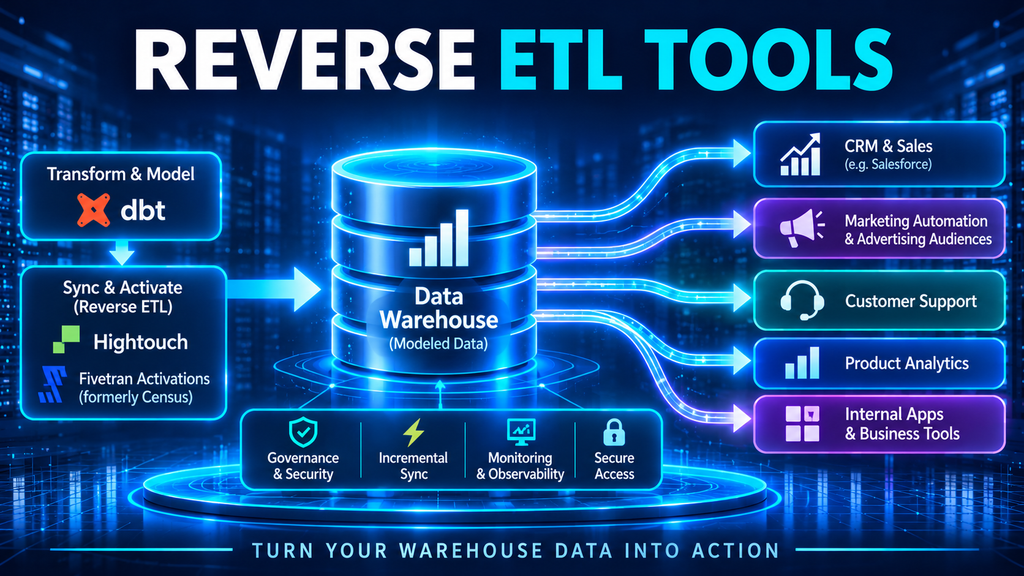
Reverse ETL addresses this problem by moving prepared data from centralized analytical environments back into operational applications. Instead of simply presenting insights in dashboards, it makes those insights available inside CRM systems, marketing platforms, customer support software, advertising tools, and other business applications.
For example, a company might identify its most valuable customers through warehouse analysis and automatically update their Salesforce records. A marketing team could use purchasing behavior to create targeted campaign audiences, while a customer success team could receive updated churn-risk information inside its support workflow.
Reverse ETL tools make these workflows repeatable, manageable, and scalable. They help organizations turn analytical data into operational action.
What Are Reverse ETL Tools?
Reverse ETL tools are platforms that synchronize data from analytical systems, such as data warehouses and lakehouses, into operational business applications.
Traditional ETL and ELT processes generally move information from operational sources into centralized analytical environments. Reverse ETL moves selected, modeled information in the opposite direction.
Common destinations include:
- Customer relationship management (CRM) platforms.
- Marketing automation and email platforms.
- Advertising and audience management systems.
- Customer support applications.
- Sales engagement tools.
- Product analytics platforms.
- Internal applications and operational databases.
Reverse ETL is closely associated with the concept of data activation. Data activation means making trusted, prepared information available to the people and systems that can use it to take action.
A reverse ETL platform generally connects to a warehouse, identifies the records and fields to synchronize, maps them to destination objects, and executes updates according to a defined schedule or supported low-latency process.
How Reverse ETL Works
A reverse ETL workflow typically includes several connected stages.
1. Data Collection and Centralization
Information is first collected from operational systems, websites, applications, databases, and other sources using traditional ETL or ELT pipelines.
This information is stored in a centralized analytical environment, such as Snowflake, BigQuery, Amazon Redshift, or Databricks.
2. Data Transformation and Modeling
Raw data is often unsuitable for direct operational use. Data engineers and analytics engineers prepare it by applying business rules, combining records, standardizing fields, and creating reusable models.
For example, a customer model might combine purchase history, subscription information, support interactions, and product usage into one customer-level record.
Tools such as dbt are frequently used to build these analytical models.
3. Selecting Data for Activation
The reverse ETL platform identifies which records need to be sent to a destination.
A business team might select customers who meet specific criteria, such as:
- Customers with a high lifetime value.
- Subscribers approaching renewal.
- Users who have abandoned a purchase.
- Accounts with declining product usage.
- Leads that meet a sales qualification threshold.
Selection can be based on warehouse tables, modeled datasets, SQL queries, or supported audience-building features.
4. Field Mapping
The selected data must be mapped to the destination application’s structure.
For example, a warehouse field named customer_lifetime_value might map to a custom Salesforce account field.
Correct mapping is essential because destination applications often have their own object structures, required fields, identifiers, and validation rules.
5. Synchronization
The platform sends the selected records to the destination.
Depending on the connector and configuration, synchronization may use full refreshes, incremental updates, upserts, or other supported methods.
Incremental synchronization can reduce unnecessary data transfers by updating only records that have changed.
6. Monitoring and Error Handling
After synchronization, teams need visibility into successful updates, failed records, destination API errors, and delayed data.
Production deployments should include monitoring, alerts, retry policies, access controls, and reconciliation procedures.
Leading Reverse ETL Tools and Platforms
Reverse ETL products differ in destination coverage, governance, deployment architecture, synchronization methods, and support for business users. Some focus specifically on warehouse-to-application synchronization, while others combine activation with broader customer data or integration capabilities.
1. Hightouch
Hightouch is a data activation platform that connects data warehouses and other supported sources to business applications.
It allows teams to define datasets using tables or SQL, map fields to destination applications, and configure synchronization workflows. Its platform also includes capabilities for audience activation, governance, and integration with modern data stack technologies.
Hightouch supports integrations with analytical platforms such as Snowflake, Databricks, BigQuery, and Amazon Redshift, along with a broad destination ecosystem.
Where it fits: Organizations that want warehouse-centered activation across marketing, sales, customer success, and other business functions.
Evaluation considerations: Examine destination-specific capabilities, synchronization frequency, governance requirements, audience workflows, and usage-based costs.
2. Fivetran Activations (formerly Census)
Fivetran Activations provides reverse ETL and data activation capabilities. The product was previously known as Census before becoming part of Fivetran’s platform.
It enables organizations to synchronize modeled warehouse data into business applications and operational destinations.
Typical workflows include updating CRM records, synchronizing customer attributes, and delivering selected warehouse datasets to downstream tools.
Where it fits: Organizations that want reverse ETL as part of a wider Fivetran data movement strategy.
Evaluation considerations: Review destination support, sync behavior, usage measurement, governance, and how Activations fits the organization’s existing Fivetran deployment.
3. RudderStack
RudderStack provides customer data infrastructure, including event collection, routing, warehouse integration, and data activation capabilities.
Its broader platform scope makes it relevant to organizations that want to connect customer event data with downstream marketing and operational systems.
Rather than focusing only on warehouse-to-application synchronization, RudderStack can be considered when event collection, customer data management, and activation are part of the same architecture.
Where it fits: Teams building customer data infrastructure and wanting connected event and activation workflows.
Evaluation considerations: Determine whether the organization needs the wider customer data platform or primarily requires a dedicated reverse ETL service.
4. Polytomic
Polytomic focuses on data synchronization across warehouses, databases, spreadsheets, APIs, and business applications.
Its broader synchronization approach can be useful for organizations that need both warehouse-to-application workflows and other forms of data movement.
Where it fits: Teams with diverse integration requirements that want to evaluate a unified synchronization platform.
Evaluation considerations: Validate the exact source and destination connectors, supported synchronization modes, conflict handling, and operational requirements for each workflow.
5. Airbyte
Airbyte is primarily known for data connectivity and ingestion, but its ecosystem also includes data activation capabilities.
It can be relevant to engineering teams that prefer open-source technology, flexible connector development, and greater control over deployment.
Its role should be evaluated carefully: data ingestion and reverse ETL are different directions of data movement, and the required activation capabilities depend on the selected Airbyte edition and connector support.
Where it fits: Organizations that value open-source data infrastructure and want to explore activation alongside broader integration workflows.
Evaluation considerations: Check destination support, deployment model, connector maturity, operational ownership, and feature availability.
6. Segment
Segment is a customer data platform designed to collect, unify, and route customer event information to downstream destinations.
Its customer data capabilities can support activation workflows, including delivering customer information to marketing, analytics, and other applications.
Segment is not simply a warehouse synchronization tool. It is particularly relevant when organizations need customer event collection, identity-related capabilities, and customer data activation together.
Where it fits: Companies building customer data infrastructure around event collection and downstream activation.
Evaluation considerations: Compare its event-centric architecture with warehouse-first reverse ETL platforms and assess whether the broader CDP capabilities justify the implementation.
Reverse ETL vs. ETL vs. ELT
Understanding the direction of data movement helps clarify where reverse ETL fits within a modern data architecture.
| Area | ETL | ELT | Reverse ETL |
|---|---|---|---|
| Data direction | Sources to destination | Sources to destination | Warehouse to operational destinations |
| Main purpose | Transform and load data | Load and transform data | Activate prepared analytical data |
| Common destinations | Warehouses and databases | Warehouses and lakehouses | CRM, marketing, support, and business apps |
| Transformation location | Before loading | Usually after loading | Usually modeled before synchronization |
| Typical users | Data engineers | Data and analytics engineers | Data, marketing, sales, and operations teams |
Reverse ETL does not replace traditional ETL or ELT. It complements them by creating a path from analytical environments back into the systems where business teams act.
Key Features to Evaluate in Reverse ETL Tools
Choosing a reverse ETL platform requires more than counting available connectors. The quality and reliability of each synchronization workflow matter.
Warehouse and Lakehouse Connectivity
The platform should connect to the organization’s analytical environment and support the required tables, views, query models, and authentication methods.
Common platforms to evaluate include Snowflake, BigQuery, Amazon Redshift, Databricks, and supported relational databases.
Destination Connector Coverage
Destination support is one of the most important evaluation criteria.
Check whether the platform supports the specific objects and actions required in the target application. A connector may support updating CRM contacts but not every custom object or relationship.
Incremental Synchronization
Incremental syncs update records that have changed rather than transferring an entire dataset each time.
This can reduce data transfer, processing requirements, and unnecessary API calls. Teams should verify how each platform identifies changed records and handles deletions.
Field Mapping and Transformation
The tool should make it possible to map warehouse fields to destination fields accurately.
Additional capabilities may include data formatting, value mapping, custom logic, and handling of destination-specific requirements.
Scheduling and Low-Latency Syncs
Different workflows require different update frequencies.
A marketing audience might be updated periodically, while a customer account status used by a sales team may require more frequent updates.
Evaluate scheduled synchronization, supported low-latency options, concurrency, and the behavior of delayed or failed jobs.
Data Governance and Access Controls
Reverse ETL can expose sensitive information to many business applications.
Look for role-based access control, approval workflows, environment separation, credential management, audit trails, and controls over which datasets can be activated.
Monitoring and Observability
Teams need to identify failed records, destination API errors, sync delays, and unexpected changes in record volume.
Useful capabilities include row-level error details, execution history, alerting, and synchronization logs.
Benefits of Reverse ETL Tools
Making Warehouse Data Operational
Reverse ETL enables organizations to use analytical information in their daily business processes.
Instead of relying exclusively on dashboards, teams can receive updated information inside the applications they already use.
Improving CRM Data Quality
Customer information stored in warehouses can be used to enrich CRM records with purchasing behavior, customer value, subscription details, and product engagement.
This helps sales and customer success teams work with more complete information.
Supporting Personalized Marketing
Marketing teams can use warehouse-generated customer segments to build audiences and deliver more relevant campaigns.
For example, customers who have not purchased recently can be separated from highly engaged customers for different campaign strategies.
Improving Customer Retention
Businesses can identify customers showing signs of reduced engagement and make relevant information available to customer success teams.
This can support earlier intervention and more informed account management.
Reducing Manual Data Work
Automated synchronization reduces repeated CSV exports, manual uploads, spreadsheet updates, and custom scripts maintained by individual teams.
Connecting Analytics with Business Outcomes
Reverse ETL creates a practical link between analytical insights and operational execution. It helps organizations measure whether data-driven decisions are being applied in business systems.
Common Reverse ETL Use Cases
Sales and CRM Enrichment
A company can synchronize customer value, purchase history, product usage, and engagement scores into CRM records.
Sales representatives can use this information to prioritize accounts and prepare for customer conversations.
Marketing Audience Activation
Warehouse-generated audience segments can be synchronized into supported advertising and marketing platforms.
This allows campaigns to use business-defined customer segments rather than relying exclusively on basic platform-level targeting.
Customer Success and Churn Management
Organizations can send subscription status, renewal dates, product engagement, and risk indicators to customer success systems.
Support teams can then prioritize accounts that require attention.
Product-Led Growth
Software companies can use product usage data to identify active users, trial customers, and accounts approaching conversion milestones.
This information can be made available to sales and lifecycle marketing teams.
Finance and Operations
Reverse ETL can also support operational reporting and internal workflows by delivering approved warehouse data into supported applications and databases.
Challenges and Risks of Reverse ETL
Incorrect Data Mapping
A field mapped to the wrong destination property can create inaccurate CRM records or disrupt business workflows.
How to address it: Validate mappings in a staging environment and test representative records before enabling production synchronization.
Stale or Delayed Data
If the upstream warehouse model is not refreshed on time, destination applications may receive outdated information.
How to address it: Monitor upstream data freshness, coordinate model and sync schedules, and define acceptable latency for each use case.
API Rate Limits
Business applications often impose API limits. Large synchronization jobs can exceed these limits or compete with other integrations.
How to address it: Use incremental updates, monitor destination API consumption, and coordinate synchronization schedules.
Duplicate Records
Poor matching logic can create duplicate contacts, accounts, or other destination records.
How to address it: Define stable identifiers, use appropriate upsert behavior, and test matching logic before deployment.
Sensitive Data Exposure
Sending excessive customer or employee information into operational tools can increase privacy and security risk.
How to address it: Apply least-privilege access, data minimization, field-level restrictions where available, and clear approval procedures.
Conflicting Updates
A warehouse and an operational application may both contain information about the same record. Unclear ownership can cause one system to overwrite another’s changes.
How to address it: Define system-of-record responsibilities for each field and establish explicit rules for conflict resolution.
Hidden Operational Costs
Pricing may depend on records synchronized, sync frequency, destinations, usage, or additional platform capabilities.
How to address it: Estimate actual workloads and review licensing, usage, monitoring, and engineering costs before selecting a platform.
How to Choose the Right Reverse ETL Platform
A practical selection process should begin with business workflows rather than product features.
- Identify the business outcome: Determine whether the goal is CRM enrichment, audience activation, customer retention, or another operational use case.
- Identify the data source: Confirm where the trusted data resides and whether it is already modeled and validated.
- List destination applications: Document the exact CRM, marketing, support, advertising, and operational systems involved.
- Validate connector behavior: Test required objects, field mappings, identifiers, update methods, and deletion handling.
- Define synchronization frequency: Decide whether the workflow needs scheduled updates or supported low-latency synchronization.
- Review governance: Establish permissions, approval procedures, sensitive-data restrictions, and audit requirements.
- Estimate total cost: Consider sync volume, frequency, platform licensing, destination API limits, and maintenance.
- Run a controlled pilot: Test realistic data, failures, retries, duplicate prevention, and reconciliation before expanding.
A successful pilot should demonstrate that the platform can reliably deliver accurate information into the destination without creating unwanted changes or compromising governance.
The Future of Reverse ETL and Data Activation
Reverse ETL is evolving as organizations move toward more connected data and application architectures.
Several developments are influencing the category:
- Broader data activation: Platforms are expanding beyond simple field synchronization into audiences, workflows, and other operational actions.
- Real-time and low-latency data movement: More business processes require updated information quickly after a source change.
- Improved governance: Organizations need stronger control over which teams can activate which datasets and where information can be sent.
- AI-driven workflows: Prepared warehouse data can support AI-powered business applications, provided data access and accuracy are carefully managed.
- Closer integration with analytics engineering: Reverse ETL platforms increasingly connect with modeled data, version control, orchestration, and data observability tools.
The direction is clear: organizations increasingly want their analytical data to participate directly in business operations rather than remain isolated in reporting environments.
Conclusion
Reverse ETL tools help organizations turn centralized analytical data into practical business action. By synchronizing trusted warehouse and lakehouse information into CRM systems, marketing platforms, customer support applications, and other operational tools, they connect data engineering with everyday business processes.
Platforms such as Hightouch, Fivetran Activations, RudderStack, Polytomic, Airbyte, and Segment provide different approaches to data activation and synchronization.
The right choice depends on the organization’s data architecture, destination applications, synchronization requirements, governance expectations, and technical resources.
Reverse ETL works best when it is built on reliable upstream data models, clear ownership rules, accurate field mappings, and strong monitoring. With these foundations in place, organizations can make their data more useful across the entire business.
Frequently Asked Questions
1. What is Reverse ETL?
Reverse ETL is the process of synchronizing prepared data from a data warehouse or lakehouse into operational applications such as CRM, marketing, sales, and customer support systems.
2. How is Reverse ETL different from traditional ETL?
Traditional ETL generally moves data from operational sources into analytical destinations. Reverse ETL moves selected analytical data back into business applications so teams can act on it.
3. Which platforms are commonly used for Reverse ETL?
Common options include Hightouch, Fivetran Activations, RudderStack, Polytomic, Airbyte’s activation capabilities, and customer data platforms such as Segment.
4. Does Reverse ETL replace a data warehouse?
No. Reverse ETL depends on an analytical source, such as a data warehouse or lakehouse. It complements that environment by delivering selected data to operational destinations.
5. Is dbt a Reverse ETL tool?
dbt is primarily used for data transformation and modeling. It can prepare datasets for activation, but a separate synchronization mechanism is generally needed to deliver the resulting data into business applications.
6. What is data activation?
Data activation is the process of making prepared and trusted data available to systems and teams that can use it to perform business actions.
7. Can Reverse ETL support real-time workflows?
Some platforms support low-latency or near-real-time synchronization. Actual latency depends on the source, platform configuration, destination connector, and application API behavior.
8. What are the biggest risks of Reverse ETL?
Common risks include inaccurate field mapping, stale data, duplicate records, API rate limits, conflicting updates, and inappropriate exposure of sensitive information.
