Upgrade & Secure Your Future with DevOps, SRE, DevSecOps, MLOps!
We spend hours scrolling social media and waste money on things we forget, but won’t spend 30 minutes a day earning certifications that can change our lives.
Master in DevOps, SRE, DevSecOps & MLOps by DevOps School!
Learn from Guru Rajesh Kumar and double your salary in just one year.
Data Warehouse Platforms: Building a Reliable Foundation for Business Analytics
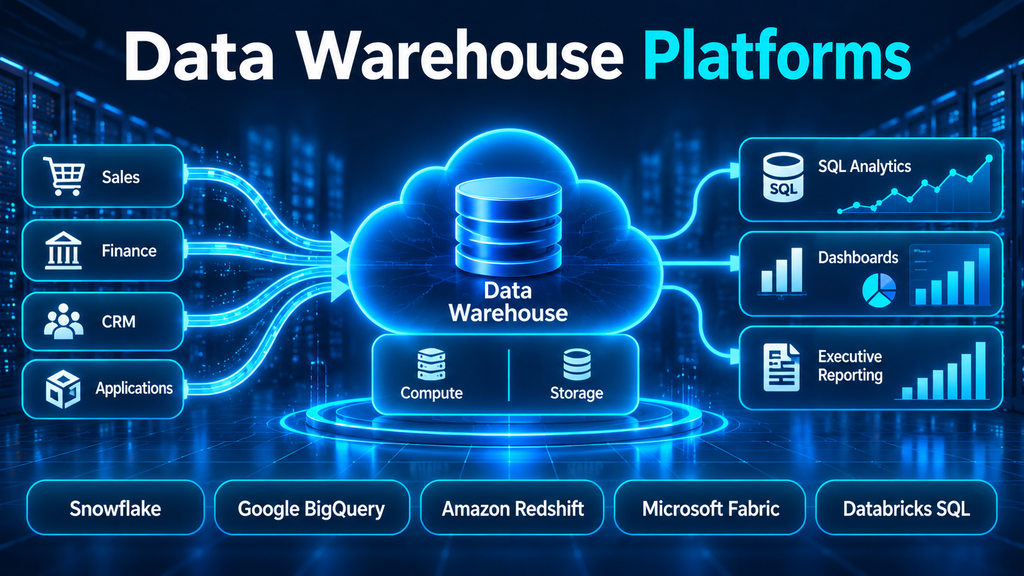
Organizations collect information from sales applications, customer relationship management systems, finance software, websites, operational databases, and external services. Individually, these systems provide useful information. Together, they can reveal business performance, customer behavior, operational bottlenecks, and opportunities for growth.
The difficulty is bringing that information together in a form that analysts and business applications can query consistently.
A data warehouse platform addresses this challenge by providing a centralized environment for integrating, organizing, storing, and analyzing business data. It is designed primarily for analytical workloads rather than the day-to-day transactions handled by operational databases.
Modern platforms have moved beyond traditional fixed-capacity database servers. Cloud services increasingly separate storage from compute, automate infrastructure management, and support large-scale SQL analytics. Some also incorporate open table formats and capabilities traditionally associated with data lakes and lakehouses.
The important decision is no longer simply which database can store the most information. It is which platform can support an organization’s analytical architecture without creating unnecessary complexity or unpredictable costs.
What Does a Data Warehouse Platform Actually Do?
A data warehouse consolidates information from different systems into a structured analytical environment.
Consider a retail company operating several systems:
- An e-commerce platform records online orders.
- A point-of-sale system records store transactions.
- A CRM platform stores customer information.
- An inventory application tracks product availability.
- An accounting system manages revenue and expenses.
Each application has its own data model. A data warehouse brings the relevant information together so analysts can answer questions such as:
- Which product categories generate the highest revenue?
- How does customer retention differ across regions?
- Which sales channels have the strongest margins?
- How does inventory availability affect order fulfillment?
- What is the relationship between marketing expenditure and revenue?
A warehouse does more than copy records. Data must usually be validated, standardized, transformed, and modeled so that different departments interpret business measures consistently.
The Architecture Behind Modern Data Warehouses
Most analytical warehouse environments contain several interconnected layers.
Data ingestion
Information enters from operational databases, enterprise applications, files, APIs, streaming services, and external datasets.
Ingestion may happen through scheduled batch loads, continuous change-data capture, streaming pipelines, or managed connectors.
Storage
The warehouse stores prepared data in a format optimized for analytical queries. Columnar storage is common because analytical queries frequently read a limited number of columns across large numbers of rows.
Cloud platforms may separate persistent storage from the compute resources that execute queries.
Processing and transformation
Raw information must be cleaned, joined, standardized, and converted into business-ready datasets.
This work can happen before loading, during loading, or after data has entered the warehouse. The choice between ETL and ELT depends on the architecture and the capabilities of the platform.
Query and analytics
Analysts, BI applications, reporting systems, and data science tools access curated datasets using SQL or other supported interfaces.
The warehouse must handle different query patterns, from interactive dashboards to complex analytical workloads.
Governance and administration
A production warehouse also needs identity management, access policies, metadata, auditing, monitoring, backup strategies, and cost controls.
Without these controls, centralizing data can create a larger security and governance problem rather than solving one.
Five Major Data Warehouse Platforms
The following platforms illustrate different approaches to analytical data management. Their architectures, cloud dependencies, operating models, and integration ecosystems are important selection factors.
1. Snowflake — Managed Analytics Across Major Cloud Providers
Snowflake is a cloud-native data platform designed to reduce the infrastructure management associated with traditional data warehouses.
Its architecture separates persistent storage from virtual warehouses that provide query compute. Different virtual warehouses can run workloads independently, allowing organizations to isolate reporting, engineering, and other analytical activity.
Snowflake supports structured and semi-structured data, SQL analytics, data sharing, and multiple data engineering capabilities. Its platform also supports Apache Iceberg tables alongside its native table architecture.
Where it fits:
- Enterprise business intelligence
- Multi-team analytical environments
- Cloud data warehousing
- Governed data sharing
- Organizations using multiple major cloud providers
Important consideration: Snowflake is a managed cloud service rather than a conventional self-hosted database. Compute consumption, warehouse sizing, storage, data transfer, and workload scheduling all require financial oversight. Independent compute environments can improve workload isolation, but poorly controlled usage can increase costs.
Official documentation: Snowflake Architecture and Key Concepts
2. Google BigQuery — Serverless Analytics on Google Cloud
Google BigQuery provides a serverless analytical platform in which users can query large datasets without managing conventional database clusters.
Its architecture separates storage and compute. This allows analytical capacity to be managed independently of the underlying data storage.
BigQuery supports SQL-based analysis, streaming ingestion, machine learning capabilities, geospatial analytics, and integrations with the wider Google Cloud ecosystem.
Its pricing and capacity options support different workload patterns, including on-demand query processing and reservation-based capacity models.
Where it fits:
- Large-scale business analytics
- Google Cloud environments
- Data science and machine learning
- Ad hoc analytical queries
- Reporting across large datasets
Important consideration: Serverless infrastructure does not automatically mean predictable costs. Under on-demand pricing, query design and the volume of data processed matter. Teams should examine partitioning, clustering, query limits, reservations, and workload governance.
Official documentation: Google BigQuery Overview
3. Amazon Redshift — Data Warehousing for AWS-Centered Organizations
Amazon Redshift is a managed cloud data warehouse designed for large-scale SQL analytics.
It offers provisioned and serverless deployment approaches. Provisioned clusters give organizations more direct control over capacity, while Redshift Serverless manages warehouse capacity automatically according to workload demand.
Redshift uses columnar storage and massively parallel processing to execute analytical queries across large datasets. It also integrates with Amazon S3, AWS data services, streaming sources, and business intelligence tools.
Its data-sharing and external-query capabilities can help organizations analyze information across warehouse and data lake environments.
Where it fits:
- Organizations already invested in AWS
- Enterprise reporting and business intelligence
- Analytics across Amazon S3 data
- SQL-based data marts
- Workloads integrated with AWS data services
Important consideration: Provisioned deployments require capacity planning and operational oversight. Serverless reduces infrastructure management but still requires workload and spending controls. Teams migrating from PostgreSQL should also understand that Redshift is PostgreSQL-derived, not a drop-in replacement for PostgreSQL.
Official documentation: Amazon Redshift Documentation
4. Microsoft Fabric Data Warehouse — Analytics Within the Microsoft Ecosystem
Microsoft Fabric brings data engineering, warehousing, analytics, and business intelligence capabilities into a unified SaaS environment.
Fabric Data Warehouse is built on OneLake and uses Delta tables as part of its storage architecture. It provides a SQL-oriented warehouse experience with T-SQL support and integration with Power BI and other Fabric workloads.
This architecture is relevant to organizations that want to combine enterprise data warehousing with existing Microsoft reporting and productivity environments.
Where it fits:
- Microsoft-centric enterprises
- Power BI reporting environments
- Corporate data marts
- Governed SQL analytics
- Organizations consolidating analytics workloads in Fabric
Important consideration: Fabric capacity is shared across workloads within the platform. Teams should understand how warehouse queries, data engineering, reporting, and other activities compete for capacity. Licensing, capacity planning, and workload management should be evaluated together.
Official documentation: Microsoft Fabric Data Warehouse
5. Databricks SQL — Warehouse Capabilities on a Lakehouse Foundation
Databricks approaches analytical warehousing through its lakehouse architecture.
Instead of requiring all analytical data to be copied into a traditional warehouse storage system, Databricks SQL provides SQL compute over data managed within the lakehouse environment.
Its SQL warehouses provide compute resources for analytical queries. The wider platform supports data engineering, streaming, machine learning, and AI workloads.
Unity Catalog provides centralized governance and discovery capabilities across supported data assets.
Where it fits:
- Data engineering and analytics teams
- Organizations using Apache Spark
- Machine learning and analytical workloads
- Large-scale data lake environments
- Teams seeking shared data infrastructure for multiple workloads
Important consideration: Databricks can offer substantial flexibility, but that flexibility requires architectural discipline. Teams must manage data modeling, table maintenance, compute configuration, governance, and workload design. It may be more platform than an organization needs if its requirements are limited to conventional SQL reporting.
Official documentation: Databricks Data Warehousing Concepts
Comparing the Platforms
| Platform | Architectural approach | Main ecosystem | Consider when |
|---|---|---|---|
| Snowflake | Managed cloud warehouse with independent virtual warehouses | AWS, Azure, Google Cloud | Managed analytics and cross-team data sharing matter |
| BigQuery | Serverless warehouse with separate storage and compute | Google Cloud | Large-scale analytics with minimal infrastructure management is important |
| Amazon Redshift | Managed MPP warehouse, provisioned or serverless | AWS | Existing AWS services are central to the data architecture |
| Microsoft Fabric | Warehouse on OneLake and Delta tables | Microsoft | Power BI and Microsoft analytics integration are priorities |
| Databricks SQL | SQL compute over lakehouse data | Databricks and major cloud providers | Data engineering, analytics, and machine learning share infrastructure |
This comparison describes architectural positioning, not a universal performance ranking. Actual performance depends on data layout, concurrency, query design, compute configuration, and workload characteristics.
Data Warehouse vs. Data Lake vs. Lakehouse
These terms are often used together, but they describe different architectural ideas.
Data warehouse
A data warehouse typically emphasizes curated, structured, and governed analytical datasets. It is particularly suitable for standardized reporting, business metrics, dimensional models, and SQL-based analysis.
Data lake
A data lake stores data in a broad range of formats, including structured, semi-structured, and unstructured information. It is commonly built on scalable object storage and can serve as a landing and exploration environment for diverse datasets.
Lakehouse
A lakehouse combines data lake storage with capabilities associated with data warehouses, such as transactional table management, schema enforcement, and SQL analytics.
The boundaries are increasingly flexible. Modern warehouses can query external data, while lakehouse platforms can support sophisticated SQL analytics. The distinction should therefore be evaluated through actual architecture, storage formats, governance, and workload requirements rather than product labels alone.
The Data Modeling Decisions That Determine Warehouse Quality
Selecting a platform is only part of building a reliable warehouse. The quality of its data model has a major influence on reporting consistency and query complexity.
Dimensional modeling
Dimensional modeling organizes analytical data around measurable business processes.
A typical model contains:
- Fact tables: Business events and measurable values, such as sales amounts, quantities, and transaction counts.
- Dimension tables: Descriptive context, such as customer, product, date, location, and sales channel.
A star schema places a central fact table around related dimensions. It is commonly used for business intelligence because it gives analysts an understandable structure for querying business activity.
Slowly changing dimensions
Business attributes change over time. A customer may move to another region, a product may change category, or an employee may change department.
A warehouse must decide whether to overwrite old values or preserve historical versions. Slowly changing dimension techniques provide established approaches for handling these changes.
Data marts
A data mart provides a focused analytical dataset for a particular department or business function.
Examples include finance, sales, marketing, and supply chain data marts.
Well-designed data marts use consistent definitions for shared measures. Otherwise, different departments may produce conflicting reports from what is supposed to be the same corporate data.
ETL and ELT: Where Should Transformations Happen?
The difference between ETL and ELT is important when designing warehouse pipelines.
ETL — Extract, Transform, Load means data is transformed before it enters the target warehouse.
This approach can be appropriate when data must be standardized or filtered before loading, or when the target environment has specific ingestion requirements.
ELT — Extract, Load, Transform means raw or lightly processed data is loaded first, with transformations executed inside the analytical platform.
ELT is common in modern cloud warehouses because compute resources can be provisioned for transformation workloads as needed.
The right approach depends on data sensitivity, transformation complexity, latency, platform capabilities, and the organization’s engineering practices.
A warehouse should not be selected in isolation from the tools that extract, orchestrate, and transform its data.
Performance: Why Bigger Compute Is Not Always the Answer
When warehouse queries become slow, increasing compute capacity may help, but it does not necessarily address the underlying problem.
Several design factors influence analytical performance.
Partitioning: Organizing data by commonly filtered attributes, such as transaction dates, can reduce the amount of data scanned.
Clustering and sorting: Appropriate data organization can improve how efficiently a platform locates relevant records.
Columnar storage: Reading only the required columns can reduce unnecessary I/O for analytical queries.
Materialized views: Precomputed query results can improve response times for frequently repeated analytical workloads.
Concurrency management: Dashboards, scheduled jobs, and ad hoc queries may compete for resources. Workload isolation and resource allocation help prevent one workload from disrupting another.
Data modeling: Excessively complex joins, unnecessary transformations, and poorly structured tables can make queries harder to optimize.
Performance evaluation should use representative datasets and real business queries. A synthetic benchmark may not reflect production concurrency, data skew, or the behavior of actual BI applications.
Cost Management in Cloud Data Warehousing
Cloud warehouses reduce the need to purchase and maintain physical infrastructure, but they introduce consumption-based financial considerations.
Common cost drivers include:
- Compute capacity and query execution time
- Data storage volume
- Query bytes processed
- Data ingestion and transformation workloads
- Replication and backup requirements
- Data transfer between services and regions
- Concurrency and workload isolation
- Licensing and platform capacity
The billing model differs by provider. Snowflake uses compute credits and storage charges; BigQuery offers on-demand and capacity-based approaches; Redshift offers provisioned and serverless models; Fabric uses capacity-based licensing; and Databricks uses platform consumption measures alongside underlying infrastructure charges.
These models are not directly comparable through a single headline price.
A realistic financial evaluation should estimate monthly storage growth, query frequency, transformation schedules, concurrent users, peak demand, and data retention. It should also include engineering and administration costs.
Practical controls include query monitoring, budget alerts, workload scheduling, idle-compute management, data lifecycle policies, and ownership of high-cost analytical workloads.
Security and Governance for Enterprise Warehouses
Centralizing business data increases its value, but it also increases the importance of controlling access.
A warehouse may contain customer information, employee records, financial data, sales performance, and operational details. Access policies must reflect the sensitivity and intended use of each dataset.
Important controls include:
- Role-based access control
- Row-level and column-level security where supported
- Identity federation and multi-factor authentication
- Encryption in transit and at rest
- Data masking and sensitive-data classification
- Audit logging and monitoring
- Data retention and deletion policies
- Backup and recovery procedures
- Governance of shared datasets and external access
Organizations should also distinguish platform-level security features from the controls they must configure themselves. A managed service does not automatically make every dataset appropriately protected.
Governance should cover not only who can query data, but also where it originated, how it was transformed, who owns it, and whether its business definitions are trusted.
How to Evaluate a Data Warehouse Before Buying
A practical proof of concept should reflect the intended production environment.
Start with representative data from several source systems. Include realistic data volumes, data quality issues, and historical records.
Then evaluate:
- SQL compatibility: Can existing applications, BI tools, and developers work effectively with the platform?
- Ingestion: How easily can batch, incremental, and streaming data be brought into the environment?
- Data modeling: Can the platform support the warehouse schemas and business definitions required?
- Performance: How do representative queries behave under realistic concurrency?
- Governance: Can the organization implement its access, auditing, and classification requirements?
- Integration: Does the platform work with existing ETL, orchestration, catalog, and reporting tools?
- Operations: What administration, monitoring, backup, and recovery work remains?
- Economics: Can expected costs be modeled and controlled as usage grows?
- Portability: How difficult would it be to migrate data, SQL logic, and dependent applications later?
A successful proof of concept should test the complete analytical workflow, not just execute a few impressive SQL queries.
Frequently Asked Questions
What is a data warehouse platform used for?
It consolidates data from multiple sources into an analytical environment for reporting, business intelligence, historical analysis, and decision support.
Are data warehouses only for structured data?
Traditional warehouses emphasize structured, schema-based data. Modern platforms increasingly support semi-structured data and external files, although the exact capabilities differ.
What is the difference between a database and a data warehouse?
Operational databases typically support application transactions, frequent updates, and day-to-day business operations. Data warehouses are designed primarily for analytical queries across larger datasets and longer historical periods.
Is Snowflake better than BigQuery?
Neither is universally better. Snowflake may appeal to organizations seeking managed analytics across multiple cloud providers, while BigQuery is particularly relevant to organizations using Google Cloud and serverless analytical workflows. Workload, cost model, governance, and integration requirements should determine the choice.
Can a data warehouse support machine learning?
Yes. Some platforms provide native machine learning capabilities, while others integrate with external data science and AI environments. Databricks, BigQuery, Snowflake, and other major platforms offer different ways to connect analytical data with machine learning workflows.
Does every organization need a cloud data warehouse?
No. Smaller organizations may be able to meet their reporting requirements using existing databases and BI tools. A dedicated warehouse becomes more valuable when multiple systems, complex reporting, historical analysis, governance, and growing data volumes create a need for a centralized analytical environment.
Building an Analytical Foundation That Can Evolve
A data warehouse should provide more than a central place to store business records. It should create a dependable foundation for consistent reporting, governed information access, and analytical applications.
Snowflake, BigQuery, Amazon Redshift, Microsoft Fabric, and Databricks SQL offer different ways to build that foundation. Their differences are especially important in deployment flexibility, storage architecture, compute management, ecosystem integration, and operational responsibility.
The most effective choice is the one that fits the organization’s existing technology environment and future analytical requirements without introducing unnecessary complexity.
Before committing, test real workloads, establish clear data ownership, model business information carefully, and build cost and governance controls into the architecture from the beginning. A well-designed warehouse can support years of analytical growth; a poorly planned one can turn into another isolated data system that teams struggle to trust.
