Upgrade & Secure Your Future with DevOps, SRE, DevSecOps, MLOps!
We spend hours scrolling social media and waste money on things we forget, but won’t spend 30 minutes a day earning certifications that can change our lives.
Master in DevOps, SRE, DevSecOps & MLOps by DevOps School!
Learn from Guru Rajesh Kumar and double your salary in just one year.
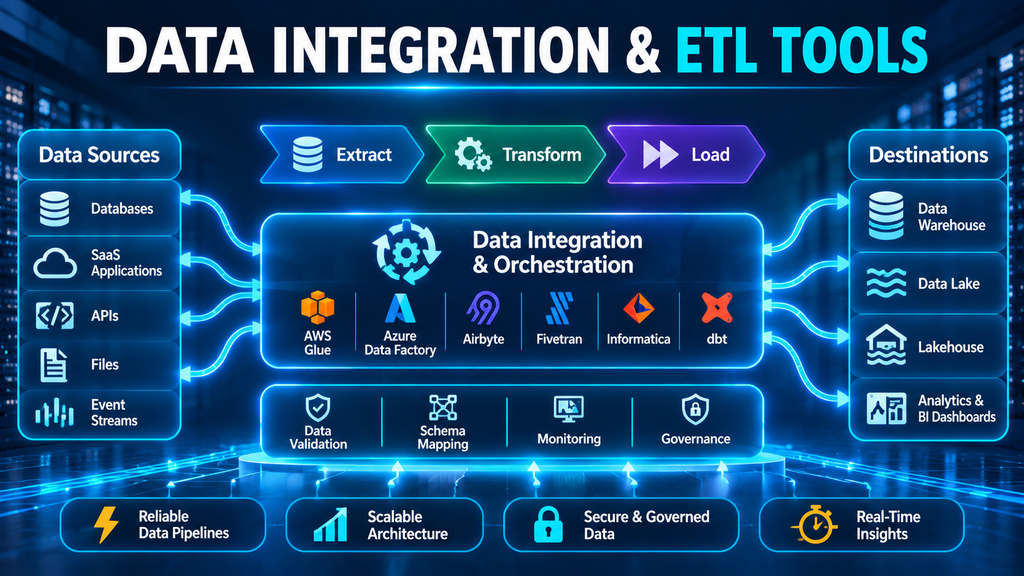
Data Integration & ETL Tools: Connecting Systems and Turning Raw Data into Business Value
Organizations rarely keep all their information in one place. Customer records may live in a CRM, financial transactions in an ERP system, website activity in analytics platforms, and operational data in databases or cloud applications. When these systems operate independently, teams struggle to build a complete and reliable picture of the business.
Data integration and ETL tools address this challenge by moving information between systems, transforming it into useful formats, and making it available for analytics, reporting, applications, and decision-making.
As organizations adopt cloud data warehouses, data lakes, lakehouses, and AI-driven applications, integration technology has become a critical part of modern data infrastructure. The challenge is no longer simply transferring records. Teams must also maintain data quality, manage schema changes, protect sensitive information, monitor pipeline performance, and control costs.
This guide explains how data integration and ETL tools work, what capabilities matter, which platforms organizations should evaluate, and how to select an approach that fits their data architecture.
What Are Data Integration and ETL Tools?
Data integration tools connect different data sources and destinations, allowing information to move between systems in a controlled and repeatable way.
ETL stands for Extract, Transform, Load. It describes a process in which data is collected from source systems, transformed into a required structure or format, and then loaded into a destination such as a data warehouse.
A typical ETL workflow includes three stages:
- Extract: Retrieve data from databases, applications, APIs, files, or other sources.
- Transform: Clean, validate, combine, standardize, and restructure the information.
- Load: Store the transformed data in a target system for reporting, analytics, or operational use.
Data integration is a broader category. It can include ETL, ELT, replication, change data capture, streaming, application integration, and data synchronization.
This distinction matters when evaluating products. Some tools focus primarily on moving data, while others provide transformation, orchestration, governance, or enterprise-wide integration capabilities.
ETL vs. ELT: Understanding the Difference
ETL and ELT are closely related approaches, but they differ in where transformation takes place.
ETL — Extract, Transform, Load
Data is transformed before it reaches the target system. This approach can be useful when information must be cleansed, masked, standardized, or reformatted before storage.
ELT — Extract, Load, Transform
Data is extracted and loaded into the destination first. Transformation then takes place inside the target warehouse or lakehouse using its processing capabilities.
| Consideration | ETL | ELT |
|---|---|---|
| Transformation location | Before loading | After loading |
| Raw data retention | Depends on pipeline design | Often retained in the destination |
| Processing | External ETL engine or staging layer | Frequently uses destination compute |
| Common use cases | Complex preprocessing and controlled ingestion | Cloud analytics and warehouse-centric workflows |
| Key consideration | Transformation infrastructure and maintenance | Destination compute and data governance |
Neither approach is universally better. ETL can be appropriate when data must be transformed before it enters a destination. ELT is attractive when the target platform has sufficient processing capacity and teams want to retain raw information for additional transformations.
Many organizations use both approaches across different pipelines.
How Data Integration and ETL Tools Work
A production data pipeline usually includes more than the three basic ETL stages.
1. Connecting to Data Sources
The integration platform establishes connections to the systems that contain required information. These may include relational databases, cloud applications, enterprise software, APIs, spreadsheets, object storage, and event streams.
Connection methods can involve database drivers, API authentication, file transfers, or specialized connectors.
2. Extracting Data
The tool retrieves information from its source. Depending on the source and business requirement, extraction may happen on a schedule, through incremental updates, or continuously.
Change data capture (CDC) is particularly useful when applications generate frequent database changes. Instead of repeatedly copying entire tables, a CDC process captures relevant inserts, updates, and deletes.
3. Transforming and Validating Data
Transformation makes information consistent and usable. Common operations include:
- Removing duplicate records.
- Standardizing dates, currencies, and formats.
- Handling missing or invalid values.
- Combining information from multiple sources.
- Applying business rules.
- Mapping fields between different schemas.
- Masking or excluding sensitive information.
Validation helps prevent incorrect or incomplete records from silently entering downstream systems.
4. Loading Data into Destinations
After extraction and any required transformation, information is loaded into its destination.
Common destinations include data warehouses, databases, data lakes, lakehouses, and business applications.
Some systems use full refreshes, while others support incremental loading to reduce unnecessary data movement.
5. Scheduling and Orchestration
Pipelines often depend on one another. For example, a reporting dataset may need to wait until customer and transaction data have both finished loading.
Orchestration tools coordinate these dependencies, schedule executions, handle retries, and provide visibility into pipeline status.
6. Monitoring and Error Handling
Reliable integration requires continuous monitoring. Teams need to identify failed connections, incomplete transfers, unexpected schema changes, delayed data, and unusual processing volumes.
Useful capabilities include execution logs, alerts, retry policies, pipeline history, and data freshness monitoring.
Leading Data Integration and ETL Tools
The market includes managed ELT services, enterprise integration suites, cloud-native services, and open-source frameworks. These tools have different strengths, so they should be compared according to workload and architecture rather than treated as interchangeable products.
1. Informatica Intelligent Data Management Cloud
Informatica provides enterprise data management and integration capabilities through its Intelligent Data Management Cloud ecosystem.
Its capabilities address data integration, data quality, governance, metadata management, and related enterprise data processes.
It is relevant to organizations managing complex environments with multiple applications, databases, cloud services, and compliance requirements.
Where it fits: Large enterprises that need broad integration capabilities alongside data governance and quality management.
Evaluation consideration: Assess implementation complexity, licensing, connector requirements, governance needs, and the skills required to operate the platform.
2. Fivetran
Fivetran focuses on managed data movement and ELT pipelines. Its connectors synchronize information from applications, databases, events, and files into analytical destinations.
Its documentation describes automated synchronization, incremental updates, schema-change handling, and a broad connector ecosystem.
Fivetran can reduce the engineering effort involved in building and maintaining routine ingestion pipelines.
Where it fits: Teams that want managed data ingestion without maintaining every connector themselves.
Evaluation consideration: Examine connector coverage, synchronization frequency, supported destinations, data volume, and usage-based costs.
3. Airbyte
Airbyte is an open-source data integration platform that supports moving data from a wide range of sources into warehouses, lakes, and databases. It also offers managed deployment options.
Its ecosystem includes prebuilt connectors, APIs, and tools for developing custom connectors.
Airbyte is useful for teams that want flexibility over deployment and integration architecture, including organizations that prefer to self-manage parts of their data infrastructure.
Where it fits: Engineering teams that value open-source technology, connector flexibility, and deployment control.
Evaluation consideration: Review connector maturity, custom connector maintenance, upgrade procedures, infrastructure requirements, and operational responsibilities.
4. AWS Glue
AWS Glue is a managed data integration service within Amazon Web Services. It supports data discovery, preparation, transformation, and integration workloads.
It can work with services across the AWS ecosystem and is particularly relevant to organizations building data lakes and analytics pipelines on AWS.
Where it fits: Organizations that already use AWS and want managed data integration capabilities within that environment.
Evaluation consideration: Understand job execution costs, supported connectors, development options, catalog requirements, and the effect of data-processing workloads on overall cloud spending.
5. Azure Data Factory
Azure Data Factory is Microsoft’s cloud-based data integration service for building and managing data pipelines.
It supports connections across different data sources and destinations, including cloud and on-premises environments through supported integration runtimes.
It can be useful for organizations that operate within Microsoft’s cloud and enterprise ecosystem.
Where it fits: Microsoft-oriented enterprises that need to coordinate data movement across cloud and hybrid infrastructure.
Evaluation consideration: Review connector support, integration runtime deployment, pipeline monitoring, orchestration requirements, and pricing for pipeline activities and data movement.
6. Qlik Talend Cloud
Qlik Talend Cloud combines data integration capabilities with data quality and management features.
Talend technology has been used for enterprise ETL, transformation, and data integration workloads. Its capabilities are relevant to organizations that need to connect systems while maintaining consistent and reliable data.
Where it fits: Organizations looking for enterprise integration alongside data quality and preparation capabilities.
Evaluation consideration: Examine deployment choices, connector requirements, governance features, licensing, and how the platform fits existing Qlik or Talend environments.
7. Matillion
Matillion provides cloud data integration and transformation capabilities, particularly for organizations using cloud data platforms.
Its approach is relevant to teams that want to design and manage data pipelines while using the processing capabilities of destinations such as Snowflake, Databricks, BigQuery, and Amazon Redshift.
Where it fits: Cloud analytics teams that need visual pipeline development and warehouse-oriented transformation.
Evaluation consideration: Compare supported platforms, transformation execution, pipeline complexity, development workflows, and consumption-based pricing.
8. IBM DataStage
IBM DataStage is an enterprise data integration technology designed for complex data processing and transformation workloads.
It is relevant to organizations with established IBM infrastructure, large integration environments, and demanding batch-processing requirements.
Where it fits: Enterprises that need sophisticated data integration within established enterprise technology environments.
Evaluation consideration: Assess modernization requirements, deployment architecture, existing IBM investments, parallel processing needs, and operational skills.
9. Apache NiFi
Apache NiFi is an open-source dataflow automation platform designed to route, transform, and manage data movement between systems.
Its visual interface supports the construction of dataflows using processors and connections. It can be useful for both streaming and batch-oriented data movement scenarios.
Where it fits: Teams that need control over data routing and flow-based integration, including hybrid and self-managed environments.
Evaluation consideration: Evaluate cluster management, processor availability, security configuration, throughput, and the engineering effort needed to maintain the deployment.
10. dbt
dbt is primarily a data transformation and workflow development technology rather than a complete source-to-destination extraction platform.
It enables data teams to define transformations, organize SQL models, test assumptions, document datasets, and manage dependencies in analytical environments.
It is commonly used alongside ingestion tools such as Fivetran or Airbyte.
Where it fits: Analytics engineering teams that want version-controlled, maintainable transformations inside a warehouse or supported data platform.
Evaluation consideration: Determine which tool will handle extraction and loading, how transformations will be scheduled, and how testing and deployment will be managed.
Comparing Common Data Integration Tools
The following comparison highlights broad positioning rather than claiming that every product offers identical functionality.
| Tool | Primary focus | Typical fit |
|---|---|---|
| Informatica | Enterprise integration and data management | Complex enterprise environments |
| Fivetran | Managed ELT and data movement | Low-maintenance ingestion |
| Airbyte | Open-source and managed integration | Flexible connector strategies |
| AWS Glue | Cloud-native data integration | AWS-centric architectures |
| Azure Data Factory | Cloud and hybrid pipelines | Microsoft-oriented environments |
| Qlik Talend Cloud | Integration and data quality | Enterprise data management |
| Matillion | Cloud data integration and transformation | Warehouse-centric analytics |
| IBM DataStage | Enterprise ETL | Complex enterprise workloads |
| Apache NiFi | Dataflow routing and automation | Custom data movement |
| dbt | Data transformation | Analytics engineering |
The right choice depends on the complete pipeline. A company may use one product for ingestion, another for transformation, and a separate tool for orchestration and monitoring.
Essential Features to Evaluate
Connector Coverage
Connector availability determines how easily a tool can access the organization’s systems.
Check not only whether a connector exists but also whether it supports the required objects, API operations, authentication methods, incremental updates, and deletion handling.
Change Data Capture
CDC can reduce the need for repeated full-table extraction. It is especially useful for frequently updated operational databases.
However, CDC implementations differ in their treatment of transaction logs, schema changes, ordering, and recovery after interruptions.
Transformation Capabilities
Some platforms provide extensive graphical transformation features, while others expect engineers to use SQL, Python, or distributed processing frameworks.
The choice should reflect the team’s skills, transformation complexity, and need for version control.
Pipeline Orchestration
Look for dependency management, scheduling, retry policies, conditional execution, and integration with existing workflow tools.
Apache Airflow is a common orchestration option, but it should not be confused with a complete ETL connector platform. It coordinates workflows; the actual data movement and transformation are usually performed by the tasks it runs.
Data Quality and Validation
A pipeline that transfers incorrect information reliably is still a problem.
Consider schema validation, uniqueness checks, null checks, reconciliation, error handling, and the ability to prevent poor-quality data from reaching critical reporting systems.
Security and Governance
Evaluate identity management, encryption, secrets handling, access controls, audit logs, network connectivity, and data masking.
Sensitive information should be protected throughout extraction, transformation, storage, and downstream delivery.
Observability and Monitoring
Teams need visibility into pipeline execution, data freshness, failures, processing duration, and unexpected volume changes.
Good monitoring should help identify the cause of a problem, not simply report that a pipeline failed.
Benefits of Data Integration and ETL Tools
Breaking Down Data Silos
Integration tools connect systems that otherwise operate independently. This allows organizations to combine information from different departments and applications.
Improving Data Consistency
Standardized transformations can reduce differences in naming, formatting, business definitions, and data representation.
Supporting Better Analytics
Combining information from multiple sources gives analysts a broader foundation for reporting, forecasting, and business intelligence.
Automating Repetitive Work
Automated pipelines reduce the need for manual exports, spreadsheet consolidation, and repeated data preparation.
Supporting AI and Machine Learning
AI applications depend on accessible and appropriately prepared data. Integration platforms can help bring together the operational and analytical datasets needed for model development and retrieval workflows.
Improving Operational Visibility
Monitoring and orchestration provide insight into when data was processed, whether it arrived successfully, and where failures occurred.
Common Challenges in ETL and Data Integration Projects
Schema Changes
Source applications and databases evolve. A field may be renamed, removed, or assigned a different data type.
How to address it: Monitor schema changes, establish compatibility checks, and define procedures for reviewing changes before they affect downstream systems.
Duplicate or Missing Records
Retries, inconsistent source behavior, and interrupted transfers can create duplicate or incomplete datasets.
How to address it: Use appropriate incremental-loading strategies, stable identifiers, deduplication rules, and reconciliation checks.
Pipeline Failures
Network issues, expired credentials, source API limits, and destination problems can interrupt data movement.
How to address it: Configure alerts, retries, recovery procedures, and clear ownership for critical pipelines.
Rising Costs
Integration expenses can grow with data volume, execution frequency, transformation complexity, and the number of connected systems.
How to address it: Monitor usage, avoid unnecessary full refreshes, optimize incremental pipelines, and review the total cost of operating each workflow.
Security and Compliance Risks
Moving data between systems can create additional exposure points, particularly when sensitive information is involved.
How to address it: Apply least-privilege access, encryption, secure credential management, audit logging, and appropriate data retention controls.
Excessive Tool Complexity
Using too many overlapping products can make pipeline ownership and troubleshooting difficult.
How to address it: Define a clear architecture, standardize tooling where practical, document responsibilities, and avoid introducing products without a specific operational need.
How to Choose the Right Data Integration Tool
A structured selection process can help avoid buying a platform that solves only part of the problem.
- Map the source systems: Identify databases, SaaS applications, APIs, files, event streams, and on-premises systems.
- Define the destinations: Determine whether information must reach a data warehouse, data lake, lakehouse, operational database, or application.
- Select the integration pattern: Decide whether batch ETL, ELT, CDC, streaming, or a combination is required.
- Assess connector quality: Validate the exact source objects and synchronization behavior needed.
- Evaluate transformation requirements: Identify whether the team needs visual transformations, SQL-based models, custom code, or distributed processing.
- Review governance and security: Confirm identity, permissions, encryption, auditing, and data handling requirements.
- Estimate total cost: Include licensing, usage, infrastructure, network transfer, engineering time, and ongoing maintenance.
- Run a realistic pilot: Test representative data volumes, schema changes, failures, recovery, and monitoring before committing to a production design.
A pilot should measure operational reliability as well as processing speed. A fast pipeline that is difficult to recover or maintain may create more problems than it solves.
The Future of Data Integration and ETL Tools
Data integration technology is evolving as organizations adopt cloud-native architectures, real-time applications, and AI-driven workflows.
Several developments are influencing the market:
- Real-time integration: More organizations need data to move continuously rather than waiting for scheduled batch jobs.
- Automated schema handling: Platforms are investing in better ways to detect and respond to changes in source systems.
- Open data architectures: Open formats and interoperable connectors help organizations reduce unnecessary dependence on individual platforms.
- Data observability: Monitoring is expanding beyond pipeline status to include freshness, quality, volume, and reliability.
- AI-assisted development: AI capabilities are increasingly being applied to connector development, pipeline configuration, documentation, and troubleshooting.
- Unified data management: Integration, quality, cataloging, governance, and transformation are becoming more closely connected.
These developments will not remove the need for sound engineering practices. Reliable pipelines still require clear ownership, testing, monitoring, security, and a well-defined data architecture.
Conclusion
Data integration and ETL tools provide the connections that make modern data environments useful. They bring information together from applications, databases, cloud services, and operational systems, then help prepare it for analytics and business use.
The market offers different approaches, from managed platforms such as Fivetran to open-source options such as Airbyte and Apache NiFi, enterprise suites such as Informatica and Qlik Talend Cloud, and cloud-native services such as AWS Glue and Azure Data Factory.
There is no single tool that fits every organization. The best choice depends on data sources, destinations, integration frequency, transformation requirements, governance expectations, technical skills, and cost.
Organizations should evaluate the complete pipeline lifecycle rather than focusing only on connector counts or visual design features. With the right architecture, data integration becomes a dependable foundation for trusted analytics, operational efficiency, and AI initiatives.
Frequently Asked Questions
1. What are data integration tools used for?
They connect different systems and move information between them. They can also transform, validate, synchronize, and prepare data for analytics or operational use.
2. What is the difference between ETL and ELT?
ETL transforms data before loading it into the destination. ELT loads data first and performs transformations inside the destination environment.
3. Which ETL tools are commonly used by enterprises?
Enterprise options include Informatica, Qlik Talend Cloud, IBM DataStage, AWS Glue, Azure Data Factory, and other platforms selected according to infrastructure and workload requirements.
4. Is Airbyte an ETL tool?
Airbyte is a data integration and replication platform commonly used for ELT workflows. It moves data from sources into destinations, where additional transformations may take place.
5. Is dbt a complete ETL platform?
dbt primarily focuses on data transformation and analytics engineering. It is commonly paired with ingestion tools that extract and load data into a warehouse or supported data platform.
6. What is change data capture?
Change data capture is a technique for identifying and transferring changes made in a source database, such as inserted, updated, or deleted records. It can reduce the need for repeated full-table transfers.
7. How do organizations reduce ETL pipeline costs?
They can use incremental loading, optimize transformation workloads, monitor data volumes, reduce unnecessary refreshes, and compare managed-service charges with infrastructure and maintenance costs.
8. Are open-source ETL tools suitable for production?
They can be suitable when organizations have the engineering expertise and operational processes needed to deploy, secure, monitor, upgrade, and maintain them.
