Upgrade & Secure Your Future with DevOps, SRE, DevSecOps, MLOps!
We spend hours scrolling social media and waste money on things we forget, but won’t spend 30 minutes a day earning certifications that can change our lives.
Master in DevOps, SRE, DevSecOps & MLOps by DevOps School!
Learn from Guru Rajesh Kumar and double your salary in just one year.
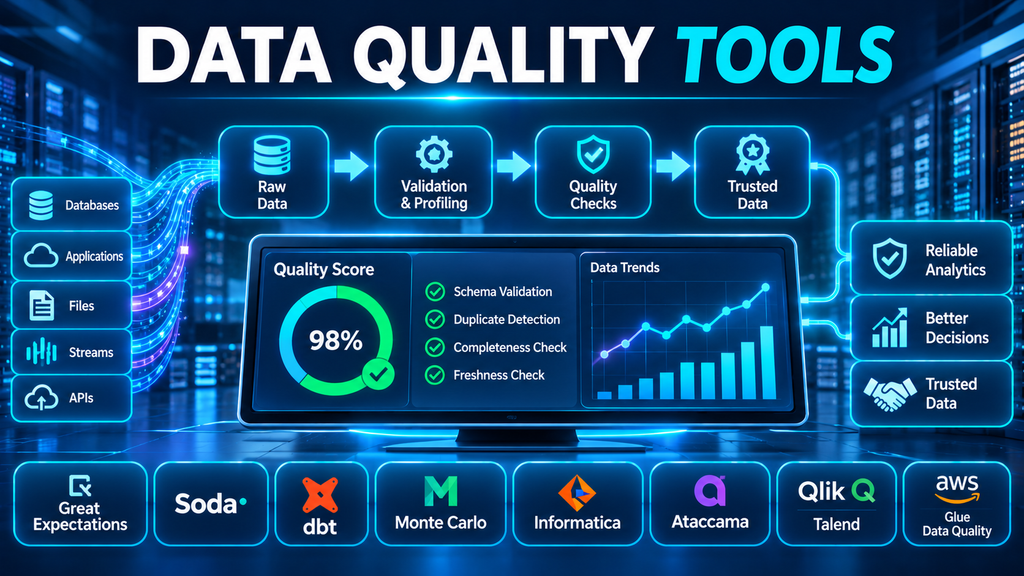
Data Quality Tools: Ensuring Accurate, Consistent, and Reliable Business Data
Modern organizations depend on data to make decisions, manage operations, understand customers, forecast demand, and power digital products. But collecting large amounts of information does not automatically make that information useful. Incomplete customer records, duplicate transactions, inconsistent product codes, outdated inventory figures, and incorrect financial values can undermine even the most sophisticated analytics systems.
Data quality tools help organizations identify, measure, prevent, and resolve these problems. They provide capabilities for data profiling, validation, cleansing, standardization, monitoring, and anomaly detection. When implemented as part of a wider data management strategy, they help businesses establish confidence in the information flowing through their systems.
The importance of data quality has grown as organizations adopt cloud data warehouses, data lakes, real-time pipelines, machine learning, and generative AI. Poor-quality data can affect everything from executive reporting to automated business decisions.
This guide explores how data quality tools work, the major platforms available, their capabilities, implementation challenges, and the criteria organizations should consider when selecting a solution.
What Are Data Quality Tools?
Data quality tools are software platforms and frameworks designed to evaluate and improve the reliability of data.
They help determine whether information meets defined business and technical expectations. These expectations may include completeness, accuracy, consistency, uniqueness, validity, and timeliness.
For example, a customer database might contain multiple records for the same person, missing email addresses, invalid telephone numbers, or inconsistent country names. A data quality platform can identify these problems and, depending on its capabilities, help standardize, merge, correct, or flag affected records.
Data quality solutions are used across databases, data warehouses, data lakes, enterprise applications, integration pipelines, and analytical environments.
Typical capabilities include:
- Data profiling and statistical analysis.
- Validation against predefined business rules.
- Detection of missing and duplicate values.
- Data cleansing and standardization.
- Format and schema validation.
- Anomaly detection and continuous monitoring.
- Referential integrity checks.
- Error reporting and remediation workflows.
- Data quality scorecards and dashboards.
Not every product performs all these functions. Some focus on developer-oriented testing, others specialize in enterprise data cleansing, and others monitor production pipelines for unexpected changes.
Understanding the Main Dimensions of Data Quality
Before selecting a platform, organizations should understand what they mean by high-quality data. Different business processes require different quality expectations.
1. Accuracy
Accuracy measures whether information correctly represents the real-world entity or event it describes.
For example, an incorrect customer address or product price can cause operational and financial problems.
Data quality processes can compare information against trusted reference sources, business rules, and verified records.
2. Completeness
Completeness measures whether required information is present.
A customer record without a required identifier, or an order without a transaction date, may be unsuitable for downstream processes.
Validation rules can identify missing values and distinguish mandatory fields from optional ones.
3. Consistency
Consistency ensures that the same information is represented coherently across systems.
For example, one application might store a country as “United States,” while another uses “US.” Standardization rules help align these representations.
4. Uniqueness
Uniqueness measures whether records that should represent distinct entities are actually distinct.
Duplicate customer profiles, repeated invoices, and multiple product entries can distort reporting and create operational confusion.
Deduplication and entity matching help identify records that may refer to the same entity.
5. Validity
Validity checks whether data conforms to an accepted format, range, or set of business rules.
Examples include:
- Email addresses following an expected format.
- Dates falling within an acceptable range.
- Product categories matching an approved list.
- Transaction amounts meeting defined constraints.
6. Timeliness
Timeliness measures whether data is available when it is needed.
A dashboard built from yesterday’s inventory information may be unsuitable for a business that requires near-real-time stock visibility.
Freshness checks and pipeline monitoring help detect delayed or missing updates.
7. Integrity
Integrity concerns the correctness of relationships between datasets.
For example, an order should reference a valid customer record, and an invoice should be associated with an appropriate transaction.
Referential integrity checks help identify broken relationships and orphaned records.
How Data Quality Tools Work
Data quality platforms generally combine several processes to evaluate and improve information.
Data Discovery and Profiling
The process often begins by examining datasets to understand their structure, contents, and patterns.
Profiling may calculate:
- Null and missing-value percentages.
- Distinct-value counts.
- Duplicate frequencies.
- Minimum and maximum values.
- Data distributions.
- Field lengths and formats.
- Unexpected or inconsistent values.
This helps teams understand the current condition of their data before defining quality requirements.
Rule Definition
Organizations establish rules that describe acceptable data conditions.
For example, an order identifier may need to be unique and non-null. A transaction status may be restricted to a predefined set of values.
Rules can be expressed through SQL, configuration files, Python code, graphical interfaces, or platform-specific rule languages.
Validation and Testing
The tool evaluates datasets against the defined expectations.
Failed checks can identify records with missing information, invalid values, duplicates, or broken relationships.
In a pipeline, validation may occur before data is loaded, after transformation, or before information is delivered to downstream applications.
Cleansing and Standardization
Some platforms can correct or standardize records using predefined rules, reference data, matching algorithms, or enrichment services.
For example, they may normalize telephone formats, standardize address fields, or identify possible duplicate customer profiles.
Automated corrections should be controlled carefully. Not every suspicious value is necessarily incorrect.
Monitoring and Alerting
Data quality requirements do not end after initial validation.
Production systems need ongoing monitoring to detect changes in record volume, freshness, distributions, schema, and other important metrics.
Alerts help data teams investigate problems before they affect reports, applications, or customers.
Reporting and Remediation
Quality dashboards and reports help teams understand which datasets are failing checks and how serious the problems are.
Effective workflows assign ownership, track remediation, document decisions, and verify that corrective actions have worked.
Leading Data Quality Tools and Platforms
The data quality market includes open-source validation frameworks, warehouse-native testing capabilities, observability platforms, and enterprise data management suites.
The following products illustrate different approaches rather than a universal ranking.
1. Great Expectations
Great Expectations (GX) is an open-source data validation framework with a broader commercial platform offering.
It allows data teams to define expectations about datasets and validate whether data meets those expectations. Its documentation covers quality use cases such as missingness, uniqueness, validity, schema, volume, freshness, distribution, and integrity.
Great Expectations is particularly relevant to engineering teams that want explicit, programmable validation rather than relying only on automated anomaly detection.
Key capabilities:
- Declarative data expectations.
- Validation workflows.
- Data quality reporting.
- Python-oriented integration.
- Support for multiple data quality dimensions.
Best suited for: Data engineering teams that need configurable, code-oriented validation and control over their quality rules.
Considerations: Teams must plan how expectations are maintained, integrated into pipelines, and acted upon when validation fails.
Official documentation: https://docs.greatexpectations.io/
2. Soda
Soda provides data quality testing and observability capabilities.
Its platform supports the definition of checks and data contracts, along with monitoring for unexpected changes in production data. Soda’s documentation distinguishes proactive testing from observability: testing checks known expectations, while observability helps detect behavior that deviates from historical patterns.
This combination is useful for organizations that want to prevent known problems and identify unexpected ones.
Key capabilities:
- Data quality checks.
- Data contracts.
- Production data monitoring.
- Anomaly detection.
- Data quality reporting and collaboration.
Best suited for: Teams that want to combine rule-based validation with ongoing monitoring.
Considerations: Evaluate the distinction between open-source components and commercial platform capabilities, as well as the operating model required for production monitoring.
Official documentation: https://docs.soda.io/
3. dbt Data Tests
dbt includes a data testing framework designed to validate data models and relationships in analytical workflows.
Its built-in generic tests include unique, not_null, accepted_values, and relationships. Teams can also create custom tests for more specific business requirements.
Because tests can be defined alongside transformation models, data quality checks can become part of the development and deployment process.
Key capabilities:
- Built-in data tests.
- Custom generic and singular tests.
- Testing of transformed models.
- Referential integrity validation.
- Integration with data transformation workflows.
Best suited for: Organizations that use dbt for analytics engineering and want quality checks close to their transformation logic.
Considerations: dbt tests are not a complete replacement for enterprise data cleansing, master data management, or broad production observability.
Official documentation: https://docs.getdbt.com/docs/build/data-tests
4. Monte Carlo
Monte Carlo is a data and AI observability platform designed to help organizations understand and monitor the reliability of their data systems.
Its observability-oriented approach is relevant when teams need to detect unexpected changes across production datasets and investigate their potential impact.
It is particularly useful in complex environments where data issues may originate in upstream sources, transformation jobs, or infrastructure dependencies.
Key capabilities to evaluate:
- Data observability and monitoring.
- Detection of unexpected data behavior.
- Incident investigation.
- Pipeline and dependency context.
- Support for data reliability operations.
Best suited for: Organizations managing large data estates that need broader visibility into data reliability and production incidents.
Considerations: Observability complements validation rules. Teams should still define critical business constraints and establish ownership for resolving incidents.
5. Informatica Data Quality
Informatica provides enterprise data management and data quality capabilities within its broader data management portfolio.
Enterprise data quality initiatives often require more than detecting null values. They may involve profiling, cleansing, standardization, matching, enrichment, and governance across multiple business systems.
Informatica is relevant to organizations that need these capabilities within a wider enterprise data management strategy.
Key capabilities to evaluate:
- Data profiling.
- Data validation and standardization.
- Data cleansing.
- Matching and deduplication.
- Enterprise data quality management.
Best suited for: Large organizations with complex data environments, multiple business domains, and formal data governance requirements.
Considerations: Assess the required product components, deployment architecture, integration effort, licensing, and ongoing stewardship responsibilities.
6. Ataccama ONE
Ataccama ONE brings data quality together with capabilities such as data observability, cataloging, governance, and lineage.
This broader approach can help organizations connect technical quality checks with business context and data stewardship processes.
Key capabilities to evaluate:
- Data profiling and quality rules.
- Data quality monitoring.
- Data catalog and metadata capabilities.
- Governance workflows.
- Data lineage and stewardship support.
Best suited for: Enterprises seeking a broader data trust and governance platform rather than an isolated validation framework.
Considerations: Review which modules are required, how responsibilities are assigned, and whether the platform fits existing governance and data architecture practices.
7. Qlik Talend Data Quality
Qlik’s Talend portfolio includes data integration and data quality capabilities.
It is relevant to organizations that want to connect data integration processes with profiling, cleansing, standardization, and quality controls.
Key capabilities to evaluate:
- Data profiling.
- Data cleansing and standardization.
- Matching and deduplication.
- Integration with data movement workflows.
- Data quality management.
Best suited for: Organizations looking to coordinate integration and quality processes across varied data sources.
Considerations: Confirm the capabilities available in the specific Qlik and Talend products or editions under evaluation.
8. AWS Glue Data Quality
AWS Glue Data Quality provides data quality capabilities for AWS-based data environments.
It uses Data Quality Definition Language (DQDL) to define rules and supports quality evaluations in AWS Glue ETL and the AWS Glue Data Catalog.
AWS documentation also describes rule recommendations, dynamic rules, and anomaly detection capabilities.
Key capabilities:
- Rule-based validation.
- Data quality scoring.
- Rule recommendations.
- Dynamic thresholds.
- Anomaly detection.
- Integration with AWS data services.
Best suited for: Organizations whose data pipelines and catalogs are already built around AWS Glue and related AWS services.
Considerations: Evaluate supported source types, AWS permissions, regional availability, compute usage, and how quality results connect to the wider data platform.
Official documentation: https://docs.aws.amazon.com/glue/latest/dg/glue-data-quality.html
9. Deequ
Deequ is an open-source data quality library built for large-scale data validation with Apache Spark.
It allows engineering teams to define constraints and compute data quality metrics across datasets.
Its Spark orientation makes it relevant to organizations that process large volumes of data using distributed data engineering infrastructure.
Key capabilities:
- Data profiling and metrics.
- Constraint-based validation.
- Large-scale dataset analysis.
- Integration with Spark-based workflows.
Best suited for: Engineering teams that use Apache Spark and want programmable quality checks within distributed processing pipelines.
Considerations: Deequ is a developer-oriented library, not a complete managed enterprise data quality application. Teams must provide operational integration and reporting.
10. Pandera
Pandera is a Python library for validating data structures, including pandas and other supported dataframe ecosystems.
It allows developers to define schemas and validation rules for dataframe columns and values.
It can be particularly useful when quality checks need to run within Python applications, notebooks, or data science pipelines.
Key capabilities:
- Dataframe schema validation.
- Column and index checks.
- Type and value constraints.
- Reusable validation logic.
- Integration with Python workflows.
Best suited for: Python-first engineering and data science teams that need validation close to application or dataframe processing code.
Considerations: Pandera is not a complete enterprise data observability or data cleansing suite. Broader monitoring and governance may require additional tools.
Comparing Data Quality Tools by Their Primary Strength
| Tool | Primary approach | Typical fit |
|---|---|---|
| Great Expectations | Explicit data validation | Python-oriented data engineering |
| Soda | Testing and observability | Continuous data quality management |
| dbt Data Tests | Transformation-level testing | dbt analytics projects |
| Monte Carlo | Data observability | Complex production data estates |
| Informatica Data Quality | Enterprise data quality management | Large, multi-system organizations |
| Ataccama ONE | Data trust and governance | Enterprise data governance programs |
| Qlik Talend Data Quality | Integration and quality | Integration-led data environments |
| AWS Glue Data Quality | Cloud-native rule validation | AWS-centered data pipelines |
| Deequ | Spark-based validation | Distributed data processing |
| Pandera | Python dataframe validation | Python applications and analytics |
The most suitable product depends on where quality checks need to run, who owns them, and whether the organization needs validation, cleansing, monitoring, governance, or a combination of these functions.
Key Features to Look for in Data Quality Software
Data Profiling
Profiling helps organizations understand dataset structure, distributions, missing values, and potential inconsistencies.
It is especially useful when onboarding unfamiliar sources or investigating legacy databases.
Rule-Based Validation
A capable solution should support rules that reflect both technical requirements and business expectations.
Examples include unique identifiers, valid status values, acceptable date ranges, and required relationships between tables.
Data Cleansing and Standardization
Organizations with customer, supplier, product, and address records may need correction and standardization capabilities.
Evaluate whether the tool can handle formatting, normalization, matching, and enrichment, or whether separate services are required.
Duplicate Detection and Matching
Duplicate records can distort customer counts, financial reports, and operational processes.
Look for matching methods appropriate to the data, including exact matching and, where needed, fuzzy matching or entity resolution.
Continuous Monitoring
A one-time quality assessment cannot guarantee long-term reliability.
Monitoring should track critical data assets and alert teams when important metrics change unexpectedly.
Data Lineage and Impact Analysis
When a quality issue appears, teams need to understand where the affected data came from and which downstream reports, models, or applications depend on it.
Lineage and dependency information can make incident investigation more efficient.
Workflow Integration
Data quality checks should fit naturally into ingestion, transformation, orchestration, and deployment processes.
Consider integration with SQL engines, cloud warehouses, Spark, dbt, CI/CD systems, and workflow orchestration tools.
Access Control and Auditability
Enterprise environments need controlled access to sensitive datasets and quality configurations.
Evaluate permissions, audit trails, environment separation, and compliance support.
Benefits of Data Quality Tools
More Reliable Business Decisions
Accurate and consistent information helps decision-makers work with more dependable reports and analytics.
Better Customer Experiences
Clean customer records help organizations reduce duplicate communications, improve personalization, and maintain consistent service information.
Improved Operational Efficiency
Automated validation and cleansing reduce manual correction, repeated investigations, and avoidable data processing errors.
Stronger Analytics and Reporting
Quality checks help prevent incorrect source records and transformation errors from reaching dashboards and business intelligence systems.
Greater Confidence in AI and Machine Learning
AI systems depend on the information used to train models, retrieve context, and generate outputs. Quality controls can reduce the risk of missing, inconsistent, or misleading inputs.
Better Governance
Documented rules, quality scores, and ownership workflows make it easier to establish accountability for important data assets.
Common Data Quality Use Cases
Customer Data Management
A business may combine customer records from CRM platforms, websites, billing systems, and support applications.
Data quality tools can help standardize contact details, identify duplicates, and detect missing information.
Financial Data Validation
Financial teams need consistent transaction records, valid account identifiers, and accurate reporting values.
Validation checks can identify missing entries, unexpected amounts, and broken relationships before financial reports are produced.
Retail and Inventory Management
Retail organizations rely on accurate product catalogs, stock quantities, pricing, and order information.
Quality checks can identify duplicate product records, invalid product codes, and unusual inventory changes.
Healthcare and Life Sciences
Healthcare data environments may contain patient, provider, laboratory, and clinical information.
Data quality processes can help identify missing fields, inconsistent identifiers, and invalid formats. Implementations must also follow applicable privacy, security, and regulatory requirements.
Supply Chain Management
Supplier records, shipment information, inventory movements, and purchase orders must remain consistent across connected systems.
Quality validation can help detect incomplete shipment data, duplicate supplier entries, and mismatched identifiers.
Data Warehouse and Lakehouse Pipelines
Analytics teams use quality tools to validate source data, transformed models, and curated datasets before they are consumed by dashboards, applications, or machine learning systems.
Data Quality Testing vs. Data Observability
These concepts are closely related, but they solve different problems.
Data quality testing checks whether data meets expectations defined in advance. For example, a test might verify that an order identifier is unique or that a transaction date is not missing.
Data observability monitors production data and its behavior over time. It can help detect unexpected changes in row counts, freshness, distributions, or other metrics.
| Area | Data Quality Testing | Data Observability |
|---|---|---|
| Main purpose | Validate known expectations | Detect unexpected behavior |
| Typical method | Rules and assertions | Monitoring and anomaly detection |
| Timing | Development and pipeline execution | Ongoing production monitoring |
| Example | Check that customer IDs are unique | Detect an unusual drop in customer records |
| Main benefit | Prevent known errors | Discover problems that predefined tests may miss |
Organizations often benefit from using both. Tests establish explicit quality expectations, while observability helps detect changes that were not anticipated when those rules were written.
Challenges in Implementing Data Quality Tools
Defining Meaningful Rules
A technically valid dataset is not necessarily useful for a business process.
For example, a transaction amount may be numeric and non-null but still be incorrect.
How to address it: Involve business owners when defining rules and document the meaning and acceptable values of important fields.
Poorly Understood Source Data
Legacy systems and external data feeds may have undocumented formats, inconsistent definitions, and incomplete metadata.
How to address it: Profile data before implementing large-scale validation and involve people who understand the source systems.
False Positives
Overly strict rules can flag legitimate changes as errors.
How to address it: Test rules against historical data, use appropriate thresholds, and review exceptions before blocking production workflows.
High Data Volumes
Large datasets can make profiling, matching, and validation computationally expensive.
How to address it: Use incremental processing, partition-aware checks, efficient queries, and appropriate distributed processing frameworks.
Unclear Ownership
Quality issues may remain unresolved when no team is responsible for a dataset or business field.
How to address it: Assign data owners and stewards, define escalation paths, and track remediation to completion.
Integration Complexity
Data may move across multiple clouds, databases, applications, and processing engines.
How to address it: Prioritize supported connectors, standardize pipeline patterns, and test integrations in a controlled environment.
Cost and Maintenance
Commercial platforms may introduce licensing, usage, infrastructure, and implementation costs. Open-source frameworks also require engineering and operational maintenance.
How to address it: Estimate the total cost of ownership, including people, compute, integration, monitoring, and ongoing rule maintenance.
How to Choose the Right Data Quality Tool
A structured evaluation helps avoid choosing a platform simply because it has the largest feature list.
- Identify the quality problem: Determine whether the main requirement is validation, cleansing, profiling, deduplication, monitoring, or governance.
- Map critical data assets: Identify the databases, warehouses, pipelines, applications, and datasets that need quality controls.
- Define measurable expectations: Establish rules for completeness, uniqueness, accuracy, validity, consistency, and freshness where relevant.
- Identify technical users: Decide whether developers, data engineers, analysts, data stewards, or business users will manage the solution.
- Check integrations: Confirm support for the actual platforms, connectors, orchestration tools, and data formats in use.
- Evaluate monitoring and remediation: Determine how failures are reported, assigned, investigated, and resolved.
- Review security and governance: Assess permissions, auditability, sensitive-data handling, and compliance requirements.
- Calculate total cost: Include licensing, infrastructure, implementation, training, and ongoing maintenance.
- Run a realistic pilot: Test representative datasets and measure detection accuracy, performance, operational effort, and business usefulness.
A good pilot should demonstrate not just that a tool can find errors, but that the organization can respond to them effectively.
The Future of Data Quality Management
Data quality management is becoming increasingly connected to automation, observability, governance, and AI.
Several developments are shaping the category:
- Automated rule recommendations: Platforms are increasingly using statistical analysis and AI-assisted approaches to help teams discover potential quality rules.
- Anomaly detection: Monitoring systems can learn historical patterns and identify unexpected changes that fixed thresholds may miss.
- Data contracts: Shared expectations between data producers and consumers help prevent incompatible schema and quality changes.
- Integrated governance: Quality metrics are increasingly connected to cataloging, lineage, stewardship, and business ownership.
- AI data reliability: Organizations are extending quality controls to the datasets and information flows used by AI applications and agents.
- Shift-left validation: Teams are moving checks earlier into development and CI/CD workflows to detect problems before production.
These developments do not remove the need for human oversight. Business context remains essential when deciding whether a value is genuinely incorrect or simply unusual.
Conclusion
Data quality tools are essential for organizations that depend on reliable information across analytics, operations, customer management, and AI systems.
Platforms such as Great Expectations, Soda, dbt Data Tests, Monte Carlo, Informatica Data Quality, Ataccama ONE, Qlik Talend Data Quality, AWS Glue Data Quality, Deequ, and Pandera offer different ways to validate, monitor, cleanse, and manage data.
The right solution depends on the organization’s architecture and its specific quality objectives. Engineering teams may begin with code-based tests, cloud-focused teams may prefer native quality services, and large enterprises may require broader cleansing, governance, and stewardship capabilities.
Ultimately, data quality is not a one-time cleanup project. It is an ongoing operational discipline built on clear expectations, automated checks, accountable ownership, and continuous improvement. The strongest data quality strategy combines the right tools with business understanding and processes that make reliable data a shared responsibility.
Frequently Asked Questions
1. What are data quality tools?
Data quality tools are software platforms and frameworks that help organizations profile, validate, cleanse, standardize, monitor, and improve data.
2. What are the main dimensions of data quality?
The commonly used dimensions include accuracy, completeness, consistency, uniqueness, validity, timeliness, and integrity.
3. Which data quality tools are commonly used?
Common options include Great Expectations, Soda, dbt Data Tests, Monte Carlo, Informatica Data Quality, Ataccama ONE, Qlik Talend Data Quality, AWS Glue Data Quality, Deequ, and Pandera.
4. What is the difference between data quality and data observability?
Data quality focuses on whether information meets defined expectations. Data observability monitors data behavior over time and helps identify unexpected problems in production.
5. Can data quality tools automatically clean data?
Some platforms provide cleansing, standardization, matching, and enrichment capabilities. Others focus on detecting and reporting issues, leaving corrections to separate processes or systems.
6. Are open-source data quality tools available?
Yes. Great Expectations, Deequ, Pandera, and dbt Core’s testing capabilities are examples of open-source technologies that can support data quality workflows.
7. How do data quality tools help AI projects?
They help identify missing, inconsistent, invalid, or outdated information that could affect training data, retrieval systems, analytics, and AI-generated outputs.
8. How often should data quality checks run?
It depends on business risk and data update frequency. Critical pipelines may need checks during every run, while other datasets may be monitored on scheduled intervals.
9. Do small businesses need data quality software?
Small businesses can benefit from basic validation and cleansing even without a large enterprise platform. SQL checks, dbt tests, Python libraries, or managed cloud services may be sufficient for their needs.
10. What should organizations evaluate before purchasing a data quality platform?
They should evaluate data source compatibility, validation coverage, cleansing capabilities, monitoring, governance, scalability, usability, security, integration effort, and total cost of ownership.
