Upgrade & Secure Your Future with DevOps, SRE, DevSecOps, MLOps!
We spend hours scrolling social media and waste money on things we forget, but won’t spend 30 minutes a day earning certifications that can change our lives.
Master in DevOps, SRE, DevSecOps & MLOps by DevOps School!
Learn from Guru Rajesh Kumar and double your salary in just one year.
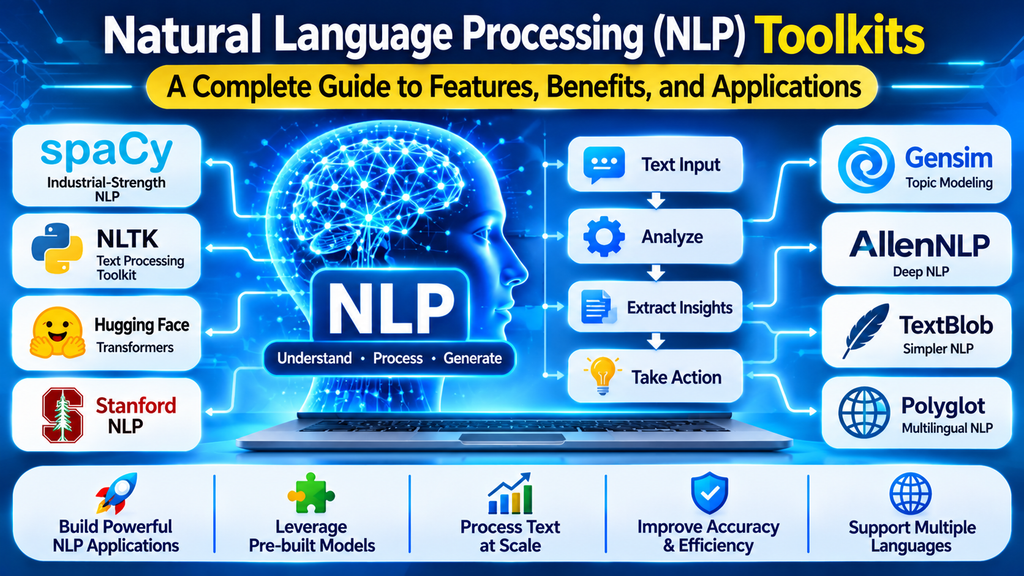
Natural Language Processing (NLP) Toolkits: A Complete Guide to Features, Benefits, and Applications
Natural Language Processing (NLP) toolkits provide developers and researchers with the libraries, models, and utilities needed to help computers understand, process, and generate human language. They support applications such as chatbots, language translation, sentiment analysis, text classification, information extraction, and intelligent search.
What Are NLP Toolkits?
NLP toolkits are software libraries and frameworks that simplify common language-processing tasks. Rather than building every algorithm from scratch, developers can use ready-made components for tokenization, stemming, lemmatization, parsing, named entity recognition, and text classification.
Some toolkits focus on traditional linguistic processing, while others provide access to pretrained transformer models and advanced neural network architectures.
Key Features
1. Tokenization: Split text into sentences, words, or smaller units that machine learning models can process.
2. Stemming and lemmatization: Reduce words to their root or dictionary forms to support consistent analysis.
3. Part-of-speech tagging: Identify grammatical roles such as nouns, verbs, adjectives, and adverbs.
4. Named entity recognition: Extract people, organizations, locations, dates, and other entities from text.
5. Text classification: Assign categories to documents, messages, and other text inputs.
6. Language processing and parsing: Analyze sentence structure, relationships, and linguistic patterns.
7. Pretrained language models: Use existing models for tasks such as summarization, translation, question answering, and text generation.
Popular NLP Toolkits
spaCy: An open-source Python NLP library designed for efficient, production-oriented text processing. It provides tokenization, linguistic annotations, named entity recognition, and customizable processing pipelines.
NLTK: The Natural Language Toolkit is a widely used Python library for language processing, education, and research. It includes tools for tokenization, stemming, tagging, parsing, and corpus analysis.
Hugging Face Transformers: A popular library for working with pretrained transformer models. It supports tasks such as text classification, translation, summarization, question answering, and text generation.
Stanford CoreNLP: A Java-based natural language processing toolkit that provides linguistic analysis features, including tokenization, part-of-speech tagging, parsing, and named entity recognition.
Gensim: An open-source Python library focused on topic modeling, document similarity, and semantic representation of text collections.
AllenNLP: A research-oriented NLP framework built around deep learning and PyTorch. It has been used for developing and evaluating advanced language models and research systems; check current maintenance and compatibility before adopting it.
TextBlob: A beginner-friendly Python library that offers a simple interface for common NLP tasks such as sentiment analysis, noun phrase extraction, and language translation integrations.
Polyglot: A multilingual NLP library designed to support language identification and text-processing tasks across many languages. Check language coverage and maintenance status for your intended use.
Benefits of NLP Toolkits
- Faster development: Reuse existing language-processing components instead of implementing everything manually.
- Lower development complexity: Access established algorithms and pretrained models through consistent interfaces.
- Multilingual support: Build applications that process different languages, depending on toolkit coverage.
- Customization: Adapt pipelines and models to specialized industries and datasets.
- Research productivity: Experiment with linguistic methods and neural architectures more efficiently.
- Scalable processing: Integrate NLP pipelines into applications and data workflows.
Common Applications
Chatbots and virtual assistants: Interpret user messages and generate relevant responses.
Sentiment analysis: Understand opinions expressed in customer reviews, surveys, and social media posts.
Document processing: Extract entities, classify documents, and organize large text collections.
Search systems: Improve information retrieval by analyzing language and meaning.
Machine translation: Convert text between supported languages.
Content analysis: Identify topics, summarize documents, and analyze textual patterns.
Healthcare and research: Process specialized text under suitable privacy, validation, and professional oversight.
How to Choose the Right NLP Toolkit
Start with the task you want to solve. For efficient production pipelines, spaCy may be a good starting point. For learning and traditional language-processing methods, NLTK offers a broad collection of resources. For modern pretrained transformer models, Hugging Face Transformers provides a flexible ecosystem.
Consider language coverage, model quality, speed, memory requirements, customization, documentation, licensing, community support, and integration with your existing technology stack. Test candidate toolkits on representative data before making a long-term decision.
Best Practices
Prepare text consistently and select models appropriate to the target language and domain. Evaluate performance using separate test data and relevant metrics. Monitor errors involving slang, ambiguity, dialects, and specialized vocabulary. Keep model and library versions documented, and review licensing requirements before commercial deployment.
For sensitive text, apply privacy controls and avoid exposing personal information unnecessarily. Use human review when NLP outputs influence important decisions.
Conclusion
NLP toolkits make it easier to build applications that understand and process human language. Libraries such as spaCy, NLTK, Hugging Face Transformers, Stanford CoreNLP, Gensim, AllenNLP, TextBlob, and Polyglot support different language-processing needs. Choosing the right toolkit depends on the task, language coverage, model requirements, performance constraints, and development experience.
