Upgrade & Secure Your Future with DevOps, SRE, DevSecOps, MLOps!
We spend hours scrolling social media and waste money on things we forget, but won’t spend 30 minutes a day earning certifications that can change our lives.
Master in DevOps, SRE, DevSecOps & MLOps by DevOps School!
Learn from Guru Rajesh Kumar and double your salary in just one year.
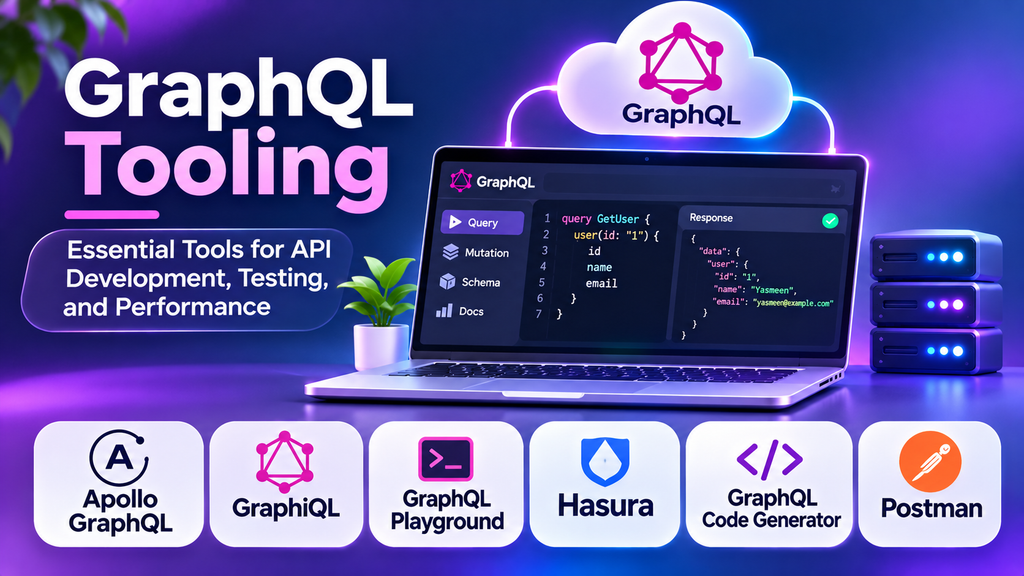
GraphQL has become a popular approach to API development because it allows clients to request exactly the data they need. Unlike traditional REST APIs, which often return predefined response structures, GraphQL enables applications to retrieve specific fields through a flexible query language. However, building reliable GraphQL APIs requires tools for schema design, development, testing, debugging, and performance monitoring.
What Is GraphQL Tooling?
GraphQL tooling refers to software that helps developers design schemas, write and validate queries, explore API data, generate code, test operations, and troubleshoot performance issues. These tools support the development lifecycle, from creating an initial schema to maintaining APIs in production.
Popular GraphQL Tools
1. Apollo GraphQL
Apollo provides a collection of tools for building, managing, and monitoring GraphQL applications. Apollo Client helps frontend applications fetch and manage GraphQL data, while Apollo Server supports the development of GraphQL APIs. Apollo Studio offers schema management, operation insights, and performance monitoring capabilities.
Best for: Teams building production GraphQL applications that need client libraries and API observability.
2. GraphiQL
GraphiQL is an interactive development environment for exploring GraphQL APIs. Developers can write queries, inspect schema documentation, and examine responses in a browser-based interface. It is useful for understanding available fields and testing operations during development.
Best for: Developers who need a straightforward environment for exploring and debugging GraphQL queries.
3. GraphQL Playground
GraphQL Playground provides an interactive interface for writing and testing GraphQL queries and mutations. Its features can include schema documentation, request headers, and query history, depending on the implementation and version. Although it remains familiar to many developers, teams should check maintenance and compatibility before adopting it for new projects.
Best for: Teams working with existing projects that already use GraphQL Playground.
4. Hasura
Hasura helps teams expose data through GraphQL APIs with reduced manual resolver development for supported data sources. It can accelerate API development and provide capabilities such as permissions and event-driven integrations, depending on the deployment and configuration.
Best for: Applications that need to build data-driven GraphQL APIs quickly.
5. GraphQL Code Generator
GraphQL Code Generator generates code from GraphQL schemas and operations. It supports workflows that create typed operation definitions and other generated artifacts for supported languages and frameworks. This can reduce repetitive coding and help detect mismatches between queries and expected data structures.
Best for: TypeScript and other supported projects that benefit from generated types and consistent API contracts.
6. Postman
Postman supports API request development and testing, including GraphQL requests. Developers can send queries and mutations, configure headers and variables, and organize tests into reusable workflows. It is particularly useful when GraphQL operations need to be tested alongside REST APIs and other services.
Best for: QA engineers and development teams managing multiple API types in one workspace.
Comparison of GraphQL Tools
| Tool | Main purpose | Suitable use case |
|---|---|---|
| Apollo GraphQL | Development and observability | Production applications |
| GraphiQL | Query exploration | Interactive debugging |
| GraphQL Playground | Query testing | Existing Playground workflows |
| Hasura | Data API development | Rapid API delivery |
| GraphQL Code Generator | Code and type generation | Type-safe development |
| Postman | API testing | Cross-API test workflows |
Essential Features to Look For
When evaluating GraphQL tooling, consider schema introspection, query validation, syntax highlighting, variable management, authentication support, automated testing, code generation, and performance visibility. For production systems, also evaluate error reporting, query complexity controls, access permissions, and compatibility with your existing development stack.
Not every project needs a large collection of tools. A small application may only require an interactive query editor and a client library. Larger teams may benefit from schema checks, generated types, automated test suites, and centralized monitoring.
How to Choose the Right GraphQL Tools
Start by identifying the biggest challenge in your development workflow. If developers struggle to explore queries, consider GraphiQL. If you need frontend data management and production insights, evaluate Apollo. For rapid data API development, assess Hasura. If type safety is a priority, consider GraphQL Code Generator. Teams that already use Postman can include GraphQL operations in their existing testing workflows.
Before committing to a tool, review its licensing, maintenance activity, security model, integration options, and learning curve. Test it against a realistic schema and representative queries rather than relying only on feature lists.
Best Practices for GraphQL Tooling
- Validate schemas and operations as part of your development workflow.
- Use automated tests for important queries, mutations, and error scenarios.
- Avoid exposing sensitive fields through overly broad permissions.
- Monitor query performance and investigate expensive operations.
- Use code generation where it improves consistency without complicating builds.
- Keep dependencies updated and verify tool compatibility before major upgrades.
Conclusion
GraphQL tooling makes API development more efficient by simplifying query exploration, schema management, testing, and code generation. Apollo GraphQL, GraphiQL, Hasura, GraphQL Code Generator, and Postman serve different needs across the development lifecycle. The best combination depends on project complexity, team experience, security requirements, and operational goals. Selecting tools that solve real workflow problems helps teams build GraphQL APIs that are easier to maintain, test, and scale.
