Upgrade & Secure Your Future with DevOps, SRE, DevSecOps, MLOps!
We spend hours scrolling social media and waste money on things we forget, but won’t spend 30 minutes a day earning certifications that can change our lives.
Master in DevOps, SRE, DevSecOps & MLOps by DevOps School!
Learn from Guru Rajesh Kumar and double your salary in just one year.
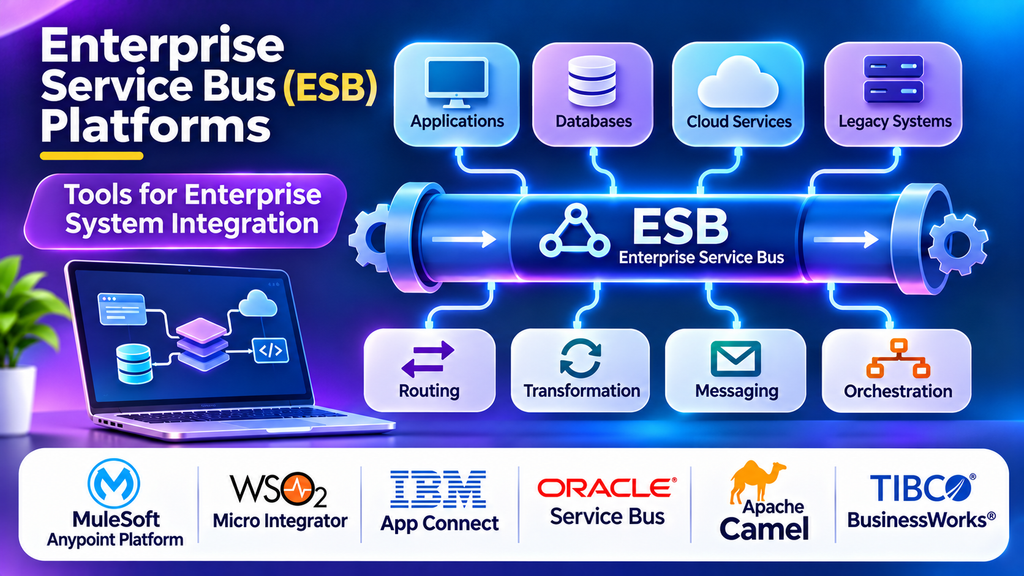
Enterprise organizations often rely on multiple applications, databases, and legacy systems to run their daily operations. Connecting these systems directly can create complex dependencies, making changes difficult and increasing maintenance costs. An Enterprise Service Bus (ESB) provides a centralized integration layer that helps applications communicate through standardized messaging, routing, and data transformation. ESB platforms are particularly useful in environments where reliable communication between diverse enterprise systems is essential.
What Is an Enterprise Service Bus?
An Enterprise Service Bus is an integration architecture that enables applications and services to exchange information through a shared messaging infrastructure. It can route messages, transform data formats, connect different protocols, and coordinate communication between systems. Rather than building a separate connection for every application pair, organizations can use an ESB to manage integrations more consistently.
Popular ESB Platforms
1. MuleSoft Anypoint Platform
MuleSoft provides integration and API management capabilities that support connectivity across cloud applications, on-premises systems, and enterprise services. Its integration tools can help teams build reusable services and orchestrate communication between applications.
Best for: Organizations modernizing complex integration environments and connecting APIs with enterprise systems.
2. WSO2 Micro Integrator
WSO2 Micro Integrator is an integration runtime designed for connecting services and applications. It supports mediation, message transformation, routing, and integration patterns used in enterprise environments. It can be deployed in different infrastructure configurations according to organizational requirements.
Best for: Technical teams seeking a flexible integration runtime with control over deployment.
3. IBM App Connect
IBM App Connect offers application integration and automation capabilities for connecting systems and data. It supports integration across enterprise applications and services, including environments that contain both cloud-based and traditional systems.
Best for: Enterprises that need application integration across diverse IBM and third-party environments.
4. Oracle Service Bus
Oracle Service Bus provides service mediation, routing, and transformation capabilities within Oracle-oriented enterprise architectures. It helps connect services and manage communication between systems while separating service consumers from underlying service implementations.
Best for: Organizations operating Oracle-based enterprise applications and service-oriented architectures.
5. Apache Camel
Apache Camel is an open-source integration framework that provides implementations of many enterprise integration patterns. Developers can use it to connect systems, route messages, and transform data through a range of components and configuration approaches. It is a framework rather than a fully managed ESB product, so teams are responsible for choosing and operating its runtime environment.
Best for: Developers who want code-driven integration and flexible control over integration logic.
6. TIBCO BusinessWorks
TIBCO BusinessWorks provides enterprise integration and process orchestration capabilities. It can connect applications and services, transform messages, and coordinate workflows across different technologies. Its suitability depends on an organization’s existing TIBCO environment, integration requirements, and licensing considerations.
Best for: Enterprises with established TIBCO environments and complex integration workflows.
Comparison of ESB Platforms
| Platform | Main strength | Suitable use case |
|---|---|---|
| MuleSoft Anypoint Platform | Integration and API connectivity | Enterprise modernization |
| WSO2 Micro Integrator | Flexible integration runtime | Custom integration environments |
| IBM App Connect | Application integration | Hybrid enterprise systems |
| Oracle Service Bus | Service mediation | Oracle-oriented architectures |
| Apache Camel | Open-source integration framework | Developer-led integrations |
| TIBCO BusinessWorks | Enterprise integration orchestration | Complex existing environments |
Essential Features to Evaluate
When evaluating an ESB platform, consider message routing, transformation, protocol support, error handling, monitoring, security, and scalability. Reliable messaging and clear operational visibility are especially important when integrations support business-critical processes.
Organizations should also assess support for legacy applications, deployment flexibility, connector availability, and compatibility with their existing infrastructure. Licensing, skills availability, maintenance effort, and migration complexity can have a significant effect on the total cost of ownership.
ESB vs. iPaaS
An ESB is traditionally associated with an integration layer that mediates communication between enterprise applications and services. iPaaS is generally delivered as a cloud-based integration service with managed connectors and visual workflow tools. The two approaches can overlap: some ESB products support cloud deployments, while iPaaS platforms can integrate with on-premises systems. The best option depends on deployment needs, governance, existing systems, and operational preferences.
How to Choose the Right ESB
Start by mapping the applications, protocols, data formats, and business processes that need to communicate. Identify whether you need a full integration platform, a developer-focused framework, or a managed cloud service. Evaluate how each option handles message failures, retries, observability, access controls, and high-volume traffic.
Run a proof of concept using a representative integration before selecting a platform. Include failure scenarios, security requirements, and realistic transaction volumes. Also consider whether your team has the skills needed to operate the solution over time.
ESB Implementation Best Practices
- Design integrations around clear service and data contracts.
- Avoid unnecessary point-to-point dependencies where shared integration patterns are appropriate.
- Implement secure authentication, authorization, and encryption.
- Use structured logging, monitoring, and alerts for integration failures.
- Apply retries carefully and prevent duplicate processing where necessary.
- Document message flows, transformations, and dependencies.
- Test performance and recovery behavior before production deployment.
- Review whether new integrations should use an ESB, APIs, event streaming, or a combination of approaches.
Conclusion
ESB platforms help enterprises integrate diverse applications, manage message flows, and support reliable communication across complex technology environments. MuleSoft, WSO2, IBM App Connect, Oracle Service Bus, Apache Camel, and TIBCO BusinessWorks each serve different integration needs. Choosing the right solution requires understanding system architecture, deployment preferences, team skills, and long-term maintenance requirements. A well-designed integration approach can reduce complexity and make enterprise systems easier to evolve.
