Upgrade & Secure Your Future with DevOps, SRE, DevSecOps, MLOps!
We spend hours scrolling social media and waste money on things we forget, but won’t spend 30 minutes a day earning certifications that can change our lives.
Master in DevOps, SRE, DevSecOps & MLOps by DevOps School!
Learn from Guru Rajesh Kumar and double your salary in just one year.
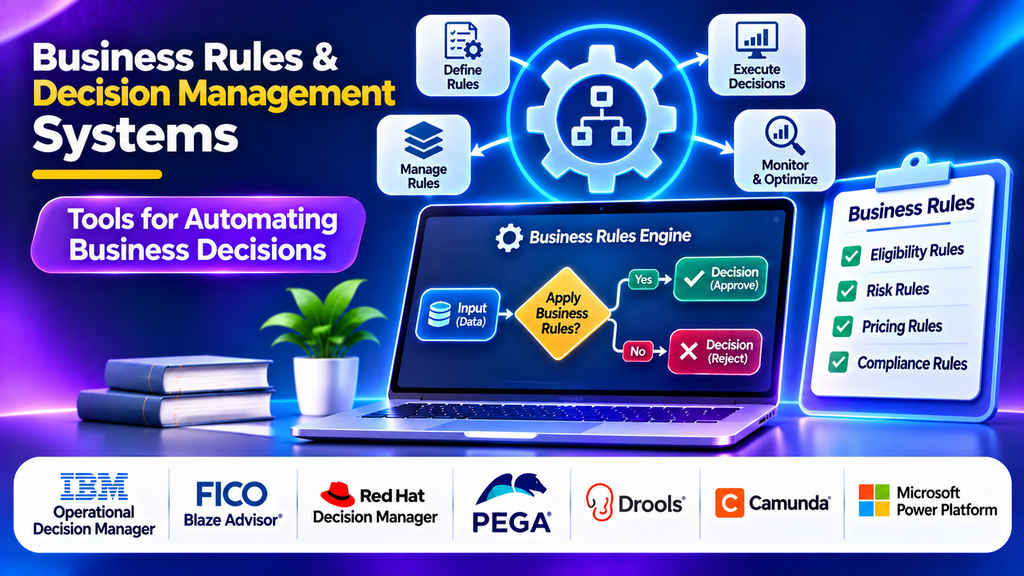
What Are Business Rules and Decision Management Systems?
Business rules and decision management systems help organizations apply consistent logic to everyday business decisions. These systems define how decisions should be made based on conditions, policies, calculations, and organizational requirements.
For example, a financial institution can use decision rules to determine whether an application meets initial eligibility criteria. An insurance company can automate claim routing, while an e-commerce business can personalize offers based on customer behavior.
Decision management platforms reduce repetitive manual reviews, improve consistency, and make business policies easier to maintain as requirements change.
Popular Business Rules and Decision Management Tools
1. IBM Operational Decision Manager
IBM Operational Decision Manager helps organizations create, manage, test, and execute business rules separately from application code. Best for large enterprises with complex decision logic, governance requirements, and high transaction volumes.
2. FICO Blaze Advisor
FICO Blaze Advisor automates operational decisions through rule authoring, testing, deployment, and decision services. Best for financial services and insurance.
3. Red Hat Decision Manager
Red Hat Decision Manager provides rules and decision models that can be integrated into applications. Best for organizations seeking rules-based decision automation in enterprise environments.
4. Pega Platform
Pega combines business rules, decisioning, workflow automation, and case management. Best for customer engagement and complex service operations.
5. Drools
Drools is an open-source business rules engine for representing and executing rules in software applications. Best for developers seeking customizable rules processing.
6. Camunda
Camunda supports workflow orchestration and decision automation, including DMN decision modeling. Best for technical teams integrating decisions into application workflows.
7. Microsoft Power Platform
Power Automate and Power Apps can implement conditional logic, approvals, and business process decisions. Best for organizations using Microsoft 365 and low-code applications.
Business Rules Tool Comparison
| Platform | Key Strength | Best Fit |
|---|---|---|
| IBM Operational Decision Manager | Enterprise rule management | Complex enterprise decisions |
| FICO Blaze Advisor | Operational decision automation | Financial services and insurance |
| Red Hat Decision Manager | Rules-based application decisions | Enterprise development teams |
| Pega Platform | Decisioning and case management | Customer-focused operations |
| Drools | Open-source rules engine | Custom software applications |
| Camunda | Workflow and DMN decision automation | Process orchestration |
| Microsoft Power Platform | Low-code conditions and approvals | Microsoft-based organizations |
Features, licensing, and deployment options vary by product and edition.
Essential Features to Consider
- Rule authoring and structured rule updates.
- Decision tables for conditions and outcomes.
- Business-user accessibility where appropriate.
- Testing and simulation before deployment.
- Version control and controlled releases.
- Integration with applications, APIs, databases, and workflows.
- Monitoring, audit trails, and explainable outcomes.
- Governance, permissions, and compliance controls.
How to Choose the Right Decision Management Tool
Identify which decisions need automation and whether they involve simple conditions, complex calculations, changing regulations, or high transaction volumes. Consider who will maintain the rules and evaluate APIs, usability, performance, testing, security, and total cost. For regulated decisions, verify audit trails, approvals, and documentation. Test the platform with real scenarios before wider adoption.
Best Practices for Decision Automation
Keep business rules separate from application code where appropriate. Use clear rule definitions and document ownership. Test edge cases and conflicting conditions. Establish review and approval processes. Monitor accuracy, exceptions, and processing time. Review rules regularly and remove obsolete logic.
Conclusion
Business rules and decision management systems help organizations automate repeatable decisions while maintaining consistency, transparency, and control. IBM Operational Decision Manager, FICO Blaze Advisor, Red Hat Decision Manager, Pega, Drools, Camunda, and Microsoft Power Platform support different business and technical needs. The right choice depends on decision complexity, integration requirements, governance, and rule maintenance. A well-designed strategy can reduce manual work and help businesses respond faster to changing requirements.
