Upgrade & Secure Your Future with DevOps, SRE, DevSecOps, MLOps!
We spend hours scrolling social media and waste money on things we forget, but won’t spend 30 minutes a day earning certifications that can change our lives.
Master in DevOps, SRE, DevSecOps & MLOps by DevOps School!
Learn from Guru Rajesh Kumar and double your salary in just one year.
Introduction
Airport operations management software helps airports manage daily operational activities such as flight schedules, gates, stands, baggage belts, check-in counters, passenger flow, resource planning, turnaround coordination, and disruption response. In simple terms, it gives airport teams a shared operational view so they can make faster and better decisions.
This software matters more than ever because airports are under pressure to improve capacity, reduce delays, manage passenger growth, support airlines, improve safety, and modernize legacy systems. A strong airport operations platform can help teams coordinate terminal, airside, landside, ground handling, and airline activities in one connected environment.
Real-world use cases include flight data management, gate and stand allocation, baggage belt planning, disruption management, airport collaborative decision making, passenger flow monitoring, resource scheduling, and operational reporting.
Buyers should evaluate AODB strength, resource management, real-time dashboards, integrations, scalability, automation, ease of use, security controls, reporting, implementation complexity, and vendor support.
Best for: Airport operators, airport authorities, ground handlers, aviation IT teams, terminal operations teams, airside operations teams, regional airports, hub airports, and multi-airport groups.
Not ideal for: Very small airfields with limited digital operations, non-aviation businesses, simple facility teams that only need maintenance software, or travel agencies that need booking software rather than airport operations control.
Key Trends in Airport Operations Management Software
- AODB-centered operations: Airports are using Airport Operational Databases as the central source of truth for flight, passenger, gate, stand, belt, and operational data.
- AI-assisted resource planning: Modern tools are adding prediction, optimization, and decision-support features to help teams allocate gates, stands, counters, belts, and ground resources more efficiently.
- Real-time operational dashboards: Airports need live views of delays, gate changes, aircraft movement, baggage updates, passenger flow, and resource conflicts.
- Cloud and hybrid deployment: Many airports are moving from rigid on-premise systems to cloud or hybrid models for scalability, faster updates, and multi-airport coordination.
- Airport Collaborative Decision Making: A-CDM-style workflows are becoming important because airports, airlines, handlers, and control teams need shared operational visibility.
- Passenger flow intelligence: Airports are connecting operations tools with queue management, sensors, Wi-Fi analytics, and passenger movement data to reduce congestion.
- Disruption management: Weather, delays, air traffic constraints, staffing issues, and equipment shortages require tools that support faster re-planning and scenario testing.
- Sustainability and capacity optimization: Better resource planning helps reduce aircraft waiting time, ground delays, energy waste, and inefficient asset usage.
- Integration-first airport ecosystems: Airport operations platforms must connect with FIDS, RMS, BHS, DCS, billing, security, airline systems, maintenance, and data platforms.
- Cybersecurity and governance: Airports are critical infrastructure environments, so secure access, audit logs, user permissions, data protection, and resilience are essential.
How We Selected These Tools
The tools below were selected based on practical airport operations needs rather than general software popularity. Airport operations management is a specialized category, so the strongest platforms are usually those with aviation-specific AODB, RMS, FIDS, A-CDM, passenger flow, and operational planning capabilities.
- Market recognition in airport and aviation technology
- Feature completeness across flight, resource, and operational workflows
- AODB, RMS, FIDS, A-CDM, and real-time data capabilities
- Suitability for regional airports, hub airports, and multi-airport operators
- Integration readiness with airport, airline, and ground handling systems
- Reliability and performance expectations for mission-critical operations
- Security posture signals and governance capabilities
- Support for automation, optimization, and decision-making
- Vendor experience in aviation environments
- Fit across enterprise, mid-market, and smaller airport operations
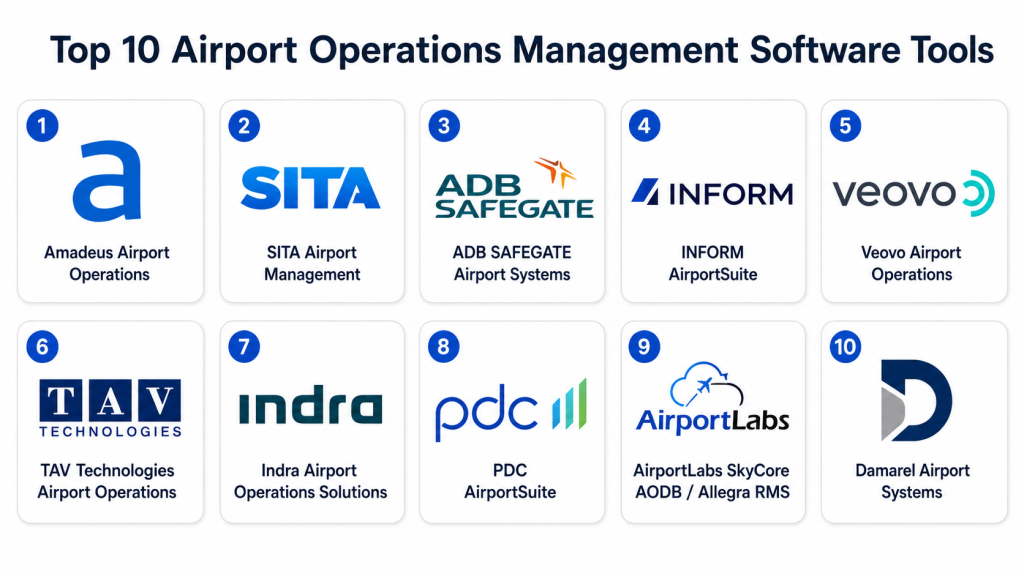
Top 10 Airport Operations Management Software Tools
#1 — Amadeus Airport Operations
Short description:
Amadeus Airport Operations is a modular airport operations software suite designed to help airports improve planning, turnaround coordination, operational visibility, and decision-making. It is suited for airports that need strong flight data management, real-time operational control, and integration with broader aviation systems. Amadeus is especially relevant for airports that want cloud-oriented flexibility and better coordination between operations teams. Its AODB capabilities support long-range operational planning and shared flight information across airport stakeholders.
Key Features
- Airport Operational Database support
- Flight schedule and operational data management
- Turnaround planning and execution support
- Real-time operational visibility
- Resource planning support
- Cloud-oriented airport operations architecture
- Integration with broader airport and airline systems
Pros
- Strong fit for larger and complex airport environments
- Good aviation technology ecosystem
- Useful for airports needing scalable operational planning
Cons
- May be more complex than smaller airports require
- Implementation can require strong internal planning
- Pricing is not publicly stated
Platforms / Deployment
Web / Cloud / Hybrid / Enterprise airport environment
Security & Compliance
Security details should be confirmed directly with the vendor. Buyers should ask about SSO, MFA, RBAC, encryption, audit logs, data residency, disaster recovery, and operational resilience.
SOC 2, ISO 27001, GDPR, HIPAA: Not publicly stated.
Integrations & Ecosystem
Amadeus Airport Operations can connect with airport and airline systems that support operational planning, flight information, and passenger movement.
- Airport Operational Database
- Resource management systems
- Flight information display systems
- Airline operational systems
- Turnaround management tools
- Reporting and data platforms
Support & Community
Amadeus provides enterprise aviation support, onboarding, training, and professional services. Community strength is mainly aviation-industry and customer-network based rather than open public community-based.
#2 — SITA Airport Management
Short description:
SITA Airport Management is designed to help airport stakeholders manage flight operations, optimize fixed and mobile resources, and support collaborative decision-making. It is suitable for airports that need real-time operational coordination across teams, airlines, ground handlers, and service providers. The platform is especially useful for airports that want a shared operational picture and stronger resource planning. SITA’s aviation footprint makes it a strong option for airports looking for mature airport technology support.
Key Features
- Flight operations management
- Fixed and mobile resource optimization
- Collaborative decision-making support
- Real-time shared operational data
- Multi-airport operation support
- Resource planning and allocation
- Airport stakeholder coordination
Pros
- Strong aviation technology reputation
- Good fit for complex airport stakeholder environments
- Supports real-time collaboration and operational visibility
Cons
- May require careful integration planning
- Public pricing details are not available
- Smaller airports may not need the full platform depth
Platforms / Deployment
Web / Cloud / Hybrid / Varies by airport implementation
Security & Compliance
Security details are not fully public for every deployment. Buyers should validate SSO, MFA, RBAC, encryption, audit trails, data protection, and compliance documentation directly.
SOC 2, ISO 27001, GDPR, HIPAA: Not publicly stated.
Integrations & Ecosystem
SITA Airport Management fits into broader airport technology ecosystems where flight data, resource planning, and stakeholder communication are important.
- Airport Operational Database
- Resource management systems
- Airline systems
- Ground handling systems
- FIDS and passenger communication systems
- Airport reporting tools
Support & Community
SITA offers enterprise support, documentation, implementation assistance, and aviation-specific services. Support levels may vary based on airport size, contract scope, and selected modules.
#3 — ADB SAFEGATE Airport Systems
Short description:
ADB SAFEGATE Airport Systems provides airport operations capabilities around AODB, resource management, airside operations, and airport system coordination. It is suitable for airports that want to centralize operational data and improve decision-making across airside and terminal workflows. The platform is especially relevant for airports that want stronger resource planning, flight information management, and operational coordination. ADB SAFEGATE is also known for its airside expertise, which makes it useful for airports focused on capacity, safety, and operational flow.
Key Features
- Airport Operational Database
- Resource Management System support
- Flight information and operational data coordination
- Airside and terminal system support
- A-CDM-oriented operational workflows
- Resource allocation and planning
- Airport system integration support
Pros
- Strong fit for airports needing AODB and RMS capabilities
- Useful for airside and terminal coordination
- Good option for airports modernizing operational systems
Cons
- Public security certification details are limited
- Implementation may require specialist aviation IT planning
- Pricing is not publicly stated
Platforms / Deployment
Web / Cloud / Hybrid / Varies by airport environment
Security & Compliance
Security capabilities should be reviewed directly with the vendor. Buyers should request information about user permissions, access control, encryption, audit logs, backup, and disaster recovery.
SOC 2, ISO 27001, GDPR, HIPAA: Not publicly stated.
Integrations & Ecosystem
ADB SAFEGATE Airport Systems is built for airport operational ecosystems where multiple systems need to share reliable flight and resource data.
- AODB
- RMS
- FIDS
- Airport billing systems
- Airside systems
- Airport operational dashboards
Support & Community
ADB SAFEGATE provides aviation-focused support, professional services, and implementation guidance. Community is primarily customer and airport-industry based.
#4 — INFORM AirportSuite
Short description:
INFORM AirportSuite is focused on advanced airport resource planning, optimization, and decision support. It is suitable for airports that need to manage gates, stands, check-in counters, baggage belts, ground support equipment, and operational constraints more efficiently. The software is especially useful for airports that want scenario planning, disruption handling, and optimized allocation of limited resources. INFORM is a strong fit for airports where operational complexity, capacity pressure, and resource efficiency are major concerns.
Key Features
- Advanced resource planning
- Gate, stand, counter, and belt optimization
- Ground support equipment planning
- Disruption and scenario support
- Decision-support recommendations
- Constraint-based operational planning
- Sustainability-oriented resource efficiency
Pros
- Strong optimization and planning capabilities
- Useful for airports with complex resource constraints
- Good fit for improving operational efficiency
Cons
- May require mature operational processes to get full value
- Not ideal for very small airports with simple workflows
- Public pricing and compliance details are limited
Platforms / Deployment
Web / Cloud / Hybrid / Varies by implementation
Security & Compliance
Security and compliance details should be confirmed directly with the vendor. Buyers should ask about SSO, MFA, RBAC, audit logs, encryption, and operational data protection.
SOC 2, ISO 27001, GDPR, HIPAA: Not publicly stated.
Integrations & Ecosystem
INFORM AirportSuite is most useful when connected with operational systems that provide reliable flight, resource, and ground movement data.
- AODB systems
- Airport resource systems
- Ground handling systems
- GSE management tools
- Operational dashboards
- Reporting and analytics platforms
Support & Community
INFORM provides professional services, implementation support, and aviation-focused expertise. Support depth should be evaluated based on project size and operational complexity.
#5 — Veovo Airport Operations
Short description:
Veovo Airport Operations helps airports connect flight operations, passenger flow, resource planning, and operational decision-making. It is suitable for airports that want real-time data, prediction-led planning, and better coordination across teams. Veovo is especially relevant for airports that want to improve capacity, reduce bottlenecks, and align operational teams through shared visibility. Its focus on passenger flow and operations intelligence makes it useful for airports dealing with congestion, disruptions, and resource pressure.
Key Features
- Flight operations visibility
- Passenger flow intelligence
- AI-supported predictions
- Resource planning and coordination
- Real-time operational dashboards
- Capacity optimization support
- Multi-stakeholder collaboration
Pros
- Strong focus on real-time operational intelligence
- Useful for passenger flow and capacity planning
- Good fit for airports that need prediction-led coordination
Cons
- May require integration with sensors and data sources for full value
- Smaller airports may not need advanced passenger flow analytics
- Pricing is not publicly stated
Platforms / Deployment
Web / Cloud / Hybrid / Varies by implementation
Security & Compliance
Security details should be validated during procurement. Buyers should confirm access control, encryption, audit trails, data protection, and any relevant compliance documentation.
SOC 2, ISO 27001, GDPR, HIPAA: Not publicly stated.
Integrations & Ecosystem
Veovo works well in data-rich airport environments where flight, passenger, and resource information need to be connected.
- Flight management systems
- Passenger flow sensors
- AODB platforms
- Resource planning systems
- Airport dashboards
- Data and analytics tools
Support & Community
Veovo provides airport-focused support, onboarding, and professional services. Community strength is mainly customer and aviation-sector based.
#6 — TAV Technologies Airport Operations
Short description:
TAV Technologies Airport Operations includes solutions for airport operational workflows, including AODB and related airport management capabilities. It is suitable for airports that want to centralize operational data, improve workflow visibility, and connect multiple airport systems. The platform supports airport operators that need practical tools for managing flight information, resources, and stakeholder communication. TAV Technologies is especially relevant for airport groups and operators looking for digital-friendly airport operations solutions.
Key Features
- Airport Operational Database
- Flight information management
- Operational workflow support
- Airport system integration
- Stakeholder data sharing
- Real-time operational updates
- Airport management modules
Pros
- Good fit for airports needing AODB-centered operations
- Useful for improving operational data visibility
- Supports airport workflow digitization
Cons
- Product depth may vary by selected module
- Public compliance details are limited
- Buyers should validate scalability for very large hubs
Platforms / Deployment
Web / Cloud / Hybrid / Varies by airport implementation
Security & Compliance
Security and compliance details are not fully publicly stated. Buyers should ask about SSO, MFA, user roles, audit logs, encryption, data backup, and compliance documentation.
SOC 2, ISO 27001, GDPR, HIPAA: Not publicly stated.
Integrations & Ecosystem
TAV Technologies Airport Operations can connect data from different airport systems into a more coordinated operational environment.
- AODB
- FIDS
- Baggage handling systems
- Resource management systems
- Airline and ground handler systems
- Reporting dashboards
Support & Community
TAV Technologies provides vendor-led support, aviation implementation services, and product assistance. Support levels should be reviewed based on contract and selected modules.
#7 — Indra Airport Operations Solutions
Short description:
Indra Airport Operations Solutions include airport operational database and resource management capabilities for airports that need coordinated flight, passenger, baggage, and resource workflows. It is suitable for airports and airport groups that need structured operational control, airport process synchronization, and reliable resource planning. The solution is especially relevant for airports that require airport-wide coordination between different operational areas. Indra’s aviation and transport technology background makes it a practical option for complex airport environments.
Key Features
- Airport Operational Database
- Resource Management System capabilities
- Flight, passenger, and baggage process coordination
- Airport resource planning
- Operational data synchronization
- Multi-airport operational support potential
- Airport workflow management
Pros
- Suitable for complex airport operational environments
- Supports AODB and RMS-style airport coordination
- Useful for airport-wide process synchronization
Cons
- Public product details may be less simple for buyers to compare
- Implementation can require specialist planning
- Security and pricing details are not publicly stated
Platforms / Deployment
Web / Cloud / Hybrid / Varies by implementation
Security & Compliance
Security capabilities should be confirmed directly with the vendor. Buyers should request details about access controls, encryption, logging, resilience, and compliance documentation.
SOC 2, ISO 27001, GDPR, HIPAA: Not publicly stated.
Integrations & Ecosystem
Indra Airport Operations Solutions are relevant for airports that need integration across several operational areas.
- AODB
- RMS
- Passenger process systems
- Baggage process systems
- Flight data systems
- Airport reporting systems
Support & Community
Indra provides enterprise technology support and professional services. Support depth will depend on project size, airport requirements, region, and implementation scope.
#8 — PDC AirportSuite
Short description:
PDC AirportSuite provides airport operations and resource scheduling applications that help airports streamline and automate operational processes. It is suitable for airports that want stronger resource planning, operational system coordination, and capacity management. The platform can support airports that need AODB, resource planning, and airport-wide scheduling functions. PDC AirportSuite is especially useful for airports focused on optimizing resources and improving daily operational efficiency.
Key Features
- Airport operations software suite
- Resource scheduling applications
- Airport Operational Database support
- Multi-airport operation support potential
- Operational process automation
- Capacity and resource planning
- Airport workflow coordination
Pros
- Strong focus on resource scheduling and operations
- Useful for airports that need structured planning
- Good fit for operational process automation
Cons
- Public compliance and security details are limited
- Implementation fit should be validated by airport size
- Pricing is not publicly stated
Platforms / Deployment
Web / Cloud / Hybrid / Varies by airport environment
Security & Compliance
Security details should be validated directly with the vendor. Buyers should check SSO, MFA, RBAC, encryption, audit logging, data protection, and backup processes.
SOC 2, ISO 27001, GDPR, HIPAA: Not publicly stated.
Integrations & Ecosystem
PDC AirportSuite is most valuable when connected with core airport operations systems and planning data sources.
- AODB
- Resource scheduling systems
- Airport operational systems
- Reporting and planning tools
- Multi-airport data environments
- Operational dashboards
Support & Community
PDC provides airport-focused implementation and support. Buyers should review training, documentation, onboarding, and support service levels before selection.
#9 — AirportLabs SkyCore AODB / Allegra RMS
Short description:
AirportLabs SkyCore AODB and Allegra RMS are airport operations tools focused on real-time data, resource management, operational recovery, and user-friendly airport workflows. SkyCore AODB centralizes operational flight and airport data, while Allegra RMS helps optimize airport resources such as gates, stands, belts, and related assets. The suite is suitable for airports that want modern cloud-oriented operations software with strong usability. It is especially relevant for airports looking to replace fragmented legacy tools with more flexible digital workflows.
Key Features
- Cloud-based AODB capabilities
- Resource Management System support
- Real-time operational data handling
- Disruption and recovery workflow support
- Gate, stand, and belt resource planning
- User-friendly operational interface
- Airport billing and related modules available
Pros
- Strong focus on modern user experience
- Good fit for airports replacing fragmented legacy systems
- Useful combination of AODB and RMS capabilities
Cons
- Buyers should validate fit for very large and highly customized environments
- Public compliance details are limited
- Product availability and module fit may vary by airport needs
Platforms / Deployment
Web / Cloud / Varies by airport implementation
Security & Compliance
Security details should be confirmed directly with the vendor. Buyers should ask about user roles, authentication, encryption, audit logs, data protection, and service resilience.
SOC 2, ISO 27001, GDPR, HIPAA: Not publicly stated.
Integrations & Ecosystem
AirportLabs tools are designed to connect airport data, resource planning, and operational workflows into a more unified environment.
- SkyCore AODB
- Allegra RMS
- FIDS systems
- Airport billing
- Resource planning workflows
- Airport community applications
Support & Community
AirportLabs provides vendor-led support, implementation assistance, and product onboarding. Community is mainly aviation customer-focused rather than public developer-led.
#10 — Damarel Airport Systems
Short description:
Damarel Airport Systems provides mission-critical software for airport and airline operations, including Airport Operational Database, turnaround management, airline billing, and departure control-related solutions. It is suitable for airports, handlers, and aviation operators that need operational coordination across passenger, flight, turnaround, and billing workflows. Damarel is especially relevant for organizations that need focused aviation software rather than broad generic operations tools. It can be a practical choice for operators seeking specialized airport operations capabilities.
Key Features
- Airport Operational Database capabilities
- Turnaround management support
- Airline billing systems
- Departure control-related solutions
- Airport and airline operational workflows
- Mission-critical aviation software focus
- Support for operational coordination
Pros
- Specialized aviation operations software provider
- Useful for turnaround and airport operational workflows
- Practical fit for operators needing focused airport systems
Cons
- May not have the same global ecosystem visibility as larger vendors
- Public compliance details are limited
- Buyers should validate integration depth before selection
Platforms / Deployment
Web / Cloud / Hybrid / Varies by implementation
Security & Compliance
Security and compliance information is not fully publicly stated. Buyers should request details about authentication, role-based access, encryption, audit logs, operational resilience, and data governance.
SOC 2, ISO 27001, GDPR, HIPAA: Not publicly stated.
Integrations & Ecosystem
Damarel Airport Systems can support airport and airline operational workflows where AODB, turnaround, and billing systems need to work together.
- Airport Operational Database
- Turnaround management
- Airline billing
- Departure control workflows
- Airport operations systems
- Reporting and operational tools
Support & Community
Damarel provides aviation-focused vendor support and implementation assistance. Support structure should be reviewed directly based on selected products and deployment requirements.
Comparison Table
| Tool Name | Best For | Platform(s) Supported | Deployment | Standout Feature | Public Rating |
|---|---|---|---|---|---|
| Amadeus Airport Operations | Large and complex airports | Web / Enterprise airport environment | Cloud / Hybrid | AODB and airport operations suite | N/A |
| SITA Airport Management | Airports needing stakeholder collaboration | Web / Enterprise airport environment | Cloud / Hybrid / Varies | Real-time flight operations and resource optimization | N/A |
| ADB SAFEGATE Airport Systems | Airports focused on AODB, RMS, and airside workflows | Web / Airport systems environment | Cloud / Hybrid / Varies | AODB and RMS-centered airport coordination | N/A |
| INFORM AirportSuite | Airports needing resource optimization | Web / Enterprise airport environment | Cloud / Hybrid / Varies | Advanced resource planning and decision support | N/A |
| Veovo Airport Operations | Airports needing passenger flow and operations intelligence | Web / Data-rich airport environment | Cloud / Hybrid / Varies | AI-supported prediction and passenger flow visibility | N/A |
| TAV Technologies Airport Operations | Airports needing AODB-centered workflow digitization | Web / Airport systems environment | Cloud / Hybrid / Varies | Operational data integration across airport systems | N/A |
| Indra Airport Operations Solutions | Complex airports and airport groups | Web / Enterprise airport environment | Cloud / Hybrid / Varies | AODB and RMS-style process synchronization | N/A |
| PDC AirportSuite | Airports needing resource scheduling and automation | Web / Airport operations environment | Cloud / Hybrid / Varies | Resource scheduling and operational process automation | N/A |
| AirportLabs SkyCore AODB / Allegra RMS | Airports modernizing AODB and RMS workflows | Web | Cloud / Varies | User-friendly AODB and resource optimization suite | N/A |
| Damarel Airport Systems | Airports needing specialized aviation operations software | Web / Varies | Cloud / Hybrid / Varies | AODB, turnaround management, and airline billing | N/A |
Evaluation & Scoring of Airport Operations Management Software
| Tool Name | Core (25%) | Ease (15%) | Integrations (15%) | Security (10%) | Performance (10%) | Support (10%) | Value (15%) | Weighted Total (0–10) |
|---|---|---|---|---|---|---|---|---|
| Amadeus Airport Operations | 9 | 7 | 9 | 8 | 9 | 9 | 7 | 8.35 |
| SITA Airport Management | 9 | 7 | 9 | 8 | 9 | 8 | 7 | 8.25 |
| ADB SAFEGATE Airport Systems | 9 | 7 | 8 | 7 | 8 | 8 | 8 | 8.00 |
| INFORM AirportSuite | 9 | 7 | 8 | 7 | 8 | 8 | 8 | 8.00 |
| Veovo Airport Operations | 8 | 8 | 8 | 7 | 8 | 8 | 8 | 7.90 |
| TAV Technologies Airport Operations | 8 | 8 | 8 | 7 | 8 | 7 | 8 | 7.75 |
| Indra Airport Operations Solutions | 8 | 7 | 8 | 7 | 8 | 8 | 7 | 7.60 |
| PDC AirportSuite | 8 | 8 | 7 | 7 | 8 | 7 | 8 | 7.65 |
| AirportLabs SkyCore AODB / Allegra RMS | 8 | 8 | 8 | 6 | 8 | 7 | 8 | 7.65 |
| Damarel Airport Systems | 7 | 8 | 7 | 6 | 7 | 7 | 8 | 7.20 |
These scores are comparative and should be used as a practical shortlist guide. A higher score does not automatically mean the tool is best for every airport. Large airport groups may prioritize scalability, resilience, and ecosystem depth, while smaller airports may prioritize usability, cost, and faster deployment. Buyers should validate demos, integrations, security documentation, support terms, and implementation scope before making a final decision.
Which Airport Operations Management Software Tool Is Right for You?
Solo / Freelancer
A solo aviation consultant, airport technology advisor, or operations analyst usually does not need to purchase a full airport operations platform. However, understanding tools such as AirportLabs, PDC AirportSuite, Veovo, and Damarel can be useful when advising small and mid-sized airports.
For consulting work, focus on tools that are easier to explain, demo, and map to operational pain points such as resource conflicts, gate changes, passenger queues, and reporting gaps.
SMB
Smaller airports should focus on practical value, easy setup, essential AODB capability, resource scheduling, simple dashboards, and vendor support. PDC AirportSuite, AirportLabs, Damarel, TAV Technologies, and selected ADB SAFEGATE modules can be good starting points.
SMBs should avoid buying a system that is too large for their operational maturity. The best choice is usually the platform that solves today’s flight, resource, and stakeholder coordination problems without creating unnecessary complexity.
Mid-Market
Mid-market airports need stronger resource optimization, integration flexibility, passenger flow visibility, operational reporting, and disruption handling. SITA Airport Management, ADB SAFEGATE, INFORM AirportSuite, Veovo, TAV Technologies, and PDC AirportSuite can be strong options.
This segment should focus heavily on integration with FIDS, BHS, RMS, airline systems, ground handler systems, billing, maintenance, security, and passenger communication tools.
Enterprise
Large hub airports and multi-airport groups need resilient, scalable, and deeply integrated platforms. Amadeus Airport Operations, SITA Airport Management, ADB SAFEGATE, INFORM AirportSuite, Veovo, and Indra Airport Operations Solutions are stronger candidates for complex environments.
Enterprise buyers should evaluate high-volume performance, multi-airport data visibility, disaster recovery, role governance, cybersecurity, operational continuity, and long-term vendor roadmap.
Budget vs Premium
Budget-conscious airports should shortlist tools that provide practical AODB, resource scheduling, and workflow visibility without unnecessary enterprise modules. PDC AirportSuite, AirportLabs, Damarel, and selected TAV Technologies modules may be easier to evaluate for cost-conscious projects.
Premium buyers should evaluate Amadeus, SITA, ADB SAFEGATE, INFORM, Veovo, and Indra when scalability, advanced optimization, deep integrations, and enterprise support are more important than basic cost savings.
Feature Depth vs Ease of Use
Feature-rich platforms can provide more control, but they may need more training, governance, and implementation planning. Amadeus, SITA, ADB SAFEGATE, INFORM, and Indra may suit airports with mature teams and complex workflows.
Ease-focused teams may prefer AirportLabs, PDC AirportSuite, Damarel, or selected TAV Technologies modules if the goal is to simplify operations quickly and improve daily team adoption.
Integrations & Scalability
Airport operations software should not work in isolation. The strongest systems connect with AODB, RMS, FIDS, BHS, DCS, billing, security, airline systems, ground handling tools, maintenance platforms, and analytics systems.
For scalability, airports should evaluate API availability, data exchange standards, multi-airport support, cloud readiness, monitoring, backup, disaster recovery, and vendor experience with similar airport sizes.
Security & Compliance Needs
Airport operations platforms manage critical operational data, user access, flight information, passenger-related workflows, resource allocation, and sometimes billing data. Security should be part of the first evaluation discussion.
Ask each vendor about MFA, SSO, RBAC, audit logs, encryption, data retention, data residency, disaster recovery, incident response, vulnerability management, and support for airport cybersecurity policies.
Frequently Asked Questions
1. What is airport operations management software?
Airport operations management software helps airports plan, monitor, and coordinate daily operations such as flights, gates, stands, baggage belts, check-in counters, passenger flow, resources, and disruptions. It gives airport teams a shared operational view so they can make faster and more accurate decisions.
2. What is an AODB in airport operations?
An Airport Operational Database is a central database that stores and distributes key airport operational data. It usually manages flight schedules, movements, delays, gates, stands, belts, counters, and related operational updates used by different airport systems.
3. What is the difference between AODB and RMS?
AODB stores and distributes operational data, while RMS helps plan and allocate airport resources such as gates, stands, counters, baggage belts, and equipment. In many airports, both systems work together to support daily operations.
4. How much does airport operations management software cost?
Pricing depends on airport size, passenger volume, number of modules, deployment model, integrations, support level, and implementation complexity. Most vendors do not publish fixed pricing, so airports usually need a custom quote.
5. How long does implementation take?
Implementation depends on the airport’s size, existing systems, data quality, integrations, training needs, and change management. A smaller airport may deploy selected modules faster, while a large hub or multi-airport group often needs phased implementation.
6. What are the most important features to compare?
Important features include AODB, RMS, flight data management, FIDS integration, passenger flow visibility, resource planning, disruption management, real-time dashboards, reporting, APIs, role-based access, audit logs, and vendor support.
7. Can airport operations software reduce delays?
It can help reduce avoidable operational delays by improving visibility, resource planning, stakeholder coordination, and disruption response. However, it cannot remove all delays because weather, air traffic control, airline issues, and external events also affect airport operations.
8. Is cloud deployment safe for airport operations?
Cloud deployment can be safe when the vendor provides strong security, resilience, access control, monitoring, backup, and disaster recovery. Airports should carefully validate cybersecurity policies, data residency, uptime commitments, and incident response processes.
9. What mistakes should airports avoid when choosing software?
Common mistakes include buying too many modules too early, ignoring integration needs, underestimating staff training, skipping data migration planning, failing to involve operations teams, and not testing real disruption scenarios before rollout.
10. Can small airports use these platforms?
Yes, small airports can use airport operations software, but they should choose practical modules that match their actual needs. A simple AODB, resource planning tool, or operational dashboard may be enough before adopting a full enterprise suite.
Conclusion
Airport operations management software is becoming essential for airports that want better visibility, stronger coordination, faster decision-making, and more efficient use of limited resources. The right platform depends on airport size, passenger volume, operational complexity, integration needs, budget, and internal readiness. Large hubs and airport groups may need enterprise-grade systems with deep AODB, RMS, A-CDM, analytics, and integration capabilities. Smaller and mid-sized airports may benefit more from focused tools that solve immediate problems such as gate planning, resource allocation, flight data visibility, and reporting.
