Upgrade & Secure Your Future with DevOps, SRE, DevSecOps, MLOps!
We spend hours scrolling social media and waste money on things we forget, but won’t spend 30 minutes a day earning certifications that can change our lives.
Master in DevOps, SRE, DevSecOps & MLOps by DevOps School!
Learn from Guru Rajesh Kumar and double your salary in just one year.
Introduction
Public transit scheduling tools help transport agencies, bus operators, metro networks, shuttle providers, paratransit teams, and mobility planners design routes, build timetables, assign vehicles, plan driver duties, manage service changes, and improve rider experience. In simple words, these tools help public transport teams decide where vehicles should go, when they should arrive, who should operate them, and how service should adjust when demand changes.
These tools matter now because transit agencies are under pressure to improve reliability, reduce operating costs, manage driver shortages, support accessibility, handle real-time disruptions, and provide better passenger information. Modern public transit scheduling platforms now include automation, AI-assisted planning, cloud workflows, GTFS support, demand-responsive scheduling, analytics, and integration with operations systems.
Common use cases include bus scheduling, route planning, driver rostering, paratransit booking, service planning, on-demand transit management, timetable publishing, passenger information updates, and performance reporting.
Buyers should evaluate:
- Fixed-route scheduling capability
- Driver and crew scheduling support
- Vehicle blocking and rostering
- Paratransit and demand-responsive features
- Real-time operations integration
- GTFS and data export support
- Reporting and analytics
- Ease of service planning
- Mobile and cloud access
- Vendor support and transit experience
Best for: Public transit agencies, bus operators, metro authorities, shuttle services, paratransit providers, transport planners, mobility departments, operations managers, and regional transport networks.
Not ideal for: Very small teams that only need a basic calendar, companies without route-based transportation needs, or organizations that only need fleet tracking without scheduling, planning, or service optimization.
Key Trends in Public Transit Scheduling Tools
- AI-assisted planning is becoming more practical as agencies look for better ways to optimize routes, timetables, driver duties, and service frequency.
- Driver shortage management is now a major scheduling priority because agencies need smarter duty planning, rostering, and overtime control.
- Demand-responsive transit is growing as cities and agencies add flexible services for low-density areas, late-night travel, paratransit, and first-mile/last-mile coverage.
- GTFS and open data support are now essential because transit schedules must feed trip planners, mobile apps, real-time passenger systems, and public information tools.
- Cloud-based planning platforms are gaining adoption because teams need easier collaboration, faster updates, and access across offices and remote planning teams.
- Real-time disruption response is becoming more important as agencies need to adjust schedules during delays, road closures, weather events, driver absences, and vehicle issues.
- Equity and accessibility planning are becoming key evaluation factors as agencies must serve seniors, disabled riders, low-income communities, students, and underserved areas more effectively.
- Integration with CAD/AVL, ticketing, passenger information, and workforce systems is critical because scheduling cannot work in isolation.
- Data-driven service planning is replacing guesswork with ridership analytics, on-time performance data, route productivity reports, and scenario modeling.
- Sustainability goals are influencing scheduling as agencies plan electric bus charging, fleet rotation, depot capacity, and energy-aware vehicle assignment.
How We Selected These Tools
The tools in this list were selected using practical public transit software evaluation factors, including:
- Recognition in public transit scheduling, planning, dispatch, and mobility management markets
- Feature completeness across route planning, scheduling, rostering, dispatch, and analytics
- Suitability for bus, metro, tram, shuttle, paratransit, and demand-responsive services
- Ability to support transit-specific workflows instead of generic workforce scheduling only
- Integration potential with CAD/AVL, GTFS, ticketing, passenger information, and ERP systems
- Support for agencies of different sizes, from small operators to large transit networks
- Strength in fixed-route, paratransit, or on-demand transit use cases
- Ease of use for planners, schedulers, dispatchers, and operations teams
- Vendor experience in public transport and mobility operations
- Practical balance of automation, usability, scalability, and reporting depth
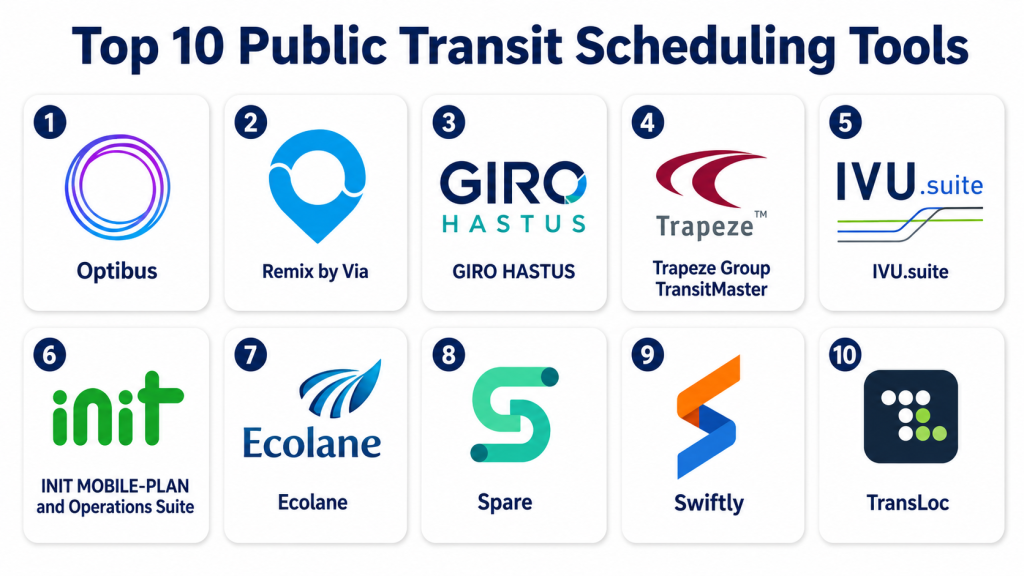
Top 10 Public Transit Scheduling Tools
1 — Optibus
Short description:
Optibus is a cloud-based public transportation planning and scheduling platform designed for bus operators, transit agencies, and mobility providers. It helps teams plan routes, build timetables, schedule vehicles, create driver duties, and optimize operations. The platform is known for automation and scenario planning, making it useful for agencies trying to improve efficiency and service quality. It is especially suitable for operators managing complex bus networks, driver constraints, and service changes. Optibus is a strong choice for agencies that want modern planning, optimization, and cloud collaboration.
Key Features
- Route and network planning
- Timetable scheduling
- Vehicle blocking
- Driver duty and roster planning
- Scenario planning and optimization
- Electric bus planning support
- Analytics and operational reporting
Pros
- Strong optimization and automation capabilities
- Cloud-based collaboration for planning teams
- Useful for complex bus scheduling environments
Cons
- May be more advanced than small operators need
- Implementation requires clean operational data
- Pricing is not publicly stated
Platforms / Deployment
Web / Cloud / Varies
Security & Compliance
SSO/SAML, MFA, encryption, audit logs, RBAC, SOC 2, ISO 27001, GDPR, HIPAA: Not publicly stated.
Integrations & Ecosystem
Optibus is designed to connect planning, scheduling, operations, and public data workflows for transport agencies.
- GTFS data exports
- CAD/AVL systems
- Passenger information systems
- Workforce systems
- Fleet systems
- Reporting and analytics platforms
Support & Community
Optibus provides vendor-led onboarding, training, and customer support. Support levels depend on agency size, selected modules, and implementation scope.
2 — Remix by Via
Short description:
Remix by Via is a public transit planning platform used for route planning, network design, service scenario analysis, and transit data visualization. It is especially useful for planners who need to redesign routes, test service changes, evaluate coverage, and communicate planning decisions clearly. The platform helps agencies understand the impact of route changes on riders, access, equity, and service performance. Remix is often used by public agencies that want a visual and collaborative planning environment. It is best for service planning teams rather than purely operational dispatch teams.
Key Features
- Route planning and service design
- Scenario modeling
- Ridership and coverage analysis
- Equity and accessibility analysis
- Map-based planning interface
- Transit data visualization
- GTFS-related planning support
Pros
- Easy visual planning experience
- Strong for service redesign and scenario testing
- Useful for public agency planning teams
Cons
- Not a full driver rostering system
- May need another tool for deep operations scheduling
- Pricing is not publicly stated
Platforms / Deployment
Web / Cloud
Security & Compliance
SSO/SAML, MFA, encryption, audit logs, RBAC, SOC 2, ISO 27001, GDPR, HIPAA: Not publicly stated.
Integrations & Ecosystem
Remix is useful for transit planning teams that need to work with route, map, schedule, and service impact data.
- GTFS data
- GIS systems
- Ridership datasets
- Planning analytics
- Public engagement workflows
- Passenger information systems
Support & Community
Via provides vendor-led support and onboarding for Remix customers. Support, training, and implementation assistance depend on the customer agreement and agency needs.
3 — GIRO HASTUS
Short description:
GIRO HASTUS is a widely recognized public transport scheduling and operations planning platform used by transit agencies and operators. It supports timetabling, vehicle scheduling, crew scheduling, rostering, and workforce planning. The platform is suitable for complex transit networks where vehicle assignment, driver duties, labor rules, and service reliability need careful planning. HASTUS is especially strong for agencies with large fixed-route operations. It is best for transport organizations that need deep scheduling logic and mature planning workflows.
Key Features
- Timetable planning
- Vehicle scheduling
- Crew scheduling and rostering
- Run cutting and duty planning
- Labor rule support
- Service planning analytics
- Operations planning support
Pros
- Strong scheduling and workforce planning depth
- Suitable for large and complex transit agencies
- Mature public transport planning platform
Cons
- May require specialist scheduling knowledge
- Implementation and configuration can be detailed
- Pricing is not publicly stated
Platforms / Deployment
Windows / Web / Cloud / Hybrid / Varies
Security & Compliance
SSO/SAML, MFA, encryption, audit logs, RBAC, SOC 2, ISO 27001, GDPR, HIPAA: Not publicly stated.
Integrations & Ecosystem
HASTUS is often integrated into wider transit operations environments where scheduling connects with payroll, dispatch, passenger information, and reporting systems.
- CAD/AVL systems
- Payroll systems
- HR systems
- Passenger information systems
- GTFS exports
- Reporting platforms
Support & Community
GIRO provides specialized implementation, training, documentation, and support services. Support levels depend on agency size, selected modules, and contract scope.
4 — Trapeze Group TransitMaster
Short description:
Trapeze Group TransitMaster supports public transit operations, scheduling, dispatching, fleet management, and service control. It is commonly used by transit agencies that need strong operational visibility and control across vehicles, routes, schedules, and service performance. The platform can help agencies manage fixed-route operations, real-time vehicle location, disruption response, and passenger information workflows. It is suitable for agencies that need both scheduling and operations technology. TransitMaster is best for transit organizations looking for an integrated operations environment.
Key Features
- Fixed-route operations management
- Scheduling and dispatch support
- CAD/AVL integration
- Real-time vehicle tracking
- Service monitoring
- Passenger information support
- Reporting and performance analytics
Pros
- Strong operational control capabilities
- Useful for fixed-route transit agencies
- Supports real-time operations visibility
Cons
- May require careful implementation planning
- User experience can vary by configuration
- Public security certification details are limited
Platforms / Deployment
Web / Windows / Cloud / Hybrid / Varies
Security & Compliance
SSO/SAML, MFA, encryption, audit logs, RBAC, SOC 2, ISO 27001, GDPR, HIPAA: Not publicly stated.
Integrations & Ecosystem
TransitMaster can connect scheduling, dispatch, vehicle tracking, passenger information, and performance reporting.
- CAD/AVL systems
- Fare collection systems
- Passenger information tools
- Radio and communications systems
- Reporting systems
- Maintenance and fleet platforms
Support & Community
Trapeze provides transit-focused implementation, customer support, documentation, and training. Support levels depend on the modules selected and contract type.
5 — IVU.suite
Short description:
IVU.suite is a public transport software platform that supports planning, scheduling, dispatch, fleet management, crew management, and operations control. It is used by public transport companies that need integrated workflows across buses, rail, trams, and mixed transit networks. The platform helps agencies plan services, assign vehicles, manage drivers, and coordinate daily operations. IVU.suite is suitable for agencies that want a broad transport platform rather than a single scheduling module. It is especially useful for complex passenger transport organizations.
Key Features
- Timetable planning
- Vehicle scheduling
- Driver and crew scheduling
- Dispatch and operations control
- Real-time service management
- Fleet and depot planning
- Passenger information integration
Pros
- Broad public transport platform coverage
- Suitable for bus, rail, tram, and mixed networks
- Strong planning-to-operations workflow support
Cons
- May be more complex than smaller operators require
- Implementation depends on operational data quality
- Pricing is not publicly stated
Platforms / Deployment
Web / Windows / Cloud / Hybrid / Varies
Security & Compliance
SSO/SAML, MFA, encryption, audit logs, RBAC, SOC 2, ISO 27001, GDPR, HIPAA: Not publicly stated.
Integrations & Ecosystem
IVU.suite is designed to connect planning, scheduling, dispatch, fleet, passenger, and workforce systems.
- Passenger information systems
- Ticketing platforms
- CAD/AVL systems
- HR and payroll systems
- Fleet management systems
- Reporting and analytics tools
Support & Community
IVU provides implementation services, training, documentation, and support. Support levels depend on customer size, region, modules, and project scope.
6 — INIT MOBILE-PLAN and Operations Suite
Short description:
INIT provides public transport technology for planning, scheduling, dispatch, fleet management, passenger information, and operations control. Its planning and operations tools are useful for transit agencies that need connected workflows across scheduling, real-time operations, fare systems, and passenger communication. INIT is especially relevant for agencies with complex bus, tram, or rail operations. The platform supports both planning teams and operations control teams. It is best for transport organizations looking for an integrated transit technology ecosystem.
Key Features
- Transit planning and scheduling support
- Operations control integration
- Real-time vehicle monitoring
- Passenger information support
- Dispatch and service management
- Fare and data ecosystem integration
- Reporting and performance analysis
Pros
- Strong integrated public transport ecosystem
- Useful for real-time operations and passenger information
- Suitable for larger agencies and multi-modal networks
Cons
- May require broader system implementation
- Best value comes when used as part of INIT ecosystem
- Public security certification details are not clearly stated
Platforms / Deployment
Web / Windows / Cloud / Hybrid / Varies
Security & Compliance
SSO/SAML, MFA, encryption, audit logs, RBAC, SOC 2, ISO 27001, GDPR, HIPAA: Not publicly stated.
Integrations & Ecosystem
INIT tools connect scheduling, fleet, fare collection, passenger information, and operations systems across public transport networks.
- CAD/AVL systems
- Fare collection systems
- Passenger information systems
- Fleet management tools
- Reporting platforms
- Operations control systems
Support & Community
INIT provides implementation, technical support, documentation, and long-term customer services. Support depends on project scope and selected systems.
7 — Ecolane
Short description:
Ecolane is a scheduling and dispatch platform focused on paratransit, demand-responsive transit, and special transportation services. It helps agencies manage ride bookings, trip scheduling, routing, dispatching, driver communication, and rider service. The platform is especially useful for organizations serving seniors, people with disabilities, healthcare transportation, and community mobility programs. Ecolane helps agencies improve trip efficiency and service reliability. It is best for transit providers that need flexible and accessible transportation scheduling.
Key Features
- Paratransit scheduling
- Demand-responsive trip management
- Dispatch and routing
- Rider booking workflows
- Driver communication
- Eligibility and service management
- Reporting and trip analytics
Pros
- Strong fit for paratransit and special transportation
- Helps manage complex rider needs
- Useful for demand-responsive operations
Cons
- Not designed as a full fixed-route planning suite
- Best suited for specialized transit operations
- Pricing is not publicly stated
Platforms / Deployment
Web / Mobile / Cloud / Varies
Security & Compliance
SSO/SAML, MFA, encryption, audit logs, RBAC, SOC 2, ISO 27001, GDPR, HIPAA: Not publicly stated.
Integrations & Ecosystem
Ecolane works well in environments where scheduling, dispatch, riders, drivers, and service eligibility must be connected.
- Rider booking systems
- Dispatch tools
- Driver mobile apps
- Payment or billing systems
- Reporting tools
- Agency management systems
Support & Community
Ecolane provides onboarding, training, customer support, and implementation assistance. Support levels depend on the agency contract and operating model.
8 — Spare
Short description:
Spare is a transit technology platform focused on on-demand transit, paratransit, microtransit, and flexible mobility services. It helps agencies manage ride requests, routing, scheduling, dispatch, rider communication, and service analytics. The platform is useful for agencies that want to provide flexible public transport in areas where fixed-route service may not be efficient. Spare supports modern rider-facing and operations workflows. It is best for public transit teams building demand-responsive or hybrid mobility services.
Key Features
- On-demand transit scheduling
- Paratransit and microtransit support
- Dynamic routing and dispatch
- Rider booking tools
- Driver app support
- Service performance analytics
- Flexible service zone management
Pros
- Strong for demand-responsive transit
- Modern rider and operator experience
- Useful for microtransit and flexible service models
Cons
- Not a traditional fixed-route scheduling suite
- May need integration with existing transit systems
- Public security certification details are limited
Platforms / Deployment
Web / iOS / Android / Cloud / Varies
Security & Compliance
SSO/SAML, MFA, encryption, audit logs, RBAC, SOC 2, ISO 27001, GDPR, HIPAA: Not publicly stated.
Integrations & Ecosystem
Spare connects riders, drivers, dispatchers, and agency teams for flexible mobility service delivery.
- Rider apps
- Driver apps
- Dispatch systems
- Payment systems
- Reporting dashboards
- Agency data tools
Support & Community
Spare provides onboarding, customer support, and operational guidance. Support levels depend on agency size, service model, and contract scope.
9 — Swiftly
Short description:
Swiftly is a public transit data and operations platform focused on real-time passenger information, service reliability, operational analytics, and data quality. While it is not a traditional schedule-building tool like some planning platforms, it plays an important role in schedule performance, service monitoring, and transit operations improvement. Agencies use Swiftly to understand delays, improve predictions, manage real-time data, and support better rider communication. It is best for agencies that want to improve the reliability and usefulness of schedule information. Swiftly is especially valuable when accurate real-time data is a priority.
Key Features
- Real-time transit data management
- Passenger arrival predictions
- Service reliability analytics
- Schedule adherence monitoring
- GTFS and GTFS-realtime support
- Operational dashboards
- Rider information improvement
Pros
- Strong for real-time data quality
- Helps improve passenger information reliability
- Useful for measuring schedule performance
Cons
- Not a full scheduling and rostering platform
- Best used alongside planning tools
- Pricing is not publicly stated
Platforms / Deployment
Web / Cloud / Varies
Security & Compliance
SSO/SAML, MFA, encryption, audit logs, RBAC, SOC 2, ISO 27001, GDPR, HIPAA: Not publicly stated.
Integrations & Ecosystem
Swiftly is designed to work with transit data feeds, vehicle location systems, passenger information tools, and agency dashboards.
- GTFS data
- GTFS-realtime feeds
- CAD/AVL systems
- Passenger information displays
- Transit apps
- Reporting and analytics platforms
Support & Community
Swiftly provides customer support, onboarding, documentation, and agency success resources. Support depends on product scope and agency agreement.
10 — TransLoc
Short description:
TransLoc provides transit technology for fixed-route, on-demand, and campus or shuttle transportation operations. It supports agencies and operators with route visibility, rider information, dispatch workflows, and demand-responsive transit capabilities. The platform is useful for universities, municipalities, shuttle providers, and transit organizations that need practical mobility management tools. TransLoc can help improve rider communication and service coordination. It is best for teams that need accessible transit technology without a heavy enterprise planning system.
Key Features
- Fixed-route tracking support
- On-demand transit tools
- Rider-facing information
- Dispatch support
- Shuttle and campus transit workflows
- Service visibility dashboards
- Mobility operations reporting
Pros
- Useful for smaller transit networks and shuttles
- Supports fixed-route and on-demand use cases
- Rider communication features are practical
Cons
- May not offer deep enterprise scheduling optimization
- Best fit depends on service model
- Public security details are not clearly stated
Platforms / Deployment
Web / iOS / Android / Cloud / Varies
Security & Compliance
SSO/SAML, MFA, encryption, audit logs, RBAC, SOC 2, ISO 27001, GDPR, HIPAA: Not publicly stated.
Integrations & Ecosystem
TransLoc supports transit visibility, rider communication, dispatch, and mobility operations workflows.
- Rider mobile apps
- Dispatch systems
- Vehicle tracking systems
- GTFS-related data
- Reporting dashboards
- Agency operations tools
Support & Community
TransLoc provides onboarding, customer support, and documentation. Support levels depend on agency size, service model, and selected product package.
Comparison Table
| Tool Name | Best For | Platform(s) Supported | Deployment | Standout Feature | Public Rating |
|---|---|---|---|---|---|
| Optibus | Bus scheduling and optimization | Web | Cloud | AI-assisted planning and vehicle-driver optimization | N/A |
| Remix by Via | Route planning and service redesign | Web | Cloud | Visual scenario planning and service analysis | N/A |
| GIRO HASTUS | Large transit scheduling and workforce planning | Windows / Web / Varies | Cloud / Hybrid | Deep crew, vehicle, and timetable scheduling | N/A |
| Trapeze Group TransitMaster | Fixed-route operations and dispatch | Web / Windows / Varies | Cloud / Hybrid | Integrated scheduling, dispatch, and CAD/AVL support | N/A |
| IVU.suite | Multi-modal passenger transport operations | Web / Windows / Varies | Cloud / Hybrid | Planning-to-operations transport platform | N/A |
| INIT MOBILE-PLAN and Operations Suite | Integrated transit operations ecosystems | Web / Windows / Varies | Cloud / Hybrid | Connected planning, fleet, fare, and passenger systems | N/A |
| Ecolane | Paratransit and special transportation | Web / Mobile / Varies | Cloud | Paratransit scheduling and dispatch | N/A |
| Spare | Microtransit and on-demand public transport | Web / iOS / Android | Cloud | Flexible demand-responsive transit scheduling | N/A |
| Swiftly | Real-time schedule performance and passenger data | Web | Cloud | GTFS-realtime and service reliability analytics | N/A |
| TransLoc | Shuttle, campus, fixed-route, and on-demand transit | Web / iOS / Android | Cloud | Rider information and flexible mobility tools | N/A |
Evaluation & Scoring of Public Transit Scheduling Tools
| Tool Name | Core (25%) | Ease (15%) | Integrations (15%) | Security (10%) | Performance (10%) | Support (10%) | Value (15%) | Weighted Total (0–10) |
|---|---|---|---|---|---|---|---|---|
| Optibus | 9 | 8 | 9 | 7 | 9 | 8 | 8 | 8.35 |
| Remix by Via | 8 | 9 | 8 | 7 | 8 | 8 | 8 | 8.05 |
| GIRO HASTUS | 10 | 7 | 9 | 7 | 9 | 9 | 7 | 8.55 |
| Trapeze Group TransitMaster | 9 | 7 | 9 | 7 | 9 | 8 | 7 | 8.25 |
| IVU.suite | 9 | 7 | 9 | 7 | 9 | 8 | 7 | 8.25 |
| INIT MOBILE-PLAN and Operations Suite | 8 | 7 | 9 | 7 | 9 | 8 | 7 | 8.00 |
| Ecolane | 8 | 8 | 7 | 6 | 8 | 8 | 8 | 7.65 |
| Spare | 8 | 9 | 8 | 7 | 8 | 8 | 8 | 8.05 |
| Swiftly | 7 | 9 | 9 | 7 | 9 | 8 | 8 | 8.00 |
| TransLoc | 7 | 8 | 7 | 6 | 8 | 7 | 8 | 7.35 |
These scores are comparative and should be used as a shortlist guide, not a final buying decision. A tool with a higher score may not be the best option for every agency. Fixed-route operators may need deep timetable, vehicle, and driver scheduling, while paratransit providers may value dynamic dispatch and rider booking more. Real-time data platforms may score strongly for analytics but may still need to be paired with a full scheduling system. Buyers should validate integrations, service model fit, security controls, and implementation support before choosing.
Which Public Transit Scheduling Tool Is Right for You?
Solo / Freelancer
Solo consultants, independent transport planners, and mobility advisors usually do not need a heavy enterprise scheduling system. They may need planning tools that help with route analysis, service redesign, public presentations, or schedule performance review.
Remix by Via can be useful for service planning and scenario visualization. Swiftly can be useful when the work focuses on real-time data quality and service reliability analysis. For simple advisory work, the best option is usually a tool that supports clear reporting, maps, and planning insights.
SMB
Small and mid-sized transit providers need practical tools that are easy to adopt and strong enough to manage daily scheduling problems. These organizations may include shuttle operators, community transport providers, campus transit teams, small municipal agencies, and paratransit providers.
Ecolane, Spare, TransLoc, Remix by Via, and Swiftly may be good options depending on the service model. SMB buyers should focus on ease of use, rider communication, dispatch support, simple reporting, and affordable implementation.
Mid-Market
Mid-market agencies often need a balance of planning depth, operations visibility, driver scheduling, performance analytics, and integration with passenger information systems. They may operate buses, shuttles, paratransit, or mixed mobility services.
Optibus, Trapeze Group TransitMaster, IVU.suite, GIRO HASTUS, and Spare can be suitable depending on whether the agency’s main challenge is fixed-route planning, driver scheduling, paratransit, or real-time service management.
Enterprise
Large transit agencies and multi-modal transport authorities need scalable platforms with strong scheduling depth, workforce planning, service planning, operations control, integrations, and reporting. Enterprise teams often manage thousands of trips, many vehicles, multiple garages, labor rules, and real-time operations complexity.
GIRO HASTUS, Optibus, IVU.suite, Trapeze Group TransitMaster, and INIT are strong candidates for enterprise transit operations. Large agencies should prioritize vendor experience, system integration, cybersecurity review, data governance, and long-term support.
Budget vs Premium
Budget-focused buyers should avoid buying a broad enterprise suite when they only need paratransit scheduling, shuttle tracking, or route planning. Ecolane, Spare, TransLoc, Remix, or Swiftly may be more practical depending on the specific need.
Premium buyers should consider Optibus, GIRO HASTUS, Trapeze, IVU.suite, or INIT when the goal is advanced scheduling, deep operations integration, driver planning, and network-wide scalability.
Feature Depth vs Ease of Use
Feature-rich platforms such as GIRO HASTUS, IVU.suite, Trapeze, INIT, and Optibus can support complex transit operations, but they may require more implementation planning and training.
Tools like Remix, Spare, Swiftly, Ecolane, and TransLoc can be easier to adopt for specific use cases such as route planning, demand-responsive transit, real-time data, paratransit, or rider communication.
Integrations & Scalability
Transit scheduling tools often need to connect with CAD/AVL, GTFS, GTFS-realtime, passenger information, payroll, HR, fare collection, fleet management, and reporting systems. Integration should be reviewed early, not after purchase.
Scalability should be evaluated based on number of routes, vehicles, drivers, depots, service zones, rider volume, labor rules, reporting needs, and real-time operational complexity.
Security & Compliance Needs
Public transit systems may manage staff data, rider data, operational schedules, real-time vehicle data, and accessibility service information. Security should be reviewed carefully during procurement.
Important questions include:
- Does the platform support SSO and MFA?
- Are role-based permissions available?
- Are audit logs provided?
- Is data encrypted?
- Where is data hosted?
- Can the platform meet agency privacy requirements?
- How does the vendor support uptime and recovery?
- What documentation is available for security review?
If certifications are not publicly stated, agencies should request security documentation directly from the vendor.
Frequently Asked Questions
1. What are public transit scheduling tools?
Public transit scheduling tools help agencies plan routes, timetables, vehicles, drivers, shifts, trips, and service changes. They are used to improve service reliability, reduce manual planning, and support better operations.
2. Who uses public transit scheduling software?
These tools are used by public transit agencies, bus operators, shuttle providers, metro systems, paratransit teams, transport planners, dispatchers, driver managers, and mobility service providers.
3. How much does public transit scheduling software cost?
Pricing is usually not publicly stated because it depends on agency size, number of vehicles, number of users, selected modules, deployment type, integrations, support level, and implementation scope.
4. How long does implementation take?
Implementation time depends on route complexity, data quality, number of users, integrations, and training needs. A small deployment may be faster, while a large agency rollout may require phased planning, testing, and change management.
5. What are common mistakes when choosing a scheduling tool?
Common mistakes include choosing only by price, ignoring driver scheduling rules, failing to test GTFS exports, skipping integration review, not involving dispatchers, and underestimating staff training needs.
6. Can these tools help improve on-time performance?
Yes, many tools help improve on-time performance by improving schedule design, monitoring service reliability, analyzing delays, and supporting better operational decisions. Results depend on accurate data and proper process adoption.
7. Do public transit scheduling tools support GTFS?
Many public transit scheduling and planning tools support GTFS or GTFS-related workflows, but support levels vary. Agencies should confirm export quality, validation tools, real-time support, and integration with passenger apps.
8. Can these tools support paratransit and on-demand transit?
Some tools are built specifically for paratransit and on-demand transit, such as Ecolane and Spare. Traditional fixed-route scheduling tools may need separate modules or integrations for demand-responsive services.
9. Is cloud-based transit scheduling software safe?
Cloud-based tools can be safe when they include strong access controls, encryption, audit logs, backup processes, and reliable hosting. Agencies should verify security documentation instead of assuming compliance.
10. What is the best alternative to public transit scheduling software?
For very small teams, spreadsheets or basic route planning tools may work temporarily. However, transit-specific scheduling software becomes important when agencies need driver planning, service reliability, GTFS data, dispatch support, rider communication, and reporting.
Conclusion
Public transit scheduling tools help agencies design better routes, create reliable timetables, assign vehicles and drivers, manage demand-responsive services, improve passenger information, and make smarter operational decisions. The best platform depends on the type of service, agency size, budget, labor rules, integration needs, and long-term mobility strategy. GIRO HASTUS, Optibus, Trapeze, IVU.suite, and INIT are strong choices for larger and more complex transit networks. Remix, Swiftly, Spare, Ecolane, and TransLoc are practical options for planning, real-time data, paratransit, on-demand mobility, and smaller service models. A smart is to shortlist two or three tools, test real schedules and service scenarios, validate GTFS and system integrations, review security controls, and run a pilot before making a final decision.
