Upgrade & Secure Your Future with DevOps, SRE, DevSecOps, MLOps!
We spend hours scrolling social media and waste money on things we forget, but won’t spend 30 minutes a day earning certifications that can change our lives.
Master in DevOps, SRE, DevSecOps & MLOps by DevOps School!
Learn from Guru Rajesh Kumar and double your salary in just one year.
Introduction
Port Community Systems are digital platforms that connect port authorities, terminal operators, shipping lines, customs, freight forwarders, transport companies, warehouses, agents, importers, exporters, and government agencies in one shared information environment. In simple words, a Port Community System helps everyone in the port ecosystem exchange data, submit documents, track cargo, coordinate vessel and truck movement, and reduce paper-based communication.
Port operations are becoming more digital, connected, and compliance-driven. Ports now need faster cargo clearance, better visibility, secure data exchange, lower congestion, smoother customs coordination, and stronger supply chain transparency. A strong Port Community System supports use cases such as import and export documentation, cargo status tracking, customs declarations, terminal appointment coordination, vessel call management, gate operations, e-payment workflows, and regulatory reporting.
Buyers should evaluate stakeholder coverage, customs integration, terminal connectivity, data security, uptime, ease of use, API support, scalability, workflow automation, reporting, compliance readiness, and onboarding support.
Best for: Port authorities, terminal operators, shipping lines, customs agencies, logistics providers, freight forwarders, inland transport operators, government trade bodies, and national trade facilitation teams.
Not ideal for: Small logistics teams that only need shipment tracking, single freight forwarders that do not manage port-wide workflows, or companies that only need a transport management system without port community collaboration.
Key Trends in Port Community Systems
- Digital trade facilitation: Ports are moving from manual paperwork to shared electronic platforms for faster cargo movement, document exchange, and regulatory processing.
- Maritime Single Window alignment: Many countries and ports are connecting Port Community Systems with national or maritime single-window initiatives to simplify vessel and cargo reporting.
- API-first connectivity: Modern PCS platforms increasingly need APIs and secure data exchange methods to connect customs, terminals, shipping lines, carriers, banks, warehouses, and government agencies.
- AI-supported planning and prediction: Some port ecosystems are exploring predictive analytics for vessel arrival, yard congestion, truck appointment planning, cargo dwell time, and exception management.
- Interoperability between ports: Ports need better data exchange between different communities, countries, and logistics networks to support international supply chain visibility.
- Paperless cargo workflows: Digital bills, electronic delivery orders, e-payments, online permits, and automated status updates are becoming major PCS priorities.
- Cybersecurity and data governance: Since PCS platforms connect many private and public stakeholders, security, access control, audit logs, encryption, and data ownership rules are critical.
- Cloud and hybrid deployment: Port communities are adopting cloud or hybrid models to improve scalability, reduce infrastructure complexity, and support continuous platform upgrades.
- Real-time visibility: Port users expect live cargo status, vessel information, gate movement, customs release updates, terminal data, and exception alerts.
- Sustainability and congestion reduction: Better digital coordination can reduce truck waiting time, repeated visits, manual errors, paper use, and inefficient cargo movement.
How We Selected These Tools
The Port Community System market is different from standard SaaS categories because many PCS platforms are operated by port authorities, national trade bodies, public-private partnerships, or specialized logistics technology providers. The following platforms were selected using practical buyer-focused criteria.
- Recognition in port community, maritime, and logistics technology markets
- Coverage of core PCS workflows such as cargo status, vessel reporting, customs, terminal coordination, and document exchange
- Ability to connect multiple stakeholders across the port ecosystem
- Suitability for large ports, regional ports, national gateways, and trade communities
- Integration readiness with customs, terminal operating systems, shipping lines, transport providers, and government systems
- Reliability expectations for mission-critical port operations
- Security posture, governance model, and controlled data-sharing expectations
- Support for automation, paperless processing, and digital trade facilitation
- Practical fit across public, private, and hybrid port community models
- Vendor or operator experience in maritime and logistics environments
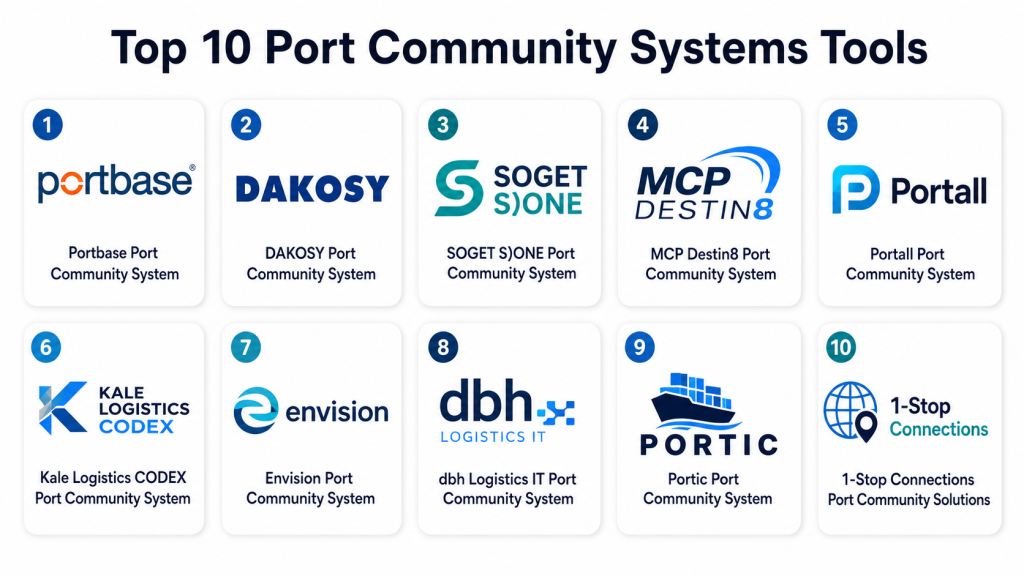
Top 10 Port Community Systems Tools
#1 — Portbase Port Community System
Short description:
Portbase Port Community System is a major digital platform used to connect organizations across the Dutch port logistics chain. It supports secure information exchange between port stakeholders such as shipping lines, terminals, freight forwarders, customs, transport companies, and logistics service providers. The system is designed to make cargo flow more efficiently through ports by reducing fragmented communication and improving process visibility. It is best suited for port communities, national gateways, and logistics ecosystems that need broad stakeholder coordination and high-volume data exchange.
Key Features
- Digital data exchange across port logistics stakeholders
- Cargo, customs, and transport process support
- Central platform for port community collaboration
- Workflow support for import, export, and transit processes
- Real-time information sharing for logistics coordination
- Integration with multiple port and supply chain participants
- Support for large-scale port community operations
Pros
- Strong recognition in port community system operations
- Useful for broad stakeholder coordination across complex ports
- Supports digitalization of key port logistics processes
Cons
- May be more suitable for organized port communities than individual companies
- Implementation depends on stakeholder participation and process alignment
- Pricing and commercial details are not publicly stated
Platforms / Deployment
Web / Cloud / Hosted port community platform
Security & Compliance
Security details should be confirmed directly with the operator or vendor. Buyers and stakeholders should ask about user authentication, access control, encryption, audit logs, data-sharing governance, and resilience.
SOC 2, ISO 27001, GDPR, HIPAA: Not publicly stated.
Integrations & Ecosystem
Portbase is designed around ecosystem connectivity, so integrations are central to its value. It works best when many participants across the port logistics chain use the platform consistently.
- Customs systems
- Terminal systems
- Shipping line workflows
- Freight forwarder systems
- Inland transport operators
- Cargo status and document exchange
Support & Community
Portbase provides community-driven support, user guidance, onboarding resources, and stakeholder engagement. Its strength depends on broad adoption by the port community and strong cooperation between public and private stakeholders.
#2 — DAKOSY Port Community System
Short description:
DAKOSY Port Community System is a well-known digital platform associated with the Port of Hamburg and broader logistics communication workflows. It connects companies and authorities involved in port and cargo handling, helping them exchange operational and regulatory information more efficiently. The system supports cross-company communication and helps improve planning across logistics, customs, terminals, carriers, and other port stakeholders. It is best suited for port communities that need a mature platform for high-volume maritime trade and coordinated information exchange.
Key Features
- Cross-company communication for port logistics
- Digital workflows for cargo and transport processes
- Customs and authority-related communication support
- Port stakeholder coordination
- Data exchange for maritime logistics operations
- Integration with logistics and transport participants
- Support for port and cargo community workflows
Pros
- Strong experience in port and logistics communication
- Useful for complex port communities with many stakeholders
- Supports digital coordination between companies and authorities
Cons
- May require port-wide stakeholder cooperation to deliver full value
- Public pricing details are not available
- Product scope may depend on selected services and regional requirements
Platforms / Deployment
Web / Hosted / Cloud or hybrid logistics communication platform
Security & Compliance
Security and compliance details should be validated directly with the vendor. Buyers should request information about access control, encryption, user permissions, audit trails, data protection, and service continuity.
SOC 2, ISO 27001, GDPR, HIPAA: Not publicly stated.
Integrations & Ecosystem
DAKOSY is built for connected logistics communities where multiple parties need to exchange structured operational and regulatory data.
- Customs systems
- Port authority systems
- Terminal systems
- Freight forwarder platforms
- Carrier and shipping systems
- Cargo and transport documentation workflows
Support & Community
DAKOSY provides specialized support for logistics and port community users. Support is mainly ecosystem-driven and focused on companies, authorities, and participants connected to the platform.
#3 — SOGET S)ONE Port Community System
Short description:
SOGET S)ONE is a Port Community System designed to support port, airport, and logistics community operations through shared digital processes. It helps port stakeholders exchange cargo, vessel, customs, and logistics information in a more coordinated way. The system is used to improve document handling, traceability, process automation, and collaboration between public and private actors. It is best for port authorities and logistics communities that want a structured platform for trade facilitation, regulatory compliance, and operational visibility.
Key Features
- Port community data exchange
- Cargo and vessel information management
- Customs and regulatory workflow support
- Traceability and process visibility
- Public-private stakeholder collaboration
- Digital document handling
- Support for port and logistics communities
Pros
- Strong fit for ports that need structured community collaboration
- Supports both operational and regulatory information flows
- Useful for improving cargo visibility and process automation
Cons
- Deployment success depends on community adoption
- May require process redesign and stakeholder onboarding
- Public pricing and some compliance details are not stated
Platforms / Deployment
Web / Cloud / Hosted / Hybrid deployment may vary by implementation
Security & Compliance
Security details should be confirmed directly with the vendor. Buyers should evaluate SSO, MFA, RBAC, audit logs, encryption, data governance, and compliance documents.
SOC 2, ISO 27001, GDPR, HIPAA: Not publicly stated.
Integrations & Ecosystem
SOGET S)ONE is designed to work across public and private port ecosystems, connecting operational, customs, and logistics data flows.
- Customs and border systems
- Terminal systems
- Port authority systems
- Freight forwarders
- Shipping agents
- Cargo tracking workflows
Support & Community
SOGET provides vendor-led implementation and customer support for port and logistics communities. Documentation, onboarding, and support services should be reviewed during procurement.
#4 — MCP Destin8 Port Community System
Short description:
MCP Destin8 is a Port Community System used for electronic information exchange in port and cargo environments. It supports digital communication between shipping lines, freight forwarders, terminals, customs, and other logistics stakeholders. The platform helps users manage cargo-related messages, clearance workflows, and operational updates. It is suitable for port communities and logistics networks that need a secure and structured way to exchange port-related information across multiple organizations.
Key Features
- Electronic port community messaging
- Cargo and customs-related information exchange
- Stakeholder communication across port logistics
- Support for import and export workflows
- Terminal and carrier communication support
- Digital process visibility
- Port community data coordination
Pros
- Practical fit for port cargo communication workflows
- Useful for reducing manual and fragmented information exchange
- Supports multiple stakeholders in the port community
Cons
- May be less suitable for companies outside port-related workflows
- Public feature and pricing details may be limited
- Full value depends on ecosystem participation
Platforms / Deployment
Web / Hosted / Cloud or hybrid platform depending on setup
Security & Compliance
Security and compliance details should be validated directly. Buyers should ask about authentication, access permissions, encryption, audit logs, data retention, and operational resilience.
SOC 2, ISO 27001, GDPR, HIPAA: Not publicly stated.
Integrations & Ecosystem
Destin8 is strongest when connected to port cargo stakeholders that need reliable data exchange and clearance-related communication.
- Customs systems
- Terminal systems
- Shipping line systems
- Freight forwarder platforms
- Port operators
- Cargo status workflows
Support & Community
Support is vendor-led and focused on port community users. Buyers should review onboarding, training, support channels, service-level expectations, and documentation availability.
#5 — Portall Port Community System
Short description:
Portall Port Community System is a digital trade and logistics platform designed to unify shipping lines, terminals, customs, port authorities, and logistics stakeholders. It focuses on smart port operations, digital process automation, and stakeholder connectivity. The platform is suitable for port authorities, government trade bodies, and logistics communities that want to improve data exchange and port performance. It can support cargo workflows, regulatory interactions, and operational visibility across the maritime ecosystem.
Key Features
- Unified platform for port stakeholders
- Shipping line, terminal, and customs connectivity
- Digital trade and logistics workflow support
- Smart port process automation
- Cargo and documentation exchange
- Operational visibility across port processes
- Support for public-private port community coordination
Pros
- Good fit for digital port transformation initiatives
- Supports multiple port and logistics stakeholders
- Useful for automation of port trade workflows
Cons
- Implementation may require government and stakeholder alignment
- Public pricing and certification details are limited
- Product scope may vary by country or port project
Platforms / Deployment
Web / Cloud / Hosted / Hybrid deployment may vary by project
Security & Compliance
Security capabilities should be verified directly with the vendor. Buyers should check access control, role-based permissions, audit logs, encryption, API security, and regulatory data handling.
SOC 2, ISO 27001, GDPR, HIPAA: Not publicly stated.
Integrations & Ecosystem
Portall is designed for digital trade ecosystems where multiple maritime and logistics systems need to connect.
- Customs systems
- Terminal operating systems
- Shipping line workflows
- Port authority systems
- Freight forwarding platforms
- Digital documentation and payment workflows
Support & Community
Portall provides vendor-led implementation and support. For public-sector or national trade projects, support planning should include stakeholder training, process change management, and long-term governance.
#6 — Kale Logistics CODEX Port Community System
Short description:
Kale Logistics CODEX is a digital platform that supports cargo community and port community processes through electronic data exchange and workflow automation. It is designed for logistics ecosystems that involve ports, cargo handlers, customs, transport operators, shipping lines, and freight forwarders. The platform helps reduce paperwork, improve visibility, and connect different stakeholders in one digital environment. It is best suited for port communities and logistics hubs that need trade facilitation, digital documentation, and multi-party collaboration.
Key Features
- Digital cargo and port community workflows
- Electronic data exchange between stakeholders
- Customs and regulatory process support
- Documentation and process automation
- Logistics visibility and cargo status support
- Multi-stakeholder collaboration
- Support for trade facilitation initiatives
Pros
- Useful for port and cargo community digitization
- Supports multi-party logistics data exchange
- Practical fit for trade and cargo workflow automation
Cons
- Exact feature set may vary by project and implementation
- Public security certification details are limited
- Full benefits depend on stakeholder adoption
Platforms / Deployment
Web / Cloud / Hosted / Hybrid options may vary
Security & Compliance
Security details should be confirmed directly with the vendor. Buyers should evaluate user access controls, data protection, audit trails, encryption, and compliance support.
SOC 2, ISO 27001, GDPR, HIPAA: Not publicly stated.
Integrations & Ecosystem
Kale Logistics CODEX is designed to connect cargo and logistics stakeholders through structured digital workflows.
- Customs systems
- Port authority platforms
- Cargo terminal systems
- Freight forwarder systems
- Transport operators
- Trade documentation workflows
Support & Community
Kale Logistics provides vendor-led support, onboarding, and implementation services. Buyers should assess training, documentation, project governance, and support models before selection.
#7 — Envision Port Community System
Short description:
Envision Port Community System is a digital platform for secure information exchange between public and private stakeholders in port communities. It is designed to support collaboration between shipping lines, agents, terminals, freight forwarders, transport operators, importers, exporters, customs, and other authorities. The platform focuses on improving coordination, reducing manual communication, and enabling smarter port logistics. It is best suited for port communities that want an open platform approach for connected maritime and logistics processes.
Key Features
- Secure information exchange for port stakeholders
- Public and private sector collaboration
- Support for shipping lines, agents, terminals, and forwarders
- Customs and authority communication support
- Digital process coordination
- Logistics data visibility
- Support for single-window style projects
Pros
- Good fit for multi-stakeholder port environments
- Supports public-private information exchange
- Useful for ports wanting improved logistics coordination
Cons
- Public pricing and compliance details are limited
- Implementation success depends on stakeholder participation
- Buyers should validate scalability for high-volume ports
Platforms / Deployment
Web / Cloud / Hosted / Varies by implementation
Security & Compliance
Security capabilities should be validated directly with the vendor. Buyers should ask about role-based access, authentication, encryption, audit logs, API security, and data governance.
SOC 2, ISO 27001, GDPR, HIPAA: Not publicly stated.
Integrations & Ecosystem
Envision PCS is built for port communities where many systems and stakeholders need to exchange operational and regulatory information.
- Customs platforms
- Terminal systems
- Shipping line systems
- Freight forwarding systems
- Road, rail, and inland transport systems
- Importer and exporter workflows
Support & Community
Envision provides vendor-led support and project assistance. Buyers should review onboarding practices, documentation, stakeholder training, and long-term operational support.
#8 — dbh Logistics IT Port Community System
Short description:
dbh Logistics IT provides port community and logistics IT solutions that support digital communication across maritime and logistics processes. Its platform capabilities are relevant for ports, customs-related workflows, shipping agents, freight forwarders, and logistics service providers. The system helps connect stakeholders and improve electronic data exchange in port and hinterland logistics. It is best suited for port communities and trade participants that need structured logistics communication, customs connectivity, and digital workflow support.
Key Features
- Port and logistics community communication
- Customs and trade process support
- Cargo and transport data exchange
- Shipping and forwarding workflow support
- Digital document handling
- Integration with logistics stakeholders
- Support for port and hinterland processes
Pros
- Strong fit for logistics and port communication workflows
- Useful for customs-related and cargo data exchange
- Supports digitalization of maritime logistics processes
Cons
- Public product details may require direct vendor clarification
- Pricing and security certification details are not publicly stated
- May require project-specific configuration
Platforms / Deployment
Web / Hosted / Cloud or hybrid deployment may vary
Security & Compliance
Security details should be validated directly with the vendor. Buyers should request information about access control, encryption, audit logs, data protection, and compliance documentation.
SOC 2, ISO 27001, GDPR, HIPAA: Not publicly stated.
Integrations & Ecosystem
dbh Logistics IT solutions are useful in connected logistics environments where customs, port, and transport systems must exchange information.
- Customs systems
- Port authority systems
- Shipping agent tools
- Freight forwarder systems
- Transport management systems
- Cargo documentation workflows
Support & Community
dbh Logistics IT provides specialized support for logistics and port users. Support quality should be reviewed based on project requirements, deployment model, and stakeholder coverage.
#9 — Portic Port Community System
Short description:
Portic is a Port Community System associated with digital services for port logistics, especially in the Barcelona port ecosystem. It supports electronic communication between port stakeholders, helping improve cargo processes, customs-related workflows, and logistics coordination. The platform is suitable for port communities that need a shared digital environment for shipping, freight forwarding, terminal, and transport processes. It is best for stakeholders seeking better visibility and coordination within a specific port logistics community.
Key Features
- Port community digital services
- Cargo and logistics workflow support
- Electronic communication between stakeholders
- Shipping and freight forwarding process support
- Customs and documentation workflow support
- Terminal and transport coordination
- Port-specific process visibility
Pros
- Practical fit for port community collaboration
- Helps reduce manual communication in port logistics
- Supports stakeholders working within connected port workflows
Cons
- May be more region-specific than global commercial platforms
- Public pricing and security details are limited
- Full value depends on local ecosystem adoption
Platforms / Deployment
Web / Hosted / Cloud or hybrid model may vary
Security & Compliance
Security and compliance details should be confirmed directly. Buyers should review authentication, user roles, audit logs, encryption, data-sharing rules, and service continuity.
SOC 2, ISO 27001, GDPR, HIPAA: Not publicly stated.
Integrations & Ecosystem
Portic is useful for port ecosystems where many stakeholders need shared information and workflow coordination.
- Shipping line systems
- Freight forwarder systems
- Terminal systems
- Customs workflows
- Transport operators
- Port logistics documentation
Support & Community
Support is focused on the connected port community and participating stakeholders. Buyers should review onboarding, user assistance, process documentation, and service-level expectations.
#10 — 1-Stop Connections Port Community Solutions
Short description:
1-Stop Connections provides digital solutions for port, terminal, transport, and logistics communities. Its port community capabilities are useful for managing truck appointments, terminal access, cargo visibility, and stakeholder coordination. The platform is especially relevant for ports and logistics networks that need better landside planning and operational efficiency. It is best suited for port communities, terminal operators, transport companies, and logistics providers that want improved scheduling, visibility, and digital coordination.
Key Features
- Port and terminal community solutions
- Truck appointment and vehicle booking support
- Cargo visibility workflows
- Terminal access coordination
- Transport operator connectivity
- Digital communication between logistics stakeholders
- Support for port landside efficiency
Pros
- Strong fit for landside and terminal coordination
- Useful for reducing congestion and improving truck planning
- Practical for ports and terminals with transport-heavy workflows
Cons
- May not cover every traditional PCS workflow in all regions
- Public compliance and pricing details are limited
- Buyers should validate customs and regulatory integration needs
Platforms / Deployment
Web / Cloud / Hosted / Mobile access may vary
Security & Compliance
Security details should be verified directly with the vendor. Buyers should ask about access control, user authentication, encryption, audit logs, data protection, and uptime practices.
SOC 2, ISO 27001, GDPR, HIPAA: Not publicly stated.
Integrations & Ecosystem
1-Stop Connections is valuable where terminals, transport operators, and port users need digital coordination and appointment visibility.
- Terminal operating systems
- Truck appointment systems
- Transport operator platforms
- Cargo visibility tools
- Gate access workflows
- Port community communication systems
Support & Community
1-Stop Connections provides vendor-led support for port, terminal, and logistics users. Buyers should review training, implementation help, support channels, and community adoption in their target port region.
Comparison Table
| Tool Name | Best For | Platform(s) Supported | Deployment | Standout Feature | Public Rating |
|---|---|---|---|---|---|
| Portbase Port Community System | Large national port logistics communities | Web | Cloud / Hosted | Broad stakeholder data exchange across Dutch ports | N/A |
| DAKOSY Port Community System | Complex port and logistics communication | Web | Hosted / Cloud / Hybrid | Cross-company communication for port and cargo workflows | N/A |
| SOGET S)ONE Port Community System | Public-private port collaboration | Web | Cloud / Hosted / Hybrid | Cargo, customs, and stakeholder process coordination | N/A |
| MCP Destin8 Port Community System | Cargo messaging and port data exchange | Web | Hosted / Cloud / Hybrid | Electronic cargo and customs-related communication | N/A |
| Portall Port Community System | Smart port and trade facilitation projects | Web | Cloud / Hosted / Hybrid | Unified platform for shipping, terminals, and customs | N/A |
| Kale Logistics CODEX Port Community System | Cargo and trade workflow digitization | Web | Cloud / Hosted / Hybrid | Digital cargo community and port community automation | N/A |
| Envision Port Community System | Open multi-stakeholder port collaboration | Web | Cloud / Hosted / Varies | Secure public-private information exchange | N/A |
| dbh Logistics IT Port Community System | Port and logistics data communication | Web | Hosted / Cloud / Hybrid | Customs and logistics process connectivity | N/A |
| Portic Port Community System | Port-specific logistics collaboration | Web | Hosted / Cloud / Hybrid | Digital services for port cargo stakeholders | N/A |
| 1-Stop Connections Port Community Solutions | Landside, terminal, and transport coordination | Web / Varies | Cloud / Hosted | Truck appointment and terminal access coordination | N/A |
Evaluation & Scoring of Port Community Systems
| Tool Name | Core (25%) | Ease (15%) | Integrations (15%) | Security (10%) | Performance (10%) | Support (10%) | Value (15%) | Weighted Total (0–10) |
|---|---|---|---|---|---|---|---|---|
| Portbase Port Community System | 9 | 8 | 9 | 8 | 9 | 8 | 8 | 8.45 |
| DAKOSY Port Community System | 9 | 7 | 9 | 8 | 9 | 8 | 8 | 8.30 |
| SOGET S)ONE Port Community System | 9 | 7 | 8 | 7 | 8 | 8 | 8 | 7.95 |
| MCP Destin8 Port Community System | 8 | 8 | 8 | 7 | 8 | 7 | 8 | 7.75 |
| Portall Port Community System | 8 | 8 | 8 | 7 | 8 | 7 | 8 | 7.75 |
| Kale Logistics CODEX Port Community System | 8 | 8 | 8 | 7 | 8 | 7 | 8 | 7.75 |
| Envision Port Community System | 8 | 8 | 7 | 7 | 7 | 7 | 8 | 7.45 |
| dbh Logistics IT Port Community System | 8 | 7 | 8 | 7 | 8 | 7 | 7 | 7.50 |
| Portic Port Community System | 7 | 8 | 7 | 7 | 7 | 7 | 8 | 7.30 |
| 1-Stop Connections Port Community Solutions | 7 | 8 | 7 | 7 | 8 | 7 | 8 | 7.45 |
These scores are comparative and should be used as a practical shortlist guide. A high score does not mean one platform is the universal best choice. Port Community Systems are deeply tied to local trade rules, customs systems, port processes, and stakeholder participation. Buyers should validate local fit, integration requirements, governance model, security documents, and implementation support before selecting a platform.
Which Port Community System Tool Is Right for You?
Solo / Freelancer
A solo consultant, trade advisor, or logistics analyst usually does not need to purchase a full Port Community System. However, understanding platforms such as Portbase, DAKOSY, SOGET, Portall, and Kale Logistics can help when advising ports, customs bodies, logistics communities, or government trade projects.
For independent consultants, the focus should be on process mapping, stakeholder readiness, data standards, digital documentation, and integration planning. A PCS project is not just a software purchase. It is a community transformation project that requires governance, cooperation, and trust between many organizations.
SMB
Small logistics companies, freight forwarders, transport operators, and warehouse providers usually do not buy a full Port Community System. Instead, they connect to an existing PCS operated by the local port community, authority, or technology provider.
For SMB users, the most important criteria are ease of onboarding, simple user interface, affordable transaction pricing, support availability, documentation clarity, and smooth integration with internal transport or freight systems. If a smaller port is planning its first PCS, it should start with essential workflows such as cargo status, document submission, truck appointments, customs updates, and terminal coordination.
Mid-Market
Mid-sized ports, regional gateways, logistics clusters, and growing trade communities need a PCS that balances practical deployment with strong integration capability. Solutions such as Portall, Kale Logistics CODEX, Envision PCS, dbh Logistics IT, Portic, and 1-Stop Connections may be relevant depending on region and workflow needs.
Mid-market buyers should focus on modular adoption. Instead of trying to digitize every process at once, they can begin with high-value workflows such as import release, export documentation, terminal appointment management, e-payments, cargo visibility, and customs connectivity.
Enterprise
Large ports, national gateways, and multi-port communities need highly scalable, secure, and governance-ready systems. Portbase, DAKOSY, SOGET S)ONE, MCP Destin8, and Portall can be strong reference points for enterprise-scale PCS thinking.
Enterprise buyers should evaluate stakeholder coverage, high-volume performance, interoperability, API maturity, cybersecurity controls, auditability, disaster recovery, customs integration, and long-term governance. For large ecosystems, the technology is only one part of success. Adoption by shipping lines, terminals, forwarders, customs, transport companies, and authorities is equally important.
Budget vs Premium
Budget-conscious port communities should focus on essential workflows first. Start with digital documentation, cargo status visibility, customs message exchange, terminal appointment support, and user onboarding. A smaller PCS project can grow over time if the foundation is strong.
Premium or enterprise buyers should invest in deeper integration, real-time dashboards, advanced analytics, API frameworks, high availability, data governance, and multi-stakeholder automation. Larger ports usually need a more mature governance structure and stronger vendor implementation support.
Feature Depth vs Ease of Use
Feature-rich platforms are powerful but may require more process redesign, stakeholder training, and integration work. Platforms such as Portbase, DAKOSY, SOGET, and MCP Destin8 are strong examples of mature community platforms, but similar deployments require strong ecosystem participation.
Ease-focused buyers should look for simple onboarding, role-based workflows, clean dashboards, transaction clarity, and guided documentation. For first-time PCS projects, user adoption is often more important than having every advanced feature from day one.
Integrations & Scalability
A Port Community System must connect many systems. These may include customs platforms, terminal operating systems, shipping line systems, freight forwarder platforms, transport management systems, warehouse systems, banking systems, port authority systems, and government platforms.
For scalability, buyers should evaluate API readiness, message standards, event-driven updates, uptime commitments, performance under high transaction volume, data ownership rules, and ability to support additional ports or stakeholders over time.
Security & Compliance Needs
Port Community Systems handle sensitive trade, cargo, vessel, customs, commercial, and operational information. Strong security is essential because the platform becomes a shared digital infrastructure for public and private stakeholders.
Buyers should ask vendors about MFA, SSO, RBAC, audit logs, encryption, API security, data retention, data residency, disaster recovery, access governance, vulnerability management, and incident response. If security certifications are not publicly stated, request official documentation during procurement.
Frequently Asked Questions
1. What is a Port Community System?
A Port Community System is a shared digital platform that connects different organizations involved in port and logistics operations. It helps port authorities, customs, terminals, shipping lines, freight forwarders, transport companies, and other stakeholders exchange information securely and efficiently.
2. Why do ports need a Port Community System?
Ports need a PCS to reduce paperwork, speed up cargo movement, improve visibility, simplify customs coordination, and reduce communication gaps. It helps many independent organizations work from a shared digital process instead of relying on emails, phone calls, and manual documents.
3. Is a Port Community System the same as a Maritime Single Window?
No, they are related but not always the same. A Maritime Single Window usually focuses on regulatory reporting for vessel arrival, stay, and departure. A Port Community System is broader and often supports commercial, logistics, customs, cargo, terminal, and transport workflows.
4. How much does a Port Community System cost?
Pricing varies based on country, port size, number of stakeholders, selected modules, transaction volume, integrations, hosting model, and support scope. Many PCS projects are priced through custom agreements because they involve community-wide implementation.
5. Who owns a Port Community System?
Ownership depends on the port model. A PCS may be owned or governed by a port authority, public-private partnership, government body, specialized technology operator, or port community organization. Governance is important because many stakeholders share data through the platform.
6. How long does PCS implementation take?
Implementation time depends on stakeholder readiness, process complexity, customs integration, data standards, legal requirements, training, and migration from manual workflows. Smaller projects may start with a few modules, while national or large-port projects often require phased rollout.
7. What are the most important features in a PCS?
Important features include cargo status visibility, customs integration, document exchange, terminal coordination, truck appointments, vessel call support, payment workflows, role-based access, audit logs, APIs, reporting, alerts, and stakeholder onboarding tools.
8. Can a small port use a Port Community System?
Yes, small ports can use a PCS, but they should start with essential workflows rather than a large complex platform. A simple PCS can support cargo visibility, documentation, customs updates, terminal communication, and transport coordination.
9. What mistakes should ports avoid when choosing a PCS?
Common mistakes include treating PCS as only an IT project, ignoring stakeholder adoption, underestimating integration work, failing to redesign manual processes, skipping data governance, and choosing features without understanding actual port workflow pain points.
10. How secure are Port Community Systems?
A PCS can be secure when designed with strong access control, encryption, audit logs, user roles, secure APIs, and proper data governance. Buyers should always request detailed security documentation before selecting or joining a platform.
Conclusion
Port Community Systems are becoming essential digital infrastructure for ports that want faster cargo movement, better stakeholder coordination, stronger compliance, and improved supply chain visibility. The right PCS depends on the port’s size, trade volume, stakeholder maturity, customs environment, integration needs, governance model, and long-term digital strategy. Large national gateways may need mature and highly integrated platforms, while smaller ports may begin with focused modules for documentation, cargo visibility, customs updates, and transport coordination. The best choice is not always the biggest system. It is the platform that fits the community’s real workflows and gains strong stakeholder adoption.
