Upgrade & Secure Your Future with DevOps, SRE, DevSecOps, MLOps!
We spend hours scrolling social media and waste money on things we forget, but won’t spend 30 minutes a day earning certifications that can change our lives.
Master in DevOps, SRE, DevSecOps & MLOps by DevOps School!
Learn from Guru Rajesh Kumar and double your salary in just one year.
Introduction
Airline crew scheduling tools help airlines plan, assign, manage, and adjust pilot and cabin crew duties across flights, routes, bases, aircraft types, and operational changes. In plain English, these tools make sure the right crew member is available for the right flight while following rest rules, duty limits, training requirements, qualifications, labor agreements, and safety regulations.
For modern airlines, crew scheduling is no longer a simple calendar task. Airlines now deal with complex route networks, crew shortages, weather disruptions, aircraft changes, flight delays, compliance pressure, and crew satisfaction challenges. A strong crew scheduling platform helps reduce manual work, improve operational reliability, control costs, and keep crew schedules legal and practical.
Common use cases include crew pairing, roster planning, reserve crew management, disruption recovery, crew communication, qualification tracking, training schedule alignment, payroll support, and compliance reporting.
Buyers should evaluate:
- Crew pairing and rostering capability
- Regulatory compliance support
- Fatigue risk management
- Disruption recovery tools
- Mobile crew access
- Crew preference and bidding support
- Integration with airline operations systems
- Reporting and analytics
- Scalability across fleets and bases
- Vendor support and aviation experience
Best for: Airlines, regional carriers, low-cost carriers, charter operators, crew planning teams, operations control teams, pilot scheduling teams, cabin crew managers, and aviation groups with complex crew planning needs.
Not ideal for: Very small aviation operators with simple schedules, companies that only need basic staff shift planning, or teams that do not need aviation-specific compliance, crew legality, and qualification tracking.
Key Trends in Airline Crew Scheduling Tools
- AI-assisted scheduling is becoming more practical as airlines look for faster ways to create legal, cost-efficient, and crew-friendly schedules.
- Disruption recovery is now a priority because delays, weather issues, aircraft changes, and cancellations can quickly impact crew legality and passenger service.
- Crew fatigue management is getting more attention as airlines focus on safety, wellness, duty limits, and sustainable workforce planning.
- Mobile-first crew communication is expected because crew members need instant access to roster updates, duty changes, alerts, and acknowledgements.
- Crew preference and bidding systems are growing as airlines try to improve crew satisfaction while still meeting operational needs.
- Cloud and hybrid deployment models are becoming more common because airlines want scalability, faster updates, and lower infrastructure complexity.
- Integration with airline operations systems is essential because crew planning must connect with flight operations, HR, payroll, training, OCC, and reporting tools.
- Compliance automation is becoming deeper as airlines manage different regulations, labor agreements, crew groups, route networks, and base-specific rules.
- Data analytics is improving planning decisions by helping teams measure crew utilization, schedule stability, disruption cost, reserve usage, and operational risk.
- Scenario planning is becoming more valuable because airlines want to test different schedule models before disruption happens.
How We Selected These Tools
The tools in this list were selected based on practical airline technology evaluation factors, including:
- Recognition in airline crew planning, rostering, and crew management markets
- Feature depth for crew pairing, rostering, tracking, and disruption handling
- Suitability for commercial airlines, regional airlines, and aviation operators
- Ability to support aviation-specific compliance and crew legality rules
- Integration potential with airline operations, training, HR, payroll, and OCC systems
- Scalability across crew bases, fleets, routes, and crew types
- Support for crew communication and mobile access
- Vendor maturity and aviation industry experience
- Flexibility for different airline operating models
- Fit across enterprise, mid-market, and smaller aviation environments
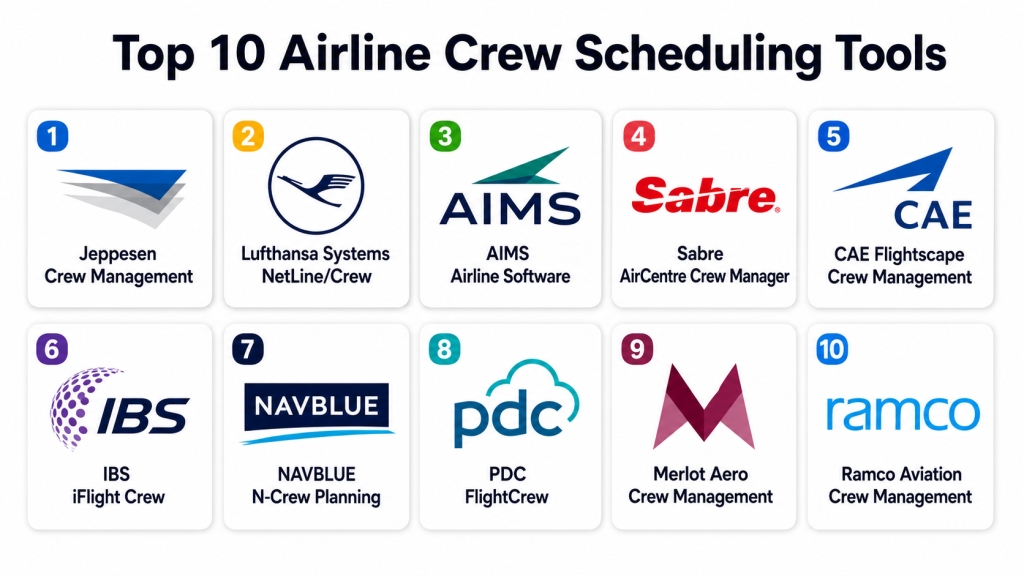
Top 10 Airline Crew Scheduling Tools
1 — Jeppesen Crew Management
Short description:
Jeppesen Crew Management is a well-known airline crew planning and optimization platform designed for complex airline environments. It helps airlines manage crew pairing, rostering, legality checks, and operational planning. The platform is suitable for airlines with multiple crew bases, different fleet types, labor rules, and large-scale scheduling needs. It is often used by teams that need strong optimization logic and reliable planning support. Jeppesen is best suited for airlines that require advanced planning depth instead of simple roster management.
Key Features
- Crew pairing optimization
- Crew rostering and duty planning
- Legality and rule-based scheduling
- Scenario planning and what-if analysis
- Disruption recovery support
- Qualification-aware scheduling
- Planning support for large airline networks
Pros
- Strong optimization capability for complex airline schedules
- Suitable for large and multi-base airline operations
- Mature aviation-focused platform
Cons
- May require significant implementation planning
- Can be complex for smaller operators
- Pricing details are not publicly stated
Platforms / Deployment
Web / Windows / Cloud / Hybrid / Varies
Security & Compliance
SSO/SAML, MFA, encryption, audit logs, RBAC, SOC 2, ISO 27001, GDPR, HIPAA: Not publicly stated.
Integrations & Ecosystem
Jeppesen Crew Management is generally used as part of a wider airline operations ecosystem where crew planning, flight schedules, and operational control need to work together.
- Flight operations systems
- Airline operations control systems
- Crew tracking systems
- Training and qualification records
- HR and payroll platforms
- Reporting and analytics tools
Support & Community
Jeppesen provides enterprise-level aviation software support and implementation services. Documentation, onboarding, and support levels usually depend on airline size, selected modules, and contract scope.
2 — Lufthansa Systems NetLine/Crew
Short description:
Lufthansa Systems NetLine/Crew is a crew management solution designed for airline planning, tracking, and operational control. It supports crew pairing, rostering, disruption handling, and legality management. The platform is useful for airlines that need strong integration between crew planning and airline operations. It is especially suitable for complex carriers that manage multiple bases, crew groups, and operational changes. NetLine/Crew is a good fit for airlines seeking a mature aviation operations platform.
Key Features
- Crew pairing and rostering
- Crew tracking and duty management
- Disruption management support
- Legality and compliance checks
- Fatigue-aware planning support
- Scenario and operational planning
- Integration with airline operations systems
Pros
- Strong airline operations focus
- Suitable for complex airline networks
- Supports planning and day-of-operations workflows
Cons
- May be too advanced for very small operators
- Implementation can require process alignment
- Pricing is not publicly stated
Platforms / Deployment
Web / Cloud / Hybrid / Varies
Security & Compliance
SSO/SAML, MFA, encryption, audit logs, RBAC, SOC 2, ISO 27001, GDPR, HIPAA: Not publicly stated.
Integrations & Ecosystem
NetLine/Crew is designed to connect crew planning with broader airline operations and network control workflows.
- Operations control systems
- Flight scheduling tools
- Crew planning modules
- Crew tracking systems
- HR and payroll platforms
- Reporting tools
Support & Community
Lufthansa Systems provides aviation-focused enterprise support, onboarding, and consulting. Support availability and service levels usually depend on the customer agreement and implementation scope.
3 — AIMS Airline Software
Short description:
AIMS Airline Software is an airline operations and crew management platform used by carriers to manage crew scheduling, operational control, and compliance workflows. It helps airlines plan crew duties, track availability, manage schedule changes, and support day-to-day operations. AIMS can be a practical choice for regional airlines, mid-sized airlines, and growing operators. It offers aviation-specific functionality rather than generic shift planning. The platform is useful for teams that want scheduling, tracking, and operational visibility in one system.
Key Features
- Crew scheduling and roster management
- Crew legality and compliance checks
- Day-of-operations crew tracking
- Disruption handling
- Crew records management
- Qualification tracking
- Operational reporting
Pros
- Practical for regional and mid-sized airlines
- Supports daily crew planning and tracking
- Good fit for aviation-specific workflows
Cons
- Advanced optimization depth should be evaluated during demo
- User experience may vary by implementation
- Public security certifications are not clearly stated
Platforms / Deployment
Web / Cloud / Hybrid / Varies
Security & Compliance
SSO/SAML, MFA, encryption, audit logs, RBAC, SOC 2, ISO 27001, GDPR, HIPAA: Not publicly stated.
Integrations & Ecosystem
AIMS can connect crew planning with airline operations, flight schedules, records, and reporting workflows.
- Flight operations systems
- Crew records
- Payroll exports
- HR systems
- Training records
- Operations reporting tools
Support & Community
AIMS provides vendor-led onboarding and support. Documentation, support tiers, and implementation assistance depend on the airline’s selected package and contract.
4 — Sabre AirCentre Crew Manager
Short description:
Sabre AirCentre Crew Manager supports airline crew planning, crew tracking, and operational recovery. It is part of Sabre’s broader airline technology ecosystem and is useful for airlines that want crew scheduling connected with wider airline operations. The tool helps operations teams manage crew legality, schedule changes, disruptions, and crew assignments. It is especially relevant for airlines already using Sabre systems. Sabre AirCentre Crew Manager is best suited for carriers needing enterprise-level crew operations support.
Key Features
- Crew planning and scheduling
- Crew tracking and operational visibility
- Disruption recovery workflows
- Legality and compliance support
- Crew communication support
- Integration with airline operations tools
- Reporting and decision support
Pros
- Strong ecosystem fit for Sabre users
- Useful for operational control environments
- Supports enterprise airline workflows
Cons
- Best value may come with broader Sabre ecosystem use
- Implementation can be complex
- Public security and pricing details are limited
Platforms / Deployment
Web / Cloud / Hybrid / Varies
Security & Compliance
SSO/SAML, MFA, encryption, audit logs, RBAC, SOC 2, ISO 27001, GDPR, HIPAA: Not publicly stated.
Integrations & Ecosystem
Sabre AirCentre Crew Manager works well when connected with broader airline operations and commercial systems.
- Sabre airline operations tools
- Flight operations systems
- Crew tracking systems
- Reservation and planning environments
- HR and payroll systems
- Reporting platforms
Support & Community
Sabre provides enterprise support, onboarding, and professional services. Support quality and availability depend on contract type, modules used, and implementation complexity.
5 — CAE Flightscape Crew Management
Short description:
CAE Flightscape Crew Management supports crew planning, scheduling, training alignment, and qualification-aware crew workflows. CAE has a strong aviation training background, making this platform relevant for airlines that need crew scheduling connected with training and qualification data. The tool is useful for operators that want to improve crew productivity while maintaining compliance and readiness. It can support planning teams, training departments, and operations teams. CAE Flightscape Crew Management is suitable for airlines with structured training and crew qualification needs.
Key Features
- Crew roster planning
- Pairing and scheduling support
- Training and qualification alignment
- Crew legality management
- Fatigue-aware planning support
- Operational reporting
- Analytics and decision support
Pros
- Strong aviation training ecosystem connection
- Useful for qualification-heavy operations
- Helps connect crew planning with training readiness
Cons
- May be more suitable for airlines with formal training workflows
- Deployment details may vary
- Public pricing and certifications are not clearly stated
Platforms / Deployment
Web / Cloud / Hybrid / Varies
Security & Compliance
SSO/SAML, MFA, encryption, audit logs, RBAC, SOC 2, ISO 27001, GDPR, HIPAA: Not publicly stated.
Integrations & Ecosystem
CAE Flightscape Crew Management is useful where crew scheduling, training records, and qualification tracking need to work together.
- CAE training systems
- Crew qualification records
- Flight operations tools
- Training management systems
- HR platforms
- Reporting and analytics systems
Support & Community
CAE offers aviation-focused enterprise support and onboarding. Support levels, documentation, and training depend on the purchased solution and customer agreement.
6 — IBS iFlight Crew
Short description:
IBS iFlight Crew is part of the iFlight airline operations platform and supports crew planning, management, tracking, and disruption workflows. It is designed for airlines that want crew scheduling connected with real-time operations and broader airline performance. The platform helps teams improve visibility, automate workflows, and manage crew-related operational changes. It is suitable for airlines that need a modern crew management system with integration depth. IBS iFlight Crew works well for carriers looking for scalable airline operations technology.
Key Features
- Crew planning and management
- Real-time operational visibility
- Crew optimization support
- Disruption management
- Compliance workflow automation
- Integration with airline operations modules
- Analytics and decision support
Pros
- Strong integrated airline operations approach
- Good for real-time crew visibility
- Suitable for growing and large airlines
Cons
- Full value may depend on broader iFlight adoption
- Implementation planning is important
- Public certification details are not clearly stated
Platforms / Deployment
Web / Cloud / Hybrid / Varies
Security & Compliance
SSO/SAML, MFA, encryption, audit logs, RBAC, SOC 2, ISO 27001, GDPR, HIPAA: Not publicly stated.
Integrations & Ecosystem
IBS iFlight Crew is designed to connect crew management with wider airline operations and decision support workflows.
- iFlight operations modules
- Operations control systems
- Crew tracking tools
- Flight operations systems
- HR and payroll systems
- Analytics platforms
Support & Community
IBS provides enterprise software support, onboarding, and implementation services. Documentation and support tiers usually depend on the airline’s contract and selected modules.
7 — NAVBLUE N-Crew Planning
Short description:
NAVBLUE N-Crew Planning is designed to support crew planning, preferential bidding, schedule generation, and crew preference management. It helps airlines balance crew satisfaction with legality, coverage, productivity, and business rules. The platform is useful for airlines that use seniority-based or preference-driven scheduling models. It gives planners better control over schedule fairness and rule-based roster creation. NAVBLUE N-Crew Planning is especially useful for airlines focused on transparent crew schedule awards.
Key Features
- Preferential bidding support
- Crew schedule generation
- Crew preference management
- Seniority and rule-based planning
- Qualification-aware scheduling
- Coverage and productivity balancing
- Schedule award explanation support
Pros
- Strong fit for preference-based scheduling
- Supports crew transparency and satisfaction
- Useful for balancing operational and crew needs
Cons
- Best suited for airlines using bidding models
- Requires careful rule configuration
- Public security details are limited
Platforms / Deployment
Web / Cloud / Varies
Security & Compliance
SSO/SAML, MFA, encryption, audit logs, RBAC, SOC 2, ISO 27001, GDPR, HIPAA: Not publicly stated.
Integrations & Ecosystem
NAVBLUE N-Crew Planning works well where crew preferences, bidding, pairings, and scheduling rules need to be connected.
- Crew bidding systems
- Pairing optimizers
- Crew planning databases
- Training records
- Airline operations tools
- Reporting systems
Support & Community
NAVBLUE provides aviation software support and customer onboarding. Support model, documentation, and training availability depend on the selected solution and airline agreement.
8 — PDC FlightCrew
Short description:
PDC FlightCrew is part of the PDC Airline Suite and supports flight crew scheduling, crew dispatch, and operational planning. It is useful for airlines and aviation operators that want crew scheduling connected with flight schedules and day-of-operations workflows. The platform can support crew assignments, operational monitoring, and schedule updates. It may be suitable for airlines, general aviation operators, and helicopter operators. PDC FlightCrew is a practical option for teams that want integrated planning rather than disconnected scheduling tools.
Key Features
- Flight crew scheduling
- Crew dispatch support
- Flight scheduling integration
- Operations control support
- Real-time monitoring
- Crew records support
- Planning and reporting tools
Pros
- Good fit for integrated airline planning
- Connects crew scheduling with flight operations
- Useful for aviation operators with practical scheduling needs
Cons
- Advanced optimization depth should be validated
- May have less market visibility than larger enterprise vendors
- Public certification details are not clearly stated
Platforms / Deployment
Web / Cloud / Hybrid / Varies
Security & Compliance
SSO/SAML, MFA, encryption, audit logs, RBAC, SOC 2, ISO 27001, GDPR, HIPAA: Not publicly stated.
Integrations & Ecosystem
PDC FlightCrew works best when used with other airline planning and operations tools.
- PDC airline modules
- Flight scheduling systems
- Crew dispatch workflows
- Operations control tools
- Reporting systems
- HR and payroll exports
Support & Community
PDC provides vendor-led onboarding and support. Documentation, training, and service levels usually depend on the selected modules and implementation agreement.
9 — Merlot Aero Crew Management
Short description:
Merlot Aero Crew Management helps airlines manage crew scheduling, tracking, communication, and operational workflows. It supports distributed crew operations through mobile and portal-based access. Crew members can view schedules, receive alerts, manage updates, and stay connected with operations teams. The platform is useful for airlines that want stronger crew engagement and better schedule visibility. Merlot Aero is a good fit for airlines that value communication, mobility, and practical crew management workflows.
Key Features
- Crew scheduling and tracking
- Mobile crew access
- Duty and preference management
- Training and document tracking
- Schedule change notifications
- Crew communication workflows
- Operational alerts
Pros
- Strong mobile crew engagement
- Useful for distributed crew teams
- Helps improve schedule communication
Cons**
- Advanced optimization depth should be reviewed
- Best fit depends on airline workflow complexity
- Public security certifications are not clearly stated
Platforms / Deployment
Web / iOS / Android / Cloud / Varies
Security & Compliance
SSO/SAML, MFA, encryption, audit logs, RBAC, SOC 2, ISO 27001, GDPR, HIPAA: Not publicly stated.
Integrations & Ecosystem
Merlot Aero is useful where crew scheduling must connect with communication, training records, and mobile crew self-service.
- Crew mobile app
- Crew portal
- Training systems
- HR and payroll systems
- Operations workflows
- Travel and accommodation tools
Support & Community
Merlot Aero provides vendor-led implementation and support. Airlines should review documentation, support tiers, onboarding process, and service-level expectations before selection.
10 — Ramco Aviation Crew Management
Short description:
Ramco Aviation Crew Management is part of Ramco’s aviation software ecosystem and supports crew management, workforce workflows, compliance records, and operational coordination. It is useful for aviation organizations that want crew management connected with MRO, HR, payroll, and enterprise systems. The platform can help airlines manage crew-related processes as part of a wider aviation business system. It is a good fit for companies that need more than standalone crew scheduling. Ramco Aviation Crew Management is especially relevant for aviation enterprises with broad operational workflows.
Key Features
- Crew management workflows
- Mobile access support
- Aviation operations integration
- Compliance and records support
- Enterprise workflow automation
- Reporting and analytics
- Integration with MRO and HR systems
Pros
- Good fit for broader aviation enterprise needs
- Useful when crew workflows connect with MRO and HR
- Supports workflow automation
Cons
- May be broader than pure crew scheduling needs
- Implementation scope can be larger
- Public ratings and certifications are not clearly stated
Platforms / Deployment
Web / Mobile / Cloud / Hybrid / Varies
Security & Compliance
SSO/SAML, MFA, encryption, audit logs, RBAC, SOC 2, ISO 27001, GDPR, HIPAA: Not publicly stated.
Integrations & Ecosystem
Ramco Aviation Crew Management works well when crew processes need to connect with aviation enterprise systems.
- Ramco Aviation modules
- MRO systems
- HR and payroll systems
- Operations systems
- Mobile workforce tools
- Reporting and analytics platforms
Support & Community
Ramco provides enterprise onboarding, implementation, and support services. Support quality depends on region, contract scope, implementation partner involvement, and selected modules.
Comparison Table
| Tool Name | Best For | Platform(s) Supported | Deployment | Standout Feature | Public Rating |
|---|---|---|---|---|---|
| Jeppesen Crew Management | Large airlines and complex crew planning | Web / Windows / Varies | Cloud / Hybrid | Advanced crew pairing optimization | N/A |
| Lufthansa Systems NetLine/Crew | Enterprise airline crew planning | Web / Varies | Cloud / Hybrid | Integrated crew planning and tracking | N/A |
| AIMS Airline Software | Regional and mid-sized airlines | Web / Varies | Cloud / Hybrid | Practical crew scheduling and tracking | N/A |
| Sabre AirCentre Crew Manager | Airlines using Sabre ecosystem | Web / Varies | Cloud / Hybrid | Crew operations connected with airline systems | N/A |
| CAE Flightscape Crew Management | Airlines with training-heavy operations | Web / Varies | Cloud / Hybrid | Crew planning linked with qualification data | N/A |
| IBS iFlight Crew | Airlines needing integrated operations | Web / Varies | Cloud / Hybrid | Real-time crew and operations visibility | N/A |
| NAVBLUE N-Crew Planning | Airlines using crew bidding models | Web / Varies | Cloud / Varies | Preference-based schedule generation | N/A |
| PDC FlightCrew | Aviation operators needing integrated planning | Web / Varies | Cloud / Hybrid | Flight scheduling and crew dispatch connection | N/A |
| Merlot Aero Crew Management | Airlines needing mobile crew engagement | Web / iOS / Android / Varies | Cloud / Varies | Crew mobile access and communication | N/A |
| Ramco Aviation Crew Management | Aviation enterprises with broad workflows | Web / Mobile / Varies | Cloud / Hybrid | Crew workflows connected with enterprise systems | N/A |
Evaluation & Scoring of Airline Crew Scheduling Tools
| Tool Name | Core (25%) | Ease (15%) | Integrations (15%) | Security (10%) | Performance (10%) | Support (10%) | Value (15%) | Weighted Total (0–10) |
|---|---|---|---|---|---|---|---|---|
| Jeppesen Crew Management | 10 | 7 | 9 | 7 | 9 | 9 | 7 | 8.45 |
| Lufthansa Systems NetLine/Crew | 9 | 7 | 9 | 7 | 9 | 9 | 7 | 8.25 |
| AIMS Airline Software | 8 | 8 | 7 | 6 | 8 | 8 | 8 | 7.65 |
| Sabre AirCentre Crew Manager | 9 | 7 | 9 | 7 | 8 | 8 | 7 | 8.00 |
| CAE Flightscape Crew Management | 8 | 7 | 8 | 6 | 8 | 8 | 7 | 7.45 |
| IBS iFlight Crew | 9 | 8 | 9 | 7 | 8 | 8 | 8 | 8.20 |
| NAVBLUE N-Crew Planning | 8 | 8 | 7 | 6 | 8 | 7 | 8 | 7.55 |
| PDC FlightCrew | 7 | 8 | 7 | 6 | 7 | 7 | 8 | 7.25 |
| Merlot Aero Crew Management | 7 | 8 | 7 | 6 | 7 | 7 | 8 | 7.25 |
| Ramco Aviation Crew Management | 8 | 7 | 8 | 7 | 8 | 8 | 8 | 7.80 |
The scoring is comparative and should be used as a shortlist guide, not a final buying decision. A higher score does not automatically mean the tool is best for every airline. Large airlines may value optimization depth, while smaller airlines may prefer ease of use and faster implementation. Security scores are conservative where public details are not clearly stated. Buyers should validate features, integrations, compliance, and pricing directly during vendor evaluation.
Which Airline Crew Scheduling Tool Is Right for You?
Solo / Freelancer
Airline crew scheduling tools are usually not designed for solo users or freelancers. However, aviation consultants, independent schedulers, or small charter advisors may still evaluate simpler tools when supporting smaller operators.
For this type of user, the best choice is usually a practical tool with clean reporting, schedule visibility, and export options instead of a heavy enterprise optimization platform.
SMB
Small and mid-sized airlines need tools that can manage legality, availability, crew assignments, and schedule changes without making the process too complex. AIMS Airline Software, PDC FlightCrew, Merlot Aero Crew Management, and NAVBLUE N-Crew Planning may be suitable depending on the scheduling model.
SMBs should focus on ease of setup, mobile access, crew communication, compliance checks, reporting, and affordable support.
Mid-Market
Mid-market airlines usually need stronger automation, better integration, and more structured disruption recovery. IBS iFlight Crew, AIMS Airline Software, Ramco Aviation Crew Management, CAE Flightscape Crew Management, and NAVBLUE N-Crew Planning can be suitable depending on operational requirements.
Mid-market buyers should look for crew pairing support, roster quality, training alignment, disruption management, and integration with HR, payroll, OCC, and flight operations systems.
Enterprise
Enterprise airlines need scalable optimization, multi-base planning, complex compliance rules, strong vendor support, and high operational reliability. Jeppesen Crew Management, Lufthansa Systems NetLine/Crew, Sabre AirCentre Crew Manager, and IBS iFlight Crew are strong candidates for large airline environments.
Enterprise buyers should prioritize scalability, advanced rule configuration, operational resilience, global compliance, vendor maturity, and integration with core airline systems.
Budget vs Premium
Budget-focused airlines should not choose a large enterprise platform unless they truly need advanced optimization and complex integration. AIMS, PDC FlightCrew, Merlot Aero, and NAVBLUE can be practical options for focused needs.
Premium buyers should consider Jeppesen, Lufthansa Systems, Sabre, or IBS when optimization depth, global scale, and enterprise integration are more important than initial cost.
Feature Depth vs Ease of Use
Feature-rich tools offer powerful planning and optimization but may require more training and implementation effort. Jeppesen, NetLine/Crew, Sabre, and IBS are strong for depth.
For simpler adoption and practical workflows, AIMS, PDC FlightCrew, Merlot Aero, and NAVBLUE may be easier to evaluate for specific use cases.
Integrations & Scalability
Integration is very important because crew scheduling does not work alone. It must connect with flight operations, HR, payroll, training, crew tracking, OCC, and reporting systems.
Scalability should be measured by crew count, number of bases, fleet diversity, labor rules, route complexity, regional regulations, and disruption volume.
Security & Compliance Needs
Airlines should request clear documentation for security and compliance before buying. Important areas include SSO, MFA, RBAC, encryption, audit logs, data hosting, privacy controls, and compliance reporting.
Because many vendors do not publish complete security certification details openly, buyers should verify everything through procurement questionnaires and direct vendor review.
Frequently Asked Questions
1. What is an airline crew scheduling tool?
An airline crew scheduling tool is software used to plan and manage pilot and cabin crew duties. It helps airlines create legal schedules, assign crew to flights, track availability, manage disruptions, and follow rest and duty rules.
2. Why do airlines need dedicated crew scheduling software?
Airlines need dedicated software because crew scheduling is more complex than normal staff planning. It involves flight times, crew legality, aircraft types, qualifications, labor agreements, rest rules, reserve crew, and operational changes.
3. How much does airline crew scheduling software cost?
Most airline crew scheduling vendors do not publish standard pricing. Cost usually depends on airline size, number of crew members, selected modules, deployment model, integrations, support level, and implementation scope.
4. How long does implementation take?
Implementation time varies based on airline complexity. A smaller airline may need a simpler rollout, while a large carrier may require rule configuration, data migration, integrations, testing, user training, and phased deployment.
5. What are common mistakes when choosing crew scheduling software?
Common mistakes include focusing only on price, ignoring integration needs, underestimating rule complexity, not testing real disruption scenarios, and not involving crew planners early in the evaluation process.
6. Can these tools manage crew fatigue?
Many modern airline crew scheduling tools support fatigue-aware planning or duty-time monitoring. However, buyers should confirm whether the tool offers advanced fatigue risk management or only basic legality checks.
7. Do crew scheduling tools integrate with payroll systems?
Many tools can integrate with HR and payroll systems, but integration depth varies by vendor. Airlines should check API support, export formats, payroll rules, data accuracy, and implementation services before purchase.
8. Are cloud-based crew scheduling tools safe for airlines?
Cloud-based tools can be safe when they include strong access control, encryption, audit logs, identity management, and secure hosting. Airlines should verify vendor security documentation instead of assuming compliance.
9. Can crew members access schedules on mobile?
Many modern crew management platforms support mobile or portal access. This allows crew members to view duties, receive alerts, acknowledge changes, submit preferences, and stay updated during operations.
10. What is the best alternative to airline crew scheduling software?
For very small operators, spreadsheets or generic workforce tools may work temporarily. However, growing airlines usually need aviation-specific crew scheduling software to manage legality, safety, compliance, and disruption recovery.
Conclusion
Airline crew scheduling tools play a major role in keeping airline operations safe, legal, efficient, and reliable. The right tool helps airlines manage crew pairing, rostering, disruption recovery, compliance, crew communication, and operational visibility. Jeppesen, Lufthansa Systems, Sabre, and IBS are strong options for large and complex airline environments, while AIMS, NAVBLUE, PDC FlightCrew, Merlot Aero, CAE, and Ramco may fit specific operational needs.
