Upgrade & Secure Your Future with DevOps, SRE, DevSecOps, MLOps!
We spend hours scrolling social media and waste money on things we forget, but won’t spend 30 minutes a day earning certifications that can change our lives.
Master in DevOps, SRE, DevSecOps & MLOps by DevOps School!
Learn from Guru Rajesh Kumar and double your salary in just one year.
Introduction
Payroll software helps businesses calculate salaries, wages, taxes, deductions, benefits, reimbursements, bonuses, overtime, and employee payments in a structured digital system. In simple words, payroll software makes sure employees and contractors are paid accurately and on time while helping businesses manage payroll records, compliance, reports, and integrations with HR or accounting tools.
Payroll matters because even small mistakes can create employee dissatisfaction, compliance risk, tax issues, delayed payments, and finance-team stress. Modern payroll platforms are no longer just payment calculators. They now support employee self-service, tax workflows, benefits data, contractor payments, global payroll, time tracking, HR integration, reporting, and compliance documentation.
Real-world use cases include:
- Monthly or biweekly employee payroll
- Contractor and freelancer payments
- Tax and deduction management
- Payroll reports for finance teams
- Benefits and reimbursement workflows
- Time tracking to payroll conversion
- Multi-location payroll processing
- Global workforce payroll coordination
Buyers should evaluate:
- Payroll calculation accuracy
- Tax and compliance support
- Direct deposit and payment options
- Contractor payroll support
- HR and benefits integration
- Time tracking integration
- Employee self-service portal
- Reporting and audit trails
- Security and permissions
- Pricing and support quality
Best for: Payroll software is best for startups, SMBs, enterprises, HR teams, finance teams, accounting firms, remote-first companies, professional services teams, contractors-based businesses, and organizations that need reliable payroll processing.
Not ideal for: Payroll software may not be ideal for very small businesses with no employees, companies that outsource all payroll to an accountant, or teams with very simple manual payment processes and no payroll compliance requirements. However, once headcount grows, payroll software usually becomes more useful.
Key Trends in Payroll Software Platforms
Payroll and HR are becoming more connected. Businesses now prefer platforms that connect payroll with employee records, benefits, onboarding, time tracking, leave, attendance, and compliance.
- Global payroll is becoming more important. Remote hiring has increased demand for tools that support international employees, contractors, currencies, local rules, and employer-of-record workflows.
- Employee self-service is now expected. Employees want to access payslips, tax documents, payment details, benefits information, and personal data updates without waiting for HR.
- Payroll automation is reducing manual work. Modern tools automate calculations, deductions, approvals, reminders, tax forms, payroll runs, and recurring employee payments.
- Compliance support is becoming a top priority. Payroll teams need help with tax rules, labor regulations, leave policies, statutory deductions, reporting, and audit readiness.
- Real-time payroll reporting is gaining value. Finance leaders want clear visibility into payroll cost, department cost, contractor cost, tax liabilities, overtime, and headcount spend.
- AI is entering payroll workflows carefully. AI may help summarize payroll exceptions, detect anomalies, guide support questions, and improve reporting, but payroll still requires strong human review.
- Security expectations are rising. Payroll systems hold sensitive employee, tax, bank, salary, and identity data, so SSO, MFA, RBAC, encryption, audit logs, and access controls are important.
- Payroll and workforce management are converging. Scheduling, time tracking, attendance, overtime, and payroll are increasingly managed in connected workflows.
- Flexible payment options are growing. Some companies are exploring faster payments, earned wage access, contractor payouts, and more flexible payroll cycles.
How We Selected These Tools
This Top 10 list was selected using practical buyer-focused evaluation logic:
- Market adoption among startups, SMBs, enterprises, HR teams, finance teams, and accountants
- Feature completeness across payroll processing, tax support, employee records, benefits, contractors, reporting, and payments
- Ease of use for HR admins, finance teams, employees, and managers
- Reliability for recurring payroll runs and sensitive payroll workflows
- Security posture signals such as SSO, MFA, RBAC, audit logs, encryption, and admin permissions
- Integration ecosystem with HRIS, accounting, time tracking, benefits, workforce management, and finance platforms
- Fit across small business, mid-market, enterprise, remote-first, contractor-heavy, and global teams
- Employee self-service experience and mobile accessibility
- Reporting depth for payroll costs, taxes, benefits, departments, and finance planning
- Practical value based on usability, support, compliance assistance, scalability, and total cost
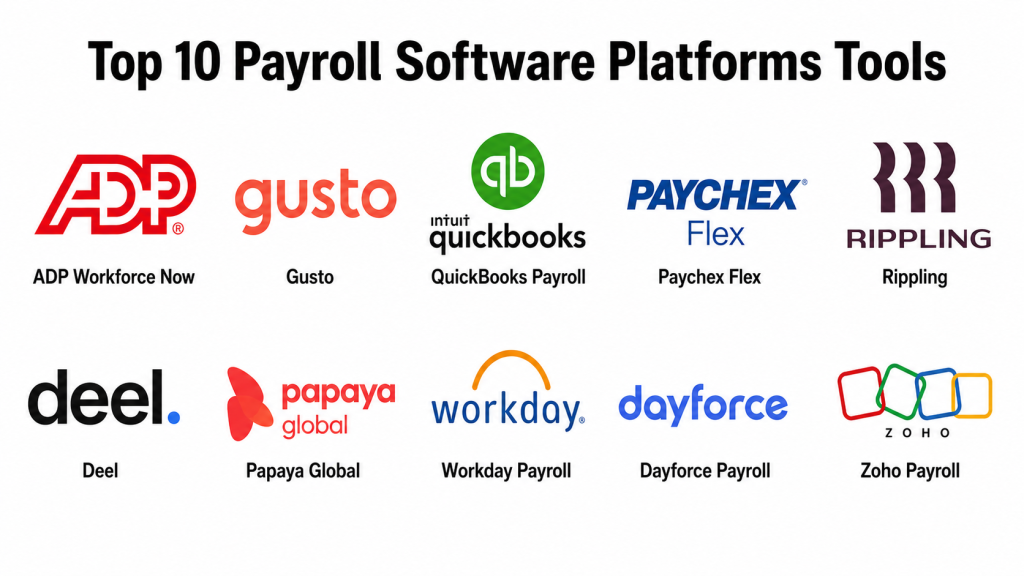
Top 10 Payroll Software Platforms Tools
#1 — ADP Workforce Now
Short description: ADP Workforce Now is a payroll and HR platform for SMB and mid-market organizations. It supports payroll, HR management, benefits administration, time tracking, reporting, and compliance-related workforce workflows.
Key Features
- Payroll processing
- Tax and deduction workflows
- HR management tools
- Benefits administration
- Time and attendance support
- Employee self-service
- Reporting and analytics
Pros
- Strong payroll experience for growing businesses.
- Good fit for companies that want payroll and HR together.
- Useful for businesses needing structured support and compliance workflows.
Cons
- Configuration can require onboarding.
- Pricing and add-ons should be reviewed carefully.
- Some advanced features may depend on selected modules.
Platforms / Deployment
Web / iOS / Android
Cloud
Security & Compliance
ADP Workforce Now supports payroll and HR security controls depending on plan and configuration. Specific details such as SSO/SAML, MFA, audit logs, RBAC, SOC 2, ISO 27001, GDPR, HIPAA, and encryption should be verified directly.
Integrations & Ecosystem
ADP Workforce Now fits businesses that need payroll connected with HR, benefits, time, and finance workflows.
- HR systems
- Benefits platforms
- Time tracking tools
- Accounting systems
- Workforce management tools
- Reporting exports
Support & Community
ADP provides documentation, payroll support, implementation guidance, HR resources, and customer service options. It is a strong choice for companies that want payroll expertise and broader HR support.
#2 — Gusto
Short description: Gusto is a payroll and HR platform designed mainly for small businesses, startups, and growing teams. It helps manage payroll, tax workflows, benefits, hiring, onboarding, contractor payments, and employee self-service.
Key Features
- Payroll processing
- Employee and contractor payments
- Tax filing support workflows
- Benefits administration
- Employee onboarding
- Time tracking options
- Self-service employee portal
Pros
- Easy to use for small businesses.
- Good payroll and HR basics in one platform.
- Useful for startups and teams with employees plus contractors.
Cons
- Larger enterprises may need more advanced controls.
- International payroll depth should be reviewed carefully.
- Some HR features may require higher plans.
Platforms / Deployment
Web / iOS / Android
Cloud
Security & Compliance
Gusto provides payroll and HR account security controls depending on plan. Specific details such as SSO/SAML, MFA, audit logs, RBAC, SOC 2, ISO 27001, GDPR, HIPAA, and encryption should be verified directly.
Integrations & Ecosystem
Gusto works well with small business finance, HR, and productivity workflows.
- Accounting tools
- Time tracking platforms
- Benefits systems
- Hiring workflows
- Contractor payment workflows
- Reporting exports
Support & Community
Gusto provides help resources, onboarding support, payroll guidance, and customer support options. It is especially practical for small businesses that want simple payroll with HR features.
#3 — QuickBooks Payroll
Short description: QuickBooks Payroll is a payroll platform built for small businesses that already use QuickBooks accounting. It helps businesses run payroll, manage taxes, handle employee payments, and connect payroll data with accounting workflows.
Key Features
- Payroll processing
- Direct deposit workflows
- Tax calculation support
- Employee self-service
- Time tracking connection
- QuickBooks accounting integration
- Payroll reporting
Pros
- Strong fit for QuickBooks users.
- Good for small business payroll and accounting alignment.
- Helps reduce duplicate finance data entry.
Cons
- Best value appears inside the QuickBooks ecosystem.
- Advanced HR functionality may be limited compared with HCM platforms.
- Buyers should review plan differences carefully.
Platforms / Deployment
Web / iOS / Android
Cloud
Security & Compliance
QuickBooks Payroll benefits from Intuit account and business security controls. Specific details such as SSO/SAML, MFA, audit logs, RBAC, SOC 2, ISO 27001, GDPR, HIPAA, and encryption should be verified directly.
Integrations & Ecosystem
QuickBooks Payroll is strongest when payroll must connect with small business accounting.
- QuickBooks accounting
- QuickBooks Time
- Tax workflows
- Employee payment workflows
- Finance reports
- Small business operations tools
Support & Community
QuickBooks provides help resources, support options, accountant ecosystem support, and payroll guidance. It is practical for businesses already using QuickBooks for accounting.
#4 — Paychex Flex
Short description: Paychex Flex is a payroll, HR, benefits, and workforce management platform for small, mid-sized, and larger businesses. It supports payroll processing, HR administration, benefits, reporting, time tracking, and compliance-related workflows.
Key Features
- Payroll processing
- Tax and compliance workflows
- HR administration
- Benefits support
- Time and attendance options
- Employee self-service
- Reporting and analytics
Pros
- Strong payroll and HR service ecosystem.
- Useful for businesses that want payroll plus HR support.
- Scales across small and growing companies.
Cons
- Pricing and service packages should be reviewed carefully.
- User experience may vary by module and setup.
- Advanced configurations may require onboarding support.
Platforms / Deployment
Web / iOS / Android
Cloud
Security & Compliance
Paychex Flex supports payroll and HR security controls depending on selected services and configuration. Specific details such as SSO/SAML, MFA, audit logs, RBAC, SOC 2, ISO 27001, GDPR, HIPAA, and encryption should be verified directly.
Integrations & Ecosystem
Paychex Flex fits payroll, HR, benefits, and workforce administration workflows.
- HR systems
- Benefits workflows
- Time tracking
- Accounting tools
- Retirement and insurance workflows
- Reporting exports
Support & Community
Paychex provides payroll support, HR guidance, customer service resources, onboarding, and business support options. It is a strong fit for businesses that value service-backed payroll.
#5 — Rippling
Short description: Rippling is a workforce platform that combines payroll, HR, IT, device management, app access, benefits, and employee lifecycle workflows. It is best for tech-forward companies that want payroll connected with employee identity, systems, and operations.
Key Features
- Payroll processing
- HRIS and employee records
- Benefits administration
- App and device management workflows
- Contractor management support
- Workflow automation
- Reporting and permissions
Pros
- Strong connection between payroll, HR, and IT operations.
- Good for fast-growing and tech-forward companies.
- Automation helps reduce manual onboarding and offboarding tasks.
Cons
- May be more platform than some small businesses need.
- Setup requires clean employee data and process planning.
- Pricing and modules should be reviewed carefully.
Platforms / Deployment
Web / iOS / Android
Cloud
Security & Compliance
Rippling supports workforce identity, HR, IT, and payroll security patterns depending on plan and configuration. Specific details such as SSO/SAML, MFA, audit logs, RBAC, SOC 2, ISO 27001, GDPR, HIPAA, and encryption should be verified directly.
Integrations & Ecosystem
Rippling fits businesses that want payroll tied to employee systems and automation.
- HR workflows
- IT app access
- Device management
- Benefits systems
- Accounting tools
- Workflow automation
Support & Community
Rippling provides documentation, customer support, onboarding help, and workforce platform resources. It is suitable for businesses that want payroll connected with broader employee operations.
#6 — Deel
Short description: Deel is a global payroll, contractor management, employer-of-record, and HR platform for companies hiring across countries. It is best for remote-first companies, global startups, international teams, and businesses managing employees and contractors in multiple regions.
Key Features
- Global payroll workflows
- Contractor payments
- Employer-of-record support
- Compliance support workflows
- Multi-currency payments
- HR management tools
- Global employee onboarding
Pros
- Strong for global and remote teams.
- Useful for contractor-heavy businesses.
- Helps simplify international workforce payment operations.
Cons
- May not be necessary for local-only businesses.
- Pricing and country coverage should be reviewed carefully.
- Complex global compliance needs still require expert review.
Platforms / Deployment
Web / iOS / Android
Cloud
Security & Compliance
Deel supports global workforce and payroll security patterns. Specific details such as SSO/SAML, MFA, audit logs, RBAC, SOC 2, ISO 27001, GDPR, HIPAA, and encryption should be verified directly.
Integrations & Ecosystem
Deel fits remote, global, contractor, and international payroll workflows.
- HR systems
- Accounting tools
- Contractor payment workflows
- Global payroll workflows
- Benefits and compliance workflows
- Workforce reporting
Support & Community
Deel provides support resources, onboarding help, global payroll guidance, and workforce management support. It is useful for businesses expanding beyond one country.
#7 — Papaya Global
Short description: Papaya Global is a global payroll and workforce management platform designed for organizations managing international payroll, contractors, workforce payments, and compliance workflows across multiple countries.
Key Features
- Global payroll management
- Workforce payments
- Contractor management
- Employer-of-record support
- Payroll analytics
- Compliance workflow support
- Multi-country workforce visibility
Pros
- Strong for global payroll operations.
- Useful for companies managing international teams.
- Provides centralized visibility into global workforce payments.
Cons**
- May be too advanced for small local businesses.
- Country coverage and pricing should be validated.
- Global compliance still requires careful internal review.
Platforms / Deployment
Web
Cloud
Security & Compliance
Papaya Global supports global payroll and workforce payment security patterns. Specific details such as SSO/SAML, MFA, audit logs, RBAC, SOC 2, ISO 27001, GDPR, HIPAA, and encryption should be verified directly.
Integrations & Ecosystem
Papaya Global fits businesses managing payroll across multiple countries and workforce types.
- Global payroll systems
- HR platforms
- Finance tools
- Workforce payment workflows
- Contractor management
- Reporting dashboards
Support & Community
Papaya Global provides onboarding, payroll support, global workforce resources, and customer success guidance. It is best for organizations with multi-country payroll needs.
#8 — Workday Payroll
Short description: Workday Payroll is part of the Workday enterprise HCM and finance ecosystem. It is best for larger organizations that want payroll connected with HR, workforce planning, finance, talent, reporting, and employee data.
Key Features
- Payroll management
- HR data integration
- Workforce planning alignment
- Employee self-service
- Reporting and analytics
- Absence and time data connection
- Enterprise payroll controls
Pros
- Strong for enterprise HR and payroll alignment.
- Useful when payroll must connect with finance and workforce data.
- Good fit for companies already using Workday.
Cons**
- May be too broad for small businesses.
- Implementation can require significant planning.
- Best value appears inside the Workday ecosystem.
Platforms / Deployment
Web / iOS / Android
Cloud
Security & Compliance
Workday Payroll benefits from Workday’s enterprise security and access control framework. Specific details such as SSO/SAML, MFA, audit logs, RBAC, SOC 2, ISO 27001, GDPR, HIPAA, and encryption should be verified directly based on deployment and contract.
Integrations & Ecosystem
Workday Payroll fits larger organizations connecting payroll with people, finance, and workforce planning.
- Workday HCM
- Finance systems
- Time tracking
- Absence management
- Benefits workflows
- Enterprise reporting
Support & Community
Workday provides enterprise support, implementation partner services, customer success resources, documentation, and training options. It is best for mature HR and payroll operations.
#9 — Dayforce Payroll
Short description: Dayforce Payroll is part of the Dayforce human capital management platform. It helps organizations connect payroll with time, attendance, scheduling, HR, benefits, and workforce data in one cloud system.
Key Features
- Payroll processing
- Time and attendance connection
- Scheduling data alignment
- HR and benefits workflows
- Employee self-service
- Workforce analytics
- Compliance support workflows
Pros
- Strong connection between payroll, time, and scheduling.
- Useful for organizations with hourly and shift-based teams.
- Good fit for mid-market and enterprise workforce operations.
Cons**
- Implementation requires planning and process alignment.
- May be more than small businesses need.
- Buyers should review module fit and pricing carefully.
Platforms / Deployment
Web / iOS / Android
Cloud
Security & Compliance
Dayforce Payroll supports HCM and payroll security patterns depending on configuration. Specific details such as SSO/SAML, MFA, audit logs, RBAC, SOC 2, ISO 27001, GDPR, HIPAA, and encryption should be verified directly.
Integrations & Ecosystem
Dayforce Payroll works well where payroll must connect with workforce operations.
- Time and attendance
- Employee scheduling
- HR workflows
- Benefits administration
- Workforce analytics
- Reporting tools
Support & Community
Dayforce provides documentation, implementation help, support resources, and enterprise workforce guidance. It is suitable for businesses that need payroll tied closely to workforce operations.
#10 — Zoho Payroll
Short description: Zoho Payroll is a payroll platform for businesses using the Zoho ecosystem. It helps manage employee salary processing, taxes, deductions, payslips, reimbursements, and payroll reports in supported regions.
Key Features
- Salary processing
- Tax and deduction workflows
- Employee self-service
- Payslip generation
- Reimbursement handling
- Payroll reports
- Zoho ecosystem integration
Pros
- Good fit for Zoho users.
- Practical for SMB payroll workflows in supported regions.
- Connects well with other Zoho business tools.
Cons**
- Availability and features may vary by country.
- Not ideal for complex global payroll.
- Buyers should verify local compliance and payroll support.
Platforms / Deployment
Web
Cloud
Security & Compliance
Zoho Payroll benefits from Zoho account and business security controls. Specific details such as SSO/SAML, MFA, audit logs, RBAC, SOC 2, ISO 27001, GDPR, HIPAA, and encryption should be verified directly based on region and plan.
Integrations & Ecosystem
Zoho Payroll fits businesses already using Zoho’s finance, HR, and operations tools.
- Zoho Books
- Zoho People
- Zoho Expense
- Accounting workflows
- Employee records
- Payroll reports
Support & Community
Zoho provides documentation, support resources, product ecosystem guidance, and customer assistance. Zoho Payroll is practical for SMBs that want payroll connected with Zoho business operations.
Comparison Table
| Tool Name | Best For | Platform(s) Supported | Deployment | Standout Feature | Public Rating |
|---|---|---|---|---|---|
| ADP Workforce Now | SMB and mid-market payroll plus HR | Web / iOS / Android | Cloud | Payroll, HR, benefits, and time workflows | N/A |
| Gusto | Small business payroll and HR basics | Web / iOS / Android | Cloud | Easy payroll with employee and contractor support | N/A |
| QuickBooks Payroll | QuickBooks accounting users | Web / iOS / Android | Cloud | Payroll connected with accounting workflows | N/A |
| Paychex Flex | Payroll with HR service support | Web / iOS / Android | Cloud | Payroll, HR, benefits, and compliance workflows | N/A |
| Rippling | Payroll connected with HR and IT | Web / iOS / Android | Cloud | Workforce automation across HR, IT, and payroll | N/A |
| Deel | Global payroll and contractor payments | Web / iOS / Android | Cloud | International payroll and contractor management | N/A |
| Papaya Global | Multi-country payroll operations | Web | Cloud | Global payroll and workforce payments | N/A |
| Workday Payroll | Enterprise HR and payroll alignment | Web / iOS / Android | Cloud | Payroll connected with enterprise HCM and finance | N/A |
| Dayforce Payroll | Payroll with workforce management | Web / iOS / Android | Cloud | Payroll connected with time, scheduling, and HR | N/A |
| Zoho Payroll | Zoho ecosystem SMB payroll | Web | Cloud | Payroll connected with Zoho finance and HR tools | N/A |
Evaluation & Scoring of Payroll Software Platforms
| Tool Name | Core (25%) | Ease (15%) | Integrations (15%) | Security (10%) | Performance (10%) | Support (10%) | Value (15%) | Weighted Total (0–10) |
|---|---|---|---|---|---|---|---|---|
| ADP Workforce Now | 9 | 7 | 9 | 9 | 9 | 9 | 7 | 8.45 |
| Gusto | 8 | 9 | 8 | 8 | 8 | 8 | 8 | 8.15 |
| QuickBooks Payroll | 8 | 8 | 9 | 8 | 8 | 8 | 8 | 8.15 |
| Paychex Flex | 9 | 7 | 8 | 9 | 8 | 9 | 7 | 8.20 |
| Rippling | 9 | 8 | 9 | 9 | 8 | 8 | 7 | 8.35 |
| Deel | 9 | 8 | 8 | 8 | 8 | 8 | 7 | 8.10 |
| Papaya Global | 9 | 7 | 8 | 8 | 8 | 8 | 6 | 7.85 |
| Workday Payroll | 9 | 6 | 9 | 9 | 9 | 9 | 6 | 8.15 |
| Dayforce Payroll | 9 | 7 | 9 | 9 | 8 | 9 | 7 | 8.35 |
| Zoho Payroll | 7 | 8 | 8 | 7 | 8 | 8 | 9 | 7.75 |
These scores are comparative and should be interpreted based on company size, payroll complexity, region, and workforce model. Gusto, QuickBooks Payroll, and Zoho Payroll are practical for SMBs. ADP Workforce Now and Paychex Flex are strong for growing businesses needing payroll plus HR support. Rippling fits tech-forward teams. Deel and Papaya Global are better for global payroll and contractors. Workday Payroll and Dayforce Payroll fit enterprise HCM environments.
Which Payroll Software Platform Is Right for You?
Solo / Freelancer
Solo users usually do not need full payroll software unless they pay contractors, hire employees, or need formal payroll records. If you manage only your own income, accounting software may be enough.
Choose Gusto, QuickBooks Payroll, or Zoho Payroll if you are moving from solo work to hiring employees. Choose Deel if you mainly pay international contractors. Choose QuickBooks Payroll if your accounting is already managed in QuickBooks.
SMB
Small and medium businesses need payroll software that is easy to run, simple to understand, and connected with accounting, taxes, employees, and contractors. Gusto, QuickBooks Payroll, ADP Workforce Now, Paychex Flex, and Zoho Payroll are practical options.
Choose Gusto for simple payroll and HR basics. Choose QuickBooks Payroll if accounting integration is important. Choose ADP Workforce Now or Paychex Flex if you want more payroll service support. Choose Zoho Payroll if you already use Zoho business apps.
Mid-Market
Mid-market organizations often need stronger reporting, benefits workflows, time tracking, HR integration, compliance support, and role-based access. ADP Workforce Now, Paychex Flex, Rippling, Dayforce Payroll, and Deel can fit different needs.
Choose Rippling if payroll should connect with HR and IT automation. Choose Dayforce Payroll if time, attendance, scheduling, and payroll need to work together. Choose ADP Workforce Now or Paychex Flex if payroll support and HR workflows are central.
Enterprise
Enterprise buyers should prioritize scalability, compliance, auditability, multi-entity support, security, reporting, integrations, employee self-service, and global workforce needs. Workday Payroll, Dayforce Payroll, ADP Workforce Now, Papaya Global, and Deel are practical options.
Choose Workday Payroll if payroll must connect with enterprise HR and finance. Choose Dayforce Payroll if workforce management and payroll alignment matter. Choose Papaya Global or Deel for international payroll complexity. Choose ADP Workforce Now for payroll and HR support in growing enterprise environments.
Budget vs Premium
For budget-conscious businesses, Gusto, QuickBooks Payroll, and Zoho Payroll may be practical starting points. They work well for small teams that need payroll without heavy enterprise complexity.
Premium platforms such as Workday Payroll, Dayforce Payroll, ADP Workforce Now, Paychex Flex, Rippling, Deel, and Papaya Global may cost more, but they provide deeper HR, compliance, automation, global payroll, benefits, and workforce support.
Feature Depth vs Ease of Use
If ease of use matters most, choose Gusto, QuickBooks Payroll, or Zoho Payroll. These tools are often easier for small business admins and finance teams.
If feature depth matters more, choose ADP Workforce Now, Paychex Flex, Rippling, Dayforce Payroll, Workday Payroll, Deel, or Papaya Global. These platforms support broader HR, global operations, workforce planning, and compliance complexity.
Integrations & Scalability
Payroll software should connect with accounting, HR, benefits, time tracking, workforce management, expense tools, contractor systems, and reporting workflows.
Choose QuickBooks Payroll for QuickBooks accounting. Choose Rippling for HR and IT automation. Choose Dayforce Payroll for time and scheduling alignment. Choose Workday Payroll for enterprise HR and finance. Choose Deel or Papaya Global for global workforce payment workflows.
Security & Compliance Needs
Payroll systems hold sensitive salary, bank, tax, identity, benefit, and employment data. Review SSO, MFA, RBAC, audit logs, encryption, data retention, payroll approval controls, admin access, and employee self-service permissions.
For international teams or regulated industries, involve finance, HR, legal, payroll specialists, IT, and compliance teams before selecting a platform.
Frequently Asked Questions
What is payroll software?
Payroll software helps businesses calculate wages, salaries, taxes, deductions, reimbursements, bonuses, and employee payments. It also helps manage payroll records, reports, payslips, and payroll workflows.
How is payroll software different from HR software?
Payroll software focuses on payments, taxes, deductions, and payroll records. HR software manages employee profiles, onboarding, performance, benefits, documents, and broader people operations.
Which payroll software is best for small businesses?
Gusto, QuickBooks Payroll, Zoho Payroll, ADP Workforce Now, and Paychex Flex are practical options for small businesses. The best choice depends on accounting tools, HR needs, contractor payments, and support preferences.
Which payroll platform is best for global teams?
Deel and Papaya Global are strong options for global payroll and contractor payments. Workday Payroll and other enterprise systems may also fit larger global organizations depending on country coverage and setup.
Can payroll software handle contractors?
Many payroll platforms support contractor payments, but features vary. Businesses should check contractor onboarding, tax forms, payment methods, international support, and reporting.
Does payroll software integrate with accounting tools?
Yes, many payroll platforms integrate with accounting software. QuickBooks Payroll is especially useful for QuickBooks users, while other platforms may connect with accounting systems through direct integrations or exports.
What are common payroll mistakes?
Common mistakes include incorrect employee classification, wrong tax settings, missing overtime, late payroll approvals, poor time tracking, weak recordkeeping, and not reviewing payroll reports before submission.
Is payroll software secure?
Payroll software can be secure when configured properly. Buyers should review SSO, MFA, RBAC, encryption, audit logs, admin permissions, employee self-service controls, and vendor security documentation.
What pricing factors should buyers check?
Buyers should check base fees, per-employee fees, contractor fees, tax filing support, benefits modules, HR add-ons, global payroll coverage, implementation costs, and support tiers.
Can payroll software manage benefits?
Many payroll platforms include or integrate with benefits administration. Buyers should check health benefits, retirement plans, deductions, reimbursements, and employee self-service options.
How hard is it to switch payroll software?
Switching can be complex because employee records, tax settings, bank details, historical payroll, benefits, deductions, and compliance data must be migrated carefully. A phased setup and parallel payroll check are helpful.
Do startups need payroll software?
Startups need payroll software once they hire employees or contractors and need formal payment, tax, and recordkeeping workflows. Early adoption can prevent payroll mistakes as the team grows.
Conclusion
Payroll software helps businesses pay employees accurately, manage taxes and deductions, reduce manual work, and keep payroll records organized. The best platform depends on company size, region, workforce type, accounting stack, HR needs, and compliance complexity. ADP Workforce Now and Paychex Flex are strong for growing businesses that want payroll plus HR support. Gusto is practical for small businesses and startups. QuickBooks Payroll is a strong fit for QuickBooks users. Rippling is useful for companies that want payroll connected with HR and IT automation. Deel and Papaya Global are strong options for global payroll and contractor management. Workday Payroll and Dayforce Payroll fit larger organizations that need payroll connected with enterprise HR, finance, time, and workforce data. Zoho Payroll is practical for businesses already using Zoho tools in supported regions.
