Upgrade & Secure Your Future with DevOps, SRE, DevSecOps, MLOps!
We spend hours scrolling social media and waste money on things we forget, but won’t spend 30 minutes a day earning certifications that can change our lives.
Master in DevOps, SRE, DevSecOps & MLOps by DevOps School!
Learn from Guru Rajesh Kumar and double your salary in just one year.
Introduction
Model Monitoring & Drift Detection Tools help teams watch machine learning models after they go live. In simple words, these tools check whether a model is still performing correctly, whether input data has changed, whether predictions are becoming unreliable, and whether business risk is increasing. A model that works well during testing can behave differently in production because customer behavior, market conditions, data pipelines, or external systems can change.
This matters in and beyond because AI systems are now used in banking, healthcare, hiring, fraud detection, customer support, insurance, ecommerce, and operations. If a model drifts silently, it can create wrong predictions, poor customer experience, financial loss, compliance issues, and trust problems.
Common use cases include:
- Detecting data drift and prediction drift
- Monitoring model accuracy and performance
- Tracking model bias and fairness signals
- Observing LLM and generative AI behavior
- Alerting teams when model behavior changes
- Supporting audit, governance, and retraining decisions
Buyers should evaluate:
- Drift detection depth
- Model performance monitoring
- Data quality checks
- Explainability features
- Alerting and incident workflows
- LLM observability support
- Integrations with ML pipelines
- Deployment flexibility
- Security and access control
- Pricing and scalability
Best for: ML engineers, data scientists, MLOps teams, AI platform teams, risk teams, compliance teams, enterprises, regulated industries, SaaS companies, banks, healthcare providers, insurers, and ecommerce businesses.
Not ideal for: teams that only run small offline experiments, organizations without production models, or companies that only need basic infrastructure monitoring instead of AI-specific model behavior monitoring.
Key Trends in Model Monitoring & Drift Detection Tools
- Model monitoring is expanding from classical ML to LLM and generative AI observability.
- Drift detection now covers data drift, prediction drift, concept drift, embedding drift, and model quality changes.
- Enterprises want monitoring tools that connect with governance, risk, and compliance workflows.
- Real-time alerting is becoming more important for high-risk models.
- Explainability is now closely connected with monitoring, especially in regulated industries.
- Open-source monitoring tools are growing because teams want transparency and lower entry costs.
- Cloud-native monitoring is increasing as more models run on managed AI platforms.
- Teams are combining model monitoring with data quality monitoring and feature store checks.
- Cost monitoring for AI systems is becoming more important as inference usage grows.
- Monitoring tools are expected to integrate with CI/CD, MLOps pipelines, dashboards, and incident tools.
How We Selected These Tools
These tools were selected using practical buyer-focused evaluation logic:
- Recognition in model monitoring, drift detection, or AI observability
- Support for production ML monitoring workflows
- Ability to detect drift, data quality issues, and model performance changes
- Support for alerting, dashboards, and model health tracking
- Integration with MLOps, cloud, data, and DevOps ecosystems
- Suitability for different team sizes and technical maturity levels
- Availability of open-source, managed, or enterprise deployment options
- Strength of documentation, onboarding, and ecosystem
- Practical fit for classical ML and modern AI workflows
- Governance, auditability, and explainability signals where clearly known
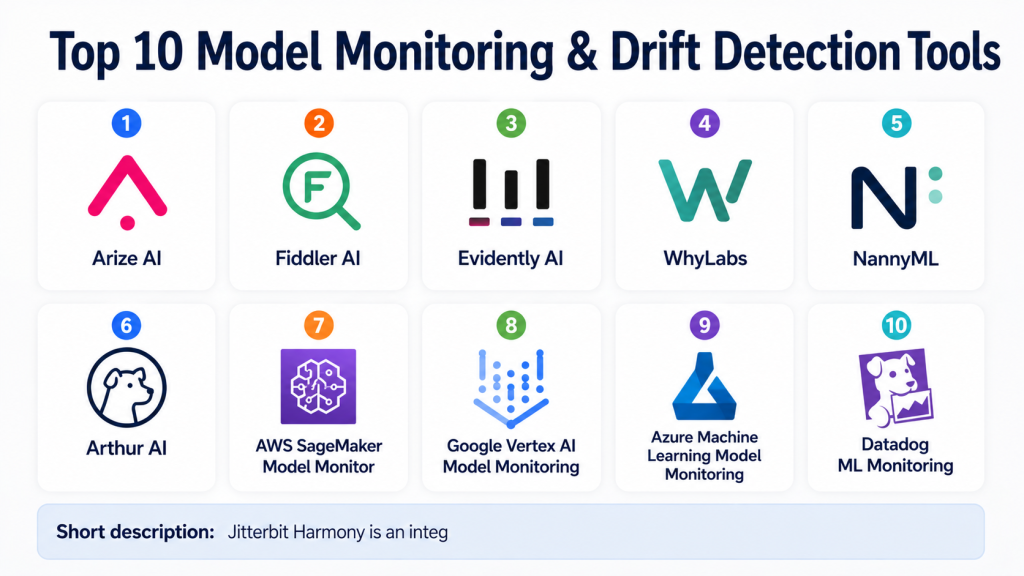
Top 10 Model Monitoring & Drift Detection Tools
#1 — Arize AI
Short description: Arize AI is an AI observability and model monitoring platform built for production ML and LLM systems.
It helps teams monitor model performance, detect drift, analyze data quality, track embeddings, and investigate production issues.
The platform is useful for ML engineers, data scientists, AI platform teams, and enterprises running models at scale.
Arize supports monitoring across model inputs, outputs, predictions, labels, and performance metrics.
It is also relevant for teams working with generative AI and LLM applications.
The platform focuses on helping users debug why model behavior changes after deployment.
It is strong for organizations that need visibility across many models and teams.
Arize is suitable for production environments where reliability, trust, and explainability matter.
Key Features
- Model performance monitoring
- Data drift and prediction drift detection
- Embedding and LLM observability support
- Data quality analysis
- Alerting and issue investigation workflows
- Dashboards for model health tracking
- Root cause analysis for model behavior changes
Pros
- Strong AI observability focus for production teams
- Useful for both classical ML and LLM monitoring
- Good fit for enterprise model operations
Cons
- May be more than needed for very small ML teams
- Best value comes when models are already in production
- Pricing and advanced features may vary by plan
Platforms / Deployment
Cloud / Hybrid / Varies
Security & Compliance
Enterprise security features may include role-based access, identity integration, and access controls. Specific certifications should be verified directly with the vendor.
Integrations & Ecosystem
Arize fits into modern AI and MLOps workflows.
- Python SDKs
- ML pipelines
- Cloud platforms
- Data warehouses
- LLM application workflows
- Monitoring and alerting systems
Support & Community
Arize provides documentation, onboarding resources, enterprise support options, and educational material for AI observability teams.
#2 — Fiddler AI
Short description: Fiddler AI is a model monitoring, explainability, and AI observability platform for production AI systems.
It helps teams understand model performance, drift, bias, fairness, and explainability signals.
The platform is often used by organizations that need transparency and governance around AI decisions.
Fiddler is useful for financial services, insurance, healthcare, enterprise SaaS, and regulated industries.
It supports monitoring for models after deployment and helps teams investigate changes in model behavior.
The platform also focuses on responsible AI and trustworthy AI workflows.
It is helpful when business and risk teams need visibility into model decisions.
Fiddler is a strong option for companies where monitoring and explainability must work together.
Key Features
- Model monitoring and AI observability
- Drift detection and model performance tracking
- Explainability and root cause analysis
- Bias and fairness monitoring
- Dashboards and alerting
- Governance-oriented AI visibility
- Support for production ML workflows
Pros
- Strong explainability and responsible AI focus
- Useful for regulated and risk-sensitive teams
- Good fit for enterprise AI governance
Cons
- May be heavier than needed for simple monitoring
- Advanced adoption may need onboarding support
- Pricing details may vary by enterprise needs
Platforms / Deployment
Cloud / Hybrid / Varies
Security & Compliance
Enterprise security capabilities may include access control, identity integration, and audit-focused workflows. Specific compliance certifications should be verified with the vendor.
Integrations & Ecosystem
Fiddler AI connects with enterprise AI and ML operations workflows.
- ML pipelines
- Cloud platforms
- Data platforms
- Model serving systems
- BI and reporting workflows
- Enterprise AI governance processes
Support & Community
Fiddler provides documentation, support resources, customer onboarding, and enterprise-focused assistance.
#3 — Evidently AI
Short description: Evidently AI is an open-source and commercial platform for evaluating, testing, and monitoring ML models and AI systems.
It helps teams detect data drift, prediction drift, data quality issues, and model performance changes.
Evidently is popular with data scientists and ML engineers who want transparent and flexible monitoring workflows.
It can generate reports, dashboards, and tests for production and pre-production model checks.
The tool is useful for teams that want open-source visibility before committing to a full enterprise platform.
It also supports AI evaluation workflows beyond basic model drift monitoring.
Evidently fits well into Python-based and MLOps pipeline-driven environments.
It is a strong choice for teams that want a practical, developer-friendly monitoring setup.
Key Features
- Data drift detection
- Prediction drift monitoring
- Data quality checks
- Model performance reports
- Test suites and dashboards
- Python-based workflow
- Open-source and managed options
Pros
- Strong open-source foundation
- Flexible for technical teams
- Good fit for testing and monitoring workflows
Cons
- Requires technical setup for production use
- Enterprise governance depends on deployment choice
- Non-technical users may need support from ML teams
Platforms / Deployment
Windows / macOS / Linux / Cloud / Self-hosted / Hybrid
Security & Compliance
For open-source use, security depends on the deployment environment. Enterprise security features may vary by commercial offering. Specific compliance details are not publicly stated here.
Integrations & Ecosystem
Evidently fits well into Python and MLOps workflows.
- Python
- Jupyter
- MLflow
- Airflow
- Grafana
- CI/CD pipelines
Support & Community
Strong documentation, active open-source community, tutorials, and commercial support options.
#4 — WhyLabs
Short description: WhyLabs is an AI observability and data monitoring platform designed to monitor machine learning and AI systems in production.
It helps teams detect data drift, data quality problems, model performance issues, and unusual behavior.
WhyLabs is useful for ML engineers, data teams, platform teams, and organizations that need scalable monitoring.
The platform focuses on lightweight data profiling and observability across production pipelines.
It can help teams identify changes in data before those changes cause major model failures.
WhyLabs is also relevant for monitoring ML and AI applications where reliability matters.
It is useful for teams that want monitoring without moving large volumes of sensitive data.
WhyLabs is a strong option for organizations focused on data-centric AI observability.
Key Features
- Data and model observability
- Drift and data quality monitoring
- Lightweight data profiling
- Production monitoring dashboards
- Alerting and anomaly detection
- Support for ML pipelines
- Scalable monitoring architecture
Pros
- Strong focus on data quality and observability
- Useful for production data and ML teams
- Can support scalable monitoring workflows
Cons
- May require setup planning for complex pipelines
- Advanced governance needs may require additional tools
- Pricing and deployment details may vary
Platforms / Deployment
Cloud / Hybrid / Varies
Security & Compliance
Security features may vary by plan and deployment. Specific certifications should be verified with the vendor.
Integrations & Ecosystem
WhyLabs integrates with data and machine learning workflows.
- Python
- Data pipelines
- Cloud storage
- ML platforms
- Monitoring tools
- Production applications
Support & Community
WhyLabs provides documentation, support resources, and onboarding options. Community strength is strongest among AI observability and data quality users.
#5 — NannyML
Short description: NannyML is a model monitoring tool focused on detecting performance changes and data drift, including cases where ground truth labels are delayed or unavailable.
It helps teams estimate model performance in production and understand when a model may be degrading.
NannyML is useful for data scientists and ML engineers working with production models where feedback labels arrive late.
The platform is especially relevant for business use cases such as credit risk, fraud, churn, and classification systems.
It supports monitoring workflows that help teams decide when retraining or investigation is needed.
NannyML has open-source and commercial options.
It is practical for teams that want model performance estimation rather than only simple drift checks.
It is a strong fit for organizations that need early warning signals before labels become available.
Key Features
- Model performance monitoring
- Data drift detection
- Performance estimation without immediate labels
- Support for delayed ground truth scenarios
- Monitoring dashboards and reports
- Open-source and commercial options
- Root cause analysis support
Pros
- Strong for delayed-label monitoring use cases
- Useful for performance estimation
- Good fit for technical ML teams
Cons
- May require statistical understanding for best use
- Not always a full enterprise MLOps platform
- Commercial details may vary by plan
Platforms / Deployment
Windows / macOS / Linux / Cloud / Self-hosted / Hybrid
Security & Compliance
For open-source use, security depends on deployment environment. Commercial security and compliance details should be verified directly with the vendor.
Integrations & Ecosystem
NannyML fits into Python and production ML workflows.
- Python
- Jupyter
- ML pipelines
- Data warehouses
- Model monitoring workflows
- Custom dashboards
Support & Community
Good documentation and open-source resources are available. Commercial support may be available depending on the chosen plan.
#6 — Arthur AI
Short description: Arthur AI is a model monitoring and AI performance platform focused on helping teams manage production AI systems.
It supports model performance tracking, drift detection, explainability, and monitoring for AI reliability.
Arthur is useful for enterprises that need operational visibility across deployed models.
It is relevant for regulated industries and organizations where AI trust and accountability matter.
The platform helps teams detect changes in model behavior and investigate production issues.
It can support both technical teams and governance stakeholders.
Arthur is often considered when AI monitoring must include risk, performance, and explainability.
It is a practical option for organizations running high-impact models in production.
Key Features
- Model performance monitoring
- Drift detection
- Explainability workflows
- Production AI observability
- Alerts and dashboards
- Governance-focused monitoring
- Support for enterprise AI workflows
Pros
- Strong enterprise AI monitoring focus
- Useful for high-risk model environments
- Supports explainability and performance tracking
Cons
- May be more suitable for enterprise buyers than small teams
- Pricing and deployment may be custom
- Advanced implementation may require onboarding
Platforms / Deployment
Cloud / Hybrid / Varies
Security & Compliance
Enterprise security features may be available. Specific certifications and compliance details should be verified with the vendor.
Integrations & Ecosystem
Arthur AI integrates with AI production and governance workflows.
- ML pipelines
- Cloud platforms
- Data platforms
- Model serving systems
- Governance workflows
- Alerting systems
Support & Community
Enterprise support, onboarding resources, and documentation are typically part of the vendor experience. Public community strength is more limited than open-source tools.
#7 — AWS SageMaker Model Monitor
Short description: AWS SageMaker Model Monitor is a managed model monitoring capability within Amazon SageMaker.
It helps teams monitor data quality, model quality, bias drift, and feature attribution drift for models deployed in SageMaker.
The tool is best suited for organizations already using AWS for machine learning workloads.
It supports scheduled monitoring jobs and integration with AWS storage, logs, and alerting services.
SageMaker Model Monitor is useful for ML engineers and cloud teams that need AWS-native monitoring.
It is not usually selected as a standalone third-party monitoring platform.
It works best when model training, deployment, and operations already happen inside SageMaker.
It is a strong fit for AWS-first production ML environments.
Key Features
- Data quality monitoring
- Model quality monitoring
- Bias drift monitoring
- Feature attribution drift monitoring
- Scheduled monitoring jobs
- Integration with SageMaker endpoints
- AWS-native alerting and logging integration
Pros
- Strong fit for AWS SageMaker users
- Managed and cloud-native
- Integrates with AWS monitoring and storage services
Cons
- Best suited for SageMaker-based deployments
- Less flexible for multi-cloud environments
- Requires AWS knowledge for effective setup
Platforms / Deployment
Cloud
Security & Compliance
Uses AWS security controls such as IAM, encryption, access control, VPC options, and logging. Compliance depends on AWS configuration and service usage.
Integrations & Ecosystem
SageMaker Model Monitor connects with AWS machine learning and operations tools.
- Amazon SageMaker
- Amazon S3
- CloudWatch
- AWS Lambda
- AWS IAM
- AWS data services
Support & Community
Strong AWS documentation, cloud support options, and broad AWS community adoption.
#8 — Google Vertex AI Model Monitoring
Short description: Google Vertex AI Model Monitoring is a managed monitoring capability within Google Vertex AI.
It helps teams monitor deployed models for changes in input data, prediction behavior, and model-related issues.
The tool is useful for teams already building and deploying models on Google Cloud.
It supports cloud-native AI operations and integrates with Vertex AI workflows.
Vertex AI Model Monitoring helps teams detect drift and understand when model behavior may be changing.
It is suitable for cloud-native ML teams and enterprises using Google Cloud data services.
It works best when the organization already uses Vertex AI for training and deployment.
It is a practical choice for Google Cloud-centered MLOps teams.
Key Features
- Managed model monitoring
- Drift detection support
- Integration with Vertex AI deployments
- Cloud-native dashboards and alerting
- Support for production ML workflows
- Integration with Google Cloud services
- Monitoring for deployed model behavior
Pros
- Strong fit for Google Cloud users
- Managed monitoring inside Vertex AI
- Useful for cloud-native ML operations
Cons
- Best suited for Vertex AI deployments
- Less ideal for teams outside Google Cloud
- Advanced setup may require cloud and ML expertise
Platforms / Deployment
Cloud
Security & Compliance
Uses Google Cloud security controls such as IAM, encryption, access management, audit logging, and private networking options. Compliance depends on configuration.
Integrations & Ecosystem
Vertex AI Model Monitoring fits into Google Cloud ML workflows.
- Vertex AI
- BigQuery
- Cloud Storage
- Cloud Monitoring
- Dataflow
- Google Cloud APIs
Support & Community
Strong Google Cloud documentation, enterprise support options, learning resources, and cloud community support.
#9 — Azure Machine Learning Model Monitoring
Short description: Azure Machine Learning includes model monitoring capabilities for teams deploying and managing ML models in Microsoft Azure.
It helps organizations track model behavior, data changes, performance signals, and production reliability.
The tool is useful for enterprises already using Azure Machine Learning and Microsoft cloud services.
It supports MLOps workflows across training, deployment, monitoring, and governance.
Azure ML monitoring is suitable for teams that want cloud-native visibility inside the Microsoft ecosystem.
It connects well with Azure identity, DevOps, data, and observability services.
It is practical for regulated organizations that require access control and auditability.
It is a strong option for Microsoft-first AI and ML teams.
Key Features
- Model monitoring workflows
- Data and model behavior tracking
- Integration with Azure ML deployments
- Responsible AI and interpretability support
- MLOps pipeline integration
- Cloud-native monitoring and logging
- Enterprise identity and access support
Pros
- Strong fit for Azure users
- Good enterprise integration
- Supports broader ML lifecycle management
Cons
- Best suited for Azure ML environments
- May require Azure expertise
- Cost depends on cloud usage and configuration
Platforms / Deployment
Cloud / Hybrid
Security & Compliance
Supports role-based access, identity integration, encryption, private networking, audit capabilities, and Microsoft cloud security controls. Compliance depends on configuration.
Integrations & Ecosystem
Azure ML monitoring fits into Microsoft cloud and DevOps workflows.
- Azure Machine Learning
- Azure Monitor
- Azure Data Lake
- Azure Synapse
- GitHub
- Azure DevOps
Support & Community
Strong Microsoft documentation, enterprise support, learning resources, and a large Azure community.
#10 — Datadog ML Monitoring
Short description: Datadog ML Monitoring is designed for teams that want to observe machine learning models alongside infrastructure, applications, logs, traces, and business metrics.
It is useful for organizations already using Datadog for observability and reliability engineering.
The platform helps teams monitor model performance, data drift, prediction behavior, and operational signals.
Datadog is especially relevant for DevOps, SRE, ML engineering, and platform teams that want unified observability.
It can help connect model issues with infrastructure or application problems.
The tool fits production environments where AI systems are part of larger software systems.
It is not only a model monitoring tool; it is part of a broader observability platform.
It is a strong option for teams that want ML monitoring inside existing operational dashboards.
Key Features
- ML model monitoring
- Data drift and performance tracking
- Infrastructure and application observability
- Dashboards and alerting
- Logs, metrics, and traces integration
- Production incident workflows
- Unified operational visibility
Pros
- Strong for teams already using Datadog
- Connects ML issues with system observability
- Useful for DevOps and SRE collaboration
Cons
- May not be as specialized as dedicated AI observability tools
- Best value depends on existing Datadog adoption
- Pricing can vary with usage volume
Platforms / Deployment
Cloud / Agent-based / Hybrid
Security & Compliance
Datadog offers enterprise security controls such as access management and identity integration. Specific compliance details should be verified directly with the vendor.
Integrations & Ecosystem
Datadog integrates broadly across software, infrastructure, and AI operations.
- Cloud platforms
- Kubernetes
- CI/CD tools
- Logs and traces
- Application monitoring
- Incident management tools
Support & Community
Strong documentation, enterprise support options, training resources, and a large observability community.
Comparison Table
| Tool Name | Best For | Platform(s) Supported | Deployment | Standout Feature | Public Rating |
|---|---|---|---|---|---|
| Arize AI | Production AI observability | Web / API-based workflows | Cloud / Hybrid / Varies | Model and LLM observability | N/A |
| Fiddler AI | Explainable model monitoring | Web / API-based workflows | Cloud / Hybrid / Varies | Monitoring plus explainability | N/A |
| Evidently AI | Open-source drift detection | Windows / macOS / Linux | Cloud / Self-hosted / Hybrid | Flexible reports and test suites | N/A |
| WhyLabs | Data and model observability | Web / API-based workflows | Cloud / Hybrid / Varies | Lightweight data profiling | N/A |
| NannyML | Delayed-label performance monitoring | Windows / macOS / Linux | Cloud / Self-hosted / Hybrid | Performance estimation without labels | N/A |
| Arthur AI | Enterprise AI performance monitoring | Web / API-based workflows | Cloud / Hybrid / Varies | Governance-focused AI monitoring | N/A |
| AWS SageMaker Model Monitor | AWS-native ML monitoring | Web | Cloud | SageMaker endpoint monitoring | N/A |
| Google Vertex AI Model Monitoring | Google Cloud ML monitoring | Web | Cloud | Vertex AI-native drift monitoring | N/A |
| Azure Machine Learning Model Monitoring | Microsoft cloud ML teams | Web | Cloud / Hybrid | Azure ML lifecycle integration | N/A |
| Datadog ML Monitoring | Unified ML and system observability | Web / Agent-based workflows | Cloud / Hybrid | ML monitoring with full-stack observability | N/A |
Evaluation & Scoring of Model Monitoring & Drift Detection Tools
| Tool Name | Core (25%) | Ease (15%) | Integrations (15%) | Security (10%) | Performance (10%) | Support (10%) | Value (15%) | Weighted Total (0–10) |
|---|---|---|---|---|---|---|---|---|
| Arize AI | 9 | 8 | 8 | 8 | 9 | 8 | 8 | 8.35 |
| Fiddler AI | 9 | 8 | 8 | 8 | 8 | 8 | 7 | 8.10 |
| Evidently AI | 8 | 8 | 8 | 6 | 8 | 7 | 9 | 7.75 |
| WhyLabs | 8 | 8 | 8 | 7 | 8 | 7 | 8 | 7.75 |
| NannyML | 8 | 7 | 7 | 6 | 8 | 7 | 8 | 7.35 |
| Arthur AI | 8 | 7 | 7 | 8 | 8 | 8 | 7 | 7.60 |
| AWS SageMaker Model Monitor | 8 | 7 | 9 | 9 | 8 | 9 | 8 | 8.15 |
| Google Vertex AI Model Monitoring | 8 | 8 | 9 | 9 | 8 | 9 | 8 | 8.30 |
| Azure Machine Learning Model Monitoring | 8 | 8 | 9 | 9 | 8 | 9 | 8 | 8.30 |
| Datadog ML Monitoring | 7 | 8 | 9 | 8 | 9 | 9 | 7 | 8.00 |
These scores are comparative and should not be treated as universal rankings. A tool that scores lower overall may still be the best choice for a specific cloud stack, budget, or technical team. Dedicated AI observability tools tend to score well in model-specific monitoring, while cloud-native tools score well in ecosystem integration. Open-source tools can offer strong value but may require more internal setup and maintenance.
Which Model Monitoring & Drift Detection Tool Is Right for You?
Solo / Freelancer
Solo users and freelancers should usually start with lightweight and lower-cost tools. Evidently AI and NannyML are practical choices because they support technical workflows and can be used without a large enterprise platform commitment.
If you work with clients, choose tools that make it easy to generate reports, explain drift, and show model behavior clearly. A simple monitoring stack is often better than a complex enterprise platform when project size is small.
SMB
SMBs should focus on usability, cost control, and integration with the current cloud or data stack. Evidently AI, WhyLabs, Arize AI, and Datadog ML Monitoring may be good options depending on the team’s needs.
If the SMB already uses AWS, Google Cloud, or Azure for model deployment, native monitoring tools can reduce integration work. However, dedicated platforms may provide stronger AI-specific visibility.
Mid-Market
Mid-market companies often need stronger dashboards, alerting, team collaboration, and production monitoring. Arize AI, Fiddler AI, WhyLabs, Datadog ML Monitoring, and cloud-native monitoring tools are strong candidates.
At this level, teams should evaluate whether they need only drift detection or a broader AI observability strategy. They should also check alert routing, incident workflows, retraining triggers, and governance reporting.
Enterprise
Enterprises should prioritize governance, security, audit logs, identity integration, explainability, scalability, and support. Arize AI, Fiddler AI, Arthur AI, Datadog ML Monitoring, AWS SageMaker Model Monitor, Vertex AI Model Monitoring, and Azure ML monitoring are strong enterprise options.
Regulated enterprises should involve compliance, risk, security, and legal teams early. Monitoring is not only a technical feature; it is part of AI governance and operational risk management.
Budget vs Premium
Budget-conscious teams can start with Evidently AI or NannyML, especially if they have technical staff. Open-source and self-hosted options can reduce licensing cost but require setup, security, hosting, and maintenance.
Premium tools such as Arize AI, Fiddler AI, Arthur AI, and enterprise cloud-native monitoring options may provide stronger support, dashboards, governance workflows, and scalability.
Feature Depth vs Ease of Use
Dedicated AI observability platforms often provide deeper model-specific monitoring features. Cloud-native tools are easier when models already live inside the same cloud environment. Open-source tools are flexible but need more engineering work.
Teams should avoid choosing only based on feature lists. The best tool is the one that your team can actually deploy, use, maintain, and trust in production.
Integrations & Scalability
Integration is one of the most important buying factors. A monitoring tool should connect with model serving systems, data warehouses, pipelines, cloud storage, dashboards, alerting tools, and incident management systems.
For cloud-first teams, native tools may simplify setup. For multi-cloud or mixed environments, dedicated observability platforms may offer more flexibility.
Security & Compliance Needs
Security-sensitive teams should check SSO, SAML, MFA, RBAC, encryption, audit logs, private deployment, data retention, and access controls. They should also verify how much production data must be sent to the monitoring platform.
For regulated industries, monitoring should support investigation, documentation, and audit workflows. The tool should help explain what changed, when it changed, and how the organization responded.
Frequently Asked Questions
1. What is model monitoring?
Model monitoring is the process of watching a machine learning model after it is deployed. It checks whether the model is still accurate, reliable, fair, and stable in real-world conditions.
2. What is drift detection?
Drift detection identifies changes in data, predictions, or model behavior over time. Drift matters because a model trained on old patterns may become less reliable when real-world data changes.
3. What types of drift should teams monitor?
Teams commonly monitor data drift, prediction drift, concept drift, feature drift, label drift, and embedding drift. The right drift type depends on the model, business use case, and data availability.
4. How are model monitoring tools priced?
Pricing varies by vendor. Some tools charge by number of models, volume of predictions, number of users, data processed, or enterprise plan. Open-source tools may reduce license cost but require hosting and maintenance.
5. How long does implementation take?
Basic monitoring can be set up quickly for simple models. Full enterprise implementation can take longer because teams need data pipelines, alerts, dashboards, security reviews, governance workflows, and ownership processes.
6. What are common mistakes in model monitoring?
Common mistakes include monitoring only infrastructure metrics, ignoring data quality, not defining alert thresholds, failing to track ground truth, and not assigning ownership for model incidents.
7. Do model monitoring tools improve accuracy automatically?
No. Monitoring tools detect problems and provide visibility, but they do not automatically fix model accuracy unless connected to retraining and deployment workflows. Human review is still important.
8. Are open-source monitoring tools enough?
Open-source tools can be enough for technical teams with strong engineering skills. However, enterprise teams may need managed support, governance, access controls, and scalable dashboards.
9. What security features should buyers check?
Buyers should check SSO, RBAC, encryption, audit logs, private deployment, data retention, and whether sensitive production data leaves their environment. Security review should happen before production rollout.
10. Can these tools monitor LLM applications?
Many modern monitoring tools are adding LLM observability features. Buyers should check support for prompts, responses, embeddings, hallucination signals, toxicity checks, latency, cost, and user feedback.
Conclusion
Model Monitoring & Drift Detection Tools help teams keep machine learning and AI systems reliable after deployment. The best tool depends on your models, cloud stack, budget, team skills, compliance needs, and production risk. Arize AI, Fiddler AI, WhyLabs, Arthur AI, and Datadog ML Monitoring are strong options for production AI observability. Evidently AI and NannyML are useful for technical teams that want flexible and cost-conscious monitoring. AWS SageMaker Model Monitor, Google Vertex AI Model Monitoring, and Azure Machine Learning Model Monitoring are practical choices for teams already working inside those cloud ecosystems.
