Upgrade & Secure Your Future with DevOps, SRE, DevSecOps, MLOps!
We spend hours scrolling social media and waste money on things we forget, but won’t spend 30 minutes a day earning certifications that can change our lives.
Master in DevOps, SRE, DevSecOps & MLOps by DevOps School!
Learn from Guru Rajesh Kumar and double your salary in just one year.
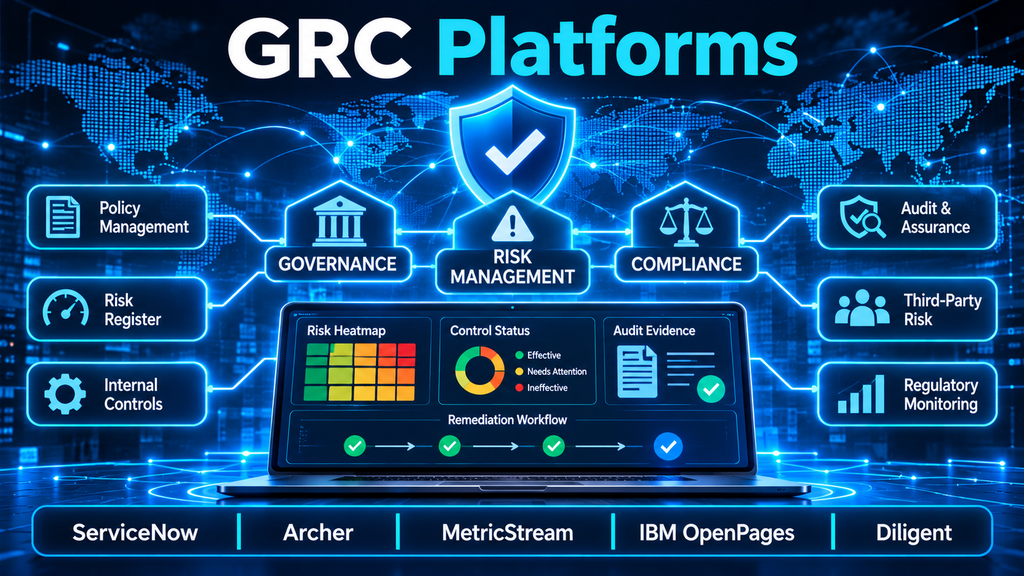
GRC Platforms: Connecting Governance, Risk Management, and Compliance Across the Enterprise
Introduction
Organizations face a growing range of risks involving cybersecurity, regulatory obligations, financial controls, third-party relationships, data protection, business continuity, and operational resilience. Managing these responsibilities independently can create fragmented records, duplicated assessments, inconsistent policies, and limited visibility for senior leadership.
Governance, Risk, and Compliance (GRC) platforms help address this challenge by connecting organizational policies, risk registers, control frameworks, audit activities, regulatory obligations, and remediation workflows.
Rather than treating governance, risk, and compliance as separate administrative functions, a GRC platform provides a coordinated environment in which teams can identify risks, assign accountability, monitor controls, and demonstrate compliance.
The objective is not simply to produce better reports. It is to help organizations make informed decisions, reduce exposure, and build accountability into everyday operations.
What Are GRC Platforms?
GRC platforms are enterprise software solutions that help organizations coordinate three closely related disciplines:
- Governance: Establishing policies, responsibilities, decision-making structures, and organizational accountability.
- Risk management: Identifying, assessing, prioritizing, monitoring, and mitigating threats that could affect business objectives.
- Compliance: Ensuring that organizational processes and controls address applicable laws, regulations, standards, contractual requirements, and internal policies.
Modern platforms often extend beyond these foundations to include audit management, third-party risk, IT risk, cybersecurity governance, privacy management, business continuity, and operational resilience.
A centralized GRC environment can connect a business risk to the controls intended to manage it, the evidence demonstrating whether those controls operate, and the remediation activities required when weaknesses are discovered.
Why Organizations Need GRC Software
1. Risk information is scattered across departments
Finance, legal, IT, security, procurement, human resources, and operations often maintain their own risk records. This makes it difficult to understand how individual issues affect the organization’s overall risk profile.
A GRC platform provides a shared structure for recording risks, owners, assessments, and treatment plans.
2. Regulatory requirements continue to expand
Organizations may need to address requirements associated with information security, privacy, financial reporting, industry-specific regulations, and contractual obligations.
A GRC platform helps map requirements to internal policies and controls, assign responsibilities, and retain evidence of compliance activities.
3. Manual processes create inconsistencies
Spreadsheets, email approvals, and disconnected document repositories can make assessments difficult to standardize. They also create problems with version control, overdue actions, and audit traceability.
Workflow automation helps establish consistent processes and reduces repetitive administrative work.
4. Leadership needs a consolidated risk view
Executives and boards need to understand which risks are most significant, whether mitigation activities are progressing, and where the organization needs additional investment.
GRC reporting can connect operational findings with enterprise-level risk indicators and management decisions.
5. Third-party relationships introduce additional exposure
Suppliers, cloud providers, consultants, and technology partners can introduce security, privacy, operational, and regulatory risks.
GRC platforms can connect vendor assessments with enterprise risk registers, contractual obligations, control requirements, and remediation activities.
Core Capabilities of Modern GRC Platforms
Enterprise risk management
Enterprise risk management (ERM) provides a structured approach to identifying and evaluating risks across business functions.
Typical capabilities include:
- Centralized risk registers.
- Risk categorization and ownership.
- Inherent and residual risk assessments.
- Risk scoring and heatmaps.
- Risk appetite and tolerance tracking.
- Mitigation plans and action tracking.
- Key risk indicators (KRIs).
- Management dashboards and reporting.
A useful ERM implementation should connect risks to business objectives and accountable owners. A risk score without an actionable treatment plan offers limited operational value.
Policy and procedure management
Organizations need a reliable way to create, approve, distribute, and review policies.
GRC platforms can support policy lifecycle management through:
- Centralized policy repositories.
- Version control and approval workflows.
- Policy acknowledgments and attestations.
- Scheduled reviews.
- Ownership and accountability records.
- Mapping between policies and regulatory requirements.
This helps reduce the risk of employees following outdated or conflicting instructions.
Compliance management
Compliance management helps organizations identify obligations and translate them into internal requirements and controls.
Important capabilities include:
- Regulatory obligation registers.
- Compliance frameworks and control libraries.
- Control ownership and testing.
- Evidence collection.
- Compliance assessments.
- Gap identification.
- Remediation tracking.
- Compliance reporting.
Organizations should confirm that a platform supports the specific frameworks and jurisdictions relevant to their operations. A generic control library does not automatically establish regulatory compliance.
Internal audit management
Internal audit teams need structured processes for planning engagements, documenting findings, gathering evidence, and tracking remediation.
GRC platforms may support:
- Risk-based audit planning.
- Audit schedules and workpapers.
- Evidence requests.
- Testing procedures.
- Findings and observations.
- Corrective action tracking.
- Audit reporting.
The value comes from connecting audit findings to the underlying risks and controls rather than treating every audit as an isolated exercise.
Third-party risk management
Third-party risk management (TPRM) evaluates the risks introduced by suppliers, service providers, and business partners.
Relevant capabilities include:
- Vendor onboarding assessments.
- Security and compliance questionnaires.
- Inherent risk classification.
- Due diligence workflows.
- Contract and assurance documentation.
- Ongoing monitoring.
- Periodic reassessments.
- Vendor remediation tracking.
Organizations should evaluate whether assessments can be tailored to vendor criticality and whether findings connect to enterprise risk and procurement workflows.
IT and cybersecurity risk management
Technology-related risks can affect business operations, information security, privacy, and regulatory compliance.
A GRC platform may help coordinate:
- IT risk registers.
- Cybersecurity control assessments.
- Vulnerability and issue tracking.
- Security policy compliance.
- Asset and service risk relationships.
- Business impact assessments.
- Incident-related remediation.
It is important to distinguish GRC platforms from technical security products. A GRC solution may track vulnerability-related risk, but it does not necessarily replace vulnerability scanners, endpoint protection, SIEM, or security operations tools.
Business continuity and operational resilience
Business continuity capabilities help organizations prepare for disruptions and maintain critical services.
Useful features include business impact analysis, continuity plans, recovery responsibilities, scenario exercises, and action tracking.
The objective is to connect disruption scenarios with critical business processes, dependencies, and recovery priorities.
Leading GRC Platforms
The following solutions illustrate different approaches to enterprise governance, risk, and compliance. They are not a universal ranking. Selection should reflect organizational scale, regulatory complexity, existing technology investments, and implementation capacity.
1. ServiceNow Integrated Risk Management
<text weight=”medium”>Vendor:</text> <Entity value=”ServiceNow” category=”company” disambig=”Enterprise workflow and IT service management software provider”/>
ServiceNow Integrated Risk Management connects risk and compliance activities with the broader ServiceNow workflow environment.
Its GRC-related capabilities include enterprise risk management, compliance management, third-party risk management, business continuity, and related governance workflows.
Key evaluation areas:
- Workflow automation and task routing.
- Risk and control relationships.
- Compliance monitoring and evidence.
- Third-party risk lifecycle management.
- Integration with existing ServiceNow applications.
Potential fit: Enterprises already using ServiceNow or seeking to connect risk and compliance processes with IT and operational workflows.
Official product information: https://www.servicenow.com/products/governance-risk-and-compliance/grc-tools.html
2. Archer Integrated Risk Management
<text weight=”medium”>Vendor:</text> <Entity value=”Archer” category=”company” disambig=”Enterprise governance, risk, and compliance software provider”/>
Archer provides enterprise GRC and integrated risk management capabilities covering areas such as operational risk, IT and security risk, third-party risk, audit, and regulatory compliance.
It is relevant to organizations managing complex risk programs that require configurable data models, workflows, and control relationships.
Key evaluation areas:
- Enterprise and operational risk management.
- Regulatory and corporate compliance.
- Third-party risk management.
- Audit and control management.
- Workflow configuration and governance.
Potential fit: Organizations with established enterprise risk functions and complex requirements for configurable GRC processes.
Official product information: https://www.archerirm.com/
3. MetricStream GRC
<text weight=”medium”>Vendor:</text> <Entity value=”MetricStream” category=”company” disambig=”Governance, risk, compliance, and audit management software provider”/>
MetricStream provides a broad GRC platform supporting governance, risk, compliance, cybersecurity, and audit-related activities.
Its platform is relevant to organizations that need to coordinate multiple risk disciplines and maintain structured oversight across business units.
Key evaluation areas:
- Enterprise risk and operational risk.
- Regulatory compliance management.
- Cybersecurity and IT risk.
- Audit management.
- Risk analytics and reporting.
Potential fit: Large organizations and regulated enterprises with complex governance structures and interconnected risk requirements.
Official website: https://www.metricstream.com/
4. IBM OpenPages
<text weight=”medium”>Vendor:</text> <Entity value=”IBM” category=”company” disambig=”Enterprise technology, cloud, and AI software provider”/>
IBM OpenPages provides integrated governance, risk, and compliance capabilities for organizations seeking structured oversight across risk and control activities.
It can support enterprise risk management, operational risk, regulatory compliance, internal controls, and related governance processes.
Key evaluation areas:
- Enterprise risk management.
- Policy and compliance workflows.
- Internal controls and audit relationships.
- Risk aggregation and reporting.
- Integration with enterprise data and analytics environments.
Potential fit: Enterprises with established risk management programs and requirements for centralized oversight across multiple risk domains.
Official product information: https://www.ibm.com/products/openpages
5. Diligent One Platform
<text weight=”medium”>Vendor:</text> <Entity value=”Diligent” category=”company” disambig=”Governance, risk, compliance, and board management software provider”/>
Diligent provides governance, risk, compliance, and audit capabilities through its connected platform portfolio.
Its approach is relevant to organizations seeking to connect operational risk and assurance activities with management and board-level oversight.
Key evaluation areas:
- Risk and compliance workflows.
- Internal audit management.
- Control and evidence tracking.
- Executive and board reporting.
- Connected governance information.
Potential fit: Organizations seeking stronger connections between GRC operations, internal audit, and leadership oversight.
Official website: https://www.diligent.com/
GRC Platform Comparison
| Platform | Primary approach | Areas to evaluate | Potential fit |
|---|---|---|---|
| ServiceNow IRM | Workflow-connected risk and compliance | Automation, controls, integrations, third-party risk | ServiceNow-centric enterprises |
| Archer | Configurable enterprise risk management | Operational risk, IT risk, compliance, audit | Complex enterprise risk programs |
| MetricStream | Broad integrated GRC | Regulatory compliance, cyber risk, audit, analytics | Large and regulated organizations |
| IBM OpenPages | Enterprise governance and risk | Risk aggregation, controls, reporting, analytics | Enterprises with established risk functions |
| Diligent One | Connected governance and assurance | Audit, risk, compliance, leadership reporting | Organizations connecting GRC with board oversight |
The comparison reflects general product positioning. Feature availability, integrations, implementation models, and licensing should be verified directly with vendors.
How to Choose the Right GRC Platform
Define the organization’s GRC scope
Start by identifying the processes that need improvement.
For example, an organization may need a central enterprise risk register, while another may prioritize internal audit, regulatory compliance, third-party risk, or IT controls.
Avoid purchasing a broad platform before understanding the actual operational requirements.
Identify the applicable frameworks
Document the standards, regulations, and internal policies that apply to the organization.
Examples may include ISO 27001, SOC 2, NIST Cybersecurity Framework, PCI DSS, privacy requirements, financial controls, and sector-specific obligations.
The platform should help map requirements to controls and evidence without assuming that one framework automatically satisfies another.
Evaluate workflow flexibility
GRC processes vary across departments and industries.
Check whether the solution supports configurable approvals, assessment templates, risk scoring, escalations, ownership, exceptions, and remediation workflows.
Review integration capabilities
A GRC platform is more useful when it can connect to systems that already contain relevant information.
Evaluate integrations with:
- IT service management platforms.
- Identity and access management systems.
- Vulnerability management tools.
- Security monitoring platforms.
- Human resources systems.
- Procurement and vendor management applications.
- Document repositories and collaboration tools.
Confirm whether integrations are native, API-based, custom-built, or dependent on additional licensing.
Assess reporting and risk visibility
Dashboards should help different stakeholders answer meaningful questions.
Operational teams need actionable tasks, risk owners need treatment status, compliance teams need control evidence, and executives need a consolidated view of significant exposures.
Evaluate whether the platform supports meaningful aggregation without hiding important context.
Understand implementation complexity
Enterprise GRC implementations can involve process redesign, data migration, control mapping, workflow configuration, integration development, and training.
Assess the resources required from internal teams and implementation partners before committing to a platform.
Calculate total cost of ownership
Include subscription costs, modules, professional services, integrations, configuration, administration, training, and ongoing maintenance.
A broad platform may provide significant value, but only if the organization can implement and maintain the capabilities it purchases.
Common GRC Implementation Challenges
Treating GRC as a software installation
Technology cannot compensate for unclear accountability or poorly defined risk processes.
Recommendation: Establish governance structures, roles, escalation paths, and risk ownership before configuring the platform.
Duplicating control frameworks
Different departments may maintain overlapping controls for security, privacy, financial compliance, and operational risk.
Recommendation: Build a common control structure and map multiple requirements to shared controls where appropriate.
Using inconsistent risk scoring
Different teams may assess similar risks using different scales and assumptions.
Recommendation: Define common assessment criteria, scoring methodology, and risk acceptance procedures.
Collecting evidence without validating it
A document uploaded to a GRC platform does not automatically prove that a control operates effectively.
Recommendation: Define evidence requirements and testing procedures. Record who reviewed the evidence, when it was assessed, and what conclusion was reached.
Failing to maintain risk registers
Risk registers quickly lose value when ownership, treatment plans, and business context are not updated.
Recommendation: Assign accountable risk owners and establish periodic reviews and event-driven reassessment triggers.
Automating every process immediately
Trying to implement all GRC modules at once can create unnecessary complexity and slow adoption.
Recommendation: Begin with high-priority workflows, demonstrate measurable improvements, and expand in stages.
A Practical GRC Implementation Roadmap
Phase 1: Assess current maturity
Review existing risk registers, policies, compliance processes, audit records, third-party assessments, and control frameworks.
Phase 2: Establish governance
Define ownership across risk, compliance, security, legal, internal audit, procurement, and business operations.
Phase 3: Standardize the data model
Create consistent structures for risks, controls, policies, obligations, assessments, findings, and remediation activities.
Phase 4: Select priority workflows
Choose initial use cases such as enterprise risk management, compliance assessments, internal audit, or third-party risk.
Phase 5: Configure and integrate
Set up workflows, roles, dashboards, evidence repositories, and relevant system integrations.
Phase 6: Test and validate
Run realistic scenarios involving risk identification, control testing, audit findings, overdue actions, and management reporting.
Phase 7: Train and expand
Train stakeholders and gradually introduce additional GRC capabilities based on adoption, performance, and organizational priorities.
Questions to Ask GRC Vendors
- Which GRC modules are included in the proposed licensing package?
- Can risks, controls, policies, and obligations be linked?
- How are multiple regulatory frameworks mapped to shared controls?
- Can the platform support different business units and risk methodologies?
- How are control tests and evidence reviews recorded?
- What integration options are available for existing enterprise systems?
- Can workflows and assessment templates be customized?
- How are risk exceptions and remediation activities tracked?
- What reporting is available for executives and boards?
- How are historical records and audit trails retained?
- What implementation resources and specialist skills are required?
- Can data and configuration be exported if the organization changes platforms?
A proof of concept should demonstrate an end-to-end process, from risk identification through control assessment, remediation, and management reporting.
The Role of AI and Automation in GRC
AI and automation are changing how GRC teams collect information, analyze risk, and coordinate assurance activities.
Potential applications include:
- Summarizing regulatory updates.
- Suggesting relationships between obligations and controls.
- Identifying incomplete or inconsistent risk records.
- Assisting with assessment questionnaires.
- Summarizing audit evidence.
- Highlighting overdue remediation activities.
- Supporting management reporting.
These capabilities can reduce repetitive work, but AI-generated assessments and recommendations require human validation.
Organizations should also examine access controls, data confidentiality, model governance, traceability, and approval requirements. AI should not independently determine risk acceptance or make consequential compliance decisions without appropriate oversight.
Conclusion
GRC platforms help organizations establish a coordinated approach to governance, risk management, and compliance. By connecting risk registers, policies, controls, assessments, audits, third-party relationships, and remediation activities, they improve visibility and accountability across the enterprise.
Choosing the right solution requires a clear understanding of organizational priorities, regulatory obligations, existing systems, and implementation capacity. A platform with extensive features is not necessarily the best choice if its workflows are too complex or its capabilities cannot be maintained.
The strongest GRC programs combine appropriate technology with clear ownership, consistent risk methodologies, reliable evidence, and continuous improvement.
Ultimately, GRC should not be treated as a periodic compliance exercise. It should become an ongoing management discipline that helps organizations make better decisions, respond to uncertainty, and maintain trust.
