Upgrade & Secure Your Future with DevOps, SRE, DevSecOps, MLOps!
We spend hours scrolling social media and waste money on things we forget, but won’t spend 30 minutes a day earning certifications that can change our lives.
Master in DevOps, SRE, DevSecOps & MLOps by DevOps School!
Learn from Guru Rajesh Kumar and double your salary in just one year.
Audit Management Software: Streamlining Audit Planning, Evidence Collection, and Risk-Based Assurance
Introduction
Internal audit teams play an important role in helping organizations understand whether their governance structures, business processes, financial controls, and security measures are operating as intended. Their work provides independent assurance, identifies control weaknesses, and helps management address risks before those weaknesses create larger problems.
However, managing an audit program can be complicated. Audit teams must coordinate annual plans, risk assessments, engagement schedules, evidence requests, testing procedures, workpapers, findings, management responses, and follow-up activities. When these processes depend on spreadsheets, email, and disconnected document repositories, maintaining consistency and traceability becomes difficult.
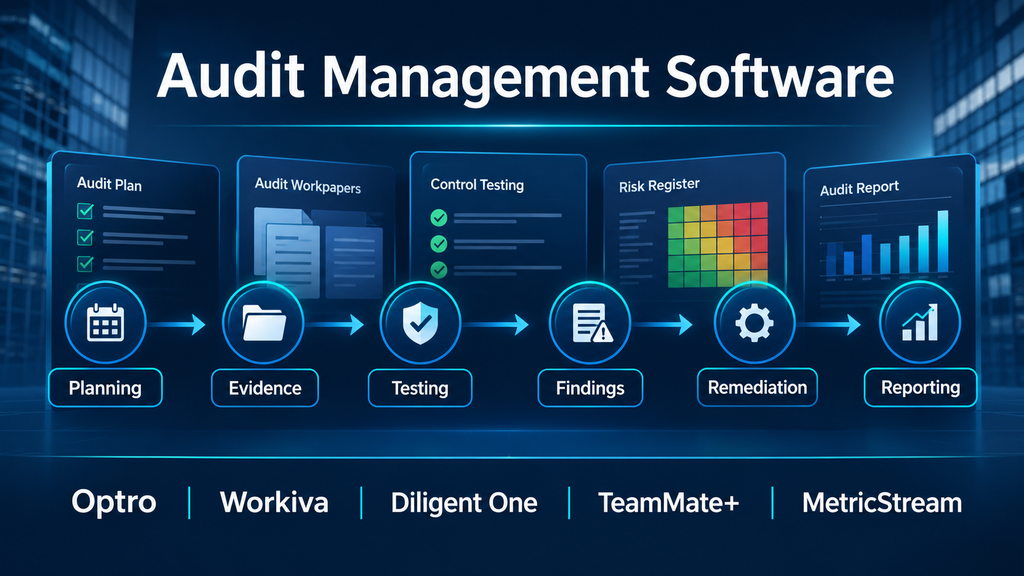
Audit management software provides a centralized environment for managing the audit lifecycle. It helps auditors plan engagements, collect and evaluate evidence, document testing, communicate findings, and monitor remediation.
The objective is not simply to digitize audit paperwork. Effective audit software helps teams improve audit coverage, maintain defensible documentation, coordinate stakeholders, and deliver useful insights to management.
What Is Audit Management Software?
Audit management software is a platform designed to organize and automate the activities involved in planning, executing, documenting, and reporting audits.
It can support internal audit departments, compliance teams, external assurance functions, and organizations conducting operational or regulatory audits.
Depending on the product, capabilities include:
- Audit universe and risk assessment management.
- Annual and multi-year audit planning.
- Engagement scheduling and resource allocation.
- Audit program and workpaper management.
- Evidence requests and document collection.
- Control testing and sampling.
- Findings and issue tracking.
- Corrective action management.
- Review and approval workflows.
- Audit reporting and dashboards.
- Integration with risk, compliance, and business systems.
Some solutions concentrate on internal audit workflows, while others offer audit as part of a broader governance, risk, and compliance platform.
Why Organizations Need Audit Management Software
1. Audit processes become difficult to coordinate
An audit may involve multiple departments, locations, systems, and stakeholders. Tracking requests, deadlines, approvals, and evidence through email can create confusion and unnecessary administrative work.
A centralized platform gives auditors and business owners a shared view of engagement progress and outstanding responsibilities.
2. Evidence needs reliable documentation
Audit conclusions depend on supporting evidence. Teams need to know what was requested, what was submitted, who reviewed it, and how the evidence supports the testing conclusion.
Audit management software can maintain structured workpapers and an audit trail that supports review and subsequent examination.
3. Risk priorities change
Annual audit plans can become outdated when new technologies, acquisitions, incidents, regulatory developments, or business changes introduce new exposures.
Risk-based planning tools help audit leaders reassess priorities and adjust coverage as the organization’s risk profile changes.
4. Findings require consistent follow-up
Identifying a control weakness is only the beginning. Management must agree on corrective actions, assign owners, establish deadlines, and provide evidence that remediation has been completed.
A platform can track these activities and make overdue or unresolved issues visible.
5. Leadership needs meaningful assurance reporting
Audit committees and executives need to understand audit coverage, significant findings, recurring control weaknesses, and remediation progress.
Centralized audit information makes it easier to produce consistent reports and identify patterns across engagements.
Core Features of Audit Management Software
Audit universe and risk-based planning
The audit universe represents the areas, processes, systems, and business units that may be subject to audit.
A strong platform should help teams maintain this inventory and assess areas according to factors such as:
- Financial and operational impact.
- Cybersecurity and technology exposure.
- Regulatory importance.
- Historical control failures.
- Business process changes.
- Third-party dependencies.
- Previous audit results.
- Management concerns.
Risk assessments should inform audit priorities rather than rely exclusively on fixed annual schedules.
Audit engagement management
Engagement management coordinates the work performed during an individual audit.
Useful capabilities include:
- Engagement scope and objectives.
- Audit team assignments.
- Schedules and milestones.
- Stakeholder notifications.
- Audit programs and procedures.
- Review responsibilities.
- Engagement status tracking.
The platform should provide visibility into the relationship between planned work, completed procedures, and outstanding activities.
Workpaper and evidence management
Workpapers document the procedures performed, evidence examined, analysis conducted, and conclusions reached.
Important capabilities include:
- Structured workpaper templates.
- Document and evidence attachments.
- Version history.
- Reviewer comments.
- Approval workflows.
- Cross-references between tests and evidence.
- Access controls.
- Traceable audit history.
Buyers should verify how the platform preserves evidence integrity and supports review. A document repository alone does not provide a complete audit workpaper process.
Control testing and sampling
Auditors need to determine whether controls are designed appropriately and operate effectively.
Audit software can help organize testing procedures, record samples, document exceptions, and connect test results to findings.
For data-intensive audits, analytics integrations can help examine larger populations rather than relying exclusively on manual sampling. The auditor must still validate the data, testing logic, and conclusions.
Findings and issue management
When testing identifies a weakness, the platform should allow auditors to document:
- The condition observed.
- The applicable control or requirement.
- The supporting evidence.
- The associated risk or impact.
- The root cause, where established.
- The agreed corrective action.
- The responsible owner.
- The target completion date.
Findings should remain traceable from discovery through management response and closure.
Reporting and dashboards
Audit leaders need to understand program performance and coverage.
Useful reporting measures include engagement completion, audit plan progress, outstanding evidence requests, significant findings, overdue remediation, recurring issues, and risk coverage.
Reports should support different audiences, from detailed operational views for audit teams to concise summaries for senior leadership.
Integration and collaboration
Audit processes often depend on information held in other enterprise systems.
Useful integrations may include:
- Enterprise resource planning systems.
- Governance, risk, and compliance platforms.
- IT service management tools.
- Identity and access management systems.
- Document management platforms.
- Business intelligence tools.
- Data analytics applications.
Integration quality matters because disconnected systems can force auditors to repeat data collection and manually reconcile information.
Leading Audit Management Software Platforms
The following products represent established approaches to audit management. They are not a universal ranking; the right platform depends on audit methodology, organizational size, integration needs, and existing governance systems.
1. Optro (formerly AuditBoard)
<text weight=”medium”>Vendor:</text> <Entity value=”Optro” category=”company” disambig=”Enterprise audit, risk, and compliance software provider”/>
Optro offers audit management capabilities within a broader connected risk platform. Its audit solution is designed to help organizations centralize audit activities, align audit work with emerging risks, and coordinate stakeholders.
Areas to evaluate include:
- End-to-end audit lifecycle management.
- Audit planning and execution.
- Issue and remediation tracking.
- Connections with enterprise risk and compliance information.
- AI-assisted capabilities and workflow automation.
Potential fit: Organizations seeking to connect internal audit with enterprise risk, information security, and compliance workflows.
Optro confirms that AuditBoard has officially rebranded as Optro. <Cite refs={[“turn386191search10″,”turn386191search12”]}/>
Official product information: https://optro.ai/product/operational-audit
2. Workiva Audit Management
<text weight=”medium”>Vendor:</text> <Entity value=”Workiva” category=”company” disambig=”Connected reporting, risk, and compliance software provider”/>
Workiva provides audit management capabilities within its connected reporting and governance, risk, and compliance environment.
Its platform can be relevant where audit activities need to connect with financial reporting, control documentation, evidence, and broader reporting workflows.
Areas to evaluate include:
- Audit and assessment workflows.
- Evidence and request management.
- Connected documents and spreadsheets.
- Reporting and collaboration.
- Data traceability and integration.
Potential fit: Finance-led and internal audit teams that need connections between audit evidence, controls, and corporate reporting.
Official support information: https://support.workiva.com/hc/en-us/articles/360059565172-Workiva-for-Audit-Management
3. Diligent Audit Management
<text weight=”medium”>Vendor:</text> <Entity value=”Diligent” category=”company” disambig=”Governance, risk, audit, and board management software provider”/>
Diligent offers audit management capabilities as part of its broader governance and risk platform portfolio.
Its approach is relevant to organizations that want to coordinate internal audit, risk oversight, and governance information.
Areas to evaluate include:
- Audit planning and engagement management.
- Evidence and workpaper workflows.
- Findings and corrective action tracking.
- Risk-based audit coverage.
- Reporting for management and audit committees.
Potential fit: Organizations looking to connect internal audit with wider governance and risk oversight.
Official buyer guidance: https://www.diligent.com/resources/guides/audit-management-software-buyers-guide
4. Wolters Kluwer TeamMate Audit
<text weight=”medium”>Vendor:</text> <Entity value=”Wolters Kluwer” category=”company” disambig=”Professional information, software, and services provider”/>
TeamMate Audit is purpose-built for internal audit workflows, covering audit planning, fieldwork, reporting, and follow-up.
The platform emphasizes risk-focused planning, stakeholder collaboration, data-driven insights, and integration with business systems. Its ecosystem also includes analytics and related risk and controls capabilities.
Areas to evaluate include:
- Annual and multi-year audit planning.
- Audit execution and workpapers.
- Stakeholder collaboration.
- Audit reporting and dashboards.
- APIs and data integrations.
- Cloud and on-premises deployment options, where available.
Potential fit: Internal audit departments seeking an audit-focused platform with structured lifecycle workflows.
Official product information: https://www.wolterskluwer.com/en/solutions/teammate/internal-audit-management-software <Cite refs={[“turn386191search0″,”turn386191search3”]}/>
5. MetricStream Audit Management
<text weight=”medium”>Vendor:</text> <Entity value=”MetricStream” category=”company” disambig=”Governance, risk, compliance, and audit management software provider”/>
MetricStream provides audit capabilities within its integrated GRC portfolio. This can be useful for organizations that want audit activities connected to enterprise risks, controls, compliance requirements, and remediation workflows.
Areas to evaluate include:
- Risk-based audit planning.
- Audit execution and documentation.
- Control and compliance relationships.
- Findings and remediation.
- Enterprise reporting and analytics.
Potential fit: Larger organizations that need audit management integrated with broader GRC operations.
Official website: https://www.metricstream.com/
Audit Management Software Comparison
| Platform | General approach | Key areas to evaluate | Potential fit |
|---|---|---|---|
| Optro | Connected audit and risk platform | Audit lifecycle, issue tracking, risk alignment | Enterprises connecting audit and risk |
| Workiva | Connected audit and reporting environment | Evidence, documents, data traceability | Finance-led and reporting-intensive teams |
| Diligent | Audit within governance and risk | Audit workflows, oversight, reporting | Organizations connecting audit with governance |
| TeamMate Audit | Purpose-built internal audit | Planning, workpapers, fieldwork, reporting | Dedicated internal audit departments |
| MetricStream | Audit within integrated GRC | Risk, compliance, controls, remediation | Large and regulated enterprises |
This table describes general product positioning, not a feature-by-feature certification. Confirm the specific capabilities, integrations, deployment choices, and licensing included in each vendor proposal.
How to Choose the Right Audit Management Platform
Understand the audit function’s requirements
Determine whether the primary need is internal audit, operational audit, financial controls, compliance audits, IT audits, or a combination.
The intended use case should determine the required workflow depth and reporting model.
Evaluate workpaper quality
Workpapers are central to audit documentation. Test whether the platform can preserve evidence, record testing procedures, support reviewer sign-off, and maintain a clear history of changes.
Ask auditors to perform a complete engagement using realistic examples rather than reviewing sample screens.
Assess risk-based planning
The platform should help the audit function prioritize work according to changing business risks.
Look for flexible risk assessments, audit universe management, resource planning, and the ability to revise coverage when new exposures emerge.
Test evidence collection
Evaluate how the software handles requests, uploads, permissions, versioning, missing evidence, and reviewer comments.
Consider the experience of business stakeholders who must respond to audit requests. Difficult workflows can reduce participation and delay engagements.
Review analytics capabilities
Data analytics can improve audit coverage by helping teams examine larger populations, identify anomalies, and target higher-risk transactions.
Verify which analytics capabilities are native, which require external tools, and how data quality and reproducibility are managed.
Check integrations
Review connections with ERP, GRC, document management, IT, and analytics systems.
Confirm the supported APIs, authentication methods, integration limits, and responsibility for maintaining connections.
Consider implementation and administration
A platform may require methodology configuration, workflow design, data migration, role mapping, and training.
Understand how much configuration can be maintained by the internal audit team and where specialist support will be necessary.
Common Audit Management Implementation Challenges
Digitizing inefficient audit processes
Moving an existing spreadsheet process into software does not automatically improve it.
Recommendation: Review audit methodology, approval structures, and evidence requirements before configuring the platform.
Poor audit universe data
Incomplete process inventories and outdated risk assessments can lead to weak audit coverage.
Recommendation: Establish accountable owners and a recurring process for updating the audit universe.
Inconsistent evidence standards
Different auditors may document testing and conclusions in different ways.
Recommendation: Develop standardized workpaper templates, evidence criteria, and review expectations.
Limited stakeholder participation
Business teams may delay responses if audit requests are unclear or difficult to manage.
Recommendation: Use clear requests, defined responsibilities, reminders, and escalation paths.
Findings that remain unresolved
A finding may be documented but not remediated effectively.
Recommendation: Assign action owners, establish realistic due dates, require closure evidence, and validate corrective actions before closure.
Over-customization
Excessive customization can increase implementation costs and make upgrades difficult.
Recommendation: Prioritize standard workflows and customize only where a genuine business or regulatory requirement justifies it.
A Practical Audit Management Deployment Roadmap
Phase 1: Assess current processes
Review audit planning, engagement execution, workpapers, reporting, evidence collection, and issue follow-up.
Phase 2: Define the audit methodology
Standardize audit objectives, risk scoring, workpaper requirements, review responsibilities, and finding classifications.
Phase 3: Configure the audit universe
Import business processes, systems, locations, and other auditable entities. Validate ownership and risk information.
Phase 4: Implement priority workflows
Start with audit planning, engagement execution, evidence collection, and findings management before expanding into more advanced features.
Phase 5: Integrate enterprise systems
Connect relevant business applications, document repositories, and data sources. Test data accuracy and access permissions.
Phase 6: Pilot and train
Run a pilot engagement with realistic evidence requests, testing, reviews, and reporting. Train auditors and business stakeholders.
Phase 7: Monitor performance
Measure audit plan completion, engagement cycle time, overdue requests, findings, remediation status, and stakeholder response.
Questions to Ask Audit Management Vendors
- Can the platform manage the complete audit lifecycle?
- How are annual and multi-year audit plans created?
- Can audit engagements be prioritized by changing risk?
- How are workpapers, evidence, and review comments maintained?
- Does the platform support sampling and data analytics?
- Can findings be linked to risks and controls?
- How are corrective actions assigned and verified?
- What integrations are available with ERP and GRC systems?
- Can auditors customize methodologies and templates?
- What audit trail and version history are available?
- Which deployment and data residency options are offered?
- Which capabilities require separate modules or licensing?
A proof of concept should demonstrate an entire audit engagement, from planning and evidence collection through testing, reporting, and remediation follow-up.
The Role of AI in Audit Management
AI is beginning to support audit teams in activities such as summarizing documents, organizing evidence, drafting workpaper narratives, identifying unusual patterns, and assisting with risk assessments.
These capabilities can reduce administrative effort, but they should not replace professional judgment.
Auditors must validate AI-generated summaries, confirm source evidence, review analytical logic, and retain responsibility for audit conclusions. Organizations should also evaluate data confidentiality, access permissions, model governance, and the traceability of AI-assisted work.
AI is most useful when it improves efficiency while preserving the independence, skepticism, and accountability required in audit work.
Conclusion
Audit management software helps organizations transform fragmented audit processes into structured, traceable, and risk-focused workflows. By centralizing audit planning, engagement execution, evidence collection, workpapers, findings, and remediation, these platforms can improve coordination and strengthen assurance.
Selecting the right solution requires attention to audit methodology, evidence integrity, risk-based planning, integrations, usability, and implementation effort. The best platform is the one that supports the organization’s actual audit work rather than forcing teams into unnecessary complexity.
Ultimately, successful audit management depends on more than technology. Skilled auditors, clear standards, reliable evidence, management cooperation, and consistent follow-up remain essential.
When these elements work together, audit management software becomes a foundation for stronger internal controls, better risk visibility, and more informed organizational decisions.
