Upgrade & Secure Your Future with DevOps, SRE, DevSecOps, MLOps!
We spend hours scrolling social media and waste money on things we forget, but won’t spend 30 minutes a day earning certifications that can change our lives.
Master in DevOps, SRE, DevSecOps & MLOps by DevOps School!
Learn from Guru Rajesh Kumar and double your salary in just one year.
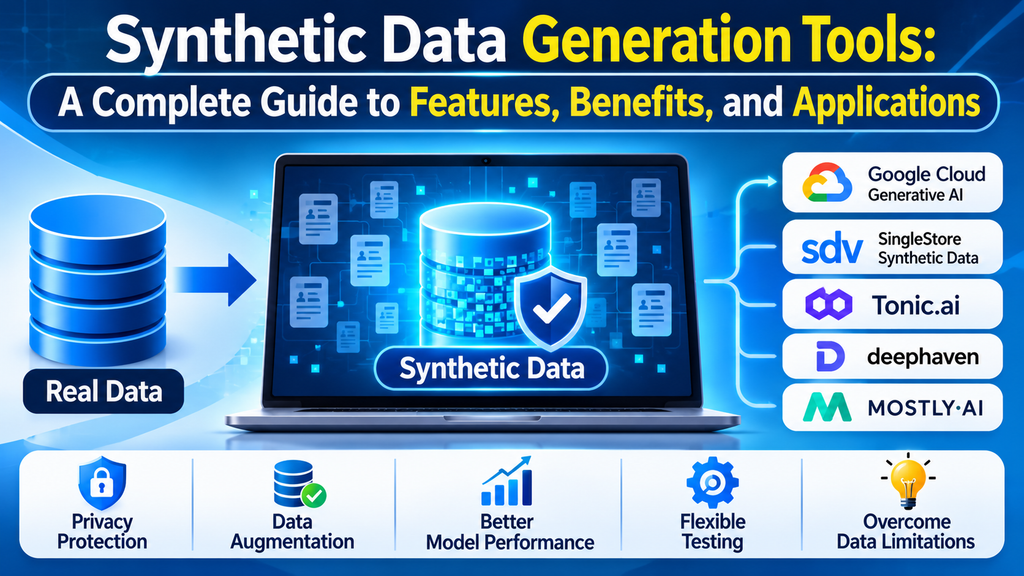
Synthetic Data Generation Tools: A Complete Guide to Features, Benefits, and Applications
Synthetic data generation tools create artificial datasets that reproduce important patterns and characteristics of real-world data. They help organizations develop, test, and evaluate data-driven systems while reducing reliance on directly using sensitive or restricted production data.
What Are Synthetic Data Generation Tools?
Synthetic data generation tools use statistical methods, machine learning, generative models, or predefined rules to create artificial records. These records can resemble real data in structure and statistical behavior without simply copying the original entries.
Synthetic datasets may include customer profiles, financial transactions, medical records, images, text, time-series observations, or application events. Their usefulness depends on how well they preserve the patterns required for a particular task.
Why Synthetic Data Matters
Organizations often face limitations when collecting or sharing real-world data. Privacy requirements, data access restrictions, limited sample sizes, rare events, and high labeling costs can slow development.
Synthetic data can help address these challenges by creating additional examples for testing, development, analytics, and model training. It can also support safer data sharing when privacy risks are carefully evaluated.
However, synthetic data is not automatically anonymous or risk-free. Generated records can still reveal information about training data if the generation process memorizes individual examples. Privacy testing and governance remain important.
Key Features
1. Statistical pattern preservation: Generate data that reflects selected distributions, relationships, and correlations found in source datasets.
2. Privacy controls: Apply techniques and evaluation methods designed to reduce disclosure and re-identification risks.
3. Data augmentation: Create additional examples to expand training datasets or improve coverage of underrepresented cases.
4. Customizable generation: Define schemas, constraints, relationships, and data types to suit different applications.
5. Relational data generation: Generate connected records across multiple tables while maintaining referential consistency.
6. Quality evaluation: Compare synthetic and real datasets using statistical similarity, utility, and privacy assessments.
7. Integration: Connect generation workflows with databases, cloud platforms, analytics tools, and machine learning pipelines.
Popular Synthetic Data Generation Tools
Synthetic Data Vault (SDV): An open-source ecosystem for generating synthetic tabular, relational, and sequential data. It offers models and evaluation capabilities for building and assessing synthetic datasets.
MOSTLY AI: A synthetic data platform focused on generating realistic structured data, with capabilities aimed at enterprise data use cases and privacy-aware data access.
Tonic.ai: Provides tools for generating synthetic data and preparing development and testing datasets. It is relevant to teams that need realistic data for software testing and database workflows.
Gretel: Offers synthetic data generation and related privacy-focused data workflows, including support for structured and unstructured data use cases.
Google Cloud: Provides synthetic data capabilities through its cloud data and AI ecosystem, including tools and approaches for generating artificial data for development and machine learning workflows.
These solutions differ in supported data types, deployment models, customization, privacy methods, and evaluation features. Teams should verify current product capabilities and service terms before choosing a platform.
Benefits of Synthetic Data Generation
- Reduced exposure to sensitive data: Helps limit the need to distribute raw production records.
- More training examples: Expands datasets when real examples are scarce.
- Faster development: Gives developers and testers access to realistic datasets without waiting for production extracts.
- Improved test coverage: Makes it possible to create edge cases and rare scenarios.
- Controlled data sharing: Can support collaboration when privacy and disclosure risks are properly assessed.
- Lower data collection costs: Reduces some of the effort associated with collecting and labeling additional real-world examples.
Common Applications
Synthetic data is used in financial services, healthcare research, insurance, retail, telecommunications, cybersecurity, software testing, and autonomous systems.
For example, a fraud detection team may have very few examples of certain fraud patterns. Synthetic data generation can create additional representative scenarios for model development and testing. The generated records should then be evaluated carefully to ensure they improve model utility without introducing unrealistic patterns.
In healthcare, synthetic records may help researchers test data pipelines or develop analytical methods when access to real patient data is restricted. They should not be treated as a substitute for clinical validation.
How to Choose the Right Tool
Start with the type of data you need to generate. Tabular business data, relational databases, time-series records, text, and images may require different techniques and platforms.
Evaluate statistical fidelity, privacy risk, downstream model utility, scalability, ease of integration, deployment options, and cost. Check whether the platform supports schema constraints, relationships between tables, custom generation rules, and reproducible workflows.
Run a pilot using representative data. Compare synthetic and real datasets across the dimensions that matter to your use case, and test whether models trained on synthetic data perform appropriately on held-out real data.
Best Practices
Define the intended use before generating data. Remove unnecessary sensitive fields from source data, configure constraints carefully, and document the generation method and dataset version. Evaluate statistical similarity and downstream utility, and perform privacy assessments appropriate to the sensitivity of the source data.
Keep synthetic and real datasets clearly labeled. Do not assume that synthetic data is automatically compliant with privacy regulations. Establish access controls, retention policies, and review procedures for generated datasets.
Conclusion
Synthetic data generation tools help organizations create useful artificial datasets for machine learning, analytics, software testing, and research. Platforms and frameworks such as SDV, MOSTLY AI, Tonic.ai, Gretel, and Google Cloud provide different approaches to generating structured and other forms of synthetic data. With careful evaluation of quality, utility, and privacy, synthetic data can become a valuable part of modern data engineering and AI workflows.
