Upgrade & Secure Your Future with DevOps, SRE, DevSecOps, MLOps!
We spend hours scrolling social media and waste money on things we forget, but won’t spend 30 minutes a day earning certifications that can change our lives.
Master in DevOps, SRE, DevSecOps & MLOps by DevOps School!
Learn from Guru Rajesh Kumar and double your salary in just one year.
Introduction
Podcast Hosting Platforms help creators, businesses, educators, media teams, and brands upload, store, distribute, manage, and analyze podcast episodes. In simple words, a podcast host stores your audio files and creates an RSS feed so your podcast can appear on listening platforms like podcast apps and directories.
Podcast hosting matters because podcasting is now used for education, marketing, brand building, interviews, storytelling, internal communication, audience growth, and community engagement. A good podcast host does more than store audio. It helps with publishing, analytics, monetization, websites, team access, private podcasting, transcripts, scheduling, and distribution.
Common use cases include:
- Public podcast publishing
- Branded business podcasts
- Private internal company podcasts
- Educational audio series
- Interview and storytelling shows
- Paid subscriber podcasts
- Podcast analytics and audience growth
Buyers should evaluate:
- Storage and bandwidth limits
- RSS feed control
- Distribution support
- Analytics depth
- Monetization features
- Private podcasting support
- Website and landing page tools
- Team collaboration
- Security and access control
- Pricing and scalability
Best for: Podcasters, creators, marketers, educators, coaches, agencies, media companies, founders, community builders, internal communications teams, and businesses using audio content for audience growth.
Not ideal for: Users who only need one-time audio file sharing, simple voice notes, or short social audio clips. In those cases, cloud storage, video platforms, or social media tools may be enough.
Key Trends in Podcast Hosting Platforms
- AI-powered podcast workflows are growing: Platforms are adding transcription, show notes, title ideas, chapter suggestions, audio cleanup, clips, and content repurposing features.
- Private podcasting is becoming more common: Companies use private feeds for employee updates, training, leadership messages, onboarding, and member-only content.
- Video podcasting is influencing hosting needs: Many creators now publish both audio and video, so workflow integration with video platforms matters.
- Podcast analytics are becoming deeper: Creators want listener trends, episode performance, location data, retention signals, device insights, and campaign tracking.
- Monetization options are expanding: Paid subscriptions, dynamic ads, sponsorship tools, listener support, memberships, and premium feeds are becoming more important.
- Distribution control remains critical: Podcasters need reliable RSS feeds, directory submissions, episode scheduling, metadata control, and redirect options.
- Brand-owned podcast websites are gaining value: Teams want custom pages, SEO-friendly show notes, embedded players, email capture, and episode landing pages.
- Team workflows matter for businesses: Agencies and brands need roles, approvals, multiple shows, client dashboards, and collaboration tools.
- Security is more important for private content: Internal podcasts, paid feeds, and unreleased episodes need access controls, private links, secure feeds, and team permissions.
- Pricing is becoming more segmented: Platforms may price by downloads, shows, storage, team seats, private subscribers, monetization tools, or advanced analytics.
How We Selected These Tools
The tools below were selected using practical evaluation logic:
- Strong recognition in podcast hosting, distribution, analytics, monetization, or creator workflows
- Feature depth across RSS hosting, episode publishing, analytics, websites, and monetization
- Fit for different users, including solo creators, freelancers, SMBs, media teams, agencies, and enterprises
- Support for public and private podcast workflows
- Reliability and scalability for ongoing publishing
- Ease of migration, RSS control, and directory distribution
- Analytics quality and reporting usefulness
- Pricing flexibility for beginners and growing shows
- Support resources, onboarding, and community strength
- Balanced inclusion of creator-friendly, business-focused, enterprise-ready, and monetization-focused platforms
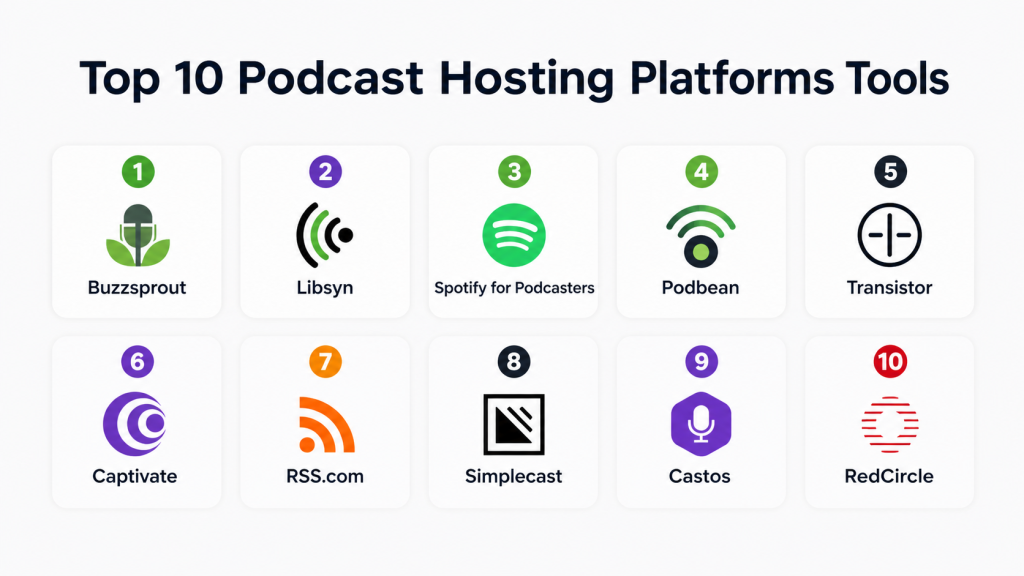
Top 10 Podcast Hosting Platforms Tools
#1 — Buzzsprout
Short description: Buzzsprout is a podcast hosting platform focused on simple publishing, distribution, analytics, and creator-friendly workflows. It is best for beginners, independent podcasters, small businesses, coaches, and educators who want an easy way to launch and manage a podcast.
Key Features
- Simple podcast upload and publishing
- RSS feed creation and management
- Podcast directory distribution support
- Basic website and embedded player tools
- Episode analytics
- Monetization options depending on plan
- Transcription and enhancement options depending on features available
Pros
- Very beginner-friendly
- Clean publishing workflow
- Good for creators who want simple setup
Cons
- May be less flexible for large media networks
- Advanced enterprise controls may be limited
- Higher usage may require paid plans
Platforms / Deployment
Web
Cloud
Security & Compliance
SSO/SAML, MFA, encryption, audit logs, RBAC: Not publicly stated.
SOC 2, ISO 27001, GDPR, HIPAA: Not publicly stated.
Integrations & Ecosystem
Buzzsprout works well for creators who need simple hosting, RSS management, directory publishing, and basic promotion tools.
- Podcast directory distribution
- Embeddable podcast players
- Podcast website tools
- Monetization workflows depending on plan
- Social sharing tools
- Basic analytics workflows
Support & Community
Buzzsprout provides learning resources, help content, onboarding guidance, and creator-focused support. Community strength is good among beginner and independent podcasters.
#2 — Libsyn
Short description: Libsyn is one of the long-established podcast hosting platforms used by independent podcasters, businesses, and professional publishers. It is best for users who want reliable podcast hosting, distribution, analytics, and long-running feed management.
Key Features
- Podcast hosting and RSS feed management
- Episode publishing and scheduling
- Distribution tools
- Podcast analytics
- Monetization options depending on plan
- Multiple show support depending on configuration
- Custom publishing workflows
Pros
- Long-standing podcast hosting reputation
- Good for serious and long-running podcasts
- Useful for creators who value feed reliability
Cons
- Interface may feel less modern to some beginners
- Plan structure should be reviewed carefully
- Some advanced features may depend on package
Platforms / Deployment
Web
Cloud
Security & Compliance
SSO/SAML, MFA, encryption, audit logs, RBAC: Varies / N/A.
SOC 2, ISO 27001, GDPR, HIPAA: Not publicly stated.
Integrations & Ecosystem
Libsyn fits traditional podcast hosting workflows where RSS control, publishing, distribution, and analytics matter.
- Podcast directory distribution
- RSS feed management
- Podcast websites depending on plan
- Ad and monetization workflows depending on plan
- Episode scheduling
- Analytics reporting
Support & Community
Libsyn provides help resources, support, and long-standing podcasting knowledge. Its community includes independent creators, professional podcasters, and media publishers.
#3 — Spotify for Podcasters
Short description: Spotify for Podcasters is a podcast creation, hosting, distribution, and audience tool connected to Spotify’s podcast ecosystem. It is best for creators who want easy publishing, audience insights, and simple entry into podcasting.
Key Features
- Podcast hosting and publishing
- Spotify audience insights
- RSS feed support
- Episode management
- Creator dashboard
- Monetization options depending on eligibility and region
- Simple podcast setup workflow
Pros
- Easy for new podcasters to start
- Strong connection with Spotify audience tools
- Good for creators focused on simple publishing
Cons
- Advanced hosting controls may be limited for professional teams
- Monetization availability may vary
- Not always ideal for large enterprise podcast networks
Platforms / Deployment
Web
Cloud
Security & Compliance
SSO/SAML, MFA, encryption, audit logs, RBAC: Varies by account and platform configuration.
SOC 2, ISO 27001, GDPR, HIPAA: Not publicly stated.
Integrations & Ecosystem
Spotify for Podcasters fits creator workflows where publishing, audience insights, and Spotify visibility matter.
- Spotify podcast ecosystem
- RSS feed workflows
- Creator dashboard
- Audience analytics
- Monetization tools depending on availability
- Episode management
Support & Community
Support is mainly through help resources, creator documentation, and platform guidance. Community strength is strong among new podcasters and creators using Spotify.
#4 — Podbean
Short description: Podbean is a podcast hosting platform with publishing, websites, monetization, live streaming, and private podcasting features. It is best for creators, small businesses, educators, brands, and organizations that need flexible podcast hosting.
Key Features
- Podcast hosting and RSS feeds
- Podcast website tools
- Monetization options
- Private podcasting support depending on plan
- Live streaming features
- Analytics dashboards
- Mobile app workflows
Pros
- Good all-around feature set
- Useful for both public and private podcasts
- Monetization options are helpful for growing shows
Cons
- Feature availability varies by plan
- Interface may require learning for advanced tools
- Enterprise needs should be reviewed carefully
Platforms / Deployment
Web / iOS / Android options vary
Cloud
Security & Compliance
SSO/SAML, MFA, encryption, audit logs, RBAC: Varies by plan and private podcast setup.
SOC 2, ISO 27001, GDPR, HIPAA: Not publicly stated.
Integrations & Ecosystem
Podbean supports a broad podcast workflow from hosting to monetization and private feeds.
- Podcast directory distribution
- Podcast website tools
- Advertising and monetization tools
- Private podcast workflows
- Mobile app workflows
- Analytics dashboards
Support & Community
Podbean provides documentation, help resources, and support options. Community strength is good among independent creators, businesses, and education users.
#5 — Transistor
Short description: Transistor is a podcast hosting platform designed for brands, businesses, creators, and teams managing one or more shows. It is best for companies, agencies, and professional creators who want multiple podcasts, analytics, team access, and private podcasting.
Key Features
- Multiple podcast hosting
- Public and private podcasts
- Team member access
- Analytics and reporting
- Podcast websites
- RSS feed management
- Embeddable players
Pros
- Strong for businesses and agencies
- Multiple shows can be managed from one account
- Private podcasting is useful for teams and memberships
Cons
- May be more than casual hobbyists need
- Pricing should be reviewed for show and download needs
- Advanced monetization features may require additional tools
Platforms / Deployment
Web
Cloud
Security & Compliance
SSO/SAML, MFA, encryption, audit logs, RBAC: Varies by plan and workspace configuration.
SOC 2, ISO 27001, GDPR, HIPAA: Not publicly stated.
Integrations & Ecosystem
Transistor works well for business podcast workflows where teams need clean management, multiple shows, and private feeds.
- Podcast websites
- Embeddable players
- Private podcast feeds
- Team workflows
- Analytics dashboards
- Directory distribution support
Support & Community
Transistor provides help resources, onboarding guidance, and support. Community strength is good among business podcasters, agencies, and independent creators.
#6 — Captivate
Short description: Captivate is a podcast hosting platform focused on growth, analytics, marketing tools, and creator-friendly publishing. It is best for independent podcasters, brands, marketers, and teams that want audience growth features with hosting.
Key Features
- Podcast hosting and RSS management
- Podcast website tools
- Analytics and growth dashboards
- Calls-to-action and marketing tools
- Private podcasting depending on plan
- Team access depending on plan
- Embeddable players
Pros
- Good for growth-focused podcasters
- Strong marketing-oriented features
- Useful for creators and small teams
Cons
- Some advanced features depend on plan
- May not be the simplest option for absolute beginners
- Large networks should review scaling needs
Platforms / Deployment
Web
Cloud
Security & Compliance
SSO/SAML, MFA, encryption, audit logs, RBAC: Varies by plan and team setup.
SOC 2, ISO 27001, GDPR, HIPAA: Not publicly stated.
Integrations & Ecosystem
Captivate fits creators and businesses that want hosting plus growth and marketing workflows.
- Podcast websites
- Embeddable players
- Email and marketing workflows depending on integrations
- Calls-to-action
- Analytics dashboards
- Private podcast workflows depending on plan
Support & Community
Captivate provides help content, onboarding resources, and creator support. Community strength is strong among growth-focused podcasters and marketers.
#7 — RSS.com
Short description: RSS.com is a podcast hosting platform focused on easy publishing, distribution, analytics, and monetization options. It is best for beginners, independent creators, educators, and small teams that want straightforward podcast hosting.
Key Features
- Podcast hosting and RSS feed management
- Directory distribution support
- Episode scheduling
- Analytics dashboard
- Podcast website tools
- Monetization options depending on eligibility
- Simple publishing workflow
Pros
- Easy to use for beginners
- Good for simple podcast launch workflows
- Useful for independent creators and educators
Cons
- Advanced enterprise features may be limited
- Monetization availability may vary
- Large teams should review collaboration needs
Platforms / Deployment
Web
Cloud
Security & Compliance
SSO/SAML, MFA, encryption, audit logs, RBAC: Not publicly stated.
SOC 2, ISO 27001, GDPR, HIPAA: Not publicly stated.
Integrations & Ecosystem
RSS.com fits simple podcast hosting and distribution workflows.
- RSS feed management
- Podcast directory distribution
- Podcast website tools
- Analytics dashboards
- Episode scheduling
- Monetization workflows depending on availability
Support & Community
RSS.com provides help resources, documentation, and support. Community strength is growing among new and independent podcasters.
#8 — Simplecast
Short description: Simplecast is a podcast hosting and analytics platform used by creators, brands, and media teams. It is best for podcasters who want clean publishing, strong analytics, and a professional hosting experience.
Key Features
- Podcast hosting and RSS feeds
- Analytics and reporting
- Episode publishing and scheduling
- Embeddable players
- Show websites
- Team workflows depending on plan
- Distribution support
Pros
- Clean professional hosting workflow
- Strong analytics focus
- Good for brands and serious creators
Cons
- Pricing should be reviewed for scaling needs
- Some advanced features may depend on plan
- May not be the cheapest beginner option
Platforms / Deployment
Web
Cloud
Security & Compliance
SSO/SAML, MFA, encryption, audit logs, RBAC: Varies by plan and organization setup.
SOC 2, ISO 27001, GDPR, HIPAA: Not publicly stated.
Integrations & Ecosystem
Simplecast supports professional podcast publishing and audience measurement workflows.
- Podcast directory distribution
- Analytics dashboards
- Embeddable players
- Podcast websites
- Team workflows depending on plan
- API or advanced workflows depending on plan
Support & Community
Simplecast provides help documentation, support resources, and professional podcasting guidance. Community strength is good among serious creators and brand publishers.
#9 — Castos
Short description: Castos is a podcast hosting platform known for public podcasts, private podcasts, and WordPress-friendly workflows. It is best for creators, businesses, membership sites, educators, and WordPress users managing podcast content.
Key Features
- Podcast hosting and RSS feeds
- Public and private podcast support
- WordPress-friendly workflows
- Analytics dashboards
- Episode management
- Podcast websites
- Team and membership use cases depending on setup
Pros
- Good fit for WordPress-based creators
- Useful private podcasting options
- Practical for memberships and education
Cons
- Best value depends on WordPress or private podcast needs
- Advanced marketing may require other tools
- Plan limits should be reviewed carefully
Platforms / Deployment
Web / WordPress workflows
Cloud
Security & Compliance
SSO/SAML, MFA, encryption, audit logs, RBAC: Varies by plan and WordPress setup.
SOC 2, ISO 27001, GDPR, HIPAA: Not publicly stated.
Integrations & Ecosystem
Castos fits podcast workflows where websites, memberships, and private content matter.
- WordPress workflows
- Private podcast feeds
- Podcast analytics
- Embeddable players
- Membership workflows depending on setup
- Public podcast distribution
Support & Community
Castos provides documentation, support resources, and creator education. Community strength is good among WordPress users and business podcasters.
#10 — RedCircle
Short description: RedCircle is a podcast hosting and monetization platform focused on distribution, advertising, subscriptions, and creator growth. It is best for independent podcasters and growing shows that want monetization tools built into hosting.
Key Features
- Podcast hosting and RSS feeds
- Advertising and monetization tools
- Cross-promotion options
- Listener support and subscription features depending on plan
- Analytics dashboard
- Distribution support
- Episode publishing tools
Pros
- Strong monetization focus
- Useful for independent creators growing revenue
- Cross-promotion tools can help discovery
Cons
- Monetization features may depend on eligibility and plan
- Not every show will be ready for ad revenue
- Enterprise needs should be reviewed carefully
Platforms / Deployment
Web
Cloud
Security & Compliance
SSO/SAML, MFA, encryption, audit logs, RBAC: Varies by account and plan.
SOC 2, ISO 27001, GDPR, HIPAA: Not publicly stated.
Integrations & Ecosystem
RedCircle fits hosting workflows where monetization and growth are key priorities.
- Advertising tools
- Subscription workflows depending on plan
- Cross-promotion
- Analytics dashboards
- Podcast directory distribution
- Creator monetization workflows
Support & Community
RedCircle provides help resources, creator guidance, and support. Community strength is good among independent podcasters focused on growth and monetization.
Comparison Table
| Tool Name | Best For | Platform(s) Supported | Deployment (Cloud/Self-hosted/Hybrid) | Standout Feature | Public Rating |
|---|---|---|---|---|---|
| Buzzsprout | Beginners and independent podcasters | Web | Cloud | Simple podcast publishing workflow | N/A |
| Libsyn | Long-running podcasts and serious creators | Web | Cloud | Reliable traditional podcast hosting | N/A |
| Spotify for Podcasters | New creators and Spotify audience insights | Web | Cloud | Easy publishing with Spotify ecosystem | N/A |
| Podbean | Public and private podcasts | Web, iOS, Android options vary | Cloud | Broad hosting, monetization, and private podcasting | N/A |
| Transistor | Businesses and multiple shows | Web | Cloud | Multiple podcasts and private feeds | N/A |
| Captivate | Growth-focused podcasters | Web | Cloud | Marketing and growth tools | N/A |
| RSS.com | Simple podcast launching | Web | Cloud | Easy RSS hosting and distribution | N/A |
| Simplecast | Professional hosting and analytics | Web | Cloud | Clean analytics-focused hosting | N/A |
| Castos | WordPress and private podcasting | Web, WordPress workflows | Cloud | WordPress-friendly podcast hosting | N/A |
| RedCircle | Monetization-focused creators | Web | Cloud | Advertising and cross-promotion tools | N/A |
Evaluation & Scoring of Podcast Hosting Platforms
The scoring below is comparative. It reflects hosting capability, ease of use, integrations, security signals, reliability, support, and price/value. It is not a public rating.
| Tool Name | Core (25%) | Ease (15%) | Integrations (15%) | Security (10%) | Performance (10%) | Support (10%) | Value (15%) | Weighted Total (0–10) |
|---|---|---|---|---|---|---|---|---|
| Buzzsprout | 8 | 9 | 7 | 5 | 8 | 8 | 8 | 7.65 |
| Libsyn | 8 | 6 | 8 | 5 | 9 | 8 | 7 | 7.40 |
| Spotify for Podcasters | 7 | 9 | 7 | 6 | 8 | 7 | 9 | 7.65 |
| Podbean | 8 | 8 | 8 | 6 | 8 | 8 | 8 | 7.80 |
| Transistor | 8 | 8 | 8 | 6 | 8 | 8 | 7 | 7.65 |
| Captivate | 8 | 8 | 8 | 6 | 8 | 8 | 7 | 7.65 |
| RSS.com | 7 | 8 | 7 | 5 | 8 | 7 | 8 | 7.15 |
| Simplecast | 8 | 8 | 8 | 6 | 8 | 8 | 7 | 7.65 |
| Castos | 8 | 7 | 8 | 6 | 8 | 7 | 7 | 7.35 |
| RedCircle | 8 | 8 | 7 | 5 | 8 | 7 | 8 | 7.35 |
How to interpret the scores:
- Higher scores show stronger overall fit across the listed criteria, not a universal winner.
- Beginner-friendly platforms score well for ease of use.
- Business-focused platforms score well for teams, private podcasting, and multiple shows.
- Monetization-focused tools are better for shows ready to grow revenue.
- Final selection should depend on your show size, audience goals, budget, and privacy needs.
Which Podcast Hosting Platforms Tool Is Right for You?
Solo / Freelancer
Solo podcasters should choose a platform that is easy to use, affordable, and reliable.
Good choices include:
- Buzzsprout for beginner-friendly podcast hosting
- Spotify for Podcasters for simple publishing and Spotify audience tools
- RSS.com for straightforward podcast launching
- Podbean for public podcasting with monetization options
- RedCircle for creators focused on monetization
- Captivate for creators focused on growth
Solo creators should avoid paying for advanced team features unless they need them. Start with reliable hosting, good analytics, and easy distribution.
SMB
Small businesses and agencies need podcast hosting that supports brand growth, marketing, team workflows, and measurable results.
Good choices include:
- Transistor for businesses running multiple shows
- Captivate for growth and marketing features
- Podbean for public and private podcasts
- Castos for WordPress-based businesses
- Simplecast for professional analytics
- Buzzsprout for simple branded podcast publishing
SMBs should evaluate website tools, analytics, team roles, private podcasting, and integration with their content marketing workflow.
Mid-Market
Mid-market teams often need stronger reporting, multiple shows, brand control, collaboration, private feeds, and monetization options.
Good choices include:
- Transistor for multiple podcasts and team workflows
- Simplecast for analytics-focused hosting
- Podbean for flexible public and private podcasting
- Captivate for audience growth features
- Castos for membership and WordPress workflows
- Libsyn for established podcast hosting needs
Mid-market buyers should test migration, reporting, RSS control, private access, and team permissions before committing.
Enterprise
Enterprise teams need governance, private distribution, secure access, internal communications support, and reliable analytics.
Good choices include:
- Podbean for private podcasting and business workflows
- Transistor for private feeds and multiple shows
- Castos for private podcasting and membership-style access
- Simplecast for professional analytics and hosting
- Libsyn for established hosting workflows
- Captivate for branded growth-focused podcast programs
Enterprise buyers should involve marketing, IT, internal communications, legal, HR, security, and compliance teams before standardizing.
Budget vs Premium
For budget-focused podcasters, Spotify for Podcasters, RSS.com, Buzzsprout, and entry-level plans from other tools can be practical.
For premium or business-focused needs, Transistor, Captivate, Podbean, Simplecast, Castos, and Libsyn may provide stronger analytics, team features, private feeds, and growth tools.
Budget tools are good for launching. Premium tools are better when shows become part of business strategy.
Feature Depth vs Ease of Use
If ease of use matters most, consider Buzzsprout, Spotify for Podcasters, RSS.com, or Podbean.
If feature depth matters most, consider Transistor, Captivate, Simplecast, Castos, or Libsyn.
For monetization, review RedCircle and Podbean. For private podcasting, review Transistor, Podbean, and Castos.
Integrations & Scalability
Podcast hosting platforms should fit your broader content workflow. A good platform should connect with websites, analytics, email marketing, social promotion, monetization, and internal communication needs.
Important integration areas include:
- Podcast directories
- Website builders
- WordPress
- Email marketing tools
- Analytics platforms
- Membership platforms
- Ad networks
- Social media workflows
- Private feed access
- Embedded players
Scalability depends on episode volume, download growth, number of shows, team size, private listeners, monetization needs, and analytics expectations.
Security & Compliance Needs
Podcast hosting may include unpublished episodes, paid content, private company updates, employee training, client interviews, and member-only feeds. Security matters more when the podcast is not fully public.
Important checks include:
- Private feed controls
- Team permissions
- Password or access protection
- Secure account login
- MFA availability
- Download access controls
- Data retention policies
- Listener privacy
- Paid content protection
- Admin role management
For internal podcasts, HR updates, executive communication, paid memberships, or education content, review privacy and access control before publishing.
Frequently Asked Questions (FAQs)
What is a podcast hosting platform?
A podcast hosting platform stores your audio files, creates your RSS feed, and helps distribute your episodes to podcast listening apps and directories.
Do I need podcast hosting to start a podcast?
Yes, in most cases. A podcast host gives you the RSS feed needed for podcast apps to receive and update your episodes.
Which podcast hosting platform is best for beginners?
Buzzsprout, Spotify for Podcasters, RSS.com, and Podbean are beginner-friendly options. They are easier for first-time podcasters to set up and manage.
Which platform is best for business podcasts?
Transistor, Captivate, Podbean, Simplecast, and Castos are strong business podcast options. They offer useful features for teams, analytics, private feeds, and brand workflows.
What is a private podcast?
A private podcast is only available to selected listeners. It is commonly used for employee updates, paid communities, internal training, and member-only content.
What pricing models are common?
Pricing may depend on downloads, number of shows, storage, team seats, private subscribers, advanced analytics, monetization tools, or enterprise needs.
What are common mistakes when choosing podcast hosting?
Common mistakes include ignoring RSS ownership, choosing only by price, not checking analytics, skipping migration options, and overlooking private podcast needs.
Can I switch podcast hosting platforms later?
Yes, but you need to manage redirects carefully so listeners and directories continue receiving your episodes without interruption.
What analytics should a podcast host provide?
Useful analytics include downloads, listener location, device type, app/platform data, episode trends, retention signals where available, and campaign performance.
Can podcast hosting platforms help with monetization?
Yes, some platforms support ads, subscriptions, listener donations, premium feeds, sponsorship tools, and marketplace-style monetization options.
Is free podcast hosting good enough?
Free hosting can be good for beginners, testing, or hobby shows. Growing brands may need paid features such as better analytics, private feeds, team roles, and monetization.
What is an RSS feed?
An RSS feed is the technical feed that sends your podcast episodes, titles, descriptions, artwork, and metadata to podcast apps.
Is podcast hosting secure?
It can be secure if the platform offers good account protection, private feed controls, and safe team management. Sensitive content needs extra review.
Do podcast hosts provide websites?
Many podcast hosts provide basic show websites or episode landing pages. Businesses may still prefer a dedicated website for stronger branding and SEO.
Conclusion
Podcast Hosting Platforms are essential for publishing, distributing, tracking, and growing a podcast. The best platform depends on your goals, budget, audience size, monetization plans, and privacy needs. Buzzsprout, Spotify for Podcasters, and RSS.com are useful for beginners and simple launches. Libsyn is a strong long-standing option for serious podcast hosting. Podbean, Transistor, Captivate, Simplecast, and Castos are better for business, team, private podcasting, and branded workflows. RedCircle is useful for creators who want stronger monetization options
