Upgrade & Secure Your Future with DevOps, SRE, DevSecOps, MLOps!
We spend hours scrolling social media and waste money on things we forget, but won’t spend 30 minutes a day earning certifications that can change our lives.
Master in DevOps, SRE, DevSecOps & MLOps by DevOps School!
Learn from Guru Rajesh Kumar and double your salary in just one year.
Introduction
Digital Audio Workstations, commonly called DAWs, are software platforms used to record, edit, arrange, mix, master, and produce audio. In simple words, a DAW is the main workspace where musicians, producers, sound engineers, podcasters, composers, and audio teams create finished sound.
DAWs matter because modern audio production is no longer limited to large studios. Music producers, podcast teams, film sound designers, game audio teams, educators, and creators now need professional recording, MIDI production, plugins, automation, collaboration, and export tools from one platform.
Common use cases include:
- Music recording and production
- Podcast editing and mixing
- Film and video post-production
- Game sound design
- Voice-over recording
- Live performance production
- Mixing and mastering
Buyers should evaluate:
- Recording and editing workflow
- MIDI and virtual instrument support
- Plugin compatibility
- Mixing and automation tools
- Audio restoration and cleanup features
- Collaboration options
- Hardware and controller support
- Performance with large sessions
- Learning curve
- Pricing and licensing
Best for: Music producers, recording studios, audio engineers, podcasters, composers, sound designers, filmmakers, game audio teams, educators, creators, and post-production teams.
Not ideal for: Users who only need quick trimming, simple voice notes, basic mobile editing, or one-click social audio cleanup. In those cases, lightweight audio editors or online tools may be enough.
Key Trends in Digital Audio Workstations (DAWs)
- AI-assisted audio workflows are growing: DAWs and plugins now help with stem separation, noise cleanup, mastering suggestions, vocal tuning, drum replacement, and mix assistance.
- Spatial audio is becoming more important: Film, gaming, AR/VR, streaming, and immersive media teams need surround, binaural, Dolby Atmos-style, and 3D audio workflows.
- Remote collaboration is now expected: Producers and editors increasingly need shared sessions, cloud projects, version control, review workflows, and secure file exchange.
- Hybrid music and podcast workflows are expanding: Many teams want one tool for music, voice, editing, mixing, mastering, and publishing preparation.
- Plugin ecosystems remain a major buying factor: VST, AU, and AAX support can strongly influence which DAW fits a professional workflow.
- Low-latency performance still matters: Recording vocals, instruments, drums, and live performances requires stable latency, strong driver support, and reliable hardware integration.
- MIDI and virtual instruments are more advanced: Producers expect flexible piano roll tools, expression control, MIDI effects, orchestral workflows, and large sample libraries.
- Creator-friendly workflows are becoming simpler: Newer DAWs and updates focus on templates, smart tools, loops, presets, and faster arrangement workflows.
- Security is more relevant for business audio: Studios and agencies often handle unreleased music, confidential voice recordings, client sessions, and licensed content.
- Pricing models are more varied: Buyers can choose subscriptions, perpetual licenses, upgrade plans, free editions, bundled hardware versions, and enterprise-style licensing.
How We Selected These Tools
The tools below were selected using practical evaluation logic:
- Strong adoption in music production, studio recording, podcasting, post-production, or sound design
- Feature depth across recording, editing, mixing, mastering, MIDI, plugins, and export
- Fit for solo creators, freelancers, studios, agencies, education teams, and enterprise users
- Performance reliability with real-world sessions and large projects
- Strength of plugin, hardware, and controller ecosystem
- Support for modern workflows such as spatial audio, collaboration, and AI-assisted production
- Learning resources, documentation, tutorials, and community strength
- Pricing value for different user types
- Platform availability across Windows, macOS, and Linux where applicable
- Balanced inclusion of premium, creator-friendly, open-source, and professional studio tools
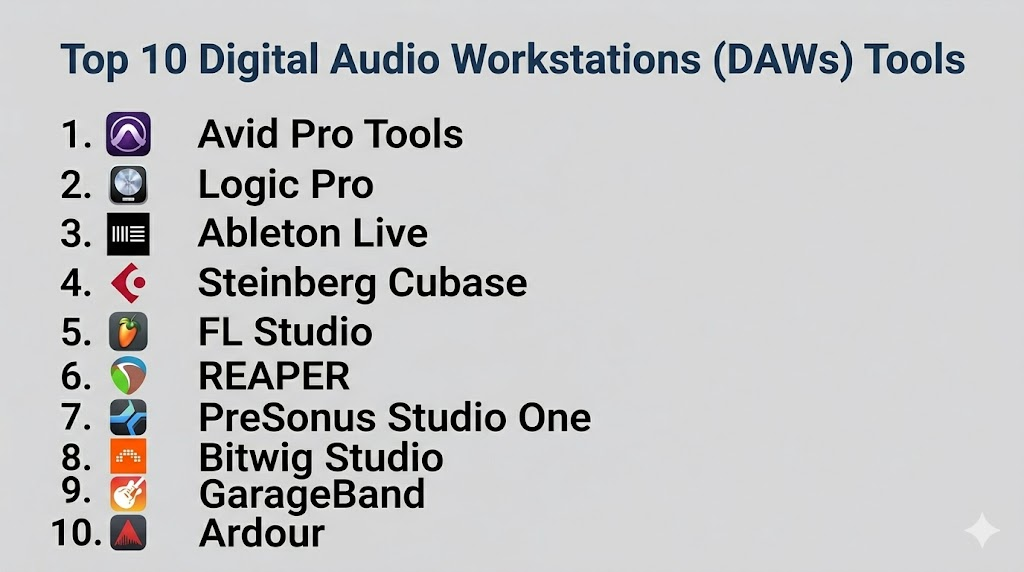
Top 10 Digital Audio Workstations (DAWs) Tools
#1 — Avid Pro Tools
Short description: Avid Pro Tools is a professional DAW used in recording studios, film post-production, broadcast, and music production. It is best for audio engineers, commercial studios, post-production houses, and teams working in industry-standard studio environments.
Key Features
- Professional multitrack recording and editing
- Advanced mixing and automation
- AAX plugin ecosystem
- Audio post-production workflows
- Surround and immersive audio options depending on version
- Strong hardware and control surface support
- Session collaboration options depending on plan
Pros
- Strong professional studio adoption
- Excellent for recording, editing, mixing, and post-production
- Large ecosystem of plugins, hardware, and trained users
Cons
- Can be expensive for beginners
- Learning curve may be high
- Plugin and hardware costs can add up
Platforms / Deployment
Windows / macOS
Self-hosted desktop / cloud-connected options vary by plan
Security & Compliance
SSO/SAML, MFA, encryption, audit logs, RBAC: Varies by Avid account and enterprise setup.
SOC 2, ISO 27001, GDPR, HIPAA: Not publicly stated.
Integrations & Ecosystem
Pro Tools is deeply connected with professional audio production environments and studio workflows.
- AAX plugins
- Avid control surfaces
- Studio hardware
- Film and broadcast workflows
- Collaboration workflows
- Post-production delivery pipelines
Support & Community
Avid provides documentation, training, support options, and professional learning resources. Pro Tools has a large professional community in music, film, and broadcast audio.
#2 — Logic Pro
Short description: Logic Pro is Apple’s professional DAW for music production, recording, MIDI composition, mixing, and mastering. It is best for Mac-based musicians, composers, producers, creators, and home studios.
Key Features
- Multitrack recording and editing
- MIDI sequencing and composition tools
- Built-in instruments and effects
- Mixing and mastering tools
- Apple Loops and sound library
- Spatial audio workflows depending on project needs
- macOS-optimized performance
Pros
- Strong value for Mac users
- Excellent built-in instruments and effects
- Great for music production and composition
Cons
- macOS only
- Not ideal for Windows-based teams
- Post-production workflows may need additional tools
Platforms / Deployment
macOS
Self-hosted desktop
Security & Compliance
SSO/SAML, MFA, encryption, audit logs, RBAC: Varies by Apple account and device setup.
SOC 2, ISO 27001, GDPR, HIPAA: Not publicly stated.
Integrations & Ecosystem
Logic Pro fits naturally into Apple-based creative production environments.
- AU plugins
- MIDI controllers
- Apple sound libraries
- GarageBand project compatibility
- Final Cut Pro-related workflows
- macOS audio hardware workflows
Support & Community
Apple provides documentation and support resources. Logic Pro also has a strong community of producers, composers, musicians, educators, and content creators.
#3 — Ableton Live
Short description: Ableton Live is a DAW built for music creation, live performance, electronic production, beat making, and sound design. It is best for electronic music producers, live performers, DJs, beat makers, and experimental creators.
Key Features
- Session View and Arrangement View
- Audio recording and editing
- MIDI sequencing
- Warping and time-stretching
- Built-in instruments and effects
- Max for Live ecosystem
- Strong controller support
Pros
- Excellent for electronic music and live performance
- Fast creative workflow
- Strong sound design and loop-based production
Cons
- Traditional recording workflows may feel different at first
- Advanced editions can be costly
- Not always the first choice for film post-production
Platforms / Deployment
Windows / macOS
Self-hosted desktop
Security & Compliance
SSO/SAML, MFA, encryption, audit logs, RBAC: Not publicly stated.
SOC 2, ISO 27001, GDPR, HIPAA: Not publicly stated.
Integrations & Ecosystem
Ableton Live has a strong creative production ecosystem for music, performance, and sound design.
- Max for Live
- MIDI controllers
- Audio plugins
- Hardware instruments
- Sample libraries
- Live performance setups
Support & Community
Ableton provides documentation, tutorials, learning resources, and support. The community is very active among electronic musicians, producers, performers, and sound designers.
#4 — Steinberg Cubase
Short description: Cubase is a professional DAW used for music production, recording, MIDI composition, editing, mixing, and scoring. It is best for composers, producers, musicians, and studios that need strong MIDI and arrangement tools.
Key Features
- Audio recording and editing
- Advanced MIDI sequencing
- Mixing and automation
- Score and composition tools
- VST plugin support
- Virtual instruments and effects
- Professional music production workflow
Pros
- Excellent MIDI and composition features
- Strong for producers and composers
- Mature professional DAW environment
Cons
- Learning curve can be high
- May be more than simple podcasters need
- Licensing and upgrade options should be reviewed
Platforms / Deployment
Windows / macOS
Self-hosted desktop
Security & Compliance
SSO/SAML, MFA, encryption, audit logs, RBAC: Not publicly stated.
SOC 2, ISO 27001, GDPR, HIPAA: Not publicly stated.
Integrations & Ecosystem
Cubase is strongly connected to music production and studio workflows.
- VST plugins
- MIDI controllers
- Audio interfaces
- Virtual instruments
- Score workflows
- Studio hardware setups
Support & Community
Steinberg provides documentation, support resources, tutorials, and forums. Cubase has a strong user community among composers, producers, and studio professionals.
#5 — FL Studio
Short description: FL Studio is a popular DAW for beat making, electronic music, loop-based production, and fast creative workflows. It is best for producers, beat makers, beginners, hip-hop creators, EDM producers, and independent artists.
Key Features
- Pattern-based workflow
- Piano roll and MIDI sequencing
- Built-in instruments and effects
- Mixer and automation tools
- Loop and sample-based production
- Plugin support
- Fast beat-making workflow
Pros
- Very approachable for beat makers
- Strong piano roll and pattern workflow
- Good value for many creators
Cons
- Traditional recording workflow may not suit every studio
- Advanced audio editing can feel different from linear DAWs
- Collaboration may require careful file management
Platforms / Deployment
Windows / macOS
Self-hosted desktop
Security & Compliance
SSO/SAML, MFA, encryption, audit logs, RBAC: Not publicly stated.
SOC 2, ISO 27001, GDPR, HIPAA: Not publicly stated.
Integrations & Ecosystem
FL Studio works well for modern music production, especially beat-driven and electronic workflows.
- VST plugins
- MIDI controllers
- Sample packs
- Built-in synths
- Loop workflows
- Export and stem workflows
Support & Community
FL Studio has documentation, tutorials, forums, and a large creator community. It is especially popular among beginner and intermediate music producers.
#6 — REAPER
Short description: REAPER is a lightweight, flexible, and highly customizable DAW for recording, editing, mixing, sound design, and post-production. It is best for technical users, freelancers, podcasters, engineers, and budget-conscious professionals.
Key Features
- Multitrack recording and editing
- Flexible routing
- Plugin support
- Scriptable workflows
- Lightweight performance
- Customizable interface
- Audio post-production support
Pros
- Strong value for the price
- Lightweight and efficient
- Highly customizable for advanced workflows
Cons
- Interface may feel plain to beginners
- Advanced setup can take time
- Built-in instrument library is not as rich as some competitors
Platforms / Deployment
Windows / macOS / Linux
Self-hosted desktop
Security & Compliance
SSO/SAML, MFA, encryption, audit logs, RBAC: Not publicly stated.
SOC 2, ISO 27001, GDPR, HIPAA: Not publicly stated.
Integrations & Ecosystem
REAPER is flexible and works across many audio production scenarios.
- VST plugins
- Custom scripts
- MIDI controllers
- Audio interfaces
- Podcast workflows
- Post-production workflows
Support & Community
REAPER has documentation, forums, tutorials, and a dedicated technical user community. Community support is strong, especially among power users.
#7 — PreSonus Studio One
Short description: Studio One is a modern DAW for recording, editing, mixing, mastering, and music production. It is best for musicians, producers, songwriters, and studios that want a streamlined workflow from idea to final master.
Key Features
- Drag-and-drop workflow
- Audio and MIDI recording
- Mixing and automation
- Built-in mastering page
- Virtual instruments and effects
- Chord and arrangement tools
- Hardware integration with PreSonus ecosystem
Pros
- Clean and modern workflow
- Good balance of recording, mixing, and mastering
- Useful for musicians and producers
Cons
- Smaller ecosystem than Pro Tools or Ableton
- Advanced users may need third-party plugins
- Collaboration options depend on setup and plan
Platforms / Deployment
Windows / macOS
Self-hosted desktop / cloud-connected options vary by plan
Security & Compliance
SSO/SAML, MFA, encryption, audit logs, RBAC: Varies by account and plan.
SOC 2, ISO 27001, GDPR, HIPAA: Not publicly stated.
Integrations & Ecosystem
Studio One fits well into recording, production, and mastering workflows.
- PreSonus hardware
- VST plugins
- MIDI controllers
- Audio interfaces
- Mastering workflows
- Songwriting and arrangement tools
Support & Community
PreSonus provides documentation, tutorials, support resources, and community forums. Studio One has a growing community of musicians, producers, and engineers.
#8 — Bitwig Studio
Short description: Bitwig Studio is a creative DAW focused on modulation, sound design, electronic music, and flexible production workflows. It is best for electronic musicians, experimental producers, sound designers, and modular workflow users.
Key Features
- Clip-based and timeline workflows
- Deep modulation system
- Audio and MIDI production
- Built-in instruments and effects
- The Grid modular sound design environment
- Plugin sandboxing
- Cross-platform support
Pros
- Excellent modulation and sound design tools
- Good for experimental and electronic music
- Modern creative workflow
Cons
- Smaller professional studio footprint than older DAWs
- Some users may need time to learn its workflow
- Not always the first choice for traditional recording studios
Platforms / Deployment
Windows / macOS / Linux
Self-hosted desktop
Security & Compliance
SSO/SAML, MFA, encryption, audit logs, RBAC: Not publicly stated.
SOC 2, ISO 27001, GDPR, HIPAA: Not publicly stated.
Integrations & Ecosystem
Bitwig fits modern music production and sound design environments.
- VST plugins
- MIDI controllers
- Modular workflows
- Hardware synth setups
- Electronic music production
- Linux-friendly production workflows
Support & Community
Bitwig provides documentation, support, tutorials, and community resources. Community strength is especially strong among electronic producers and sound designers.
#9 — GarageBand
Short description: GarageBand is Apple’s beginner-friendly DAW for music creation, podcast recording, and simple audio production. It is best for beginners, students, hobbyists, educators, and Mac or iOS users starting audio production.
Key Features
- Simple recording workflow
- Built-in instruments and loops
- MIDI support
- Basic mixing tools
- Easy project creation
- iOS and macOS support
- Logic Pro upgrade path
Pros
- Beginner-friendly
- Free for many Apple users
- Good starting point for music and podcast creation
Cons
- Limited compared with professional DAWs
- Apple ecosystem only
- Not ideal for advanced mixing or studio workflows
Platforms / Deployment
macOS / iOS / iPadOS
Self-hosted app
Security & Compliance
SSO/SAML, MFA, encryption, audit logs, RBAC: Varies by Apple account and device setup.
SOC 2, ISO 27001, GDPR, HIPAA: Not publicly stated.
Integrations & Ecosystem
GarageBand fits entry-level Apple audio workflows and can serve as a starting point before moving to Logic Pro.
- Apple Loops
- AU plugins depending on platform
- Logic Pro compatibility path
- iCloud workflows depending on setup
- MIDI keyboards
- Apple audio devices
Support & Community
Apple provides support resources, and there is a large beginner community for GarageBand tutorials and learning content.
#10 — Ardour
Short description: Ardour is an open-source DAW for recording, editing, mixing, and audio production. It is best for Linux users, open-source creators, educators, budget-conscious teams, and technical users who want control over their workflow.
Key Features
- Multitrack recording and editing
- Mixing and automation
- Plugin support
- MIDI recording and editing
- Open-source workflow
- Flexible routing
- Cross-platform support
Pros
- Open-source and flexible
- Strong for Linux-based audio production
- Useful for education and budget-conscious users
Cons
- Learning curve can be higher for beginners
- Commercial plugin support may vary by setup
- Community-driven support may not suit all enterprises
Platforms / Deployment
Windows / macOS / Linux
Self-hosted desktop
Security & Compliance
SSO/SAML, MFA, encryption, audit logs, RBAC: Not publicly stated.
SOC 2, ISO 27001, GDPR, HIPAA: Not publicly stated.
Integrations & Ecosystem
Ardour fits open-source and technical production workflows.
- Audio plugins
- Linux audio systems
- MIDI controllers
- Audio interfaces
- Open-source production pipelines
- Custom routing workflows
Support & Community
Ardour has documentation, community forums, open-source contributors, and learning resources. Formal enterprise support is limited compared with premium commercial DAWs.
Comparison Table
| Tool Name | Best For | Platform(s) Supported | Deployment (Cloud/Self-hosted/Hybrid) | Standout Feature | Public Rating |
|---|---|---|---|---|---|
| Avid Pro Tools | Professional studios and post-production | Windows, macOS | Self-hosted / cloud-connected options vary | Industry-standard studio workflow | N/A |
| Logic Pro | Mac-based music production | macOS | Self-hosted | Strong built-in instruments and Apple optimization | N/A |
| Ableton Live | Electronic music and live performance | Windows, macOS | Self-hosted | Session View and live performance workflow | N/A |
| Steinberg Cubase | Composition and MIDI production | Windows, macOS | Self-hosted | Advanced MIDI and scoring tools | N/A |
| FL Studio | Beat making and electronic production | Windows, macOS | Self-hosted | Pattern-based beat production workflow | N/A |
| REAPER | Flexible low-cost professional audio | Windows, macOS, Linux | Self-hosted | Lightweight and highly customizable DAW | N/A |
| PreSonus Studio One | Recording, mixing, and mastering | Windows, macOS | Self-hosted / cloud-connected options vary | Streamlined song-to-master workflow | N/A |
| Bitwig Studio | Sound design and modulation-heavy production | Windows, macOS, Linux | Self-hosted | Deep modulation and The Grid workflow | N/A |
| GarageBand | Beginners and Apple users | macOS, iOS, iPadOS | Self-hosted app | Simple free Apple music creation tool | N/A |
| Ardour | Open-source audio production | Windows, macOS, Linux | Self-hosted | Open-source recording and mixing workflow | N/A |
Evaluation & Scoring of Digital Audio Workstations (DAWs)
The scoring below is comparative. It reflects recording depth, editing quality, MIDI tools, plugin ecosystem, performance, support, security signals, and price/value. It is not a public rating.
| Tool Name | Core (25%) | Ease (15%) | Integrations (15%) | Security (10%) | Performance (10%) | Support (10%) | Value (15%) | Weighted Total (0–10) |
|---|---|---|---|---|---|---|---|---|
| Avid Pro Tools | 10 | 5 | 10 | 7 | 9 | 9 | 5 | 8.05 |
| Logic Pro | 9 | 8 | 8 | 6 | 9 | 8 | 9 | 8.25 |
| Ableton Live | 8 | 8 | 9 | 5 | 8 | 8 | 7 | 7.80 |
| Steinberg Cubase | 9 | 6 | 9 | 5 | 8 | 8 | 7 | 7.65 |
| FL Studio | 8 | 9 | 8 | 5 | 8 | 8 | 9 | 8.05 |
| REAPER | 8 | 6 | 8 | 4 | 9 | 7 | 10 | 7.55 |
| PreSonus Studio One | 8 | 8 | 8 | 5 | 8 | 8 | 8 | 7.75 |
| Bitwig Studio | 8 | 7 | 8 | 5 | 8 | 7 | 7 | 7.30 |
| GarageBand | 5 | 9 | 6 | 5 | 7 | 7 | 10 | 6.90 |
| Ardour | 7 | 5 | 6 | 4 | 7 | 6 | 9 | 6.35 |
How to interpret the scores:
- Higher scores show stronger overall fit across the listed criteria, not a universal winner.
- Pro Tools scores high for professional studio and post-production workflows.
- Logic Pro and FL Studio score strongly for value and music creation.
- Ableton Live and Bitwig Studio are strong for electronic music and sound design.
- REAPER and Ardour offer strong flexibility and value for technical users.
Which Digital Audio Workstations (DAWs) Tool Is Right for You?
Solo / Freelancer
Solo producers, podcasters, musicians, and audio freelancers should choose based on budget, operating system, and work type.
Good choices include:
- Logic Pro for Mac-based music production
- FL Studio for beat making and electronic music
- REAPER for affordable professional flexibility
- Ableton Live for live performance and loop-based production
- GarageBand for beginners on Apple devices
- Ardour for open-source audio production
Freelancers who work with professional studios may also need to learn Pro Tools because many studio workflows still depend on it.
SMB
Small studios, creator teams, and agencies need reliable tools that support recording, editing, mixing, and delivery without unnecessary complexity.
Good choices include:
- Studio One for streamlined recording, mixing, and mastering
- REAPER for low-cost flexible production
- Logic Pro for Mac-based production teams
- Cubase for composition-heavy teams
- Ableton Live for music and performance-focused teams
- Pro Tools for client-facing studio compatibility
SMBs should compare plugin needs, hardware support, collaboration process, and training time before choosing.
Mid-Market
Mid-market studios and content teams often need better session management, plugin standards, shared workflows, client delivery, and reliable performance.
Good choices include:
- Pro Tools for studio and post-production workflows
- Cubase for composers and music production teams
- Studio One for modern production and mastering workflows
- Logic Pro for Mac-focused teams
- Ableton Live for performance and electronic music teams
- REAPER for technical workflows and custom production environments
Mid-market buyers should test large sessions, plugin stability, collaboration needs, and export requirements before committing.
Enterprise
Enterprise users may include film studios, broadcast teams, music companies, training departments, game audio teams, and large content organizations.
Good choices include:
- Pro Tools for professional audio post-production and studio environments
- Logic Pro for Apple-based music teams
- Cubase for composition and scoring workflows
- REAPER for customizable enterprise or technical workflows
- Studio One for streamlined production teams
- Ableton Live for performance, sound design, and music-focused teams
Enterprise buyers should involve audio engineers, IT, security, procurement, legal, and production leaders before standardizing.
Budget vs Premium
For budget-focused users, GarageBand, REAPER, and Ardour are practical choices. They can support learning, recording, editing, and serious production depending on skill level.
For premium workflows, Pro Tools, Logic Pro, Cubase, Ableton Live, Studio One, and Bitwig Studio may provide deeper tools, stronger ecosystems, and better production speed.
Budget tools are useful when cost matters most. Premium tools make sense when workflow speed, plugin support, collaboration, or professional compatibility matters more.
Feature Depth vs Ease of Use
If ease of use matters most, consider GarageBand, FL Studio, Logic Pro, or Studio One.
If feature depth matters most, consider Pro Tools, Cubase, REAPER, Ableton Live, or Bitwig Studio.
For traditional studio recording, Pro Tools and Studio One are strong. For electronic music, Ableton Live, FL Studio, and Bitwig Studio are especially practical.
Integrations & Scalability
A DAW should fit into the complete production environment. This includes microphones, audio interfaces, plugins, instruments, controllers, storage, collaboration, and final delivery.
Important integration areas include:
- Audio interfaces
- MIDI controllers
- VST, AU, and AAX plugins
- Control surfaces
- Sample libraries
- Virtual instruments
- Video post-production tools
- Collaboration platforms
- Cloud storage
- Delivery formats
Scalability depends on track count, plugin usage, recording setup, project size, team workflow, hardware performance, and long-term session management.
Security & Compliance Needs
DAWs may handle unreleased songs, client recordings, confidential interviews, legal audio, voice data, film projects, and commercial sound assets. Security should not be ignored.
Important checks include:
- Secure project storage
- Access control
- MFA for cloud accounts
- Plugin source review
- Backup and archive rules
- Contractor permissions
- Encrypted transfer workflows
- Client confidentiality policies
- License compliance
- Session ownership rules
For enterprise, legal, healthcare, film, and commercial music workflows, review cloud features and file-sharing settings carefully.
Frequently Asked Questions (FAQs)
What is a Digital Audio Workstation?
A Digital Audio Workstation is software used to record, edit, arrange, mix, master, and export audio. It is the main production workspace for music, podcasts, sound design, and post-production.
Is a DAW different from audio editing software?
Yes. Audio editing software may focus on cutting and cleaning sound, while a DAW usually includes recording, mixing, MIDI, plugins, automation, and full production workflows.
Which DAW is best for beginners?
GarageBand, FL Studio, Logic Pro, Studio One, and Ableton Live are common beginner-friendly options. The best choice depends on platform and music style.
Which DAW is best for professional studios?
Pro Tools is widely used in professional studios and post-production environments. Logic Pro, Cubase, Studio One, Ableton Live, and REAPER are also strong depending on workflow.
Which DAW is best for electronic music?
Ableton Live, FL Studio, Bitwig Studio, and Logic Pro are strong choices for electronic music. They offer good MIDI, loops, instruments, and creative production tools.
Which DAW is best for recording vocals?
Pro Tools, Logic Pro, Studio One, Cubase, and REAPER are all strong for vocal recording. The best result also depends on microphone, interface, room treatment, and editing skill.
What pricing models are common?
Pricing may include free apps, one-time purchases, subscriptions, upgrade plans, hardware bundles, education pricing, and premium editions.
What are common mistakes when choosing a DAW?
Common mistakes include choosing only by popularity, ignoring platform compatibility, underestimating plugin costs, skipping hardware testing, and not considering long-term workflow needs.
Do DAWs support plugins?
Yes. Most DAWs support plugins, but formats vary. Common plugin formats include VST, AU, and AAX.
Can I switch DAWs later?
Yes, but project files usually do not transfer perfectly. Exporting stems, MIDI files, and consolidated audio makes switching easier.
Do I need expensive hardware to use a DAW?
Not always. Beginners can start with a basic computer and headphones. For serious recording, an audio interface, microphone, monitors, and acoustic treatment are useful.
Is open-source DAW software good enough?
Open-source DAWs like Ardour can be useful for recording, editing, and mixing. However, commercial DAWs may offer broader plugin ecosystems, support, and smoother onboarding.
Which DAW is best for podcasts?
REAPER, Pro Tools, Logic Pro, GarageBand, and Studio One can work well. For text-based podcast editing, dedicated podcast tools may be easier.
Is AI useful in DAWs?
Yes. AI can help with cleanup, mastering, stem separation, arrangement ideas, and workflow speed. Human judgment is still important for professional results.
Conclusion
Digital Audio Workstations are the foundation of modern audio production. The best DAW depends on your platform, budget, music style, studio needs, plugin ecosystem, and skill level. Pro Tools is strong for professional studio and post-production work. Logic Pro is excellent for Mac-based music creators. Ableton Live, FL Studio, and Bitwig Studio are strong for electronic music, beat making, and sound design. Cubase is powerful for composition and MIDI work. Studio One offers a clean modern workflow, while REAPER provides excellent flexibility and value. GarageBand is a great beginner option, and Ardour is useful for open-source audio production.
