Upgrade & Secure Your Future with DevOps, SRE, DevSecOps, MLOps!
We spend hours scrolling social media and waste money on things we forget, but won’t spend 30 minutes a day earning certifications that can change our lives.
Master in DevOps, SRE, DevSecOps & MLOps by DevOps School!
Learn from Guru Rajesh Kumar and double your salary in just one year.
Introduction
Digital Twin Platforms help companies create a virtual version of a real asset, process, product, factory, building, vehicle, machine, or system. In simple words, a digital twin connects real-world data with a digital model so teams can monitor performance, simulate changes, predict failures, and improve operations before making costly real-world decisions.
Digital twins matter more now because industries are under pressure to reduce downtime, improve energy efficiency, automate operations, and make better decisions using real-time data. They are widely used in manufacturing, smart buildings, energy, automotive, aerospace, healthcare devices, infrastructure, logistics, and industrial IoT.
Common use cases include:
- Predictive maintenance for machines and equipment
- Smart factory monitoring and optimization
- Building and infrastructure lifecycle management
- Product simulation and performance tracking
- Energy usage optimization
- Asset condition monitoring
- Supply chain and operations modeling
Buyers should evaluate:
- Real-time data ingestion
- IoT and sensor integration
- 3D visualization and simulation depth
- AI and predictive analytics
- Asset hierarchy modeling
- Integration with PLM, ERP, MES, SCADA, and cloud systems
- Security and access control
- Scalability for large asset networks
- Deployment flexibility
- Total cost and implementation effort
Best for: Industrial companies, manufacturers, energy firms, smart building operators, infrastructure owners, automotive teams, aerospace organizations, asset-heavy enterprises, engineering teams, operations leaders, and IoT teams.
Not ideal for: Small teams that only need simple dashboards, static 3D models, basic reporting, or manual asset tracking. In those cases, BI tools, CMMS platforms, CAD viewers, or simple IoT dashboards may be enough.
Key Trends in Digital Twin Platforms
- AI-powered digital twins are becoming more common: Platforms are adding predictive analytics, anomaly detection, natural language interfaces, automated insights, and AI-assisted simulation.
- Industrial IoT and digital twins are merging: Sensor data, machine data, PLC data, SCADA data, and cloud analytics are increasingly connected inside one digital twin environment.
- Simulation-driven operations are growing: Companies want to test process changes, equipment behavior, energy usage, and failure scenarios before applying changes in the real world.
- 3D visualization is becoming more important: Teams want spatial context through 3D models, BIM data, factory layouts, CAD models, and immersive visual environments.
- Digital twins are moving from pilots to enterprise programs: More companies are standardizing digital twin architectures across plants, assets, buildings, and product lines.
- Open data models and interoperability matter more: Buyers want platforms that can connect with existing engineering, operations, cloud, IoT, and business systems.
- Edge computing is becoming important: Some digital twin workloads need real-time local processing near machines, plants, vehicles, or remote industrial sites.
- Security expectations are increasing: Digital twins often connect operational technology and IT systems, so identity, access control, audit logs, encryption, and network segmentation are critical.
- Sustainability use cases are expanding: Energy optimization, emissions monitoring, water usage tracking, and facility efficiency are becoming practical digital twin priorities.
- Pricing models are becoming more complex: Buyers may pay by asset, user, data volume, cloud usage, simulation usage, or enterprise agreement, so total cost planning is important.
How We Selected These Tools
The tools below were selected using a practical buyer-focused methodology:
- Strong recognition in digital twin, industrial IoT, simulation, asset management, or infrastructure modeling
- Feature completeness across asset modeling, visualization, analytics, integration, and lifecycle management
- Fit for different customer segments, including enterprises, mid-market companies, engineering teams, cloud teams, and infrastructure owners
- Strength of ecosystem, including cloud platforms, IoT services, CAD, BIM, PLM, MES, ERP, and analytics tools
- Ability to support real-world digital twin use cases beyond static visualization
- Practical value for operations, maintenance, engineering, and business decision-making
- Scalability for complex assets, plants, buildings, products, and distributed systems
- Security posture signals such as enterprise access control and governance options
- Availability of documentation, onboarding, implementation partners, and support resources
- Balanced coverage of industrial, cloud-native, simulation-heavy, infrastructure-focused, and product lifecycle platforms
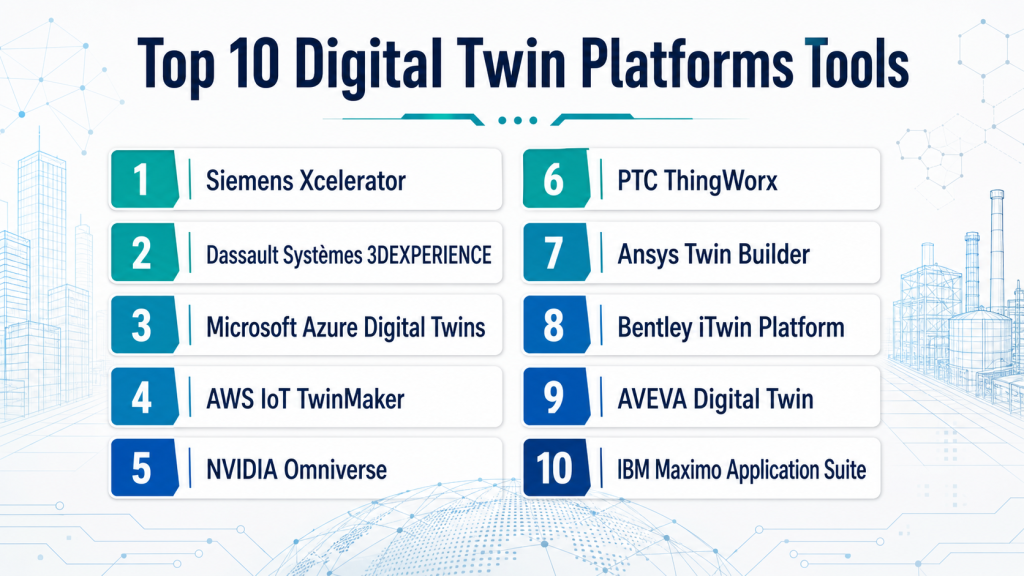
Top 10 Digital Twin Platforms Tools
#1 — Siemens Xcelerator
Short description: Siemens Xcelerator is a broad industrial digital business platform that supports digital twin, engineering, manufacturing, automation, simulation, and lifecycle workflows. It is best for large manufacturers, industrial enterprises, and engineering-heavy organizations.
Key Features
- Industrial digital twin capabilities
- Product lifecycle and manufacturing integration
- Simulation and engineering workflows
- Factory and production system modeling
- IoT and automation ecosystem alignment
- Asset and process optimization
- Strong industrial software portfolio
Pros
- Strong fit for complex industrial environments
- Deep connection between engineering and manufacturing
- Useful for product, production, and performance digital twins
Cons
- Can be complex for smaller teams
- Implementation may require expert support
- Best value comes when used across multiple Siemens workflows
Platforms / Deployment
Web / Windows / enterprise environments
Cloud / Hybrid / Self-hosted options vary by product and configuration
Security & Compliance
SSO/SAML, MFA, encryption, audit logs, RBAC: Varies by deployment and enterprise configuration.
SOC 2, ISO 27001, GDPR, HIPAA: Not publicly stated.
Integrations & Ecosystem
Siemens Xcelerator has a strong ecosystem across engineering, manufacturing, automation, simulation, and lifecycle management.
- PLM and product engineering tools
- Manufacturing execution workflows
- Simulation and CAE tools
- Industrial IoT systems
- Automation and factory systems
- Enterprise data and analytics platforms
Support & Community
Siemens provides enterprise support, documentation, training, partner services, and implementation consulting. Support is strongest for organizations with structured industrial transformation programs.
#2 — Dassault Systèmes 3DEXPERIENCE
Short description : 3DEXPERIENCE is a platform for product development, simulation, collaboration, lifecycle management, and virtual twin experiences. It is useful for automotive, aerospace, manufacturing, life sciences, industrial equipment, and product engineering teams.
Key Features
- Virtual twin experience modeling
- Product lifecycle management
- CAD, CAE, and simulation integration
- Collaboration and data management
- Manufacturing and operations alignment
- Industry-specific solution experiences
- Enterprise engineering workflows
Pros
- Strong for product and engineering digital twins
- Useful for complex product lifecycle environments
- Broad portfolio across design, simulation, and manufacturing
Cons
- Enterprise implementation can be complex
- May be more than small teams need
- Licensing and configuration require careful planning
Platforms / Deployment
Web / Windows depending on applications
Cloud / Hybrid / Self-hosted options vary
Security & Compliance
SSO/SAML, MFA, encryption, audit logs, RBAC: Varies by platform setup and enterprise configuration.
SOC 2, ISO 27001, GDPR, HIPAA: Not publicly stated.
Integrations & Ecosystem
3DEXPERIENCE connects design, simulation, manufacturing, collaboration, and lifecycle data in one ecosystem.
- CATIA design workflows
- SIMULIA simulation workflows
- ENOVIA lifecycle management
- DELMIA manufacturing workflows
- Enterprise collaboration
- Industry-specific applications
Support & Community
Dassault Systèmes offers documentation, partner support, enterprise services, training, and consulting. Community strength is high among engineering and product development professionals.
#3 — Microsoft Azure Digital Twins
Short description : Azure Digital Twins is a cloud platform service for modeling real-world environments, assets, relationships, and IoT-connected systems. It is best for cloud engineering teams, IoT developers, smart building projects, and enterprises already using Microsoft Azure.
Key Features
- Digital twin graph modeling
- IoT data integration
- Relationship-based asset modeling
- Event-driven architecture support
- Cloud-native APIs
- Integration with Azure analytics and data services
- Suitable for smart spaces, assets, and operational systems
Pros
- Strong developer-friendly cloud foundation
- Good fit for Azure-based IoT and data teams
- Flexible modeling for connected environments
Cons
- Requires cloud architecture and development skills
- Not a full turnkey industrial digital twin solution by itself
- Visualization and domain-specific workflows may need additional tools
Platforms / Deployment
Web / Cloud APIs
Cloud
Security & Compliance
SSO/SAML, MFA, encryption, audit logs, RBAC: Varies by Azure tenant, identity, and configuration.
SOC 2, ISO 27001, GDPR, HIPAA: Varies / N/A.
Integrations & Ecosystem
Azure Digital Twins works best inside the Microsoft cloud ecosystem and can connect with IoT, analytics, storage, AI, and application services.
- Azure IoT services
- Azure Data Explorer
- Azure Functions
- Power BI
- Event-driven cloud services
- Custom applications and APIs
Support & Community
Microsoft provides cloud documentation, developer guides, enterprise support plans, partner services, and a large developer ecosystem. Onboarding depends heavily on internal cloud engineering maturity.
#4 — AWS IoT TwinMaker
Short description : AWS IoT TwinMaker helps teams build digital twins of real-world systems using data from sensors, equipment, systems, and visual models. It is useful for cloud-native teams building industrial, facility, and operational digital twin applications on AWS.
Key Features
- Digital twin application building blocks
- IoT and operational data integration
- Scene and visualization support
- Asset and component modeling
- AWS cloud service integration
- Real-time operational context
- Custom application development support
Pros
- Strong fit for AWS-based IoT teams
- Flexible for custom digital twin applications
- Good integration with AWS cloud services
Cons
- Requires cloud development and architecture skills
- Not a complete out-of-the-box industry solution alone
- Implementation effort depends on data quality and system integration
Platforms / Deployment
Web / Cloud APIs
Cloud
Security & Compliance
SSO/SAML, MFA, encryption, audit logs, RBAC: Varies by AWS identity, access, and account configuration.
SOC 2, ISO 27001, GDPR, HIPAA: Varies / N/A.
Integrations & Ecosystem
AWS IoT TwinMaker fits naturally into AWS IoT, analytics, storage, and application development workflows.
- AWS IoT services
- Amazon S3
- AWS Lambda
- Amazon Managed Grafana
- Time-series and analytics services
- Custom cloud applications
Support & Community
AWS provides documentation, training, enterprise support plans, partner resources, and a large cloud developer community. Successful adoption usually needs strong cloud and data engineering skills.
#5 — NVIDIA Omniverse
Short description: NVIDIA Omniverse is a platform for building and connecting 3D workflows, simulations, industrial visualization, synthetic data, and physically based digital twins. It is best for teams needing high-quality 3D simulation, factory visualization, robotics simulation, and industrial virtual environments.
Key Features
- Real-time 3D collaboration
- USD-based workflows
- Physically based simulation support
- Industrial visualization
- Synthetic data generation
- Robotics and autonomous system simulation
- Integration with design and content tools
Pros
- Strong visual and simulation environment
- Useful for factories, robotics, and industrial 3D workflows
- Good for teams that need immersive digital twin visualization
Cons
- Requires 3D, simulation, or GPU workflow expertise
- Not a simple asset management platform
- Implementation can be resource-intensive
Platforms / Deployment
Windows / Linux / cloud and workstation options vary
Cloud / Self-hosted / Hybrid options vary
Security & Compliance
SSO/SAML, MFA, encryption, audit logs, RBAC: Varies by deployment and enterprise configuration.
SOC 2, ISO 27001, GDPR, HIPAA: Not publicly stated.
Integrations & Ecosystem
Omniverse is built around connected 3D workflows and can integrate with design, simulation, rendering, robotics, and industrial visualization tools.
- USD-based 3D workflows
- CAD and DCC tool connectors
- Robotics simulation workflows
- Synthetic data pipelines
- GPU-accelerated simulation
- Industrial visualization systems
Support & Community
NVIDIA provides documentation, developer resources, enterprise support options, and ecosystem programs. Community strength is growing among 3D, robotics, AI, and industrial simulation users.
#6 — PTC ThingWorx
Short description : PTC ThingWorx is an industrial IoT platform used to connect assets, collect operational data, build applications, and support digital twin use cases. It is best for manufacturers, industrial operators, and companies using connected product and asset monitoring workflows.
Key Features
- Industrial IoT application development
- Asset modeling and monitoring
- Real-time data connectivity
- Predictive analytics options
- Remote service and maintenance workflows
- Integration with PTC ecosystem
- Industrial dashboard and application building
Pros
- Strong fit for industrial IoT use cases
- Useful for connected products and asset monitoring
- Good alignment with PTC product lifecycle tools
Cons
- Implementation can require industrial data expertise
- May need partner support for complex deployments
- Best value appears in connected industrial environments
Platforms / Deployment
Web / enterprise environments
Cloud / Self-hosted / Hybrid options vary
Security & Compliance
SSO/SAML, MFA, encryption, audit logs, RBAC: Varies by deployment and enterprise configuration.
SOC 2, ISO 27001, GDPR, HIPAA: Not publicly stated.
Integrations & Ecosystem
ThingWorx connects with industrial systems, IoT devices, enterprise software, and PTC lifecycle tools.
- Industrial IoT gateways
- Kepware connectivity
- PTC Windchill
- Service lifecycle workflows
- Analytics systems
- Enterprise applications
Support & Community
PTC provides enterprise support, documentation, implementation partners, training, and consulting. Community strength is strongest in manufacturing, connected products, and industrial IoT.
#7 — Ansys Twin Builder
Short description : Ansys Twin Builder is a digital twin solution focused on simulation-based digital twins, system modeling, and predictive behavior. It is best for engineering teams that need physics-based models, asset performance prediction, and simulation-driven operational insights.
Key Features
- Simulation-based digital twin creation
- System-level modeling
- Physics-based behavior prediction
- Reduced-order model support
- Asset performance monitoring
- Integration with Ansys simulation tools
- Predictive maintenance and operational insights
Pros
- Strong for engineering and simulation-driven twins
- Useful where physics accuracy matters
- Good fit for complex products and equipment
Cons
- Requires simulation and engineering expertise
- Not a simple low-code IoT dashboard
- Best used when physics-based modeling is important
Platforms / Deployment
Windows / enterprise environments
Cloud / Self-hosted / Hybrid options vary
Security & Compliance
SSO/SAML, MFA, encryption, audit logs, RBAC: Varies by enterprise deployment.
SOC 2, ISO 27001, GDPR, HIPAA: Not publicly stated.
Integrations & Ecosystem
Ansys Twin Builder fits naturally with simulation, CAE, system modeling, and engineering validation workflows.
- Ansys simulation tools
- Model-based systems engineering
- IoT and operational data connections
- Reduced-order models
- Predictive analytics workflows
- Engineering validation environments
Support & Community
Ansys provides documentation, enterprise support, training, consulting, and partner services. Community strength is high among simulation and engineering professionals.
#8 — Bentley iTwin Platform
Short description : Bentley iTwin Platform is designed for infrastructure digital twins, including buildings, roads, bridges, rail, utilities, plants, and civil assets. It is best for infrastructure owners, engineering firms, construction teams, and asset operators.
Key Features
- Infrastructure digital twin modeling
- BIM and engineering data integration
- Reality modeling and visualization
- Asset lifecycle workflows
- Change tracking and design review
- Geospatial and engineering context
- Collaboration for infrastructure projects
Pros
- Strong fit for infrastructure and built environments
- Useful for asset owners and engineering firms
- Good lifecycle perspective from design to operations
Cons
- Less suited for semiconductor or product-only twins
- Best value requires structured infrastructure data
- Implementation may require BIM and asset data maturity
Platforms / Deployment
Web / Windows depending on tools
Cloud / Hybrid options vary
Security & Compliance
SSO/SAML, MFA, encryption, audit logs, RBAC: Varies by Bentley platform configuration.
SOC 2, ISO 27001, GDPR, HIPAA: Not publicly stated.
Integrations & Ecosystem
Bentley iTwin connects engineering models, infrastructure data, reality capture, and asset lifecycle workflows.
- BIM and infrastructure models
- Reality capture workflows
- GIS and geospatial data
- Engineering design tools
- Asset management systems
- Infrastructure project collaboration
Support & Community
Bentley provides documentation, training, enterprise support, and partner services. Its user community is strong in infrastructure, civil engineering, construction, and asset operations.
#9 — AVEVA Digital Twin
Short description : AVEVA Digital Twin solutions support industrial operations, process plants, asset performance, engineering data, and operational visibility. They are best for energy, chemicals, utilities, manufacturing, marine, and process industry environments.
Key Features
- Industrial operations digital twin support
- Process and asset data integration
- Engineering and operational data context
- Visualization and monitoring workflows
- Asset performance management alignment
- Plant and facility lifecycle support
- Integration with industrial systems
Pros
- Strong fit for process industries and industrial operations
- Useful for plant-level visibility and operational context
- Good alignment with engineering and asset data
Cons
- Not ideal for small simple IoT projects
- Implementation can be complex
- Requires strong industrial data foundations
Platforms / Deployment
Web / Windows / enterprise environments
Cloud / Self-hosted / Hybrid options vary
Security & Compliance
SSO/SAML, MFA, encryption, audit logs, RBAC: Varies by deployment and enterprise configuration.
SOC 2, ISO 27001, GDPR, HIPAA: Not publicly stated.
Integrations & Ecosystem
AVEVA is commonly used in industrial environments where operational data, process data, engineering information, and asset performance need to work together.
- Industrial historians
- SCADA and operations systems
- Asset performance systems
- Engineering information systems
- Process data platforms
- Enterprise analytics workflows
Support & Community
AVEVA provides enterprise support, documentation, training, and implementation partner services. Community strength is strongest in process industries and industrial operations.
#10 — IBM Maximo Application Suite
Short description: IBM Maximo Application Suite supports asset management, monitoring, reliability, predictive maintenance, and digital twin-related asset intelligence. It is best for asset-heavy organizations that want maintenance, reliability, and operational performance in one platform.
Key Features
- Enterprise asset management
- Asset monitoring and reliability workflows
- Predictive maintenance support
- IoT and operational data integration
- Inspection and maintenance planning
- AI-assisted asset insights
- Industry asset lifecycle support
Pros
- Strong fit for asset-heavy enterprises
- Useful for maintenance and reliability teams
- Connects operational data with asset management workflows
Cons
- Not a pure 3D simulation-first platform
- Implementation may require asset data cleanup
- Can be complex for smaller organizations
Platforms / Deployment
Web / enterprise environments
Cloud / Self-hosted / Hybrid options vary
Security & Compliance
SSO/SAML, MFA, encryption, audit logs, RBAC: Varies by IBM deployment and enterprise configuration.
SOC 2, ISO 27001, GDPR, HIPAA: Not publicly stated.
Integrations & Ecosystem
IBM Maximo fits well where digital twin use cases are tied to asset maintenance, reliability, inspections, and operational decision-making.
- IoT and sensor data workflows
- Enterprise asset management
- Maintenance systems
- AI analytics
- ERP and enterprise systems
- Industry asset models
Support & Community
IBM provides enterprise support, documentation, training, implementation partners, and consulting services. Community strength is high among enterprise asset management and reliability teams.
Comparison Table
| Tool Name | Best For | Platform(s) Supported | Deployment (Cloud/Self-hosted/Hybrid) | Standout Feature | Public Rating |
|---|---|---|---|---|---|
| Siemens Xcelerator | Industrial manufacturing and engineering twins | Web, Windows, enterprise environments | Cloud / Hybrid / Self-hosted options vary | Industrial digital twin across engineering and manufacturing | N/A |
| Dassault Systèmes 3DEXPERIENCE | Product lifecycle and virtual twin workflows | Web, Windows depending on apps | Cloud / Hybrid / Self-hosted options vary | Product and engineering virtual twin platform | N/A |
| Microsoft Azure Digital Twins | Cloud-native IoT and smart environments | Web, Cloud APIs | Cloud | Graph-based digital twin modeling | N/A |
| AWS IoT TwinMaker | AWS-based IoT digital twin apps | Web, Cloud APIs | Cloud | Digital twin application building on AWS | N/A |
| NVIDIA Omniverse | 3D simulation and industrial visualization | Windows, Linux | Cloud / Hybrid / Self-hosted options vary | Real-time 3D and simulation-based digital twins | N/A |
| PTC ThingWorx | Industrial IoT and connected assets | Web, enterprise environments | Cloud / Hybrid / Self-hosted options vary | Industrial IoT application platform | N/A |
| Ansys Twin Builder | Simulation-based engineering twins | Windows, enterprise environments | Cloud / Hybrid / Self-hosted options vary | Physics-based digital twin modeling | N/A |
| Bentley iTwin Platform | Infrastructure and built environment twins | Web, Windows depending on tools | Cloud / Hybrid options vary | Infrastructure digital twin platform | N/A |
| AVEVA Digital Twin | Process industries and plant operations | Web, Windows, enterprise environments | Cloud / Hybrid / Self-hosted options vary | Industrial operations and plant data context | N/A |
| IBM Maximo Application Suite | Asset management and reliability twins | Web, enterprise environments | Cloud / Hybrid / Self-hosted options vary | Asset lifecycle and predictive maintenance | N/A |
Evaluation & Scoring of Digital Twin Platforms
The scoring below is comparative. It reflects core digital twin capabilities, usability, integration strength, security signals, performance, support, and value. It is not a public review rating.
| Tool Name | Core (25%) | Ease (15%) | Integrations (15%) | Security (10%) | Performance (10%) | Support (10%) | Value (15%) | Weighted Total (0–10) |
|---|---|---|---|---|---|---|---|---|
| Siemens Xcelerator | 10 | 5 | 9 | 8 | 9 | 9 | 6 | 8.20 |
| Dassault Systèmes 3DEXPERIENCE | 9 | 5 | 9 | 8 | 8 | 9 | 6 | 7.95 |
| Microsoft Azure Digital Twins | 8 | 7 | 9 | 8 | 8 | 8 | 8 | 8.05 |
| AWS IoT TwinMaker | 8 | 7 | 9 | 8 | 8 | 8 | 8 | 8.05 |
| NVIDIA Omniverse | 9 | 6 | 8 | 7 | 9 | 8 | 7 | 7.90 |
| PTC ThingWorx | 8 | 6 | 8 | 7 | 8 | 8 | 7 | 7.45 |
| Ansys Twin Builder | 9 | 5 | 8 | 7 | 9 | 8 | 6 | 7.60 |
| Bentley iTwin Platform | 8 | 7 | 8 | 7 | 8 | 8 | 7 | 7.60 |
| AVEVA Digital Twin | 8 | 6 | 8 | 7 | 8 | 8 | 6 | 7.25 |
| IBM Maximo Application Suite | 8 | 6 | 8 | 8 | 8 | 9 | 7 | 7.65 |
How to interpret the scores:
- Higher scores indicate stronger overall fit across the selected criteria, not a universal winner.
- Industrial platforms score high when the use case involves factories, plants, products, or complex assets.
- Cloud-native platforms score well for developer flexibility and scalable IoT architecture.
- Simulation-heavy platforms are strongest when engineering accuracy matters.
- Buyers should validate each platform using real assets, real data sources, and real operating conditions.
Which Digital Twin Platforms Tool Is Right for You?
Solo / Freelancer
Solo consultants and independent engineers usually do not need a full enterprise digital twin stack unless they are working for an industrial client. They should focus on tools that help them build prototypes, visual demos, small IoT models, or analytics proof-of-concepts.
Good choices include:
- Microsoft Azure Digital Twins for developer-led cloud prototypes
- AWS IoT TwinMaker for AWS-based digital twin applications
- NVIDIA Omniverse for 3D simulation and visualization projects
- Bentley iTwin Platform for infrastructure-focused consulting
- Ansys Twin Builder for engineering simulation-focused work
For simple monitoring dashboards, a full digital twin platform may be unnecessary.
SMB
Small and medium businesses should focus on clear business outcomes: reduced downtime, better maintenance, improved energy use, faster troubleshooting, or better asset visibility.
Good choices include:
- PTC ThingWorx for industrial IoT and connected assets
- AWS IoT TwinMaker for cloud-native asset monitoring
- Microsoft Azure Digital Twins for Azure-based IoT teams
- IBM Maximo Application Suite for maintenance-heavy teams
- Ansys Twin Builder for engineering-focused equipment modeling
SMBs should avoid starting too broad. A focused pilot around one asset class, one plant area, or one maintenance problem is usually better.
Mid-Market
Mid-market companies often need stronger integration with ERP, MES, SCADA, PLM, CMMS, data lakes, and analytics systems.
Good choices include:
- Siemens Xcelerator for manufacturing and engineering-heavy companies
- PTC ThingWorx for industrial IoT and connected product use cases
- IBM Maximo Application Suite for asset reliability and maintenance
- Bentley iTwin Platform for infrastructure and construction asset owners
- AVEVA Digital Twin for plant and process industry operations
- Microsoft Azure Digital Twins or AWS IoT TwinMaker for cloud-led teams
Mid-market buyers should review integration effort, data ownership, internal skills, and long-term operating cost.
Enterprise
Large enterprises need scalability, security, governance, lifecycle integration, multi-site support, and vendor-backed implementation.
Good choices include:
- Siemens Xcelerator for manufacturing, industrial engineering, and production digital twins
- Dassault Systèmes 3DEXPERIENCE for product lifecycle and virtual twin programs
- AVEVA Digital Twin for process industries and plant operations
- IBM Maximo Application Suite for enterprise asset management and reliability
- Bentley iTwin Platform for infrastructure owners
- NVIDIA Omniverse for advanced 3D simulation and industrial visualization
- Microsoft Azure Digital Twins or AWS IoT TwinMaker for cloud-native enterprise architectures
Enterprise buyers should involve IT, OT, engineering, operations, cybersecurity, data governance, and finance teams from the start.
Budget vs Premium
Budget-focused teams should start with a narrow proof-of-concept using cloud-native tools or existing IoT infrastructure. Azure Digital Twins and AWS IoT TwinMaker can be practical for teams that already have cloud engineering skills.
Premium platforms such as Siemens Xcelerator, 3DEXPERIENCE, AVEVA, IBM Maximo, and Ansys Twin Builder make more sense when the use case involves mission-critical assets, engineering complexity, lifecycle governance, or enterprise-scale operations.
Feature Depth vs Ease of Use
If ease of use matters most, choose a platform that matches your existing ecosystem. Cloud teams may prefer Azure Digital Twins or AWS IoT TwinMaker. Maintenance teams may prefer IBM Maximo. Infrastructure teams may prefer Bentley iTwin.
If feature depth matters most, consider Siemens Xcelerator, 3DEXPERIENCE, Ansys Twin Builder, AVEVA Digital Twin, or NVIDIA Omniverse, depending on whether the main need is manufacturing, product lifecycle, simulation, plant operations, or 3D visualization.
Integrations & Scalability
A digital twin platform is only as useful as the data it can connect. Most failures happen because asset data, sensor data, CAD models, maintenance records, and operational systems are not ready.
Important integration areas include:
- IoT sensors and gateways
- SCADA and PLC systems
- MES and production systems
- ERP and supply chain systems
- PLM and engineering systems
- CMMS and asset management tools
- CAD, BIM, and 3D models
- Data lakes and analytics platforms
Scalability should include asset count, data volume, update frequency, visualization complexity, user roles, and multi-site support.
Security & Compliance Needs
Digital twins often connect IT, OT, cloud, engineering, and operational systems. This makes security a serious buying requirement, not an afterthought.
Important security checks include:
- SSO and MFA
- Role-based access control
- Audit logs
- Encryption
- Secure API access
- Network segmentation
- Data residency options
- Backup and recovery
- Vendor access governance
- OT security alignment
For industrial and critical infrastructure use cases, security review should include cybersecurity, operations, compliance, and risk management teams.
Frequently Asked Questions (FAQs)
What is a digital twin platform?
A digital twin platform helps create a digital version of a real asset, process, product, building, or system. It connects models with real-world data so teams can monitor, simulate, analyze, and improve performance.
How is a digital twin different from a dashboard?
A dashboard usually shows data. A digital twin connects data with asset relationships, behavior, context, simulation, and operational logic. It helps teams understand what is happening and what may happen next.
What industries use digital twin platforms?
Common industries include manufacturing, energy, utilities, automotive, aerospace, smart buildings, infrastructure, healthcare equipment, logistics, mining, and process industries.
What pricing models are common for digital twin platforms?
Pricing may depend on users, assets, data volume, cloud consumption, modules, integrations, support level, or enterprise agreements. Buyers should review total cost carefully before scaling.
How long does digital twin implementation take?
A small pilot can be built relatively quickly if data is ready. Enterprise programs may take longer because they require asset modeling, data integration, security review, process design, and change management.
What are common mistakes when choosing a digital twin platform?
Common mistakes include starting too broad, ignoring data quality, skipping security review, underestimating integration effort, and building a visual model without a clear business outcome.
Do digital twin platforms need IoT data?
Many digital twins use IoT data, but not all require real-time sensors from day one. Some begin with engineering models, historical data, maintenance records, or static asset information.
Are digital twin platforms secure?
They can be secure when configured properly. Buyers should check identity management, encryption, access control, audit logs, network architecture, and vendor security documentation.
Can digital twins scale across multiple sites?
Yes, but scalability depends on platform architecture, data standards, asset models, integration patterns, governance, and cloud or infrastructure capacity.
Do digital twin platforms integrate with ERP and PLM?
Many enterprise digital twin platforms integrate with ERP, PLM, MES, CMMS, SCADA, IoT, CAD, BIM, and analytics tools. Integration depth varies by vendor and deployment.
Is a digital twin the same as simulation software?
No. Simulation software predicts behavior using models. A digital twin may include simulation, but it also connects real-world data, asset context, monitoring, visualization, and operational workflows.
What is the best digital twin platform for manufacturing?
Siemens Xcelerator, PTC ThingWorx, Dassault Systèmes 3DEXPERIENCE, AVEVA Digital Twin, and IBM Maximo are strong options depending on whether the focus is factory operations, product lifecycle, assets, or process plants.
What is the best digital twin platform for buildings and infrastructure?
Bentley iTwin Platform is strong for infrastructure and built environments. Azure Digital Twins and AWS IoT TwinMaker can also support smart building and facility use cases when paired with the right data architecture.
Can small businesses use digital twin platforms?
Yes, but they should start with a focused use case such as one machine, one production line, one facility, or one maintenance problem. A full enterprise digital twin program may be unnecessary at the beginning.
Conclusion
Digital Twin Platforms can help companies move from reactive operations to smarter, data-driven decision-making. However, the best platform depends on the use case. Siemens Xcelerator and Dassault Systèmes 3DEXPERIENCE are strong for engineering, manufacturing, and product lifecycle twins. Azure Digital Twins and AWS IoT TwinMaker are practical for cloud-native IoT teams. NVIDIA Omniverse is powerful for 3D simulation and visualization. PTC ThingWorx, AVEVA Digital Twin, and IBM Maximo are valuable for industrial and asset-heavy operations. Ansys Twin Builder is strong when physics-based simulation matters, while Bentley iTwin Platform is a natural fit for infrastructure and built environments.
