Upgrade & Secure Your Future with DevOps, SRE, DevSecOps, MLOps!
We spend hours scrolling social media and waste money on things we forget, but won’t spend 30 minutes a day earning certifications that can change our lives.
Master in DevOps, SRE, DevSecOps & MLOps by DevOps School!
Learn from Guru Rajesh Kumar and double your salary in just one year.
Introduction
RAW photo processing tools help photographers edit image files captured directly from a camera sensor. Unlike JPEG files, RAW files keep more image data, giving users better control over exposure, color, highlights, shadows, sharpness, noise, white balance, and final output quality.
RAW photo processing matters now because professional and semi-professional photography workflows are becoming more demanding. Photographers need faster editing, better camera profile support, AI masking, batch processing, color consistency, cloud backup, and smooth export workflows for websites, portfolios, print, social media, product catalogs, and client delivery.
Common use cases include:
- Wedding and event photo editing
- Product photography correction
- Portrait retouching
- Landscape and travel photography
- Studio photography workflows
- Batch editing for large photo libraries
Buyers should evaluate:
- RAW file support
- Camera and lens profile support
- Color accuracy
- Noise reduction
- Batch editing
- AI masking and selection
- Export flexibility
- Catalog management
- Performance with large libraries
- Pricing and licensing
Best for: photographers, studios, creative agencies, product photography teams, content creators, eCommerce teams, and professionals who need high-quality photo output.
Not ideal for: users who only edit casual phone photos or basic social media images. Simple image editors, mobile filters, or built-in photo apps may be enough for light editing.
Key Trends in RAW Photo Processing Tools
- AI masking is becoming standard for faster subject, sky, background, face, and object-based adjustments.
- AI noise reduction is now a major feature for photographers working in low light, weddings, events, wildlife, and indoor shoots.
- Camera and lens profile support remains critical because photographers use many camera brands, mirrorless bodies, and lens systems.
- Cloud syncing is growing for photographers who edit across desktop, tablet, and mobile.
- Batch editing workflows are improving to help professionals process hundreds or thousands of photos faster.
- Color science is becoming a key differentiator for photographers who need consistent skin tones, product colors, and print-ready output.
- Tethered shooting support is important for studio, fashion, product, and commercial photography.
- Subscription and one-time license models continue to compete as users balance cost, updates, and long-term ownership.
- Privacy and storage control matter more when photographers handle client shoots, commercial images, and unreleased campaigns.
- Integration with image editors and asset libraries is becoming more important for complete professional workflows.
How We Selected These Tools
The tools were selected based on practical usefulness for photographers, studios, editors, creators, and businesses working with RAW image files.
Selection factors included:
- Recognition among photographers and creative professionals
- RAW processing depth and image quality
- Camera and lens profile support
- Color grading and correction tools
- Noise reduction and sharpening quality
- Batch editing and preset workflows
- Catalog or session management
- AI-assisted editing features
- Platform availability
- Fit for freelancers, studios, agencies, and enterprises
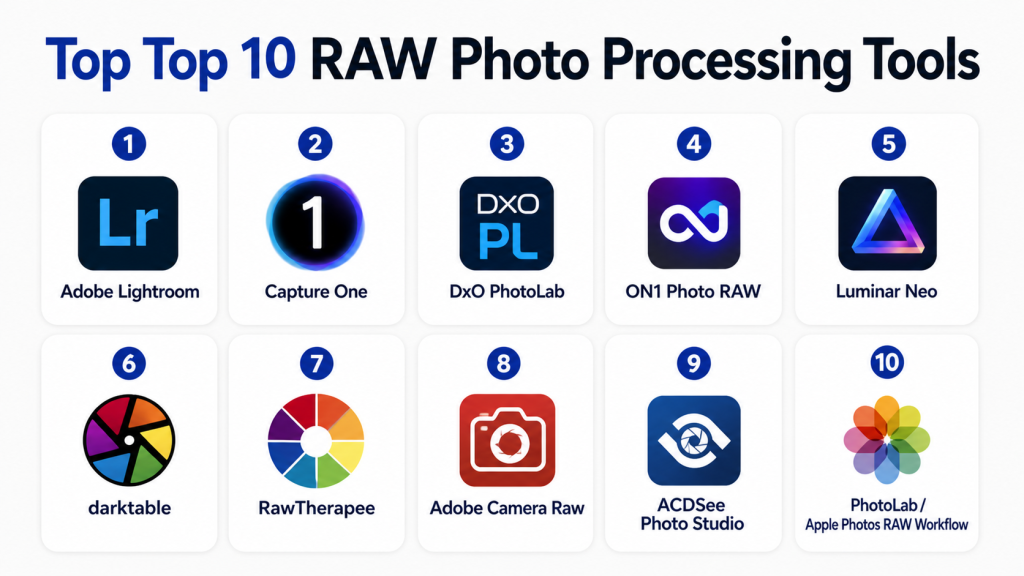
Top 10 RAW Photo Processing Tools
#1 — Adobe Lightroom
Short description: Adobe Lightroom is one of the most widely used RAW photo processing tools for photographers, creators, and studios. It combines RAW editing, photo organization, presets, AI masking, batch editing, and cloud-based workflows.
Key Features
- RAW photo editing and non-destructive adjustments
- AI masking for subject, sky, background, and objects
- Presets and batch editing
- Photo library and catalog management
- Lens and camera profile corrections
- Cloud sync across devices depending on plan
- Export presets for web, print, and social media
Pros
- Excellent for managing and editing large photo libraries
- Strong balance of power and ease of use
- Works well with Photoshop and other Adobe tools
Cons
- Subscription pricing may not suit every user
- Advanced pixel-level editing requires Photoshop
- Cloud workflows may not fit users who prefer fully local editing
Platforms / Deployment
Web / Windows / macOS / iOS / Android
Cloud-supported workflow
Security & Compliance
Adobe business and enterprise plans may include admin controls and access management depending on plan.
SOC 2, ISO 27001, HIPAA: Not publicly stated for this specific product context.
Integrations & Ecosystem
Lightroom fits smoothly into photography and creative production workflows.
- Adobe Photoshop
- Adobe Creative Cloud
- Camera RAW workflows
- Preset ecosystem
- Mobile editing workflows
- Portfolio and export workflows
Support & Community
Lightroom has strong documentation, tutorials, official learning resources, and a large global photography community.
#2 — Capture One
Short description: Capture One is a professional RAW photo processing tool used by photographers, studios, and commercial production teams. It is known for color control, tethered shooting, session workflows, and high-quality RAW output.
Key Features
- Advanced RAW processing
- Strong color editing tools
- Tethered shooting support
- Session and catalog workflows
- Layer-based local adjustments
- Styles and batch editing
- Professional export and proofing tools
Pros
- Excellent color control for professional photographers
- Strong tethered shooting for studio workflows
- Useful for commercial and product photography
Cons
- Learning curve can be higher for beginners
- Pricing may be high for casual users
- Not designed for general graphic design workflows
Platforms / Deployment
Windows / macOS / iPadOS
Desktop and tablet workflow
Security & Compliance
Not publicly stated.
Integrations & Ecosystem
Capture One is focused on professional photography and studio workflows.
- Camera tethering
- RAW image workflows
- Studio production workflows
- Preset and style workflows
- Local file management
- Photoshop handoff workflows
Support & Community
Capture One provides documentation, professional learning resources, tutorials, and a strong community among studio and commercial photographers.
#3 — DxO PhotoLab
Short description: DxO PhotoLab is a RAW processing and photo correction tool known for lens corrections, noise reduction, optical adjustments, and image quality improvements. It is suitable for photographers who care about technical correction and detail recovery.
Key Features
- RAW photo processing
- Advanced noise reduction tools
- Lens and camera profile corrections
- Local adjustment tools
- Color and tone adjustments
- Smart lighting and exposure correction
- Export workflows for photographers
Pros
- Strong optical correction and noise reduction
- Good for photographers who want clean technical output
- Useful for low-light and detail-heavy images
Cons
- Catalog management is not as broad as Lightroom
- Workflow may feel different for users coming from Adobe
- Some advanced features depend on edition
Platforms / Deployment
Windows / macOS
Desktop deployment
Security & Compliance
Not publicly stated.
Integrations & Ecosystem
DxO PhotoLab fits well into photography workflows where image correction and quality are top priorities.
- RAW file workflows
- Lens correction workflows
- Local file editing
- Export to other editors
- Noise reduction workflows
- Camera profile correction
Support & Community
DxO provides documentation, support resources, learning content, and a photography-focused user community.
#4 — ON1 Photo RAW
Short description: ON1 Photo RAW is a RAW photo editor and organizer built for photographers who want editing, effects, portrait tools, resizing, masking, and asset management in one platform. It is useful for users who want an alternative to subscription-heavy workflows.
Key Features
- RAW photo editing
- Photo organization and browsing
- AI masking and selection tools
- Effects and creative filters
- Portrait retouching
- Batch processing
- Resize and export tools
Pros
- Good all-in-one photography workflow
- Useful creative effects and masking tools
- Strong option for photographers who want broad features
Cons
- Interface can feel busy for new users
- Performance may vary with large libraries
- Ecosystem is smaller than Adobe
Platforms / Deployment
Windows / macOS
Desktop deployment
Security & Compliance
Not publicly stated.
Integrations & Ecosystem
ON1 Photo RAW supports photography workflows from import to export.
- RAW image workflows
- Presets and effects
- Local file management
- Plugin-style workflows
- Portrait editing
- Export for web and print
Support & Community
ON1 provides documentation, tutorials, product education, and a photography community around presets, editing styles, and workflow training.
#5 — Luminar Neo
Short description: Luminar Neo is an AI-assisted photo editing tool for photographers and creators who want fast RAW processing, creative looks, object removal, sky replacement, and image enhancement. It is best for users who want quick results with less manual effort.
Key Features
- RAW photo editing
- AI image enhancement
- Sky replacement and background tools
- Portrait retouching
- Object removal
- Lighting and color adjustments
- Presets and creative looks
Pros
- Easy for beginners and creators
- Strong AI-assisted editing features
- Useful for fast creative enhancements
Cons
- Not as deep as Lightroom or Capture One for library management
- Some workflows may still require another editor
- Feature access may vary by plan or edition
Platforms / Deployment
Windows / macOS
Desktop deployment
Security & Compliance
Not publicly stated.
Integrations & Ecosystem
Luminar Neo works well as a standalone RAW editor or companion tool.
- RAW workflows
- Plugin-style workflows
- Preset libraries
- AI enhancement tools
- Local file export
- Creative photography workflows
Support & Community
Luminar Neo has documentation, tutorials, support resources, and a creator-focused user community.
#6 — darktable
Short description: darktable is a free and open-source RAW photo processing tool designed for photographers who want non-destructive editing and color workflow control. It is a strong option for Linux users and budget-conscious photographers.
Key Features
- Non-destructive RAW editing
- Advanced color correction modules
- Tethering support depending on setup
- Batch processing
- Filmic tone mapping tools
- Open-source workflow
- Cross-platform availability
Pros
- Free and open-source
- Strong RAW processing depth
- Good for technical users and Linux photographers
Cons
- Learning curve can be high
- Interface may feel technical for beginners
- Formal commercial support is limited
Platforms / Deployment
Windows / macOS / Linux
Desktop deployment
Security & Compliance
Not publicly stated.
Integrations & Ecosystem
darktable fits open-source and local-first photography workflows.
- RAW file workflows
- Open-source editing ecosystem
- Local file management
- Color correction modules
- Batch export
- Linux photography workflows
Support & Community
darktable has community documentation, forums, tutorials, and open-source user support.
#7 — RawTherapee
Short description: RawTherapee is a free and open-source RAW photo processing tool with deep technical controls for color, exposure, sharpening, and detail recovery. It is best for users who want strong manual control without paying for commercial software.
Key Features
- RAW photo processing
- Advanced exposure and color controls
- Sharpening and noise reduction
- Batch processing
- Non-destructive editing
- Wide camera RAW support
- Open-source workflow
Pros
- Free and powerful
- Good for photographers who like manual control
- Cross-platform availability
Cons
- Interface can feel complex
- Less polished than premium tools
- Collaboration and cloud workflows are limited
Platforms / Deployment
Windows / macOS / Linux
Desktop deployment
Security & Compliance
Not publicly stated.
Integrations & Ecosystem
RawTherapee is strongest as a local-first RAW development tool.
- RAW file workflows
- Local export
- Open-source editing workflows
- Batch processing
- Manual color correction
- Detail recovery workflows
Support & Community
RawTherapee has open-source documentation, community forums, and user-generated tutorials.
#8 — Adobe Camera Raw
Short description: Adobe Camera Raw is a RAW processing engine used within Adobe workflows, especially Photoshop and Bridge. It is suitable for photographers and designers who want powerful RAW adjustment before advanced editing.
Key Features
- RAW file processing
- Exposure, tone, color, and detail adjustments
- Lens correction tools
- AI masking features depending on version
- Presets and profiles
- Works closely with Photoshop
- Non-destructive adjustment workflow
Pros
- Strong RAW engine inside Adobe ecosystem
- Excellent handoff into Photoshop
- Familiar workflow for Adobe users
Cons
- Best value depends on Adobe subscription
- Not a complete photo management platform by itself
- Less ideal for users outside Adobe workflows
Platforms / Deployment
Windows / macOS
Desktop workflow within Adobe applications
Security & Compliance
Adobe business and enterprise controls vary by plan.
SOC 2, ISO 27001, HIPAA: Not publicly stated for this specific product context.
Integrations & Ecosystem
Adobe Camera Raw is tightly connected to Adobe image editing workflows.
- Adobe Photoshop
- Adobe Bridge
- RAW profiles
- Preset workflows
- Camera and lens correction
- Professional retouching workflows
Support & Community
Adobe Camera Raw benefits from Adobe documentation, Photoshop learning resources, tutorials, and a large professional community.
#9 — ACDSee Photo Studio
Short description: ACDSee Photo Studio is a photo management and RAW editing tool for photographers and businesses that need organization, editing, metadata, and batch workflows. It is useful for users who manage large image libraries.
Key Features
- RAW photo editing
- Digital asset management
- Metadata and keyword tools
- Batch processing
- Layer-based editing depending on edition
- Color and exposure correction
- AI-assisted features depending on version
Pros
- Strong photo organization features
- Good for managing large image collections
- Useful batch and metadata workflows
Cons
- Interface may feel traditional to some users
- Mac and Windows feature parity may vary
- Smaller ecosystem than Adobe
Platforms / Deployment
Windows / macOS / iOS / Android availability may vary
Desktop and mobile workflow
Security & Compliance
Not publicly stated.
Integrations & Ecosystem
ACDSee supports photography management and editing workflows.
- RAW editing
- Metadata workflows
- Local file organization
- Batch processing
- Export tools
- Asset management workflows
Support & Community
ACDSee provides documentation, learning resources, customer support, and user community content.
#10 — PhotoLab / Apple Photos RAW Workflow
Short description: Apple Photos with RAW support is a practical option for Apple users who need basic RAW editing, organization, and simple adjustments without complex professional software. It is best for casual photographers and Apple ecosystem users.
Key Features
- RAW image support depending on camera and system support
- Basic exposure and color adjustments
- Photo library organization
- iCloud sync depending on setup
- Simple editing tools
- Mobile and desktop workflow
- Easy sharing inside Apple ecosystem
Pros
- Easy for Apple users
- Good for basic RAW editing and organization
- No complex setup for casual workflows
Cons
- Not suitable for advanced professional RAW processing
- Limited compared with dedicated RAW editors
- Camera support and workflow depth may vary
Platforms / Deployment
macOS / iOS / iPadOS
Cloud-supported app workflow
Security & Compliance
Security depends on Apple account, device security, iCloud settings, and user configuration.
SOC 2, ISO 27001, HIPAA: Not publicly stated.
Integrations & Ecosystem
Apple Photos fits simple Apple-based photography workflows.
- iCloud Photos
- iPhone and iPad workflows
- macOS Photos library
- Sharing workflows
- Basic export
- Apple device ecosystem
Support & Community
Apple provides help resources and product support. Community tutorials are available for basic photo editing and Apple device workflows.
Comparison Table
| Tool Name | Best For | Platform(s) Supported | Deployment | Standout Feature | Public Rating |
|---|---|---|---|---|---|
| Adobe Lightroom | Photographers and large libraries | Web, Windows, macOS, iOS, Android | Cloud-supported | RAW editing plus catalog management | N/A |
| Capture One | Studio and commercial photographers | Windows, macOS, iPadOS | Desktop / Tablet | Color control and tethered shooting | N/A |
| DxO PhotoLab | Technical image quality correction | Windows, macOS | Desktop | Lens correction and noise reduction | N/A |
| ON1 Photo RAW | All-in-one photography workflow | Windows, macOS | Desktop | RAW editing plus effects and organization | N/A |
| Luminar Neo | AI-assisted photo editing | Windows, macOS | Desktop | Fast AI-powered enhancements | N/A |
| darktable | Open-source RAW workflows | Windows, macOS, Linux | Desktop | Free non-destructive RAW processing | N/A |
| RawTherapee | Manual RAW control | Windows, macOS, Linux | Desktop | Deep technical RAW adjustments | N/A |
| Adobe Camera Raw | Photoshop-based RAW workflows | Windows, macOS | Desktop | RAW processing inside Adobe workflow | N/A |
| ACDSee Photo Studio | Photo management and batch editing | Windows, macOS, iOS, Android availability may vary | Desktop / Mobile | Asset management and RAW editing | N/A |
| Apple Photos RAW Workflow | Apple users and casual RAW editing | macOS, iOS, iPadOS | Cloud-supported app | Simple RAW editing in Apple ecosystem | N/A |
Evaluation & Scoring of RAW Photo Processing Tools
| Tool Name | Core (25%) | Ease (15%) | Integrations (15%) | Security (10%) | Performance (10%) | Support (10%) | Value (15%) | Weighted Total (0–10) |
|---|---|---|---|---|---|---|---|---|
| Adobe Lightroom | 10 | 8 | 10 | 8 | 9 | 9 | 7 | 8.85 |
| Capture One | 10 | 7 | 8 | 6 | 9 | 8 | 7 | 8.20 |
| DxO PhotoLab | 9 | 7 | 7 | 5 | 9 | 8 | 7 | 7.65 |
| ON1 Photo RAW | 8 | 7 | 7 | 5 | 7 | 7 | 8 | 7.25 |
| Luminar Neo | 7 | 9 | 6 | 5 | 8 | 7 | 8 | 7.30 |
| darktable | 8 | 5 | 6 | 5 | 7 | 6 | 10 | 7.00 |
| RawTherapee | 8 | 5 | 5 | 5 | 7 | 6 | 10 | 6.85 |
| Adobe Camera Raw | 9 | 8 | 9 | 8 | 9 | 9 | 7 | 8.45 |
| ACDSee Photo Studio | 8 | 7 | 6 | 5 | 8 | 7 | 7 | 7.10 |
| Apple Photos RAW Workflow | 5 | 10 | 7 | 7 | 8 | 7 | 8 | 7.15 |
These scores are comparative, not absolute. A tool with a lower score may still be the best fit for a specific workflow. For example, darktable and RawTherapee are strong for free open-source RAW processing, while Lightroom and Capture One are stronger for professional production workflows. Always test RAW files from your own camera before choosing.
Which RAW Photo Processing Tool Is Right for You?
Solo / Freelancer
Solo photographers need a balance of quality, speed, and price. Adobe Lightroom is strong for general photography workflows. Capture One is excellent for studio and commercial work. Luminar Neo is useful for fast AI-assisted edits. darktable and RawTherapee are good choices for users who want free tools and do not mind a learning curve.
SMB
Small businesses often need product photos, social media images, staff photos, event images, and website visuals. Lightroom, ON1 Photo RAW, Luminar Neo, and ACDSee Photo Studio can be practical choices. If the business needs simple editing with easy organization, Lightroom is a strong fit. If budget is a concern, open-source tools may be considered.
Mid-Market
Mid-market teams may need consistent brand imagery, batch editing, catalog management, and reliable export workflows. Lightroom, Capture One, DxO PhotoLab, and ACDSee Photo Studio are strong options depending on whether the team prioritizes library management, color control, image correction, or metadata workflows.
Enterprise
Enterprise buyers should evaluate security, storage, user access, admin controls, asset management, and support. Adobe Lightroom, Adobe Camera Raw, Capture One, and ACDSee Photo Studio may fit different enterprise photography workflows. Studios and product teams should also test tethered shooting, color accuracy, and file management before choosing.
Budget vs Premium
For budget users, darktable and RawTherapee provide strong free RAW processing. Apple Photos may work for casual Apple users. For premium workflows, Lightroom, Capture One, DxO PhotoLab, and Adobe Camera Raw provide stronger professional capability.
Feature Depth vs Ease of Use
Choose Capture One or Lightroom for professional depth. Choose Luminar Neo for ease and AI-assisted editing. Choose DxO PhotoLab for optical corrections and noise reduction. Choose darktable or RawTherapee if you want free tools with deep manual control.
Integrations & Scalability
Photographers should evaluate integration with Photoshop, cloud storage, studio workflows, export presets, print labs, client delivery tools, and asset management systems. Adobe tools are strong for ecosystem workflows, while Capture One is strong for studio workflows.
Security & Compliance Needs
Teams handling client images, commercial campaigns, product launches, or sensitive internal shoots should review local storage policies, cloud sync settings, access controls, encryption, sharing permissions, and user management. Do not assume SOC 2, ISO 27001, GDPR, or HIPAA support unless the vendor clearly confirms it for your plan.
Frequently Asked Questions
1. What are RAW photo processing tools?
RAW photo processing tools help edit image files captured directly from a camera sensor. They give more control over exposure, color, sharpness, highlights, shadows, and final image quality than compressed image formats.
2. Why should photographers shoot in RAW?
RAW files keep more image data, which gives photographers more flexibility during editing. This is useful for recovering highlights, fixing white balance, adjusting colors, and creating high-quality final images.
3. Which RAW photo processing tool is best for beginners?
Adobe Lightroom and Luminar Neo are good beginner-friendly options. Apple Photos can also work for casual Apple users who need simple RAW adjustments.
4. Which tool is best for professional photographers?
Capture One, Adobe Lightroom, Adobe Camera Raw, and DxO PhotoLab are strong options for professional photographers. The best choice depends on workflow, camera system, color needs, and editing style.
5. Are free RAW processing tools good enough?
Yes, tools like darktable and RawTherapee can be powerful enough for many photographers. However, they may require more learning and may not offer the same polished workflow as paid tools.
6. What pricing models are common?
Common pricing models include free open-source tools, one-time licenses, monthly subscriptions, annual subscriptions, and premium editions. Some vendors may also offer add-ons or separate mobile apps.
7. What are common mistakes when choosing RAW photo software?
Common mistakes include ignoring camera support, overlooking performance with large libraries, choosing a tool without batch editing, and failing to test color output with real files.
8. Is AI useful in RAW photo processing?
Yes, AI can help with masking, noise reduction, object selection, sky adjustments, and fast enhancements. However, photographers should still review final results carefully for natural color and detail.
9. Can RAW photo processing tools scale for studios?
Yes, some tools support large catalogs, tethered shooting, presets, batch editing, and studio workflows. Studios should test performance, storage, file naming, export settings, and collaboration needs.
10. What integrations should buyers look for?
Useful integrations include Photoshop, cloud storage, camera tethering, print workflows, client delivery tools, asset management systems, and export presets for web and print.
11. How hard is it to switch RAW processing tools?
Switching can take time because presets, catalogs, edits, color profiles, and workflows may not transfer perfectly. It is best to test migration with a small project before moving fully.
12. What are good alternatives to Lightroom?
Capture One, DxO PhotoLab, ON1 Photo RAW, Luminar Neo, darktable, RawTherapee, and ACDSee Photo Studio can be alternatives depending on budget, workflow, and editing needs.
Conclusion
RAW photo processing tools are essential for photographers and teams that need better image quality, accurate colors, flexible editing, and professional output. The right tool depends on your photography style, camera system, budget, editing volume, and delivery needs. Lightroom is strong for most photographers and large libraries. Capture One is excellent for studio and commercial workflows. DxO PhotoLab is strong for optical corrections and noise reduction. Luminar Neo is useful for fast AI-assisted editing. darktable and RawTherapee are strong free choices for users who want control without subscription costs.
